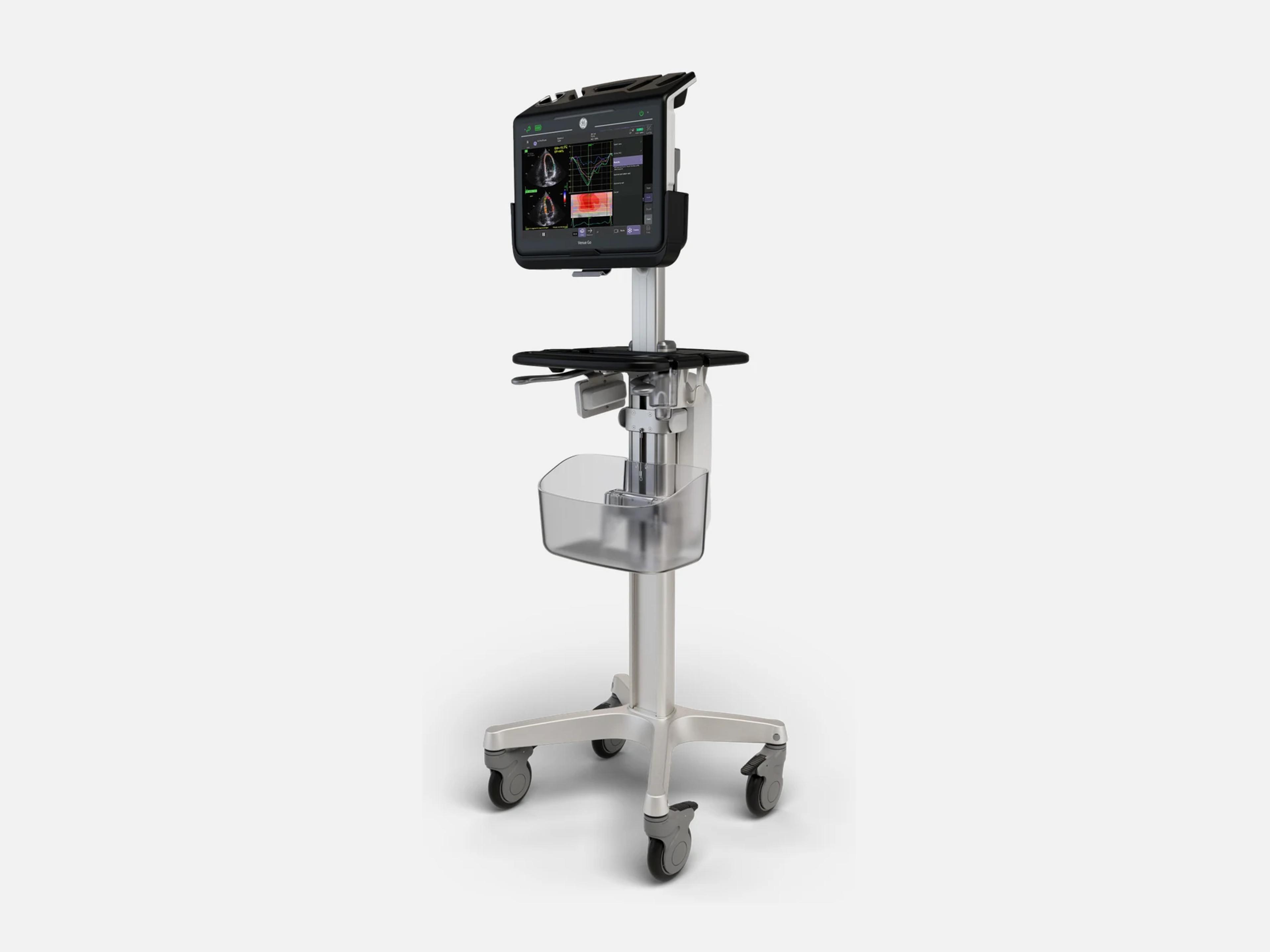
The GE Venue Go is a portable point-of-care ultrasound system in the Venue family, designed to move from cart to table to wall mount. Cleared for cardiac, vascular and musculoskeletal exams and interventional guidance, it has a 15.6-inch touch screen and three wired probe ports. Its siblings are the Venue (19-inch monitor), the Venue Fit (14-inch screen) and the tablet-style Venue Sprint.
- Released
- 2019launched by GE
- Probe ports
- 3plus wireless, R5 or later
- Display
- 15.6-inch1920x1080 multi-touch LCD
- Weight
- 6 kg13.22 lb, without cart
Compatible probes
Linear
- 9L-RS · 2.4–10.5 MHz
- 12L-RS · 3.4–12.6 MHz
- L4-12t-RS · 3.4–12.6 MHz Four programmable buttons
- ML6-15-RS · 4–18.9 MHz
- L8-18i-RS · 2.5–16.8 MHz Intraoperative
- L8-18t-RS New in K261668 (2026)
- L4-20t-RS · 3–20 MHz XDclear, four configurable buttons
- L10-22-RS · 7–22.2 MHz
Convex & microconvex
- C1-5-RS · 1.4–5.7 MHz
- C2-9-RS Added in K240053
- 8C-RS · 3.1–12.9 MHz
Phased
- 3Sc-RS · 1.1–4.7 MHz
- 4Sc-RS New in K261668 (2026)
- 6S-RS · 1.8–8.6 MHz
- 12S-RS · 2.7–12.5 MHz Pediatric cardiac and neonatal
Endocavity
- E8C-RS · 2.2–12.5 MHz Transrectal and transvaginal
Specialty
- 6Tc-RS · 1.8–8.8 MHz Transesophageal, adult cardiac
- Vscan Air CL Wireless; linear and curved ends; R5 or later
- Vscan Air SL Wireless; linear and sector ends; R5 or later
Specifications
Display
- Display
- 15.6-inch wide 16:9 multi-touch LCD, 1920 x 1080 pixels
- Contrast and viewing angles
Contrast ratio min. 800; viewing angle min. 170° horizontal and 75° verticalContrast ratio minimum 800; horizontal viewing angle minimum 170 degrees and vertical viewing angle minimum 75 degrees, at contrast ratio >10.Show allShow less
Physical
- Weight
6 kg (13.22 lb) without cart; Venue Go cart approx. 27 kg, Simple Cart approx. 23 kg6 kg (13.22 lb) without cart and peripherals, also given as less than 6 kg (13.2 lb). Venue Go cart approx. 27 kg (59.5 lb); Simple Cart approx. 23 kg (51.6 lb).Show allShow less
- Dimensions
- 33 x 41 x 12 cm (13 x 16.14 x 4.72 in), height x width x depth, system only
- Dimensions on the Venue Go cart
- 125.5 x 51.5 x 49 cm (49.4 x 20.2 x 19.2 in), maximum height x width x depth
- Dimensions on the Simple Cart
- 150.5 x 51.9 x 48.8 cm (59.3 x 20.4 x 19.2 in), height x width x depth
- Cart footprint
- 19.9 x 18.9 in (505 x 480 mm), width x depth
- Probe ports
Three RS connectors with locking levers; wireless Vscan Air CL and SL from R5Three RS probe connectors on the rear of the system, each with a locking lever; the probe selection board interfaces three RS probes with up to 192 elements, and probes can be connected or changed with the system on or off. Wireless dual-probe connectivity (Vscan Air CL and SL) requires R5 software or higher.Show allShow less
- Controls
Multi-touch display, usable bare-handed, gloved, gloved with gel or through a foil coverThe multi-touch display is the control surface, with no buttons or knobs. It works with a bare finger, a latex-gloved hand, a latex-gloved hand with ultrasound gel and through a transparent foil cover; tap and multi-finger swipe, with a long touch acting as right-click. Button probes control the system from the probe.Show allShow less
- Keyboard
- On-screen touch keyboard for manual patient-ID entry
- Mounting
Detaches from its cart; rear stand for tables; VESA mount for boom or wall; carry handleDetaches from its cart through a mounting attachment with simple release. A rear adjustable stand tilts 20 to 70 degrees (±5) from horizontal for table use; on the cart the system angle adjusts 0 to 40 degrees. VESA connection for boom or wall mounting. Hand-carried by an integrated handle, placed on a flat surface, docked on a mobile cart or wall mounted; a roller bag accessory is available.Show allShow less
- Carts
- Venue Go cart: swivel, tilt and height adjustment; Simple Cart: tilt only
- Acoustic noise
- Less than 55 dB(A) at 20 °C, measured at the operator position
Power & battery
- Battery
Two smart lithium-ion packs; up to two hours of continuous scanning with bothTwo internal smart lithium-ion battery packs as standard, each holding three lithium-ion batteries with controller and fuel-gauge electronics. The basic two-pack configuration supports up to two hours of continuous scanning. Two built-in chargers charge both packs at once, and the system switches automatically between battery and AC.Show allShow less
- Battery scan-time test
- Min. 60 minutes with 3Sc-RS, Cardiac preset, continuous 2D, new fully charged battery
- Power
- 100–240 VAC, 50–60 Hz, through an external 24 V AC/DC adapter
- Power consumption
- 250 W system only or with Simple Cart; 350 W with Venue Go cart and peripherals
- Input rating
- 4 A at 115 VAC; 2 A at 230 VAC
- Power button
- On/Off touch button with green and orange indication
Connectivity & options
- Connectivity
Rear: Ethernet 1000 Base-TX, 3 x USB 3.0, HDMI 2.1; side: 1 x USB 3; internal Wi-FiRear I/O panel: Ethernet LAN 1000 Base-TX (IEEE 802.3, 3 kV insulation), three USB 3.0 ports and HDMI (HDMI 2.1 standard); one further USB 3 port on the side. Internal Wi-Fi adapter. Networks: Wi-Fi and 10/100/1000 Mbps Ethernet.Show allShow less
- DICOM
Storage to up to two servers, Modality Worklist, Query/Retrieve, SR; TLS 1.2 encryptionDICOM storage to up to two network servers (images buffered locally, then sent by a DICOM spooler); Modality Worklist; Query/Retrieve; Structured Reporting (TID 5200 Echocardiography and TID 5100 Vascular procedure reports); DICOM Web only with the Caption Guidance option key; TLS 1.2 encryption for Modality Worklist, PACS storage and Query/Retrieve; LDAP security and RFID badge configuration.Show allShow less
- ViewPoint Reporting
On-system exam report forms; needs a continuous ViewPoint 6 link; from R4.1; by regionExam report package option that fills out an exam-specific report form on the system; requires a continuous connection to a ViewPoint 6 workstation; supported from R4.1 software; availability depends on region.Show allShow less
- Ready, Scan, Go
- RFID badge sign-in, patient wristband barcode scanning, ViewPoint 6 reporting integration
- Optional peripherals
B/W printer (Venue Go cart only), barcode and RFID readers, 3-lead ECG, CD/DVD driveBlack-and-white printer mounted on the Venue Go cart (not the Simple Cart); USB barcode reader and CD/DVD drive, supported from R4.1 software; RFID reader; ECG module with three leads; HAM box and Venue Go wireless probe charger for Vscan Air probes.Show allShow less
- Cybersecurity
- SonoDefense: Windows 10 hardening and patient-data encryption at rest and in transit
Imaging & software
- Imaging modes
B, M, PW and CW Doppler, Color and Color M Doppler, Power Doppler, Harmonic, Coded PulseCleared modes (K261668): B, M, PW Doppler, CW Doppler, Color Doppler, Color M Doppler, Power Doppler, Harmonic Imaging and Coded Pulse, with combined B/M, B/Color M, B/PWD, B/Color/PWD, B/Power/PWD, B/CWD and B/Color/CWD. Image generation also includes Tissue Velocity imaging. PDI+ (K220800), added on the ML6-15-RS in K240053 and on the L8-18i-RS, L4-20t-RS and other listed linear probes in K251322.Show allShow less
- Contrast imaging
- Contrast-enhanced ultrasound, cleared in K251322; enabled only in authorized regions
- Beamforming
- cSound software beamforming, 128 transmit/receive channels
- Revision and software
R2, R3, R4, R4.1, R5, R5.1 and R6Releases R2, R3, R4, R4.1, R5, R5.1 and R6. Model numbers by release: R2 H45181VG, R3 H45193VG, R4 H45114VG, R5 H45135VG or H45135VGW, R6 H45146VG; software upgrades H45135SWU (R5) and H45146SWU (R6). K261668 names no release number.Show allShow less
- Operating system
- Windows 10 Embedded; Windows 11 in the K261668 configuration
- Computer and storage
- Ryzen APU; internal M.2 SSD (512 GB and 256 GB drives listed as service parts)
- Software options
- Enabled by option keys specific to each unit
- Cardiac and shock tools
Real-Time EF, Automated Functional Imaging (AFI), Auto VTI, Auto IVC, Shock ToolkitReal-Time EF calculates ejection fraction continuously during live scanning in the apical 4-chamber view, without an ECG. Automated Functional Imaging (AFI) is speckle-tracking strain analysis of the left ventricle, right ventricle and left atrium. Auto VTI calculates VTI and cardiac output in one step and displays the VTI trend. Auto IVC measures IVC collapsibility or distensibility. Shock Toolkit focuses shock evaluation on the heart, lungs and inferior vena cava.Show allShow less
- Caption Guidance
AI turn-by-turn guidance for cardiac views; option key; Auto Depth added in K261668AI-driven, real-time, turn-by-turn on-screen guidance for acquiring cardiac views, with its own FDA clearance (K243065). Enabled by a Caption Guidance option key, which DICOM Web and the patient QR-code features also require. Announced for the Venue family in October 2023 as an optional add-on in the United States. K261668 added Auto Depth.Show allShow less
- Lung tools
Auto B-lines lung score, Lung Sweep panoramic view, Lung Diagram, eFAST DiagramAuto B-lines calculates an overall lung score in one step and works with Lung Sweep, a dynamic panoramic view of the entire lung. Lung Diagram is a single-view diagram of anatomical lung segments with one-click image storing; eFAST Diagram documents an eFAST assessment, from internal bleeding to pneumothorax.Show allShow less
- Needle, nerve and vessel tools
cNeedle (2.0 in K261668), cNerve (adults), Nerveblox, Catheter to Vessel Ratio, Auto CVRcNeedle enhances the needle and projects a trajectory line (K202233; added on the C2-9-RS in K251322), and K261668 cleared cNeedle 2.0. cNerve identifies and highlights the nerve landmark during scouting, live or on a stored clip; K220800 limits it to adults. Nerveblox is an AI tool for ultrasound-guided peripheral nerve blocks that labels key anatomical landmarks. Catheter to Vessel Ratio helps select catheter size from vessel diameter; Auto Catheter Vessel Ratio (CVR) was added in K261668.Show allShow less
- Flow and bladder measurement
Auto Volume Flow (AVF), Auto Bladder Volume (ABV), Bladder Volume ToolAuto Volume Flow (AVF) measures brachial or radial artery flow volume in real time from PW Doppler, for dialysis procedure preparation. Auto Bladder Volume (ABV) is a deep-learning tool that measures bladder dimensions from transverse and longitudinal views and calculates the volume (K251322). Bladder Volume Tool is a simplified bladder volume workflow (K240053).Show allShow less
- Gastric tools
Gastric Measurement; Auto Gastric Volume (AGV) added in K261668Gastric Measurement is a decision-support and measurement tool for gastric cross-sectional area, volume and volume-to-weight ratio. Auto Gastric Volume (AGV) was added in K261668.Show allShow less
- Documentation and teaching tools
Renal Diagram, MSK diagrams, Venue Coach, Venue MSK Coach, Scribble, Aesthetic ToolkitRenal Diagram documents and follows suspected hydronephrosis, with labeling tools. MSK diagrams and Venue Coach (K240053). Venue MSK Coach gives MSK exam reference images and anatomy markups. Scribble is a touch pointer and free-drawing tool for training and teaching. Aesthetic Toolkit was added in K261668.Show allShow less
- Other named features
Follow-up, Venue View, Simple Screen, Maximize image, Probe Check, AppAPIFollow-up and Venue View (K202233); Simple Screen, a modification of Full Screen (K202233); Maximize image, which enlarges the image automatically during shallow-depth scanning (K251322); Probe Check (K220800); AppAPI functionality and electronic software delivery (K240053).Show allShow less
- Probe and application availability
- Varies by product version and country; the unit's user manual sets its compatibility
Environment
- Operating environment
- +10 to +40 °C (50–104 °F), 30–85% RH non-condensing, 700–1060 hPa
- Operating altitude
- Up to 3000 m (9842 ft)
Compliance
- FDA 510(k)
K261668 (2026-08-07), K251322, K240053, K220800, K202233, K183362 (2019-01-28)K261668 (decided 2026-08-07); K251322 (2025-07-25, Venue family); K240053 (2024-06-10); K220800 (2022-06-21); K202233 (2020-11-18); K183362 (2019-01-28, device name Venue GO). Class II, product code IYN, 21 CFR 892.1550.Show allShow less
What to check when buying a used GE Venue Go
Confirm battery recall Z-1555-2025 was corrected
On R2 to R5 systems, affected batteries can fail internally and cause smoke or fire, and one FDA report describes flames from a Venue Go while it was charging.
How: Ask for proof that the recall correction was completed, and read the manufacture date on the label under each of the two batteries.
Test the cart tilt mechanism (recall Z-2652-2023)
On Venue Go Standard Carts made in August 2022 or earlier, the tilt mechanism can fail and let the system detach and fall, and one FDA report describes a Venue Go falling onto a patient's hand.
How: Lock the wheels, raise the column to its highest position and watch the tilt mechanism while rocking the system side to side, and if it is loose, do not use the cart until GE's correction is done.
Inspect both batteries and read their state
A Bad battery state disables charging and leaves the system running on AC only, and the two batteries must be swapped together.
How: Look for leaks, odor, deformation or discoloration, open the battery icon to read the state indicator, and confirm the scan-time indicator rises while on AC power.
Inspect the power cord and confirm the voltage
One FDA report describes a Venue Go cord that separated from its plug and exposed live wires, and the wrong supply voltage will most likely destroy the system.
How: Look along the cord for cuts, loose hardware, tire marks, exposed insulation or wear, have its continuity verified and check the supply voltage before plugging in.
Common questions about the GE Venue Go
Is the GE Venue Go FDA-cleared?
Yes. The Venue Go is FDA-cleared under 510(k) as a Class II device (product code IYN, 21 CFR 892.1550). Its first clearance, K183362, was decided on January 28, 2019, and its most recent, K261668, on August 7, 2026.
K261668 added the 4Sc-RS and L8-18t-RS probes, Auto Gastric Volume, cNeedle 2.0, Auto Catheter Vessel Ratio, the Aesthetic Toolkit, Auto Depth for Caption Guidance and an operating system update from Windows 10 to Windows 11. It names no software release, so check a used unit for each of them.
What clinical applications is the GE Venue Go cleared for?
It is intended for use in hospitals and medical clinics. Its cleared applications are abdominal (including gynecology and urology), thoracic and pleural, ophthalmic, fetal/OB, small organ (breast, testes, thyroid), vascular and peripheral vascular, neonatal and adult cephalic, pediatric, musculoskeletal, adult and pediatric cardiac, transrectal, transvaginal, transesophageal and intraoperative vascular imaging.
It is also cleared for interventional guidance: tissue biopsy, fluid drainage, and vascular and non-vascular access.
Has the GE Venue Go been recalled?
Two FDA Class 2 recalls name the Venue Go. Z-2652-2023, initiated September 6, 2023, applies to Venue Go Standard Carts made in August 2022 or earlier and used with R2, R3 and R4 systems: the cart's tilt adjustment mechanism can fail and the system can detach and fall.
Z-1555-2025, initiated March 6, 2025, applies to R2, R3, R4 and R5 systems, whose batteries can fail internally and cause smoke or fire. GE committed to correcting affected products, at no cost for the battery recall, and the system works fully on AC power with its batteries removed.
What is the difference between the GE Venue Go and the Venue Fit?
The Venue Go has a 15.6-inch touch screen, three wired probe ports and up to two hours of scanning on battery. The Venue Fit has a 14-inch touch screen, two wired probe ports and up to one hour of scanning, weighs 12 lb (5.44 kg) off its cart and has the smallest footprint in the Venue family.
Both detach from their carts and take wireless probes as well as wired ones.
How is the GE Venue Go different from the Venue and the Venue Sprint?
The Venue stands on an adjustable cart base with a 19-inch touch screen, four active probe ports plus wireless and up to four hours of scanning, while the Venue Go detaches from its cart for table-top or VESA mounting. The L12n-RS and M5Sc-RS probes are available on the Venue only.
The Venue Sprint is tablet-style, with a 13-inch touch screen, wireless probes only and up to 50 minutes of scanning, and unlike the rest of the family it is also intended for home use and road and air ambulances.
Does the GE Venue Go work with wireless probes?
Yes. Alongside its three wired ports it supports the Vscan Air CL and Vscan Air SL wireless probes, cleared for the Venue Go in K240053.
They need R5 software or later, the HAM box connection aid and a probe license key bought from GE HealthCare, and the first pairing and registration needs an internet connection.