Siemens ACUSON Redwood
Siemens Healthineers · ACUSON series
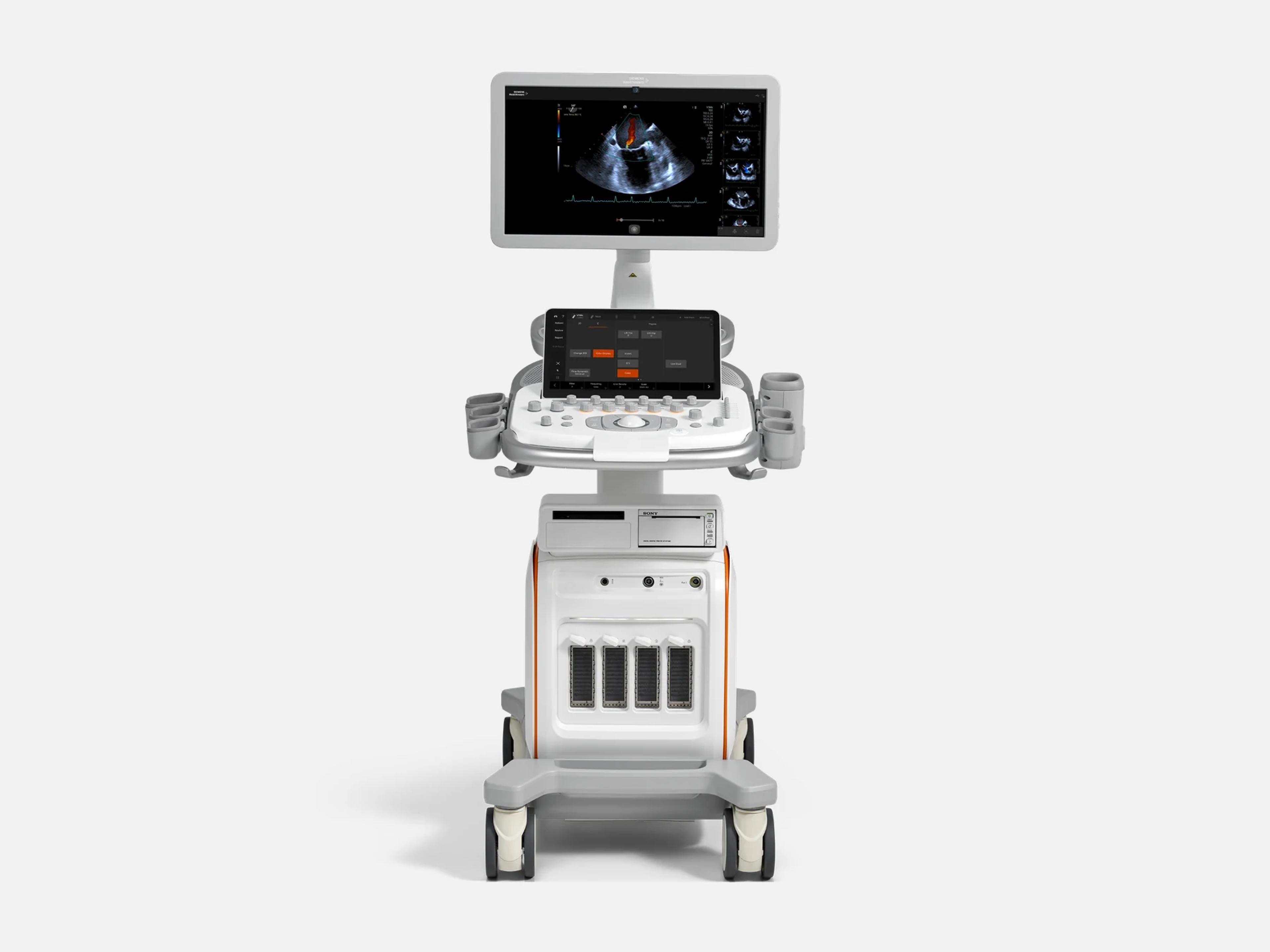
The Siemens ACUSON Redwood is a premium ultrasound system designed for shared use across radiology, cardiology and OB/Gyn departments. Its applications include contrast-enhanced ultrasound, shear wave elastography, Stress Echo and AI-powered eSie tools for cardiac and obstetric measurement. It joined the flagship ACUSON Sequoia and the ACUSON Juniper on Siemens's new platform architecture in 2019.
- Released
- 2019launched by Siemens
- Probe ports
- 4active, plus CW pencil port
- Display
- 21.5-inchhigh-resolution LCD
- Weight
- 87 kg191.80 lb
Compatible probes
Linear
- 10L4 · 2.9–9.9 MHz
- 14L5 · 4.8–13.6 MHz
- 18L6 · 4.6–17.8 MHz
- 18H6 · 5.5–21.1 MHz Hockey-stick; added in K210743
Convex & microconvex
- 5C1 · 1–5.7 MHz Single crystal; UDFF compatible
- 9C2 · 2.2–9.2 MHz Added in K243299
- 9C3 · 2.2–9.2 MHz Listed for Release 2.0
- 7VC2 · 1.8–6.9 MHz 3D/4D volume; added in K210743
Phased
- 4V1 · 1.4–5.1 MHz
- 5V1 · 1.1–4.9 MHz Transcranial Doppler preset
- 8V3 · 2.1–8.3 MHz
- 10V4 · 3.4–10.4 MHz
Endocavity
- 9EC4 · 2.9–8.1 MHz Transrectal and transvaginal
- 9VE4 · 3.2–9.9 MHz Volume endocavity; added in K210743
Specialty
- V5Ms · 3–7 MHz Transesophageal
- CW2 · 2–2 MHz Continuous-wave pencil
- CW5 · 5–5 MHz Continuous-wave pencil
Specifications
Display
- Main monitor
- 21.5-inch (54.6 cm) high-resolution LCD
- Touch screen
- 13.3-inch (33.7 cm) diagonal
Physical
- Weight
- 87 kg (191.80 lbs)
- Dimensions
- Width 53 cm (20.87 in); height 110–169 cm (43.3–66.54 in); depth 86 cm (33.86 in)
- Transducer ports
- Four active imaging-transducer ports, plus one continuous-wave pencil-transducer port
- Transducer connectors
- Compact Pinless Connector on imaging transducers; Micro Pinless Connector on the V5Ms TEE
- Controls
- Operated from the 13.3-inch touch screen and the main monitor
- Mobility
- Mobile system with a rear handle, or a front or rear handle on the CV Edition
- Cooling
- Air cooling
Power & battery
- Power consumption (scanning, measured)
0.4044 kW at 100 V/60 Hz; 0.3948 kW at 115 V/60 Hz; 0.4014 kW at 230 V/50 HzMeasured scan consumption of 0.4044 kW at 100 V/60 Hz, 0.3948 kW at 115 V/60 Hz and 0.4014 kW at 230 V/50 Hz, weighting image acquisition at 70% and freeze at 30%. These are measured operating points, not a rated input range.Show allShow less
Connectivity & options
- Network (VA30)
- Wired Ethernet, IEEE 802.3 10BaseT/100BaseT/1000BaseT
- DICOM (VA30)
Verification, Storage, Storage Commitment, Query/Retrieve, Worklist and MPPS, PrintVerification; Storage and Storage Commitment; Query/Retrieve (Study Root FIND/MOVE); Modality Worklist and MPPS; Print (grayscale and color). Storage of ultrasound images, multi-frame images and Comprehensive SR.Show allShow less
- Secure DICOM (VA30)
Per remote node; TLS v1.2 or above on port 2762 (non-secure: 104); X.509 certificatesConventional or secure DICOM per remote node; secure DICOM uses TLS v1.2 or above on fixed port 2762 (non-secure DICOM on port 104), X.509 certificates and the IHE Basic Security Integration Profile.Show allShow less
- Removable media (VA30)
DICOM export and import on CD, DVD and USB driveDICOM export to and import from CD, DVD and USB drive; supported discs: 120 mm CD-R, CD-RW, DVD-R, DVD+R, DVD-RW and DVD+RW.Show allShow less
- Kinectus Remote Service
- Cloud-based remote connect platform that supplies software updates
- Smart Remote Services (SRS)
- Remote technical support, Remote Assist and remote software updates, through eSieLink
- teamplay Fleet
- Browser-based fleet management showing equipment and service-ticket status
Imaging & software
- Revision and software
VA10 (software ID 1.0.xxx), VA20 or Redwood 2.0 (2.0.xxx), VA30 (2.5.xxx)VA10, ACUSON Redwood 1.0 (software ID 1.0.xxx; no longer commercially available); VA20, ACUSON Redwood 2.0 (software ID 2.0.xxx; announced July 14, 2022); VA30 (software ID 2.5.xxx). Point releases on record: VA10A to VA10G, VA20F, VA20H, VA20K and VA30A.Show allShow less
- Operating system
- Windows 10 (Release 2.0)
- Coherent Image Formation (CIF)
- Harmonic-imaging beamformer using phase and amplitude information
- InTune transducer technology
- Transducer family that includes single-crystal designs
- UltraArt Universal Image Processing
- Image-preference selection from a real-time quad display on the touch screen
- Auto TEQ tissue equalization
- Automatic optimization of acquisition parameters in B-mode and pulsed wave imaging
- Trapezoid Imaging
- Available on all linear transducers
- Color Flash Suppression Technology
- Reduces color flash artifacts without user interaction
- Auto Flash Artifact Suppression
- For color and spectral Doppler
- Clarify vascular enhancement (VE)
- Power color Doppler amplitude information superimposed on the 2D image
- Auto trace
- Doppler auto trace
- Doppler Tissue Imaging (DTI)
- Color and spectral DTI for assessment of myocardial motion
- Transcranial Doppler (TCD)
- Dedicated 5V1 preset for adult and pediatric patients; added in K243299
- Contrast-Enhanced Ultrasound (CEUS)
- Contrast Pulse Sequencing (CPS) and flash sequencing technologies
- Left Ventricular Opacification (LVO)
- Mode for cardiac contrast-agent imaging
- Virtual Touch 2D Shear wave elastography (SWE)
- Two-dimensional shear wave velocity map
- Virtual Touch Shear Wave
- One-touch point shear wave for liver; color-coded maps for breast and thyroid on the 10L4
- Virtual Touch strain elastography
- Qualitative measure of lesion stiffness relative to surrounding tissue
- Virtual Touch UDFF (Ultrasound-Derived Fat Fraction)
Quantitative index to aid hepatic steatosis management; 5C1 compatible; added in K243299A quantitative ultrasound index to aid management of patients with hepatic steatosis; added to the Redwood in 510(k) K243299; the 5C1 transducer is compatible with the UDFF option.Show allShow less
- Auto IMT (Intima-Media Thickness)
- Automatic carotid intima-media thickness measurement; added in K243299
- Stress Echo
With or without contrast; six user-definable default protocols; wall motion scoringWith or without contrast: six user-definable factory default protocols, wall motion scoring and a reporting package; prospective, retrospective and continuous image acquisition.Show allShow less
- syngo Velocity Vector Imaging (VVI)
2D myocardial motion and mechanics; quantifies GLS, GRS and GCS2D quantitative assessment of myocardial motion and mechanics; quantifies Global Longitudinal Strain (GLS), Global Radial Strain (GRS) and Global Circumferential Strain (GCS).Show allShow less
- eSie Left Heart
- AI-powered; identifies and contours the left ventricle and left atrium automatically
- eSie Measure
- AI-powered one-touch quantification; 1-click 2D, M-mode and Doppler cardiac measurements
- eSie OB
- AI-powered automated biometric measurements for obstetric scanning
- eSie Follicle
- AI-powered automated follicle measurements
- Volume Rendering (3D/4D)
- 3D/4D surface rendering with the 7VC2; 3D endometrial MPRs; added in K210743
- Freehand 3D
- Added in K210743; on the 18H6, 18L6 and 9EC4 (Release 2.0)
- 1-Click Registration
- Selects the transducer and exam type for each patient automatically
Compliance
- FDA 510(k)
K210743 (2021-04-01), K243299 (2024-11-15); Class II, product code IYNACUSON Redwood Diagnostic Ultrasound System: K210743 (received 2021-03-12, decided 2021-04-01) and K243299 (received 2024-10-18, decided 2024-11-15), both substantially equivalent; Class II, product code IYN, regulation 892.1550.Show allShow less
- CE mark
- European CE mark at the 2019 launch
What to check when buying a used Siemens ACUSON Redwood
Confirm the volume-flow correction on older software
On Redwood 1.0 units at software VA10G or earlier and Redwood 2.0 units at VA20K or earlier, changing the volume-flow units from the factory l/min to ml/sec or ml/min makes the system underreport volume flow (FDA recall Z-3216-2024).
How: Read the installed software level, ask for proof that the correction was applied, and check which volume-flow unit is set.
Check the cardiac SR correction on Redwood 1.0
On Redwood 1.0 units with software VA10A to VA10G, a cardiac DICOM structured report configured for the minimum or maximum of repeated measurements reports the last measured value instead (FDA recall Z-1600-2024).
How: If the unit exports cardiac DICOM SR, confirm the software correction was applied; Redwood 2.0 is not affected.
Inspect panel seams for fluid and chemical damage
Fluid that gets into the control-panel seams or the DVD slot can reach the electrical circuitry, and solvent, alcohol or ammonia-based cleaners can damage the system's surfaces.
How: Look at the control-panel seams, the touch screen, the monitor and the outer surfaces for signs of fluid ingress or chemical damage.
Record the software level and correction history
Field corrections for the Redwood are tied to software levels, and VA10 is no longer commercially available.
How: Note the installed software level, from VA10A through VA30A, and ask for the record of corrections applied to the unit.
Common questions about the Siemens ACUSON Redwood
Is the Siemens ACUSON Redwood FDA-cleared?
Yes. It is FDA-cleared under 510(k) as the ACUSON Redwood Diagnostic Ultrasound System, a Class II device with product code IYN under regulation 892.1550. K210743 was decided on April 1, 2021, and K243299 on November 15, 2024, both as substantially equivalent.
K210743 added the 7VC2, 9VE4 and 18H6 transducers and 3D/4D imaging. K243299 added the 9C2 transducer, Auto IMT, Virtual Touch UDFF and transcranial Doppler.
What is the ACUSON Redwood CV Edition?
It is a configuration of the ACUSON Redwood that combines the system's available cardiovascular options, not a separate system. The Redwood's cardiac applications include Stress Echo, syngo Velocity Vector Imaging for strain, Left Ventricular Opacification for contrast imaging, and the AI-powered eSie Left Heart and eSie Measure tools.
How is the ACUSON Redwood different from the ACUSON Sequoia?
The ACUSON Sequoia is Siemens's flagship, and the Redwood joined it on the same platform architecture. The Redwood shares transducers with the Sequoia, and several of its features were cleared on the Sequoia first, among them the 9C2, 9VE4 and 18H6 transducers, Auto IMT, UDFF, transcranial Doppler and 3D/4D.
Does the ACUSON Redwood have liver elastography and fat quantification?
Yes. Virtual Touch Shear Wave is one-touch point shear wave technology for liver assessment, and Virtual Touch 2D shear wave elastography shows a shear wave velocity map. The Virtual Touch UDFF option, added in K243299, gives a quantitative ultrasound index to aid management of patients with hepatic steatosis, and the 5C1 transducer is compatible with it.