Siemens ACUSON Maple
Siemens Healthineers · ACUSON series
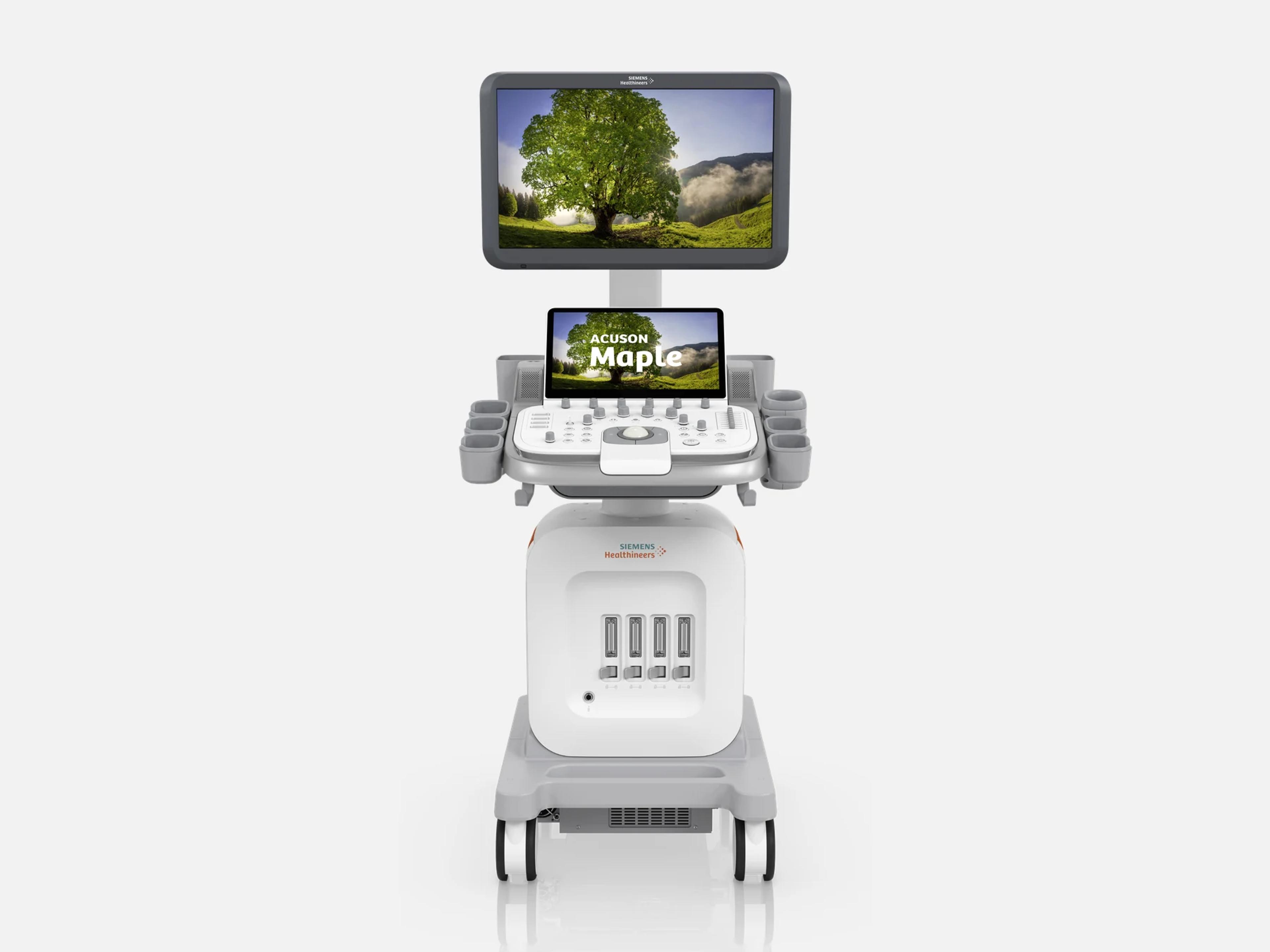
The Siemens ACUSON Maple, launched in 2023, is a cart-based general imaging system for high-volume, shared-service work in small hospitals, outpatient centers and private practices. It supports general, stress echo and TEE cardiac imaging alongside OB/GYN and vascular exams. Its sibling, the ACUSON Maple Select, is cleared under the same 510(k)s but without the neonatal and intraoperative indications.
- Released
- 2023launched by Siemens
- Probe ports
- 4 activeplus 1 pencil (CW) port
- Display
- 21.5 infull HD 1080p LCD
- Weight
- 65.3 kg144 lb, without options
Compatible probes
Linear
- L10-5v · 4.2–12 MHz
- 14L4a · 4–12.7 MHz
- 16L4 · 4.3–15.4 MHz
Convex & microconvex
- 5C1a · 1.4–5 MHz
- C5-2v · 1.7–4.9 MHz
- 7C2 · 2.1–7 MHz
- 9VC2 · 1.8–8.5 MHz
- 11M3 · 3.5–11 MHz Micro-convex
Phased
- P4-2 · 1.4–4.4 MHz
- 8V4 · 2.7–8 MHz Vector transducer
Endocavity
- 9VE4 · 3.1–8.7 MHz
- 10MC3 · 3.5–10.2 MHz
- 10BCC3 · 3–10.4 MHz Biplane transrectal, Release 2.0
Specialty
- 5VT · 3.1–9.2 MHz Transesophageal
- CW2 · 2–2 MHz Pencil (CW)
- CW5 · 5–5 MHz Pencil (CW)
Specifications
Display
- Monitor
21.5 in full HD 1080p LCD, LED backlighting, IPS, 1920 x 108021.5 in full HD 1080p flat panel LCD with LED backlighting and wide-angle viewing; IPS technology; contrast ratio 1000:1; viewing angle +/-89 degrees; 1920 x 1080; monitor size 23.6 in physical, 21.5 in visibleShow allShow less
- Monitor brightness
- 170 cd/m² default; response time 14 ms (Release 1.0)
- Monitor arm
Articulating arm: height, swivel (±160°) and tilt; folds to 122 cm for transportMonitor on an articulating arm, independent of the system; height, swivel and tilt adjustment; left/right swivel +/-160 degrees (monitor 80, arm 80); folds down for transport to a minimum system height of 122 cm (Release 1.0)Show allShow less
- Touch screen
- 13.3 in (33.8 cm) LCD touch panel, 1920 x 1080, 16:9, two USB ports
Physical
- Weight
65.3 kg (144 lb) without options65.3 kg (144 lb) without options (Release 1.0); Release 2.0 (VC10) brings a reduced weight and footprintShow allShow less
- Dimensions
W 58.5 cm x D 80.0 cm x H 140–153.9 cm, monitor uprightWidth 58.5 cm (1.92 ft), 59.9 cm with gel warmer; depth 80.0 cm (2.6 ft), 85.6 cm with color printer; height 140 to 153.9 cm (4.6 to 5.1 ft) with the flat panel display upright (Release 1.0)Show allShow less
- Control panel
Floating height-adjustable control panel; backlit keys; mechanical trackballFloating control panel, adjustable for standing and sitting, vertical articulation 11 cm; control panel height 80 to 91 cm from handle; customizable height, angle and keys; Off/White/Blue key backlighting; mechanical trackball; touch screen keyboard, conventional pull-out keyboard optionalShow allShow less
- Transducer ports
4 active + 1 pencil (auxiliary CW); Twin Cam Zero Insertion Force connectorsFour active transducer ports plus one pencil (auxiliary CW) port; Twin Cam Zero Insertion Force transducer connectors; electronic transducer selection; six transducer cup holders with gel bottle storageShow allShow less
Power & battery
- Power
100–240 Vac, 50/60 Hz; max 1.0 kVA, configuration dependent100 to 240 Vac, 50/60 Hz; universal input 90 to 264 Vac; power consumption maximum 1.0 kVA, configuration dependent; maximum heat output 2400 BTU/hr (Release 1.0)Show allShow less
- Battery
Optional replaceable lithium battery; scans up to 75 minutes unpluggedBattery Support (option): replaceable, rechargeable lithium battery; operation time up to 90 minutes; scan time up to 75 minutes under standard environmental conditionsShow allShow less
- Boot and standby
Boot from off approx. 68 s; QuikStart Standby Mode (option) wakes in approx. 15 sBoot from off approximately 68 seconds, depending on security settings; QuikStart Standby Mode (option): sleep in 15 seconds, sleep to on approximately 15 secondsShow allShow less
Connectivity & options
- DICOM
DICOM 3.0: storage, storage commitment, query/retrieve, worklist, MPPS, print, SRDICOM 3.0: Verification, Storage, Storage Commitment, Query/Retrieve, Modality Worklist, MPPS, Print; structured reporting for OB/GYN, vascular and cardiac exams; ultrasound image, ultrasound multi-frame image and Comprehensive SR storage (VC10); DICOM media on CD/DVD and USBShow allShow less
- Network
Ethernet; IPv4 supported, IPv6 not (VC10); optional Wi-Fi, IEEE 802.11a/b/g/n/acEthernet, IEEE 802.3 10/100/1000BaseT (Release 1.0); IPv4 supported, IPv6 not supported (VC10); optional Wireless Data Transfer through an internal Wi-Fi module, IEEE 802.11a/b/g/n/acShow allShow less
- Remote service
- Kinectus Remote Service, cloud-based
- Ports
USB 2.0 x4, USB 3.0 x2, Ethernet RJ45, S-Video, DVI, HDMIUSB 2.0 x4 (USB-A), USB 3.0 x2 (USB-A), Ethernet RJ45, S-Video (4-pin mini-DIN), DVI (24-pin), HDMI (19-pin); DVI and HDMI fixed at 1920 x 1080; two user-accessible USB 2.0 ports on the left of the touch screen, four on the back of the systemShow allShow less
- Storage
500 GB SSD, up to 300,000 images compressed; DVD multi-drive; USB exportInternal 500 GB solid state drive; up to 300,000 images with compression; built-in DVD multi-drive (DVD-R/RW and CD-R/RW); export to USB flash driveShow allShow less
- Documentation devices
Up to two on board: B/W printer and color printer/DVR, run from the control panelUp to two documentation devices (B/W printer and color printer/DVR) integrate into the cart, controlled from the control panel; supported devices include the UP-D898 B/W printer and the UP-D25MD color printerShow allShow less
- Physiological interface
Standard 3-lead ECG; auxiliary input/output for ECG and other physiology signalsStandard 3-lead ECG interface; auxiliary input/output for ECG and other physiology signals from third-party devicesShow allShow less
- Hardware options (Release 1.0)
Battery Support, QuikStart Standby Mode, Physio Module, Wireless Data Transfer and moreBattery Support; QuikStart Standby Mode; Physio Module; Integrated Gel Warmer; Larger Gel Holder; Barcode Reader; Dual USB Foot Switch; Wireless Data Transfer; Protective Control Panel Cover; conventional pull-out keyboardShow allShow less
Imaging & software
- Imaging modes
2D with THI; color, power and tissue Doppler; PW, HPRF and CW; M-modes; 3D/4D2D (fundamental; Phase Inversion, Filtered and Alternative THI); color Doppler (velocity, power, directional power, color Doppler tissue imaging); spectral Doppler (pulsed wave incl. HPRF, steerable CW, auxiliary CW on pencil probe, spectral Doppler tissue imaging, duplex and triplex); M-mode, color M-mode, anatomical M-mode; 3D/4D volume imaging; 2D with elastography and 2D with contrast agent imaging; trapezoidal imaging on all linear transducers; strain and Virtual Touch imaging; general, stress echo and TEE cardiac imagingShow allShow less
- Imaging technologies
eSieImage, Advanced SieClear, DTCE, Clarify VE, SieScape, fourSight, LightSourceAuto Flash Color Suppression; eSieImage multiparametric optimization; fourSight Imaging Technology (Thickslice Imaging, Curved MPR); Speed of Sound; LightSource Rendering; Clarify vascular enhancement (VE) technology; SieScape panoramic imaging; eSie Touch elasticity imaging; Dynamic Tissue Contrast Enhancement (DTCE), Advanced SieClear spatial compounding, SieClear compounding and Clarify VE built into the systemShow allShow less
- AI-powered measurement tools
eSie Calcs, eSie Left Heart, eSie Measure, syngo Auto Follicle, syngo Auto OBeSie Calcs, eSie Left Heart package, eSie Measure package, syngo Auto Follicle, syngo Auto OB measurementsShow allShow less
- Software options (Release 1.0)
Stress Echo, 4D Imaging, Contrast Enhanced Ultrasound, LightSource and moreEnhanced Needle Visualization; eSieScan Workflow Protocols; syngo Arterial Health Package (AHP); eSie Touch Elasticity Imaging; Contrast Enhanced Ultrasound; syngo Auto OB Measurements; syngo Auto Follicle Measurements; 4D Imaging; LightSource; Stress Echo; eSie Measure Workflow Acceleration Package; eSie Left Heart Measurement Package; syngo Velocity Vector Imaging; SieScape Panoramic Imaging; Data Storage EncryptionShow allShow less
- Release 2.0 (VC10) features
UltraArt, Auto TEQ, Auto IMT, enhanced needle visualization, CEUSUltraArt, Auto TEQ, Auto IMT, enhanced needle visualization, contrast-enhanced ultrasound (CEUS), stress echo, LightSource and a cybersecurity management system; image quality enhancements, prostate imaging and procedural guidanceShow allShow less
- Added in the 2025 clearance
Auto IMT, Virtual Touch UDFF, Virtual Touch pSWE; simultaneous biplane 2D (Maple only)Auto IMT, Virtual Touch UDFF (Ultrasound-Derived Fat Fraction) and Virtual Touch pSWE (Point Shear Wave Elastography); 2D-mode with simultaneous imaging for biplane transducers, on the ACUSON Maple only, not the Maple SelectShow allShow less
- System architecture
128 physical channels; up to 4,128,768 processing channels; 16 GB DDR4 RAM128 physical channels; up to 4,128,768 processing channels; system imaging frequency range 1-20 MHz (Release 1.0); 16 GB DDR4 RAMShow allShow less
- Operating system
- Windows 10 (Release 1.0)
- Revision and software
Release 1.0: software VA10, VA10A; Release 2.0: VC10Release 1.0 (Product Version 1.0): software VA10, with VA10A named on the recall records; DICOM conformance Release VA10, October 2023. Release 2.0: VC10, DICOM conformance October 2025Show allShow less
Environment
- Operating environment
10 to 40 °C (50 to 104 °F); humidity 10 to 80% non-condensing; 700 to 1060 hPaAmbient temperature +10 to +40 °C (50 to 104 °F); humidity 10 to 80% non-condensing; atmospheric pressure 700 to 1060 hPa (up to 3000 m)Show allShow less
- Fan noise
- 28 to 33 dBA
Compliance
- FDA 510(k)
K232617 (September 26, 2023); K253487 (November 17, 2025)K232617, decided September 26, 2023: ACUSON Maple and ACUSON Maple Select, Class II, product code IYN, 21 CFR 892.1550; K253487, decided November 17, 2025: ACUSON Maple and ACUSON Maple SelectShow allShow less
- CE marking
- CE marked at launch (November 2023)
What to check when buying a used Siemens ACUSON Maple
Confirm the VA10A recall corrections are installed
Two FDA recalls cover systems on software VA10A: one understates volume flow when its unit is changed from the factory default to mL/sec or mL/min, and the other sends the last cardiac measurement to the DICOM SR in place of the configured minimum or maximum.
How: Read the software version on the system and ask for the Siemens service record of the correction update; without that record, keep volume flow in liters per minute and read cardiac values from the system's Final Report.
Read the REF number: Maple or Maple Select
The ACUSON Maple Select is a separately named system under the same 510(k)s, without the Maple's neonatal and intraoperative indications or its simultaneous 2D imaging with biplane transducers.
How: On Release 1.0 units, the REF number on the system label reads 11711750 for an ACUSON Maple and 11711779 for a Maple Select.
Inspect surfaces and transducers for chemical damage
Cleaning and disinfecting agents or methods outside the maker's list can damage the system's surfaces, components and diagnostic performance.
How: Look over the housing, control panel and transducers for cracking, clouding or discoloration, and ask which cleaning and disinfecting agents were used.
Run the system unplugged on its battery
Battery Support, a replaceable, rechargeable lithium battery, is an option, so a unit may come without one.
How: Confirm the battery charges, then unplug the system and check that it boots and scans on battery alone.
Common questions about the Siemens ACUSON Maple
Is the Siemens ACUSON Maple FDA-cleared?
Yes. The ACUSON Maple and the ACUSON Maple Select were cleared together under 510(k) K232617, decided September 26, 2023, as Class II diagnostic ultrasound systems.
A second 510(k), K253487, decided November 17, 2025, covers both systems and adds Auto IMT, Virtual Touch UDFF and Virtual Touch pSWE, the 10BCC3 biplane transducer, the 6C1, 18H5, 9MC3, 10V4, 5P1 and 11L4 transducers, and intraoperative applications on the ACUSON Maple.
Is the Siemens ACUSON Maple discontinued?
Yes. Siemens Healthineers ended sales of the ACUSON Maple effective October 12, 2026. Support for installed systems continues, with maintenance, software updates and transducer availability.
What is the difference between the ACUSON Maple and the ACUSON Maple Select?
They are separately named systems cleared under the same 510(k)s. The Maple Select's indications leave out the neonatal applications listed for the ACUSON Maple, and since K253487 the intraoperative ones too. Simultaneous 2D imaging with biplane transducers runs only on the ACUSON Maple.
How is the ACUSON Maple related to the ACUSON Juniper?
The ACUSON Juniper and Juniper Select are the primary predicate in the Maple's first 510(k), K232617, which also clears the Maple's 14L4a and 5C1a transducers as substantially equivalent to the 14L4 and 5C1 cleared on the Juniper.
Virtual Touch UDFF, added in K253487, runs on the Condor software platform shared by the ACUSON Juniper and the Maple.