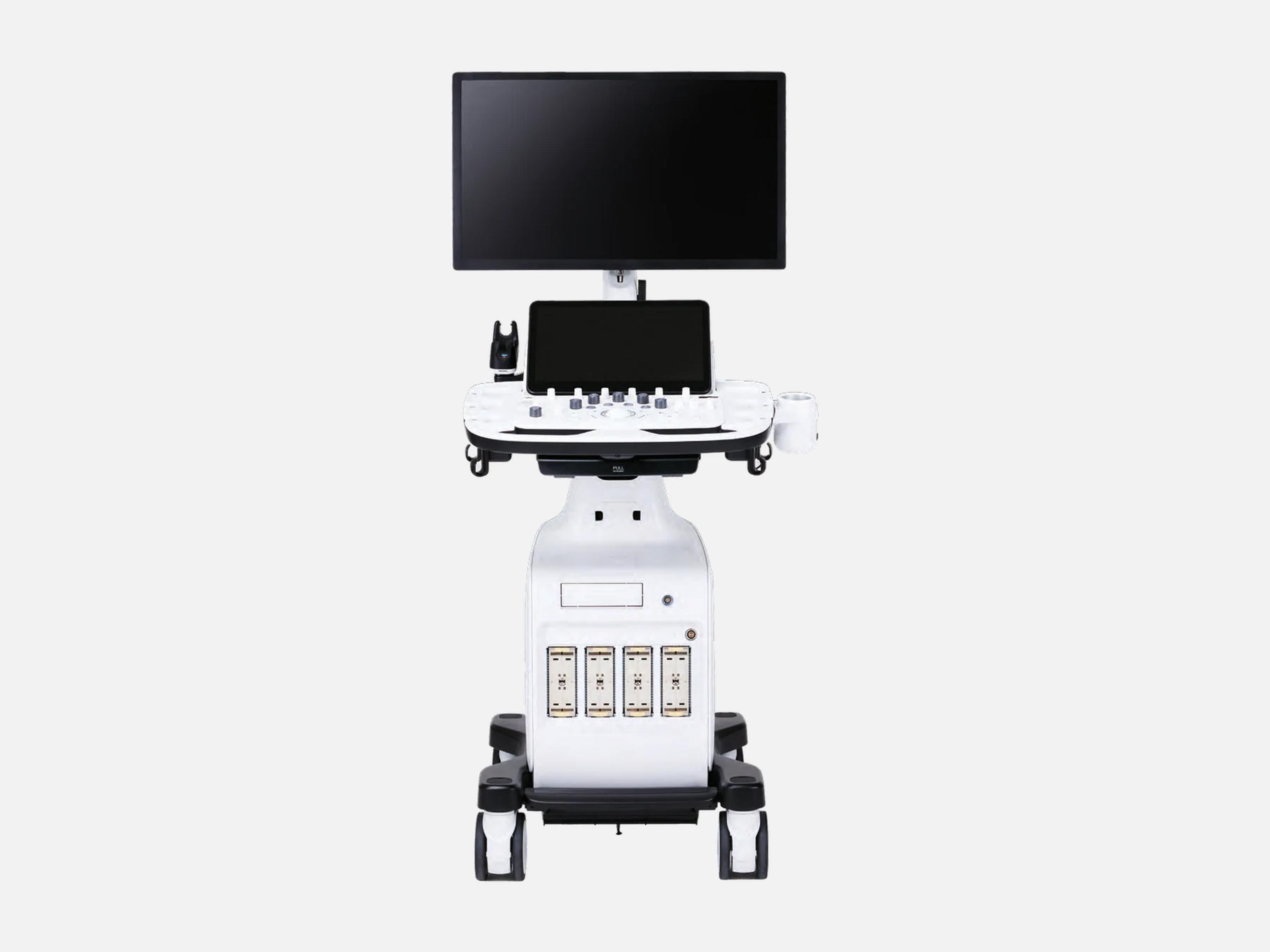
The Samsung V8 is a high-end, multi-specialty ultrasound system for shared service in radiology, vascular, cardiology and general imaging. In Samsung's women's health line the V8 emphasizes visualization, beside the V7 for automation and the V6 for everyday Ob-Gyn imaging. It is a cart of about 80 kg with a 23.8-inch monitor and 14-inch touch screen, sharing its fundamental technology with the RS85.
- Released
- 2021launched by Samsung
- Probe ports
- 3 or 4CW probe port optional
- Display
- 23.8-inchLCD, 1,920 x 1,080
- Weight
- 80 kgapprox., 176.4 lb
Compatible probes
Linear
- LA2-14A
- LA2-9A
- LA3-22AI Intraoperative
- LA4-18A
Convex & microconvex
- CA1-7S
Phased
- PA1-5A
- PA3-8B
Endocavity
- EA2-11AR
- EA2-11AV
Specialty
- EV2-10A Volume transducer
- CV1-8A Volume transducer
- MMPT3-7 Transesophageal (TEE)
- DP2B CW transducer
- CW6.0 CW transducer
Specifications
Display
- Monitor
23.8-inch LCD with LED backlight, 1,920 x 1,080 x 24 bits, 178° viewing angle23.8-inch LCD monitor with LED backlight unit; resolution 1,920 x 1,080 x 24 bits; viewing angle 178° (R/L, U/D); contrast ratio 1000:1; response time 14 ms.Show allShow less
- Monitor brightness
- 350 cd/m² (panel); brightness adjustable 0–100, default 50
- OLED monitor configuration
- 27-inch OLED monitor in the configuration cleared under K240631
- Touch screen
- 14-inch wide LED touch panel, LCD in-cell capacitive, 1,920 x 1,080 x 24 bit, tilting
Physical
- Weight
- Approx. 80 kg (176.4 lb)
- Dimensions
- Height 1,370–1,698 mm (53.9–66.9 in); width 559 mm (22.0 in); depth 964 mm (38.0 in)
- Probe ports
- 3 or 4 probe ports; CW probe port optional
- Monitor adjustment
- Height, tilt (-90° to +10°) and rotation (-360° to +360°); moves up/down and forth/back
- Control panel adjustment
- Height adjustable 180 mm; rotation +/- 30° from center
- Console
6 probe holders, 4 swivel/lock wheels (5-inch), front and rear handles, gel warmer option6 probe holders; endocavity probe holder (option); on-board storage for peripherals; gel bottle storage; gel warmer (option); 4 swivel/lock wheels (5-inch diameter); front and rear handles; integrated cable management; integrated stereo speakers; easy-to-clean air filter; transducer cable hook (accessory).Show allShow less
- Controls
Backlit hard keys, touch-screen soft keys and TGC, trackball, optional QWERTY keyboardHard-key operation with functional grouping of keys and interactive back-lighting; dynamic soft-key menu and digital TGC controls (with TGC line memory) on the touch screen; integrated backlit QWERTY keyboard (optional) and on-screen QWERTY keyboard; programmable trackball; integrated recording keys for remote control of peripherals or DICOM devices; QuickPreset one-touch probe and preset selection; TouchEdit touch-screen customization; Touch Gesture.Show allShow less
Power & battery
- Power
100–240 VAC, 50/60 Hz; max. 800 VA; heat dissipation 2,732 BTU/h100–240 VAC, 50/60 Hz; power consumption max. 800 VA; nominal input 1.22–2.71 A (110 V: 2.44 A; 220 V: 1.41 A, with peripherals); heat dissipation 2,732 BTU/h.Show allShow less
- Battery
Optional BatteryAssist: 2 x 14.4 VDC, 6,900 mAh lithium-ion; scan time approx. 40 minOptional (BatteryAssist): 2 x 14.4 VDC, 6,900 mAh, 99.36 W lithium-ion batteries; standby mode approx. 36 hours; scan time approx. 40 min; wake-up from sleep approx. 23 sec; charging time approx. 3 hours. Lets the system scan when AC power is temporarily unavailable and be moved without powering down.Show allShow less
Connectivity & options
- Connectivity
2 USB 2.0 (front), 2 USB 3.0 (rear), Gigabit Ethernet, 2 HDMI outputs, stereo audio2 USB 2.0 ports (front) and 2 USB 3.0 ports (rear); 1000BASE-T Gigabit Ethernet; 2 HDMI outputs (1920 x 1080); stereo audio output.Show allShow less
- DICOM
DICOM 3.0, optional: verification, worklist, storage, SR, query/retrieve, printDICOM 3.0 compatible (optional): Verification Service SCU/SCP; Modality Worklist Service SCU; Image Storage Service SCU and SCP; Structured Report Storage Service SCU; archiving format DICOM. System Version 1.00.00 conforms for Ultrasound Image Storage, Ultrasound Multi-frame Image Storage, Comprehensive SR, Modality Worklist, Query/Retrieve and Print Management.Show allShow less
- Storage
512 GB internal SSD; expanded storage (1TB) optional; QuickSave to USB during the examIntegrated 512 GB SSD; expanded storage (1TB) optional; archive devices: the internal SSD and an external USB memory stick; QuickSave saves image data directly to a USB drive during the exam.Show allShow less
- Peripheral options
BatteryAssist, ECG (USB), foot switch (USB), external USB printers, gel warmer, keyboard…BatteryAssist; ECG (USB type); endocavity probe holder; external USB printers; foot switch (USB type); gel warmer; integrated options for a digital B/W printer and a digital color printer; keyboard; printer tray (B/W, color); basket.Show allShow less
Imaging & software
- Imaging modes
2D, M, Color, Power, PW and CW Doppler, TDI, TDW, ElastoScan, combined, Dual/Quad, 3D/4DCleared modes: 2D, Color Doppler, Power Doppler (PD), M, Pulsed Wave (PW) Doppler, Continuous Wave (CW) Doppler, Tissue Doppler Imaging (TDI), Tissue Doppler Wave (TDW), ElastoScan, combined modes, multi-image (Dual, Quad), 3D/4D. Further modes: Power Doppler/S-Flow, CEUS+, Volume (with MPR), ElastoScan+, Panoramic imaging, S-Fusion, MV-Flow, S-Shearwave Imaging and ArterialAnalysis; CEUS+, S-Fusion, MV-Flow, S-Shearwave Imaging and ArterialAnalysis are optional.Show allShow less
- Image processing
Crystal Architecture; 2,580,480 processing channels; max. 8 beams; depth 2–55 cmCrystal Architecture image processing (CrystalBeam, CrystalLive and S-Vue Transducer); system processing channels 2,580,480; multi-beam processing max. 8 beams; imaging depth 2–55 cm.Show allShow less
- 2D frame rate
Max. 5,000 Hz in 2D (Extended Mode, cardiac preset, line density Low2, minimum depth)Max. 5,000 Hz in 2D, under Extended Mode, cardiac preset, 2D line density Low2, minimum depth and minimum write-zoom size.Show allShow less
- Cine memory
- Cine max. 23,910 frames; loop max. 13,146 lines
- Revision and software
- System Version 1.00.00
- Operating system
- Windows 10; updated to Windows 11 under K261412 (2026)
- System platform
- i5 2.5 GHz CPU; GeForce GTX 1650 GPU; 16 GB DDR4 SDRAM
- Standard features
Advanced QuickScan, Auto Calc, ShadowHDR, S-Harmonic, ClearVision, Static 3D…Advanced QuickScan (automatic optimization); Auto Calc (real-time automatic Doppler calculation); Beam Steer; cine for max. 23,910 frames and loop for max. 13,146 lines; ClearVision; customizable body marker, measurement menu, touch menu and user keys; Doppler Auto Trace; Free Angle Plane; fully digital real-time recording; MultiVision (convex, linear); on-board electronic documentation; patient information database; post-image optimization; post-measurement; Power Modulation Imaging; Power Modulated Pulse Inversion Imaging; Pulse Inversion Harmonic Imaging; screen keyboard; ShadowHDR; S-Harmonic Imaging (convex, linear); Static 3D; support for external USB storage devices; Trapezoidal Imaging; user-configurable measurement menu.Show allShow less
- Optional features
MV-Flow, LumiFlow, CEUS+, S-Shearwave Imaging, S-Fusion, NerveTrack, StressEcho, 5D NT…2D Follicle; 5D Follicle; 5D CNS+; 5D LB; 5D NT; 5D Limb Vol.; 5D Heart Color; ADVR; ArterialAnalysis; AutoEF; Auto IMT+; BiometryAssist; Cardiac Measurement; CrystalVue; CrystalVue Flow; CEUS+; CW Function; DICOM; E-Cervix; ElastoScan+; E-Strain; EzExam+; HDVI; HQ-Vision; IOTA-ADNEX; LaborAssist; LumiFlow (three-dimensional view of blood flow within a two-dimensional image); Mobile Export; MPI+; MV-Flow (visualizes low-flow blood-flow states); NeedleMate+ (needle guidance); NerveTrack (automated nerve detection and tracing); Panoramic+; RealisticVue; S-Detect for Breast; S-Detect for Thyroid (automated thyroid-nodule analysis); S-Fusion; Smart 4D; SonoSync; S-Shearwave Imaging (includes musculoskeletal tissue-stiffness evaluation); Strain+; StressEcho; XI STIC; UterineAssist; Expanded Storage (1TB). CEUS+ HyCoSy, HelloMom and BatteryAssist are optional too. Some features need an additional purchase.Show allShow less
- Other named features
IntelligentAssist, HQ Vision, ViewAssist, CrystalVue Flow, EzCompare, EzNerve, FlowMax…IntelligentAssist; HQ Vision; ShadowHDR; CrystalVue Flow; ViewAssist; S-Vue Transducer; EzCompare (matches image settings, annotations and body markers automatically); EzExam and EzExam+; SonoSync; Mobile Export QR image sharing; customizable display layouts; QuickPreset; Touch Gesture; TouchEdit; programmable trackball controls; QuickSave; EzNerve; FlowMax; VesselMax; Uterine Contour; RIS Browser. Some are options that need an additional purchase.Show allShow less
- Features in later clearances
BiometryAssist, HeartAssist, ViewAssist, EzHRI, EzPrep, QUS (TSI/TAI), EzNerveMeasure…K223387: BiometryAssist, EzHRI, EzPrep, QUS (TSI/TAI), S-Fusion and ViewAssist named, and HeartAssist extended to adult use. K240631: SonoSync. K243702: EzNerveMeasure and RFA Viewer, a Global Longitudinal Strain item added to AutoEF, and left-atrium and right-ventricle items added to Strain+. K250999: EzAssist and EzTrainer, and updated AI models for BiometryAssist, ViewAssist and HeartAssist.Show allShow less
Environment
- Operating and storage environment
Operating 10–35 °C, 30–75% RH, 700–1,060 hPa; storage/shipping -25 to 60 °C, 20–90% RHOperating: 10–35 °C, 30–75 % humidity, 700–1,060 hPa. Storage and shipping: -25 to 60 °C, 20–90 % humidity, 700–1,060 hPa. The same values apply to the system and the probes.Show allShow less
Compliance
- FDA 510(k)
K261412 (2026-07-28), K250999, K243702, K240631, K231772, K223387, K220975, K211945K211945 (decided 2021-09-08, the original V8 clearance); K220975 (2022-06-29); K223387 (2023-02-13); K231772 (2023-10-03); K240631 (2024-06-21); K243702 (2025-02-12); K250999 (2025-07-18); K261412 (2026-07-28). Class II, product code IYN, regulation 892.1550.Show allShow less
- Safety classification
- EMC class A; transducer applied part type BF (probe dependent)
What to check when buying a used Samsung V8
Confirm MI and TI display during scanning
The V8 reports its acoustic output in real time as the mechanical index and the thermal index, both displayed automatically.
How: Scan with a transducer connected and confirm both indices appear on screen.
Check every wheel swivels and locks
The cart moves on four swivel wheels with locks and is steered by front and rear handles.
How: Roll the cart, set and release each wheel lock, and check that every wheel swivels and both handles are secure.
Use NerveTrack segmentation only before injection
The NerveTrack segmentation function is for pre-injection use only and cannot guide needling.
How: If the unit carries NerveTrack, use its segmentation to find and trace the nerve before injecting, never to guide the needle.
Confirm the previous owner's patient data is removed
Exams sit on the internal SSD beside the on-board patient information database, so they travel with the system.
How: Have the patient data cleared before transfer and check that no earlier exams remain on the system.
Common questions about the Samsung V8
Is the Samsung V8 FDA-cleared?
Yes. The V8 was first cleared under 510(k) K211945, decided on September 8, 2021, as a Class II device (product code IYN, regulation 892.1550). Later clearances also include it; the most recent is K261412, decided on July 28, 2026.
Its cleared applications are fetal/obstetrics, abdominal, gynecology, intra-operative, pediatric, small organ, neonatal and adult cephalic, trans-rectal, trans-vaginal, musculoskeletal (conventional and superficial), urology, adult and pediatric cardiac, thoracic, trans-esophageal (cardiac) and peripheral vessel imaging. K261412 added an ophthalmic application.
What is the difference between the Samsung V8 and V7?
They provide the same diagnostic solutions and differ in image resolution. The V8 has a 23.8-inch LCD monitor and the V7 a 21.5-inch LCD, and in Samsung's women's health line the V8 emphasizes visualization and the V7 automation.
Their transducer clearances differ too: K223387 added the LA4-18AD, EV2-11ARE, EV2-11AVE and CV1-8AE for the V7 only.
How does the Samsung V8 differ from the V6?
The V8 is offered for general imaging, women's health and point of care, and the V6 for women's health only, aimed at everyday Ob-Gyn and reproductive-endocrinology imaging. K231772 cleared the LM2-18 as an additional transducer for the V8 and H8, and the CA1-7AD for the V6 and H6.
Is the Samsung V8 based on the RS85?
It shares the RS85's fundamental scientific technology. The V8's original clearance, K211945, names the RS85 as its primary predicate device and the HERA W9/HERA W10 as its secondary predicate.
Are the Samsung H8, XV8 and cV8 the same as the V8?
They are product names with the same specifications. K261412 includes the XV8, XH8, H8, cV8, V8 ONE, XV8 ONE, XH8 ONE, H8 ONE and cV8 ONE as names for marketing purposes, with the same specifications as the V series (V8, V7 and V6).