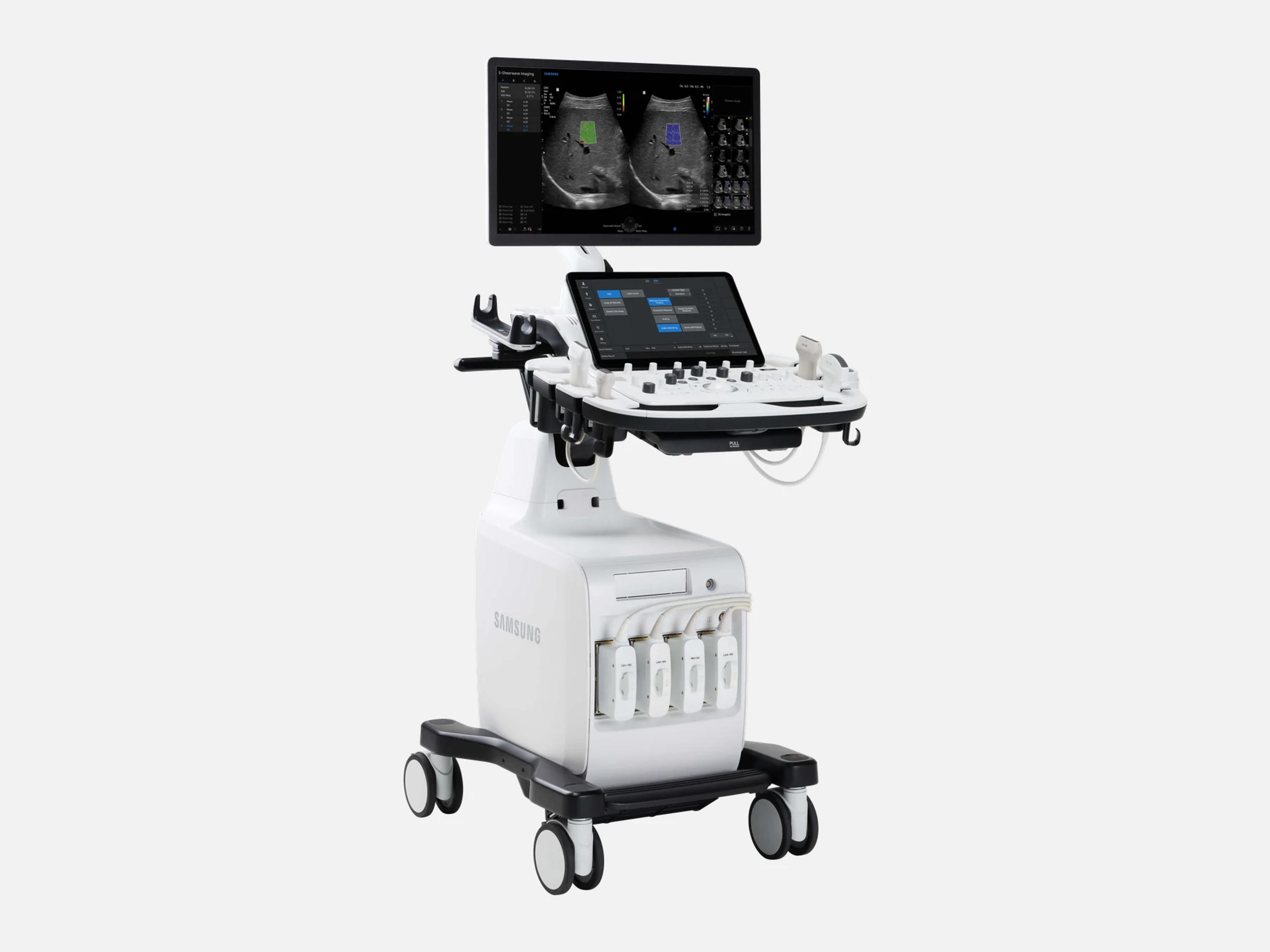
The Samsung V7 is a cart-based ultrasound system for general imaging, women's health and point of care, with features from Samsung's premium systems. The 'V' stands for 'Versatile': the V7 is meant for obstetrics, gynecology, radiology, orthopedics, cardiology and more. Samsung's premium systems are the HERA W10 and V8; the V8 shares the V7's diagnostic solutions, with some differences in image resolution.
- Released
- 2022launched by Samsung
- Probe ports
- 4active
- Display
- 21.5-inchLCD, LED backlighting
- Weight
- 176 lbs
Compatible probes
Linear
- L3-22 Added in K231772
- LA2-9S Added in K223387
- LA2-14A
- LA2-16S Added in K231772
- LA3-14AD Added in K223387
- LA3-22AI
- LA4-18AD
- LM2-18D Added in K250999
Convex & microconvex
- CA1-7S
- CA1-7SD Cleared in K220975
- CA2-13M Added in K261412
- CA3-10A
- CA4-10M
- CV1-8AD
- CV1-8AE Added in K223387
Phased
- PA1-5AE
- PA2-9S Added in K261412
- PA3-8B
- PA4-12B Added in K223387
Endocavity
- EA2-11AR
- EA2-11ARD Cleared in K220975
- EA2-11AV
- EA2-11AVD Cleared in K220975
- EV2-10A
- EV2-11ARE Added in K223387
- EV2-11AVE Added in K223387
Specifications
Display
- Monitor
- 21.5-inch LCD with LED backlighting (US v1.07)
- Monitor option
- 27-inch OLED monitor in the K240631 configuration
- Touch screen
- 14-inch, customizable with TouchEdit (US v1.07)
- Display layouts
- Images and cines expanded to Standard, Wide, Large or Full screen; configurable layout
Physical
- Weight
- 176 lbs (US v1.07)
- Dimensions
- Height 54–67 inches, width 22 inches, depth 38 inches (US v1.07)
- Probe ports
- Four active (US v1.07)
- Controls
- Touch-based control panel; programmable buttons around the trackball
- Cooling
- Airflow Management System: vents heat continuously and reduces fan noise
- Recycled materials
- Eco-friendly resin on the air vent's exterior cover
Power & battery
- BatteryAssist
Optional: scans on battery while AC power is temporarily out; moves without powering offOptional: battery power for scanning when AC power is temporarily unavailable, and for moving the system without powering off.Show allShow less
- Battery runtime
- With the battery option: approx. 36 hours standby, approx. 75 minutes scanning (US v1.07)
Connectivity & options
- DICOM
Ultrasound Image Storage, Comprehensive SR, Modality Worklist, Storage Commitment…System Version 1.01.00: Ultrasound Image Storage, Comprehensive SR, Modality Worklist, Storage Commitment Push Model, Modality Performed Procedure Step and Study Root Information Model FIND.Show allShow less
- RIS access
- RIS Browser, through the system's embedded browser
- Image sharing
SonoSync real-time sharing to PC and smartphone, with voice and text chat and markingSonoSync real-time image sharing over the network to PC, tablet and smartphone, with voice chat, text chat, real-time marking and MultiVue.Show allShow less
- Mobile export
- HelloMom: fetal images to a mobile device by QR code (needs the Mobile Export option)
- Storage
- QuickSave: image and cine data saved straight to USB memory during the exam
- Cybersecurity
Anti-virus, firewall, secured OS, account management, audit trail, data encryption…Anti-virus and firewall; secured operating system; account management; audit trail; encryption of data at rest and in transit; transmission security.Show allShow less
Imaging & software
- Imaging modes
2D, Color Doppler, PD, M, PW, CW, TDI, TDW, ElastoScan, combined, Dual/Quad, 3D/4D…2D, Color Doppler, Power Doppler (PD), M, Pulsed Wave (PW) Doppler, Continuous Wave (CW) Doppler, Tissue Doppler Imaging (TDI), Tissue Doppler Wave (TDW), ElastoScan, combined modes, Multi-Image (Dual, Quad) and 3D/4D; MV-Flow Mode added in K261412; triplex mode (carotid).Show allShow less
- Revision and software
- System Version 1.01.00; US version label v1.07
- Operating system
- Windows 11 in the K261412 configuration
- Imaging engine
Crystal Architecture: CrystalBeam, CrystalLive, S-Vue Single Crystal TransducersCrystal Architecture: CrystalBeam beamforming, CrystalLive image processing and S-Vue Single Crystal Transducers.Show allShow less
- Image quality
ShadowHDR, HQ-Vision, ClearVision, S-Harmonic, EzStructureShadowHDR (dual-frequency processing to reduce acoustic shadowing), HQ-Vision (reduces natural blurring), ClearVision (suppresses speckle artifact), S-Harmonic and EzStructure.Show allShow less
- Color and flow
- MV-Flow, S-Flow, LumiFlow (three-dimensional-like flow display), CrystalVue Flow
- 3D/4D rendering
- CrystalVue, RealisticVue, HDVI; Touch Gesture for 3D volume data on the touch screen
- Deep-learning tools
BiometryAssist, UterineAssist, HeartAssist, NerveTrack, ViewAssist, HeartAssist AdultBiometryAssist, UterineAssist, HeartAssist and NerveTrack, each based on deep learning; ViewAssist for automatic image classification and annotation; HeartAssist Adult for cardiac-anatomy measurement.Show allShow less
- Elastography and QUS
- S-Shearwave Imaging, ElastoScan+, E-Strain, Strain+, TAI and TSI (QUS), EzHRI
- Breast, thyroid and contrast
- S-Detect for Breast, S-Detect for Thyroid, CEUS+
- Vascular and cardiac
- AutoIMT+, AutoIMT, ArterialAnalysis, AutoEF, StressEcho
- Needle, fusion and panoramic
- NeedleMate+ (needle visualization), S-Fusion, Panoramic+
- Women's health tools
LaborAssist, Uterine Contour, CEUS+ HyCoSy, 5D Heart Color, E-Cervix, 5D CNS+, MPI+…LaborAssist, Uterine Contour, CEUS+ HyCoSy, 5D Heart Color, E-Cervix, 5D Limb Vol., 5D CNS+, IOTA-ADNEX, MPI+, 2D Follicle and 5D Follicle.Show allShow less
- Workflow
- EzExam+, EzCompare, QuickPreset
- US feature limits
- No S-Detect benign/malignant recommendation; no ElastoScan+ strain value (US and Canada)
- Added in later clearances
K223387: EzPrep. K243702: RFA Viewer. K261412: Voice Command, Live Q-Scan, EzCheck…K223387: EzPrep. K243702: RFA Viewer, and EzNerveMeasure as a NerveTrack sub-function. K261412: Voice Command, Live Q-Scan, EzCheck, EzFlow, EzPictogram, IDEA, IETA, IOTA-SRrisk, Luminant, PortraitVue, Slice A, 3D Printing, and Prostate Fusion as an S-Fusion sub-function.Show allShow less
Compliance
- FDA 510(k)
K261412 (2026-07-28), K250999 (2025-07-18), K243702 (2025-02-12) … K220975 (2022-06-29)K261412 (decided 2026-07-28); K250999 (2025-07-18); K243702 (2025-02-12); K240631 (2024-06-21); K231772 (2023-10-03); K223387 (2023-02-13); K220975 (2022-06-29). Class II, product code IYN, regulation 892.1550.Show allShow less
What to check when buying a used Samsung V7
Inspect the enclosure, cables and plugs for damage
A cracked or dented enclosure or a worn cable takes the system out of use, and pulling a plug out by its cable can damage the cable and short-circuit the system.
How: Look over the covers for cracks, dents, splits, sharp edges, protrusions and discoloration, and check every cable, wire and plug for wear.
Have the system's electrical safety inspected
The system needs regular checks for electrical leakage, and one that has sat unused for a long period must be confirmed safe before it is used again.
How: Ask when Samsung service last checked it for leakage, and have only an appropriately trained person carry out the safety inspection.
Ask whether any probe was ever dropped
A probe that falls on the floor or a hard surface can have damaged electrical insulation, which can cause an electric shock.
How: Ask the seller about every probe offered with the unit, and do not connect one that has been dropped.
Inspect each probe's lens, housing, cable and connector
A damaged probe can give the patient or the user an electric shock, and a cable bent or twisted too far can cause malfunction or intermittent operation.
How: Look for cracks, broken parts, leaks or sharp edges on the lens, housing, strain relief, seal and cable, and inspect the connector without touching its pins.
Common questions about the Samsung V7
Is the Samsung V7 FDA-cleared?
Yes. The V7 was first cleared under 510(k) K220975, decided June 29, 2022, as a Class II diagnostic ultrasound system (product code IYN, regulation 892.1550).
Later clearances that include the V7 are K223387 (February 13, 2023), K231772 (October 3, 2023), K240631 (June 21, 2024), K243702 (February 12, 2025), K250999 (July 18, 2025) and K261412 (July 28, 2026).
What exams is the Samsung V7 cleared for?
Under K220975 the V7 is cleared for prescription use in fetal/obstetrics, abdominal, gynecology, intra-operative, pediatric, small organ, neonatal cephalic, adult cephalic, trans-rectal, trans-vaginal, muscular-skeletal (conventional and superficial), urology, adult and pediatric cardiac, thoracic, trans-esophageal (cardiac) and peripheral vessel imaging.
K261412 added an ophthalmic application for the V8, V7 and V6 families.
What is the difference between the Samsung V7 and V8?
The V8 and V7 provide the same diagnostic solutions, with some differences in image resolution. The HERA W10 and V8 are Samsung's premium systems, and the V7 is its high-end system for various specialties.
Their transducer clearances also differ: K223387 added the LA4-18AD, EV2-11ARE, EV2-11AVE and CV1-8AE, and the migrated LA3-14AD, for the V7 only, while K231772 added the LM2-18 for the V8 and H8 only.
Are the XV7, H7 and V7 ONE the same as the Samsung V7?
They share its FDA record. K261412 lists the XV7, XH7, H7, cV7, V7 ONE, XV7 ONE, H7 ONE, XH7 ONE and cV7 ONE within the V7 Diagnostic Ultrasound System family, as names added for marketing with the same specifications as the V series.
Can NerveTrack on the Samsung V7 guide a needle?
No. NerveTrack's segmentation is for use before an injection only, and it is not a guide for needling.