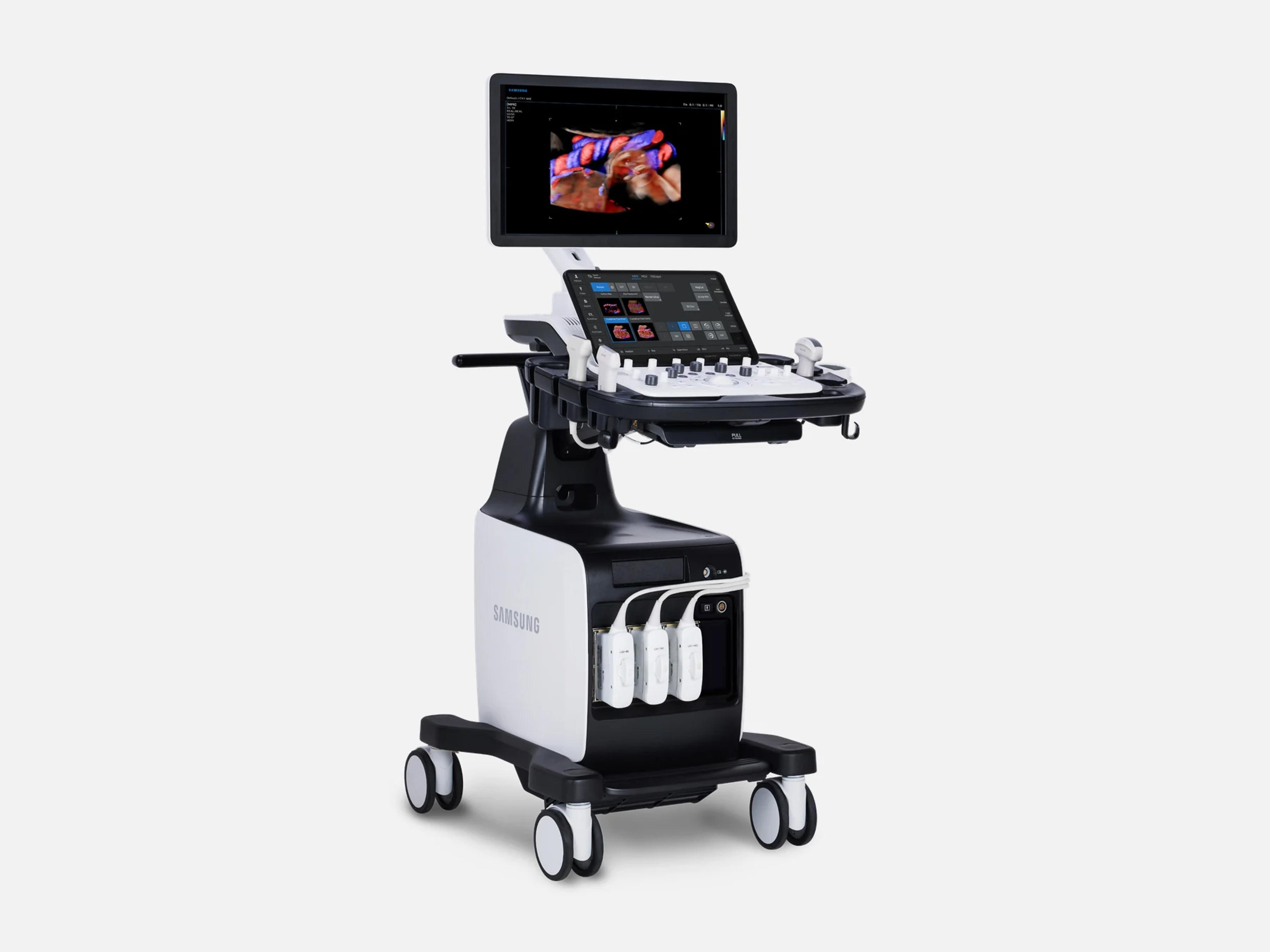
The Samsung V6 is a cart-based ultrasound system designed for everyday Ob-Gyn and reproductive endocrinology imaging, launched in the US for women's health and urology. Among Samsung's women's health systems it sits beside the V7, built around automation, and the V8, built for high-performance imaging and advanced visualization. It was FDA-cleared under 510(k) K231772 in October 2023.
- Released
- 2023launched by Samsung
- Display
- 21.5" LCDoptional 23.8" monitor
Compatible probes
Linear
- L3-22
- LA2-9S
- LA2-14A
- LA3-14AD
- LA3-22AI
Convex & microconvex
- CA1-7AD
- CA1-7S
- CA1-7SD
- CA3-10A
- CA4-10M
- CV1-8AE Volume (3D/4D)
Phased
- PA1-5A
- PA1-5APE
- PA3-8B
- PA4-12B
Endocavity
- BCL2-14 Bi-plane
- EA2-11AR
- EA2-11ARE
- EA2-11AV
- EA2-11AVE
- EV2-10A Volume
- miniER7 · 2–12 MHz 180° field of view
Specialty
- CV1-8A Volume probe
- CW6.0 CW pencil probe
- DP2B CW pencil probe
- MMPT3-7 Transesophageal
Specifications
Display
- Monitor
21.5" LCD, LED backlight, 1,920 x 1,080 x 24 bit; optional 23.8" monitor21.5" LCD monitor with LED backlight, 1,920 x 1,080 x 24 bit (8 bit RGB); optional 23.8" monitorShow allShow less
- Contrast ratio
- 1000:1
- Response time
- 14 ms
- Viewing angle
- 178° (R/L, U/D)
- Monitor luminance
- 350 cd/m² (panel)
- Monitor adjustment
Height, tilt and rotation; tilt -90° to +10°, rotation -360° to +360°Height/tilt/rotate adjustable monitor: tilt -90° to +10°, rotation -360° to +360°, movement up/down and forth/backShow allShow less
- Touch panel
- 14" wide LED touch panel, LCD in-cell capacitive, 1,920 x 1,080 x 24 bit
- Screen modes
- Wide Screen, Large Screen and Full Screen modes
Physical
- Weight
- Approx. 80 kg (176.4 lb)
- Height
- 1,370-1,698 mm (53.9-66.9")
- Width
- 549 mm (21.6") with the 21.5" monitor; 559 mm (22.0") with the optional 23.8" monitor
- Depth
- 964 mm (38.0")
- Probe ports
- 3 or 4 probe ports; CW probe port optional
- Wheels
- 4 swivel/lock wheels (5 inch); caster brake options
- Console
Front and rear handles; 6 probe holders; gel bottle storage; optional gel warmerOn-board storage for peripherals; 6 probe holders; endo-cavity probe holder (option); gel bottle storage; gel warmer (option); front and rear handles; integrated cable management; integrated stereo speakers; easy-to-clean air filter; airflow design for heat dissipation at reduced noise; sustainable resin in the air-vent exterior coverShow allShow less
- Control panel
- Height adjustable 180 mm; rotation +/- 30° from center
- Controls
Digital TGC on touch screen; programmable trackball; optional backlit QWERTY keyboardDigital TGC controls on the touch screen; trackball with programmable buttons; integrated backlit alphanumeric QWERTY keyboard (optional) and virtual on-screen keyboardShow allShow less
- Audible noise
- 34.8 dBA
Power & battery
- Power supply
- 100-240 VAC, 50/60 Hz
- Power consumption
- Max. 800 VA (with peripherals); 1.22-2.71 A nominal (110V: 2.44 A; 220V: 1.41 A)
- Heat dissipation
- 2,729.7 BTU/h
- Battery
Optional BatteryAssist: 14.4 VDC, 6,900 mAh, 99.36 W lithium-ion, x 3Optional battery (BatteryAssist): 14.4 VDC, 6,900 mAh, 99.36 W lithium-ion, x 3; backup power for uninterrupted scanning and for moving the system without powering downShow allShow less
- Battery runtime
Scan approx. 75 min; standby approx. 84 hours; charging approx. 3 hoursScan time approx. 75 min; standby mode approx. 84 hours; charging time approx. 3 hours (subject to change depending on user environment)Show allShow less
- Startup
- Boot approx. 80 sec; wake from sleep approx. 23 sec
Connectivity & options
- DICOM
DICOM 3.0: worklist, storage, commitment, MPPS, SR, query/retrieve, print; DICOM TLSDICOM 3.0 compatible: Verification (SCU, SCP), Modality Worklist (SCU), Image Storage (SCU), Storage Commitment (SCU), Modality Performed Procedure Step, Structured Report Storage (SCU), Query/Retrieve (SCU), Basic Grayscale and Basic Color Print Management (SCU), DICOM Directory (FSC, FSU, FSR); DICOM TLS; EMR/DICOM secure transmissionShow allShow less
- Network
- 1000BASE-T Gigabit Ethernet
- USB
- USB 3.0: 2 front, 2 rear
- Video output
- HDMI: 2 ports (1920 x 1080); optional S-VHS output and stereo audio output
- Storage
- 512 GB internal SSD; optional expanded storage (1TB)
- Export
Formats AVI, MPEG, JPEG, BMP, TIFF, DICOM; to USB memory stick or CD/DVDArchiving format DICOM; export formats AVI, MPEG, JPEG, BMP, TIFF, DICOM; archive devices: internal SSD, external USB memory stick, external CD/DVDShow allShow less
- Image sharing
SonoSync streaming with voice/text and remote control; Mobile Export by QR codeSonoSync: real-time image streaming with voice/text communication and remote controllability, with multiple users and systems connected at once; Mobile Export: QR-code transfer of selected fetal images to the patient's smartphoneShow allShow less
- Peripherals
BatteryAssist, ECG (USB), foot switch (USB), gel warmer, USB printers, keyboard, basketBatteryAssist, basket, ECG (USB type), endo-cavity probe holder, external USB printers, foot switch (USB type), gel warmer, integrated digital B/W and color printers, keyboard, printer tray (B/W, Color, S, M, L); pediatric ECG cable compatibility with the v1.07 updateShow allShow less
- Cybersecurity
Windows Defender, Applocker, BitLocker SSD encryption (FIPS 140-2), firewallWindows Defender antivirus; Applocker; secure erase for PHI data (by service engineer only); SSD encryption with BitLocker (FIPS 140-2 certified); firewall; DICOM TLS (TLS 1.2)Show allShow less
- Optional features
2D and 5D Follicle, Smart 4D, S-Detect, S-Shearwave, Strain+, StressEcho, ViewAssist2D Follicle, 5D Follicle, 5D LB, S-Detect for Breast, S-Detect for Thyroid, Smart 4D, SonoSync, S-Shearwave Imaging, Strain+, StressEcho, XI STIC, UterineAssist, Expanded Storage (1TB), ViewAssist, QUS (TAI/TSI). Some features require additional purchase.Show allShow less
- S-Detect
- For breast and thyroid; benign/malignant recommendations excluded in the US
- Cycle Clarity
- Compatible
Imaging & software
- Revision and software
Software v1.07 on Windows 10; Windows 11 in the configuration cleared in July 2026Software level v1.07 runs on Windows 10, and the v1.07 update includes Live BreastAssist; the V6 configuration cleared in July 2026 runs Windows 11Show allShow less
- Computing platform
- CPU i5 2.5 GHz; GPU GeForce GTX 1650; 16 GB DDR4 RAM
- Imaging engine
- Crystal Architecture (2D and color signal processing); CrystalBeam; CrystalLive
- Channels
128 Tx/Rx channels; 8,257,536 processing channels; max. 8 beams; max. 4 focal zonesTx/Rx channels: 128; system processing channel: 8,257,536; multi-beam processing max. 8 beams; multi-zone focal point max. 4Show allShow less
- Imaging depth
- 2-55 cm (depends on probe and preset)
- Gray scale
- 256 shades of gray, 8 bits
- Cine memory
- Max. 85,912 frames; loop memory max. 122,568 lines
- Imaging modes
2D, M, Color, Power, PW and CW Doppler, TDI, TDW, ElastoScan, MV-Flow, Dual/Quad, 3D/4D2D, Color Doppler, Power Doppler, M mode, Pulsed Wave (PW) Doppler, Continuous Wave (CW) Doppler, Tissue Doppler Imaging (TDI), Tissue Doppler Wave (TDW), ElastoScan, MV-Flow, combined modes, Multi-Image (Dual, Quad), 3D/4DShow allShow less
- Operating modes
Beyond 2D and Doppler: CEUS+, Volume, Elastoscan+, Panoramic, S-Shearwave, IOTA-ADNEX2D, M, Color Doppler, Power Doppler/S-Flow, Pulsed Wave Doppler, Continuous Wave Doppler, CEUS+, Volume, Elastoscan+, Panoramic Imaging, TDI, TDW, MV-Flow, Arterial Analysis, S-Shearwave Imaging, IOTA-ADNEX, S-Detect for Breast, S-Detect for ThyroidShow allShow less
- Image enhancement
- HQ-Vision, ClearVision, ShadowHDR
- Doppler and flow
MV-Flow (microvascular Doppler), LumiFlow (3D-like 2D color Doppler), S-FlowMV-Flow (microvascular Doppler); LumiFlow (three-dimensional-like presentation of 2D color Doppler); S-FlowShow allShow less
- 3D/4D
CrystalVue, RealisticVue, CrystalVue Flow, 5D NT; TouchGesture volume handlingCrystalVue, RealisticVue, CrystalVue Flow, 5D NT; 3D volume manipulation on the touchscreen (TouchGesture)Show allShow less
- AI and measurement
- ViewAssist, BiometryAssist, LaborAssist, UterineAssist, Uterine Contour
- Follicle tools
2D Follicle; 5D Follicle, a 3D tool that finds and measures ovarian follicles2D Follicle; 5D Follicle, a 3D volume tool that identifies and measures multiple ovarian folliclesShow allShow less
- Workflow
EzExam+ protocols, EzCompare prior-exam comparison, QuickPreset, TouchEditEzExam+ (predefined exam protocols), EzCompare (side-by-side prior-exam comparison), QuickPreset (single-touch transducer and preset selection), TouchEdit (touchscreen customization), programmable trackball buttons; some features are optional and require additional purchaseShow allShow less
- Standard features
Advanced QuickScan, ClearVision, ShadowHDR, UterineContour, Static 3D, harmonic imagingAdvanced QuickScan (automatic optimization), ClearVision, ShadowHDR, UterineContour, Static 3D, Trapezoidal Imaging, S-Harmonic Imaging (convex, linear), Pulse Inversion Harmonic Imaging, MultiVision (convex, linear), Doppler Auto Trace, support for external USB storage devicesShow allShow less
- Features in later clearances
Voice Command, Live Q-Scan, Prostate Fusion, PortraitVue, EzStructure, EzNerveMeasureNamed for the V6 in the clearances of February 2025 (EzNerveMeasure, RFA Viewer), July 2025 (EzAssist, EzTrainer) and July 2026 (3D Printing, EzCheck, EzFlow, EzPictogram, EzStructure, IDEA, IETA, IOTA-SRrisk, Live Q-Scan, Luminant, PortraitVue, Prostate Fusion, Slice A, Voice Command)Show allShow less
Environment
- Operating
- 10-35 °C, 30-75 % humidity, 700-1,060 hPa
- Storage and shipping
- -25-60 °C, 20-90 % humidity
Compliance
- FDA 510(k)
K231772 (2023), K240631 (2024), K243702 (2025), K250999 (2025), K261412 (2026)K231772 (October 3, 2023; V6/H6 with V8/H8 and V7/H7; Class II; product codes IYN, IYO, ITX); K240631 (June 21, 2024); K243702 (February 12, 2025); K250999 (July 18, 2025); K261412 (July 28, 2026)Show allShow less
- Electrical safety and EMC
- EMC class A; transducer safety type BF (probe dependent)
What to check when buying a used Samsung V6
Confirm MI and TI show while scanning
The V6 has a real-time acoustic output display that shows the mechanical and thermal indices automatically, so a unit scanning without them on screen is not working as designed.
How: Scan in each mode you plan to use and confirm the mechanical index and thermal index appear on screen without any setting being changed.
Test every wheel's swivel and lock
The V6 is a heavy cart on swivel-and-lock wheels, and a lock that does not hold lets it roll when it should stay put.
How: Roll the cart in each direction to confirm every wheel swivels freely, then lock each wheel in turn and push the cart to confirm it holds.
Match the rating plate to the installed options
Features, options and transducers differ by country and some V6 features are paid options, so the plate and the installed option list decide what the unit can do.
How: Read the model name on the rating plate, then open the system's option list and note every installed software option and transducer.
Boot from cold and read status and faults
The V6 runs Windows on an internal SSD, and a stalled start, a nearly full drive, screen flicker or unresolved faults in its records are problems that come with the unit.
How: Start the system from fully off to a live image, read the status icons for SSD capacity and DICOM jobs, watch the screen for flicker or heavy image noise, and ask for the fault records and how each fault was resolved.
Common questions about the Samsung V6
Is the Samsung V6 FDA-cleared?
Yes. It was cleared as a Class II device under 510(k) K231772 on October 3, 2023, named the V6/H6 Diagnostic Ultrasound System and cleared together with the V8/H8 and V7/H7.
Later clearances that name the V6 are K240631 (June 21, 2024), K243702 (February 12, 2025), K250999 (July 18, 2025) and K261412 (July 28, 2026).
What applications is the Samsung V6 cleared for?
Its first clearance includes fetal and obstetric, abdominal, gynecology, intraoperative, pediatric, small organ, neonatal and adult cephalic, transrectal, transvaginal, musculoskeletal (conventional and superficial), urology, adult and pediatric cardiac, thoracic, transesophageal cardiac and peripheral vessel imaging.
The clearance of July 2026 added an ophthalmic application.
Is the Samsung V6 used for urology?
Yes. Samsung launched the V6 in the US for women's health and urology and designed it for everyday use in a busy urology lab, and its clearance includes urology and transrectal imaging.
For urology work Samsung pairs the miniER7 and EA2-11AR with transrectal scanning, the bi-plane BCL2-14 with transperineal imaging and procedural guidance, the CA1-7AD with kidney and bladder scans, and the LA3-14AD with scrotal and testicular imaging.
How does the Samsung V6 differ from the V7 and V8?
Samsung positions the V6 for accessible, everyday Ob-Gyn and reproductive endocrinology imaging, the V7 as a versatile platform built around automation for OB/Gyn exams, and the V8 for high-performance imaging and advanced visualization in comprehensive women's health.
The three were first cleared together, and in that clearance the CA1-7AD transducer, carried over from the HS40, was added to the V6 alone and the LM2-18 to the V8 alone.
Is the Samsung V6 ONE the same as the V6?
V6 ONE is one of the product names the July 2026 clearance includes for marketing purposes, with XV6, XH6, H6 and cV6 and the ONE version of each, all with the same specifications as the V6.
Which transducers have FDA clearances added to the Samsung V6?
The first clearance, in October 2023, included the L3-22 and LA2-16S as new transducers and carried the CA1-7AD over from the HS40. The TA2-9 followed in June 2024, the bi-plane BCL2-14 in February 2025 and the LM2-18D in July 2025.
The clearance of July 2026 added the BCC2-13 as a new transducer and carried the CA2-13M and PA2-9S over from the HERA Z20 and R20 family.