Samsung HS60
Samsung Healthcare · HS series
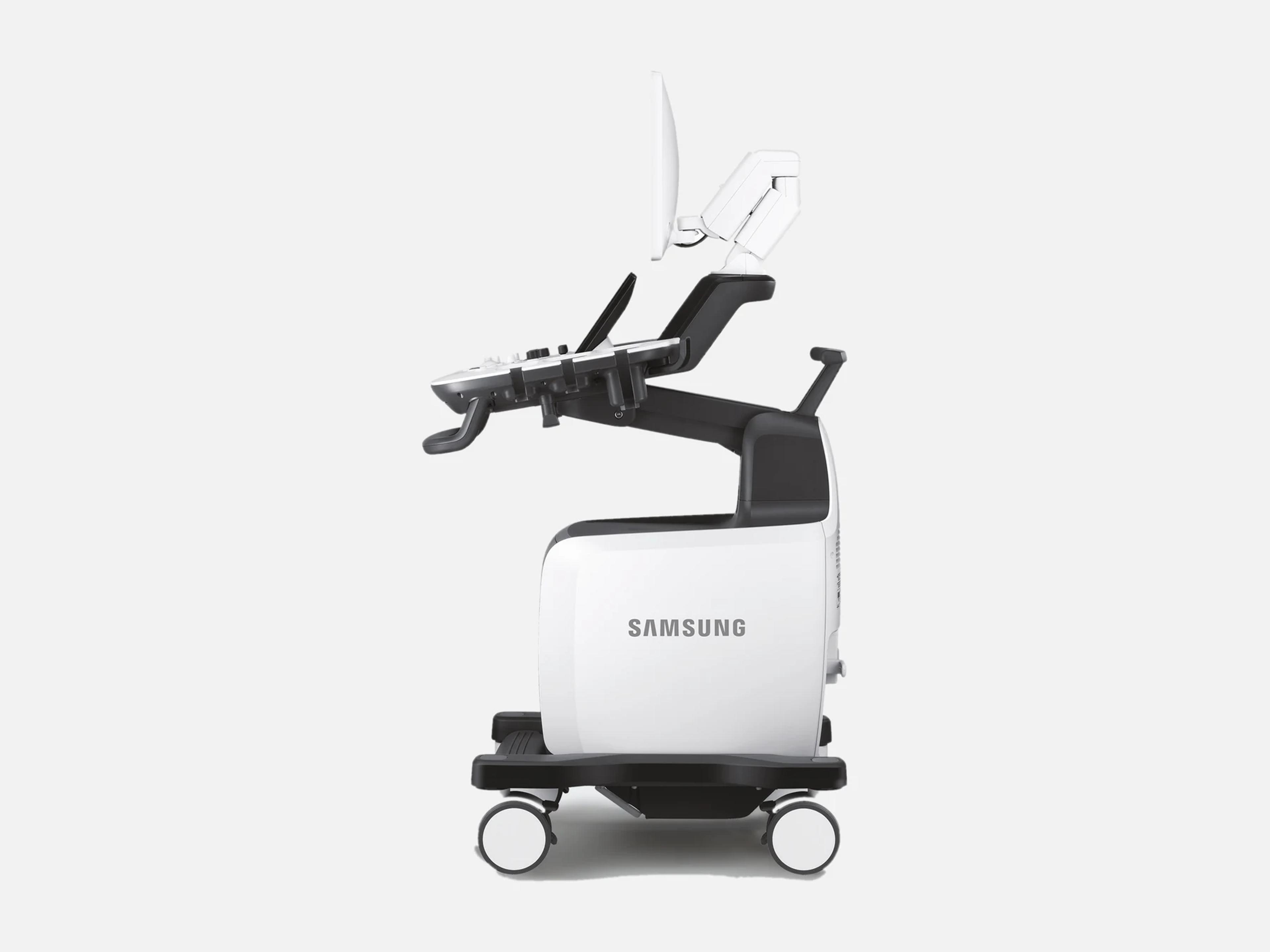
The Samsung HS60 is a cart-based general imaging ultrasound system with a 21.5-inch monitor and a 10.1-inch touchscreen, introduced in the US in 2017. Samsung designed it for busy obstetrics and gynecology, general imaging and MSK practices, and for abdominal, vascular and cardiac exams. It is FDA-cleared together with the HS50, and at version 2.03.00 MV-Flow runs on the HS60 only.
- Released
- 2017first FDA clearance
- Display
- 21.5-inchLCD with LED backlighting
Compatible probes
Linear
- LA2-9A
- LA3-14AD
- LA3-16A
- LA3-16AI
- LA4-18BD
Convex & microconvex
- CA1-7AD
- CA2-9AD
- CA3-10A
- CF4-9
Phased
- PA1-5A
- PA3-8B
- PA4-12B
Endocavity
- EA2-11AR Added in K192505
- EA2-11AV Added in K192505
- EA2-11B
Specialty
- MMPT3-7 Transesophageal (TEE)
- CW6.0 Continuous-wave (CW)
- DP2B Continuous-wave (CW)
- CV1-8AD Volume
- EV2-10A Volume; added in K192505
Specifications
Display
- Monitor
- 21.5-inch LCD with LED backlighting
- Gray scale
- 256 gray shades
- Touch screen
- 10.1-inch capacitive touchscreen
- Acoustic output display
- Mechanical (MI) and thermal (TI) indices shown automatically in real time
Physical
- Wheels and brakes
- Foot-operated brakes on the console's wheels
- Monitor arm
- Retracts fully to lock in place for transport
- Control panel height
- Adjusted with a lever on the control panel handle
- Custom keys
- Six customized keys, U1 through U6 (version 2.03.00)
- Gel warmer
- Mounts on either side of the control panel
- Air filter
- Pulls out from under the front of the console
Power & battery
- Power supply
- 100-120V, 60 Hz; 200-240V, 50 Hz
- Battery
Li-ion backup battery with Battery AssistLi-ion backup battery with the Battery Assist function, which lets the system enter and exit a sleep state and lets users scan and transfer data when AC power is temporarily unavailableShow allShow less
Connectivity & options
- DICOM
Image/multiframe storage, Comprehensive SR, worklist, storage commitment, MPPS (V1.00)At System Version 1.00: ultrasound image and multiframe storage, Comprehensive SR, worklist, storage commitment and MPPSShow allShow less
- Storage
- Solid-state drive (SSD)
- Optical drive
- Not available on the V2.03 configuration
- ECG
- Defibrillation-proof ECG electrode
- Biopsy guides
- Biopsy guides cleared in 2018; nine biopsy kits cleared in 2019
- Optional features
NeedleMate+™ and Panoramic+ optional at V2.03; EzCompare optional at 2.03.00NeedleMate+™ and Panoramic+ are optional at V2.03, and optional features may require additional purchase; EzCompare is optional at version 2.03.00Show allShow less
Imaging & software
- Imaging modes
B, M, Color M, Anatomical, Color, Power, PW and CW Doppler, TDI, TDW, ElastoScan, 3D/4D2D (B) mode, M mode, Color M mode, Anatomical mode, Color Doppler, Power Doppler (PD), Pulsed Wave (PW) Doppler, Continuous Wave (CW) Doppler, Tissue Doppler Imaging (TDI), Tissue Doppler Wave (TDW), ElastoScan mode, 3D/4D/XI STIC, and Dual, Quad, Combined, Simultaneous and Zoom modesShow allShow less
- Transducer frequency range
- 1.0 MHz to 20.0 MHz across linear, convex, phased, static and volume probes
- Beamformer
Hybrid beamformer with digital multi-beam forming (Beamformer 128)Hybrid beamformer technology with Samsung Digital Signal Processing; digital multi-beam forming; Beamformer 128Show allShow less
- Imaging engine
- CrystalLive™
- Image processing
- HQ-Vision™, ClearVision™, S-Harmonic™, HDVI™, BeamSteer, MultiVision
- Flow imaging
S-Flow™ directional power Doppler, LumiFlow™, MV-Flow™ (HS60 only at 2.03.00)S-Flow™ (directional Power Doppler) and LumiFlow™; MV-Flow™, added with LumiFlow™ in the 2021 clearance, runs on the HS60 only at version 2.03.00Show allShow less
- Elastography
- ElastoScan™; E-Strain™ strain ratio between two ROIs
- Breast and thyroid
S-Detect™ for Breast (BI-RADS®-based); S-Detect™ for ThyroidS-Detect™ for Breast (BI-RADS®-based) and S-Detect™ for Thyroid, added with the 2021 clearanceShow allShow less
- Measurement and analysis
Strain+, StressEcho, Auto EF, TMAD, Arterial Analysis™, AutoIMT+Strain+ (Bull's Eye display of LV wall motion), StressEcho, Auto EF, TMAD, Arterial Analysis™ and AutoIMT+Show allShow less
- 3D and 4D
3D/4D, XI STIC, 3D MagiCut, VOCAL, Volume CT, Realistic Vue™, Crystal Vue, Slab 3D3D Imaging, 3D Rendering (MPR), 3D XI (MSV, Oblique View), Volume CT, 3D MagiCut, Volume Calculation (VOCAL, XI VOCAL), XI STIC, Realistic Vue™, Crystal Vue and Slab 3DShow allShow less
- OB and fertility tools
2D NT, 5D NT, 2D Follicle, 5D Follicle, 5D Heart Color, BiometryAssist, LaborAssist2D NT, 5D NT, 5D Follicle, 5D Heart Color and BiometryAssist; 2D Follicle and LaborAssist added with the 2019 clearanceShow allShow less
- Workflow
QuickScan™, one-touch Quick Preset, SonoView, PanoramicQuickScan™ (optimized gray scale and Doppler parameters), one-touch Quick Preset (common transducer and preset combinations), SonoView and PanoramicShow allShow less
- Other features
- CEUS+, FAD, SFVI, VSI, SmoothCut
- Operating system
- Windows 10, implemented with the 2019 clearance; not stated for earlier units
- Revision and software
- System Version 1.00, version 2.03.00, Version V2.04 and Software Version v2.05
Compliance
- FDA 510(k)
K170493 (3/28/2017), K181336 (12/4/2018), K192505 (12/12/2019), K210068 (4/9/2021)K170493 (March 28, 2017), K181336 (December 4, 2018), K192505 (December 12, 2019) and K210068 (April 9, 2021); Class II, product codes IYN, IYO and ITXShow allShow less
- US model numbers
- USS-HS6NL40/US; USS-HS6NB4N/US (V2.03)
- Manufacturer
- Samsung Medison Co., Ltd., Hongcheon-gun, Gangwon-do, Republic of Korea
What to check when buying a used Samsung HS60
Have trained staff test electrical leakage
The system's electrical safety depends on how it has been maintained, and a unit returning from a long break in service needs its operational safety checked before use.
How: Ask for the record of the last electrical leakage check, and if there is none or the unit has been in storage, have trained staff run the safety inspection before it scans a patient.
Inspect the housing, cables, cords and plugs
A cracked or chipped housing or a worn cable rules the system out of use, and a power cord unplugged by pulling on it can be damaged, break or short-circuit the system.
How: Look over the console shell and every cable, cord and plug for cracks, chips and wear, and do not power a unit with a cracked housing or a worn cable.
Watch for hazard errors and scanning gaps
An error message that signals a hazardous condition, or a break in the scanning sequence, points to a hardware fault that must be fixed before the system is used.
How: Boot the unit and scan through several presets, noting any error code and any freeze or skip in the live image.
Check the vents for blockage, debris and spills
Blocked ventilation slots or metal pieces inside the console are a hazard, and liquid that gets into the system can cause fire, electric shock, injury or damage.
How: Look into the ventilation slots for blockages, loose metal objects and traces of spilled liquid, and reject a unit that shows liquid has been inside it.
Common questions about the Samsung HS60
Is the Samsung HS60 FDA-cleared?
Yes. The HS60 is FDA-cleared through 510(k) as the HS50 / HS60 Diagnostic Ultrasound System, a Class II device, under four clearances: K170493 (March 28, 2017), K181336 (December 4, 2018), K192505 (December 12, 2019) and K210068 (April 9, 2021).
Under K210068 its cleared applications are fetal/obstetrics, abdominal, gynecology, pediatric, small organ, neonatal and adult cephalic, trans-rectal, trans-vaginal, musculoskeletal (conventional and superficial), urology, adult and pediatric cardiac, transesophageal cardiac and peripheral vessel.
What is the difference between the Samsung HS60 and the HS50?
The two share one family of FDA 510(k) clearances, but not every probe: under K192505 the LA2-9A, LA3-16AI, LA4-18BD, EA2-11B, CA3-10A, VR5-9 and DP8B are cleared for the HS60 only, and the ER4-9 and EVN4-9 for the HS50 only.
At software version 2.03.00, MV-Flow runs on the HS60 only. At launch the HS60 also added E-Strain, which calculates a strain ratio between two regions of interest.
Does the Samsung HS60 have elastography and S-Detect?
Yes. The HS60 has ElastoScan elastography and E-Strain, which calculates a strain ratio between two regions of interest, though the ElastoScan strain value is not applied on systems in the United States.
S-Detect for Breast is BI-RADS-based, and as of 2018 it gave no benign or malignant recommendation in the United States. S-Detect for Thyroid was added to the HS60 in K210068 (April 9, 2021).
Can the Samsung HS60 do transesophageal echo?
Yes. The transesophageal (cardiac) application was added to the HS60's clearance in K181336 (December 4, 2018), with a TEE probe migrated from the RS85, and the MMPT3-7 is the HS60's TEE transducer.
The HS60 is also cleared for adult and pediatric cardiac exams, and its cardiac tools include Strain+, which shows LV wall motion in a Bull's Eye display, StressEcho and Auto EF.