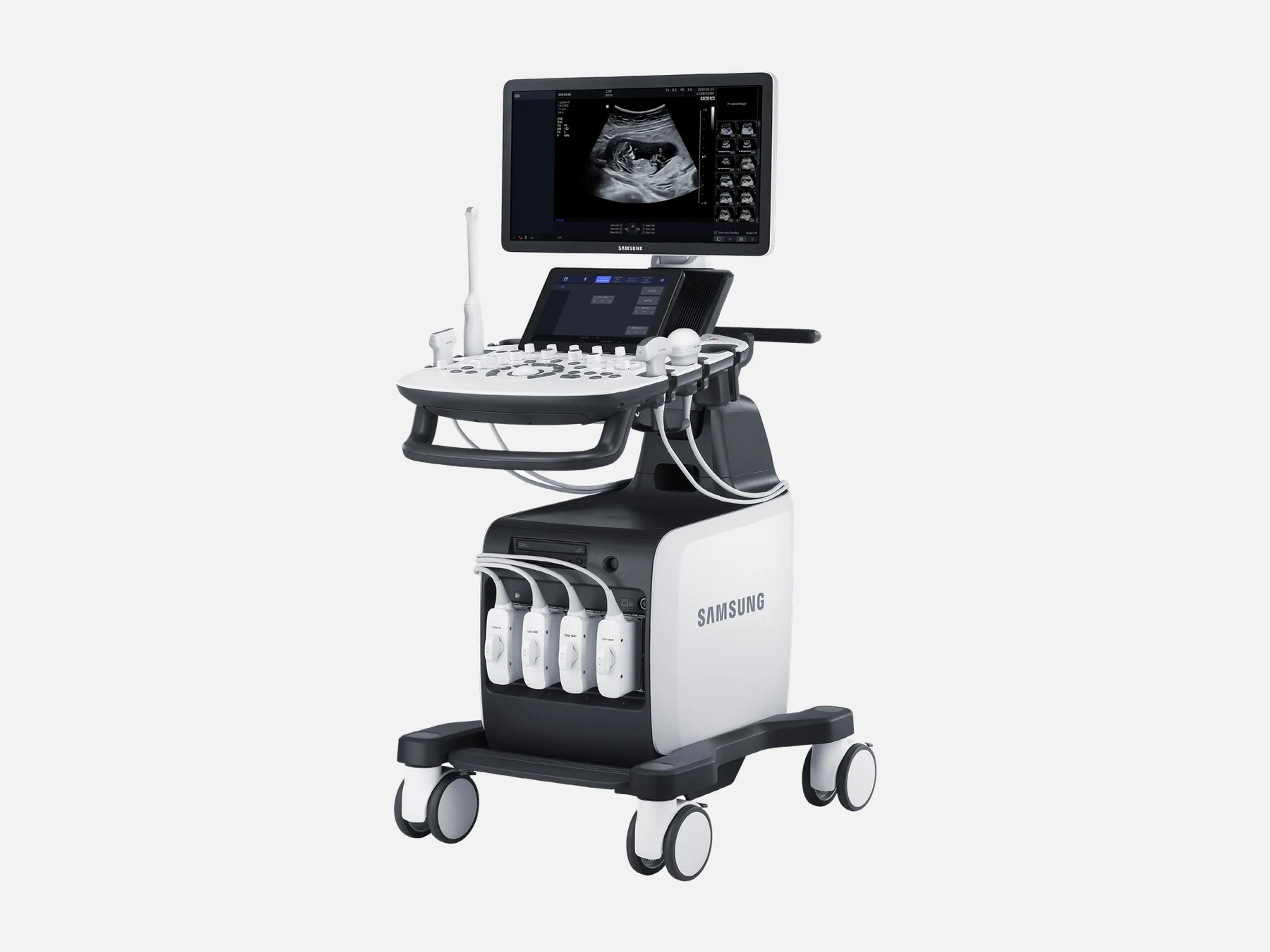
The Samsung HS50 is a cart-based ultrasound system for obstetrics and gynecology, general imaging and MSK work, built to bring image quality and technologies from Samsung's high-end systems into the mid-range. Samsung launched it with the HS60, and the two share their FDA 510(k) clearances. It has a 21.5-inch monitor on an articulated arm, a 10.1-inch touch screen and 3 or 4 active probe ports.
- Released
- 2016launched by Samsung
- Probe ports
- 3 or 4active, by configuration
- Display
- 21.5-inchfull HD, 10.1-in touchscreen
- Weight
- 79.8 kgwithout accessories
Compatible probes
Linear
- LA3-14AD Small parts, vascular, musculoskeletal
- LA3-16A
Convex & microconvex
- CA1-7AD S-Vue™ transducer
- CA2-6BM
- CA2-9AD S-Vue™ transducer
- CF4-9
Phased
- PA1-5A Listed for the HS50 from K192505
- PA3-8B
- PA4-12B
- PE2-4
Endocavity
- EA2-11AR Added in K192505
- EA2-11AV Added in K192505
- ER4-9
- EVN4-9
Specialty
- CV1-8AD 3D volume; S-Vue™ transducer
- EV2-10A 3D volume; added in K192505
- V5-9 3D volume
- MMPT3-7 Transesophageal
- CW6.0 Continuous wave
- DP2B Continuous-wave pencil
Specifications
Display
- Main monitor
21.5-inch LCD with LED backlight, full HD 1,920 x 1,080 (16:9), 16.7 M colors21.5-inch LCD monitor with LED backlight (full HD); resolution 1,920 x 1,080 (16:9); 16.7 M colors; brightness adjustment; interactive dynamic software menuShow allShow less
- Touch screen
- 10.1-inch LCD with LED backlight, 1,280 x 800, capacitive, virtual alphanumeric keyboard
- Monitor arm
- Articulated; swivel +/-160°, tilt +25° / -70°, lift 180 mm
Physical
- Console design
Cart on 4 swivel wheels, articulated monitor arm, printer storage, probe and gel holders4 swivel wheel cart-based type; articulated monitor arm; built-in printer storage; ergonomic operation panel; probe holder and gel holder; integrated PC module; integrated SSD; optional gel warmer, installable on either side of the control panelShow allShow less
- Weight
- 79.8 kg without accessories
- Dimensions
- Width 530 mm, depth 750 mm, height 1,335–1,710 mm with monitor
- Control panel
Alphanumeric keyboard, 6 user keys, trackball, height adjustment 180 mm, swivel +/-30°10.1-inch touch screen; alphanumeric keyboard; 6 user (programmable) keys; tri-status backlighting; 6 probe holders; height adjustment 180 mm; swivel +/-30°; trackball; editable touch-screen menu; over 30 user-programmable presets; front and rear handlesShow allShow less
- System noise
- Under 34.8 dB
Power & battery
- Power
100–240 VAC, 50/60 Hz; max. 800 VA with peripherals; heat dissipation 2,729.7 BTU/h100–240 VAC, 50/60 Hz; power consumption max. 800 VA with peripherals; heat dissipation 2,729.7 BTU/h; built-in equipotential circuitShow allShow less
- Battery (optional)
14.4 VDC, 6900 mAh, 99.36 W lithium-ion; scan time 25 min (basic mode live scan)14.4 VDC, 6900 mAh, 99.36 W lithium-ion; scan time 25 min (basic mode live scan); standby mode about 24 hours; wake-up from sleep mode about 30 sec; charging time about 5 hours; BatteryAssist™Show allShow less
Connectivity & options
- Probe ports
- 3 or 4 active probe ports (optional / selectable); CW probe connector optional
- Connectivity
HDMI, D-SUB (VGA), S-Video, audio L/R out; 6 USB 2.0; Ethernet 10/100/1000BASE-TAudio out L/R; D-SUB (VGA) output; S-Video output; HDMI output; USB 2.0 (6 ports); Ethernet 10/100/1000BASE-T (LAN); USB 2.0 foot switch (IPX 8); DVD recorder DVO-1000MDShow allShow less
- DICOM and IHE
DICOM 3.0: Media, PPS, Print, Storage, SC, SR, Verification, Worklist; IHE SWF, PIR, PDIDICOM 3.0: Media, Performed Procedure Step (PPS), Print, Storage, Storage Commitment (SC), Structured Reporting (SR), Verification, Worklist; IHE: Scheduled Workflow (SWF), Patient Information Reconciliation (PIR), Portable Data for Imaging (PDI)Show allShow less
- Printers
B/W UP-D897, UP-D898MD, UP-X898MD, P95DE, P95DW; color UP-D25MD, CP30DWDigital B/W video printers: UP-D897, UP-D898MD, UP-X898MD, P95DE, P95DW; digital color video printers: UP-D25MD, CP30DW; USB line printers: CLP-620NDK, ML-2950, L805, M454DNShow allShow less
- Console options
- ECG (USB type, defibrillation-proof type CF), gel warmer, battery
- System options
- Includes 4D, 3D XI™, AutoIMT+, Cardiac Measurement, CW Function, DICOM
Imaging & software
- Imaging modes
2D, M-Mode, Color Doppler, PW, CW, TDI, TDW, PD, S-Flow™, LumiFlow, ElastoScan, 3D/4D2D (B) mode; M-Mode; Color M-Mode; Anatomical M Mode; Color Doppler; Pulsed Wave (PW) spectral Doppler; Continuous Wave (CW) Doppler (steered / static); Tissue Doppler Imaging (TDI); Tissue Doppler Wave (TDW); Power Doppler (PD); S-Flow™ Mode; LumiFlow; ElastoScan Mode; 3D / 4D / 3D XI / XI STIC™ (volume mode); Freehand 3DShow allShow less
- Display modes
Single/Dual/Quad; Dual Live; Real-Time Triplex; Zoom; Panoramic; Trapezoid; Full screenSingle / Dual / Quad; Dual Live (B+B, B+B/C, B+B/PD, B+B/S-Flow, B+ElastoScan); Real-Time Triplex (Simultaneous) Mode: B+C+PW, B+PD+PW, B+S-Flow+PW, B+TDI+TDW; Duplex and Triplex combinations; Zoom (Write Zoom / Read Zoom / Pen zoom / Panning); Needle Mate+; Panoramic; Trapezoid; Full screenShow allShow less
- Imaging technologies
S-Vision™ engine, S-Vue™ transducers, S-Harmonic™, ClearVision, MultiVision, FSIS-Vision™ imaging engine; CrystalLive™ imaging engine (V2.02); S-Vue™ single-crystal transducer technology; S-Harmonic™; ClearVision™; hybrid full digital beamforming; Frequency Compounding (FSI); MultiVision (probe dependent)Show allShow less
- Frequency range and imaging depth
1–18 MHz; displayed depth 2–40 cm (probe dependent); 1–4 focal pointsFrequency range 1–18 MHz; displayed imaging depth 2–40 cm (probe dependent); 1–4 focal points (transmit focal zone 1–8 selectable, probe and application dependent)Show allShow less
- Doppler velocity range
- PW 0.1 cm/s – 8.8 m/s; CW 1 cm/s – 19.3 m/s
- Processing and frame rate
Processing channel 1,146,880; 256 gray shades; max. 2,000 fps, color 400 fpsSystem processing channel 1,146,880; system internal dynamic range 256; 256 shades of gray; maximum frame rate 2,000 fps; maximum color frame rate 400 fpsShow allShow less
- General imaging and intervention tools
ElastoScan™ (strain value not applied in the US), Auto IMT+, NeedleMate+™, Beam SteerElastoScan™ (strain value not applied in Canada and the US); Auto IMT+; NeedleMate+™; Beam Steer; S-Detect™ for BreastShow allShow less
- Women's health
2D Follicle™, 5D Follicle™, 5D NT™, BiometryAssist™, RealisticVue™, LaborAssist™, MSV™2D Follicle™, 5D Follicle™, 5D NT™, LaborAssist™ and RealisticVue™ (optional extras in V2.02; RealisticVue light direction in 9 directions); BiometryAssist™; MSV™Show allShow less
- Workflow
Quick Preset, Advanced QuickScan, EZ-Compare™, EZ-Exam+™, SonoView™, Report PackageQuick Preset; Advanced QuickScan (one-touch grayscale and Doppler optimization); EZ-Compare™; EZ-Exam+™ (user-built or predefined protocols); Measure Navigation (a picture-in-picture window); SonoView™ image viewer; Report PackageShow allShow less
- Image storage
512 GB SSD, max. 350,000 images (RAW); cine memory 500 MB; USB flash media, USB HDDBuilt-in 512 GB SSD: max. 350,000 images (RAW format); cine memory 500 MB, cine loop max. 14,000 lines, image storage max. 45,000 frames / 60 sec; USB flash memory media; USB HDD; image formats AVI, MPEG, JPEG, BMP, TIFF, DICOMShow allShow less
- Boot-up and probe change time
- System boot-up max. 90 sec; probe change 2–3 sec
- Operating system and PC
Windows 10 IoT Enterprise 2019 LTSC; i3-4100E 2.4 GHz; 8 GB memory; 512 GB SSDWindows 10 IoT Enterprise 2019 LTSC; i3-4100E 2.4 GHz main processor; 8 GB main memory; 512 GB built-in SSDShow allShow less
- Revision and software
Version 1.00 to V2.03; later clearances added Windows 10, MV-Flow™ and LumiFlow™Versions: Version 1.00, V2.00, V2.02, V2.03. K192505 (December 12, 2019) added 2D Follicle, LaborAssist, nine biopsy kits, the EA2-11AR, EA2-11AV and EV2-10A transducers and the Windows 10 operating system. K210068 (April 9, 2021) brought MV-Flow™, LumiFlow™, S-Detect™ for Thyroid and Slab 3D over from the HERA W9 / HERA W10, added Zoom Box Reference Position and raised 2D Follicle detection from 30 to 50.Show allShow less
Environment
- Operating environment
- Temperature 10–35 °C; humidity up to 90%; pressure 700–1060 hPa
Compliance
- FDA 510(k)
K170493 (3/28/2017), K181336 (12/4/2018), K192505 (12/12/2019), K210068 (4/9/2021)K170493, March 28, 2017: HS50 / HS60 Diagnostic Ultrasound System, Class II, product codes IYN, IYO, ITX; K181336, December 4, 2018; K192505, December 12, 2019; K210068, April 9, 2021Show allShow less
Languages
- Display languages
- English, French, German, Italian, Spanish, Portuguese, Chinese
What to check when buying a used Samsung HS50
Get an electrical safety and leakage test
Electrical leakage is to be checked regularly by trained service staff, and a unit returning from a long break in service needs its operational safety checked before use.
How: Have a trained technician run the safety and leakage test before the first patient scan, and plug the system only into a power supply with protective earth.
Boot it and scan, watching for error codes
The system must not be used while it shows a hazardous-condition error or runs erratically, and breaks in the scanning sequence point to a hardware failure.
How: Power it on, scan in each mode and note any error code, though a brief on-and-off at the first start after a sudden power loss is normal for its PC main board.
Inspect the housing, cords and plugs for damage
A cracked or chipped housing or a worn cable means the system is not to be used.
How: Look over the console shell, power cord, cables and plugs for cracks, chips and wear, and for the discoloring or cracking that detergent sprayed onto the surface causes.
Test that every wheel brake locks and holds
The brakes hold the cart in place, and it can topple if left unattended on an incline even with the foot lock engaged.
How: Press the bottom of each brake with your foot, push the cart to confirm that wheel stays put, and release it again.
Common questions about the Samsung HS50
Is the Samsung HS50 FDA-cleared?
Yes. The HS50 was cleared under 510(k) K170493 on March 28, 2017, together with the HS60, as the HS50 / HS60 Diagnostic Ultrasound System, a Class II device.
Later 510(k) clearances for the HS50 and HS60 followed: K181336 on December 4, 2018, K192505 on December 12, 2019, and K210068 on April 9, 2021.
What clinical applications is the Samsung HS50 cleared for?
Under K210068, the HS50 is cleared for fetal and obstetric, abdominal, gynecology, pediatric, small organ, neonatal cephalic, adult cephalic, trans-rectal, trans-vaginal, musculoskeletal (conventional and superficial), urology, adult and pediatric cardiac, trans-esophageal cardiac and peripheral vessel use.
Its clearance is for prescription use.
When did the Samsung HS50 come out in the US?
Samsung announced the HS50 and HS60 in the US on May 7, 2017, after FDA clearance that March. Sales outside the US had begun in the fourth quarter of 2016, in Korea, Europe, the Middle East and Southeast Asia.
Does the Samsung HS50 show ElastoScan strain values in the US?
No. On units in the US and Canada, ElastoScan™ runs without the strain value.