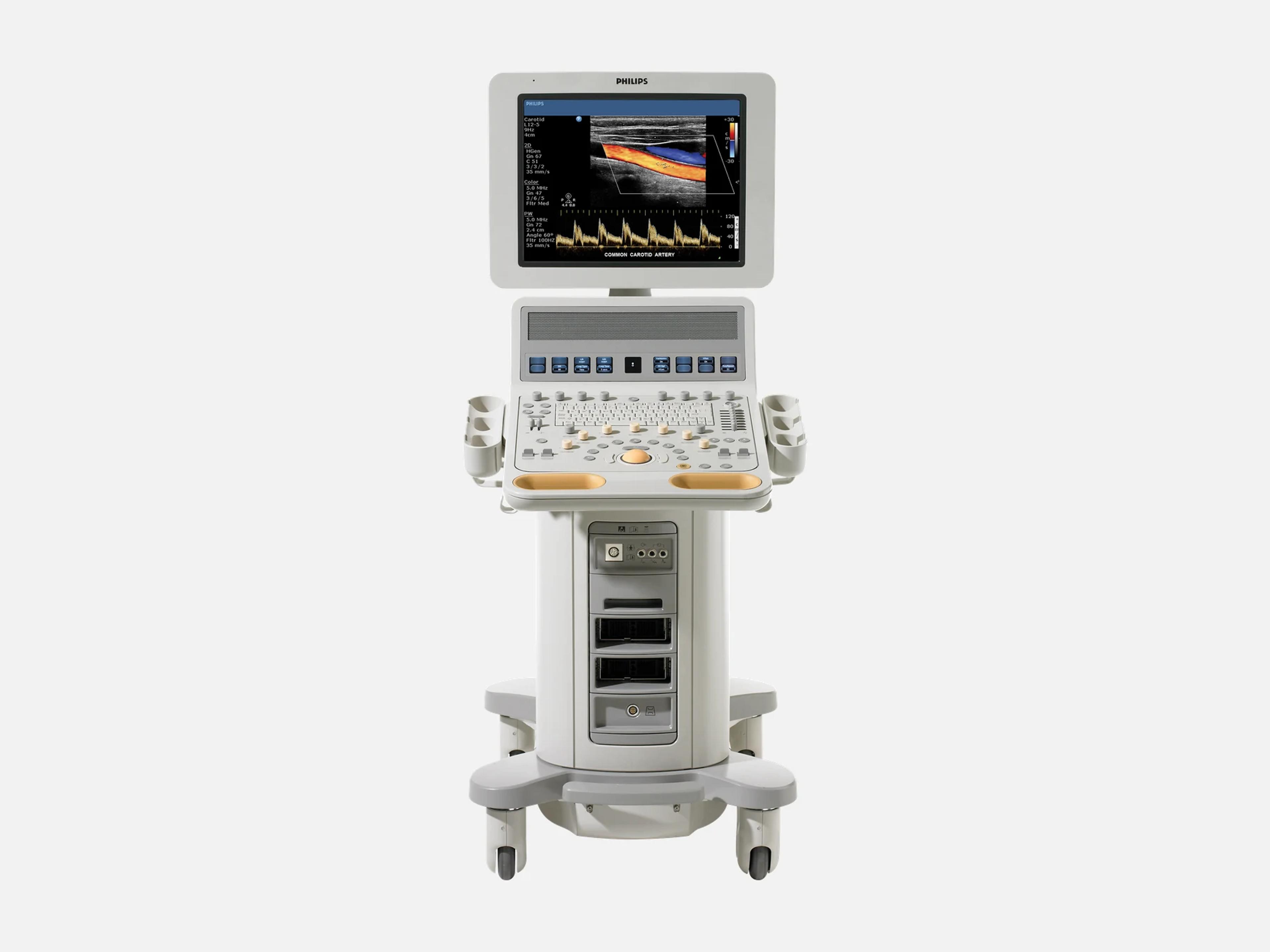
The Philips HD15 is the cart-based flagship of the HD ultrasound family, introduced in 2008 for small hospitals, clinics and private practices. It is used for abdominal, obstetrical and gynecological, cardiac, transesophageal, stress echo, vascular, musculoskeletal and pediatric exams. It shares the gray-scale and Doppler capabilities of the HD11 and supports the C5-1 probe, built on PureWave crystal technology.
- Released
- 2008launched by Philips
- Probe ports
- Up to fourelectronically switched
Compatible probes
Linear
- L12-3
- L12-5 (50 mm)
- L15-7io
Convex & microconvex
- C5-2
- C6-3
- C8-5
Phased
- S5-2
- S8-3
Endocavity
- C8-4v Endovaginal
- 3D9-3v 4D endovaginal
- BP10-5ec
Specialty
- V6-2 Mechanical 3D
- S7-2omni TEE phased array
- D2cwc Non-imaging pencil, CW Doppler
Specifications
Display
- Display
- LCD monitor; 51 cm on the Diamond Select HD15
Physical
- Weight
- 81 kg total; configuration not stated
- Dimensions
- Width 57 cm, height 138–155 cm, depth 110 cm (Diamond Select HD15)
- Probe ports
- Electronic switching of up to four transducers
- Controls
Trackball-centered interface with tri-state lighting; Patient hardkey; one-button iSCANTrackball-centered interface with tri-state lighting; fast transducer switching during exams; one-button iSCAN image optimization; a Patient hardkey that opens patient data entryShow allShow less
- Control panel and monitor
- Height and swivel adjustment
Power & battery
- Internal battery
- Lithium battery on the CPU circuit board
Connectivity & options
- Network
One Ethernet 10/100/1000BaseT RJ-45 port; static addressing or DHCPOne Ethernet 10/100/1000BaseT RJ-45 interface (UTP or STP; auto-detect speed, full or half duplex); static addressing or DHCP (HD15 1.2.x and 1.5.x)Show allShow less
- DICOM
Storage, storage commitment, structured reports, worklist, MPPS, print; each an optionDICOM SCU for Ultrasound Image Storage, Ultrasound Multiframe Image Storage, Storage Commitment Push Model, Comprehensive SR, Modality Worklist, Modality Performed Procedure Step, Basic Grayscale Print Management and Basic Color Print Management, each a purchasable option (HD15 1.2.x; the two print services also on 1.5.x). HD15 3.0.x exports images and structured reports to network storage, CD/DVD and USB, with Modality Worklist and Modality Performed Procedure Step; its network services are purchasable options.Show allShow less
- Structured reports
OB-GYN Ultrasound and Adult Echocardiography procedure reports (HD15 1.2.x)OB-GYN Ultrasound Procedure Report (Template ID 5000) and Adult Echocardiography Procedure Report (Template ID 5200), on HD15 1.2.x softwareShow allShow less
- Removable media
Export to CD-R, DVD and USB; import only from HD15 1.2.x systems on the same versionExport of images and structured reports to CD-R, DVD and USB devices; media import reads only from other HD15 1.2.x systems of the same software versionShow allShow less
- Remote services
Remote desktop, iSSL, online support requests, proactive support, utilization reportsRemote desktop, iSSL technology, online support requests, proactive support and utilization reports; not available in all geographies, and they require service contract coverageShow allShow less
Imaging & software
- Imaging modes
B, M, PWD, CWD, Color Doppler; Duplex, Triplex; Panoramic, CPA, 3D/4D, harmonics, TDI…B, M, PWD, CWD and Color Doppler; combined Duplex (2D + Doppler) and Triplex (2D + Doppler + Color); Panoramic, Color Power Angio (CPA), 3D/4D, Harmonics (Tissue and Contrast), Directional Angio Imaging and Tissue Doppler Imaging. Capabilities vary by transducer.Show allShow less
- Contrast
- Contrast enhanced ultrasound, with tissue and contrast harmonics
- Image processing
SonoCT compounding (up to nine lines of sight), XRES, Microfine EX focusing, iSCANSonoCT real-time compound imaging, merging up to nine lines of sight; XRES and advanced XRES adaptive image processing; Microfine EX focusing (dynamic receive lens tuning); iSCAN one-button optimization in 2D, color and Doppler; Tissue Specific Imaging presets that optimize transducers to the exam typeShow allShow less
- PureWave
- PureWave transducer crystal technology; tissue aberration correction with the C5-1
- Architecture
- High-resolution analog-to-digital conversion and 4X parallel processing
- 3D/4D tools
- 3D Fetal Echo STIC, Live iSlice, Multiplanar Reformatting
- Quantification
QLAB on-cart and off-cart: GI 3DQ, TMQ, Strain Quantification, IMT, ROIQLAB quantification on-cart and off-cart: General imaging 3D Quantification (GI 3DQ), Tissue Motion Quantification (TMQ), Strain Quantification (SQ), Intima Media Thickness (IMT) and Region of Interest (ROI). Off-cart QLAB 7.0 and later reviews and quantifies HD15 1.2.x images.Show allShow less
- Workflow
SmartExam protocols, Live Compare, active native data (settings editable after the exam)SmartExam protocols (customizable on-screen exam guides that enter annotation and build the report); Live Compare (a previous exam displayed beside the active exam); active native data (exam parameters and image settings adjustable after the patient has left)Show allShow less
- Clinical applications
Abdominal; small parts; breast; pediatric; musculoskeletal; OB/GYN; prostate; vascular…Abdominal; small parts and superficial; breast; pediatric; musculoskeletal; obstetrical and gynecological; prostate; vascular; intraoperative vascular; transcranial Doppler; cardiac; transesophageal; stress echo; emergency medicine; critical care; regional anesthesiaShow allShow less
- Revision and software
- Software levels HD15 1.0, R1.1.x, R1.2.x, R1.5.x and R3.0
Compliance
- FDA 510(k)
K081661 (decided 2008-06-24); Class II, product codes IYN, IYO and ITXK081661, HD15 Diagnostic Ultrasound System: received 2008-06-13, decided 2008-06-24 (substantially equivalent); Class II, product codes IYN, IYO and ITXShow allShow less
What to check when buying a used Philips HD15
Check any 3D9-3v against recall Z-2517-2023
Recall Z-2517-2023 covers the 3D9-3v, an HD15 accessory whose bonded housing can come apart, risking tissue damage and, if its built-in safety measures also fail, electric shock.
How: Match the serial number against the recall, get evidence the correction was made, and look for any separation of the bonded housing even on a serial number outside the recall.
Inspect every transducer for cracks and chemical damage
A cracked or damaged transducer must not be used, and one immersed past its specified cleaning or disinfection level carries a risk of electric shock.
How: Look over each housing, lens, cable, strain relief and system connector for cracks, discoloration or other damage, and ask how each transducer was cleaned and disinfected.
Ask whether fluid ever got inside the system
The parts inside cannot be disinfected, so a system contaminated internally with bodily fluids carrying pathogens has to be reported to Philips service and disposed of as biohazardous material.
How: Ask the seller directly about any history of fluid getting into the console.
Check any 3D9-3v against recall Z-2048-2025
Recall Z-2048-2025, still open, covers 3D9-3v transducers that were refurbished beyond their useful life.
How: Have the transducer visually inspected and given an electrical safety test, and turn down one that fails.
Common questions about the Philips HD15
Is the Philips HD15 FDA-cleared?
Yes. The HD15 Diagnostic Ultrasound System is FDA-cleared under 510(k) K081661, decided on June 24, 2008, as a Class II device (product codes IYN, IYO and ITX) for diagnostic ultrasound imaging and fluid flow analysis.
Its predicate device is the HD11 Diagnostic Ultrasound System (K043535, plus K062247), with the same gray-scale and Doppler capabilities as the HD15.
Does the Philips HD15 work with the C5-1 PureWave transducer?
Yes. The C5-1 is an HD15 transducer built on PureWave crystal technology, and an HD15 with that technology and the C5-1 is the Philips HD15 PureWave.
The C5-1 is designed for difficult-to-image patients, including obese patients, and to reduce clutter in abdominal and OB imaging; the HD15 supports tissue aberration correction with it.