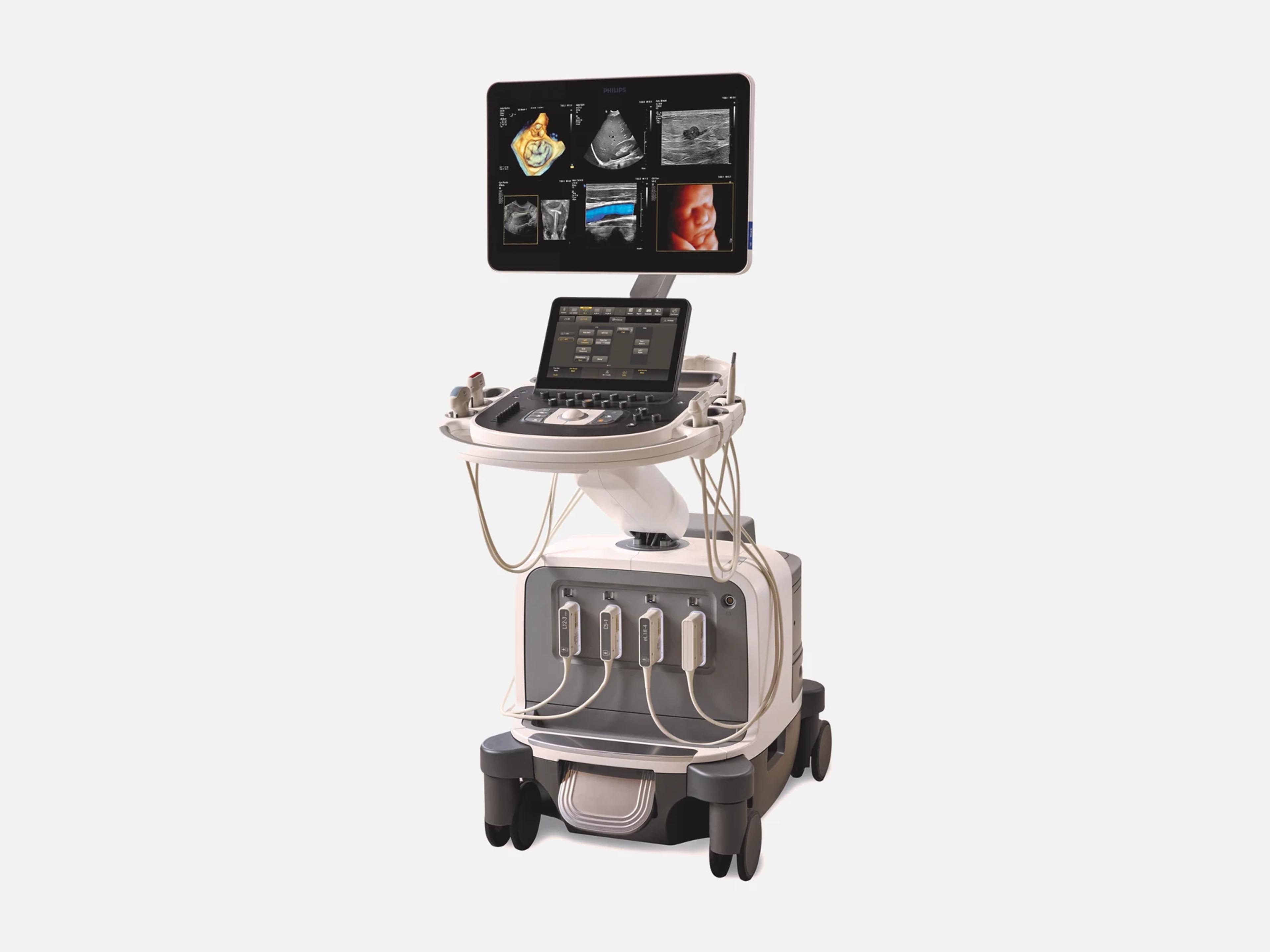
The Philips EPIQ Elite is a premium cart-based ultrasound system, launched for general imaging and for obstetrics and gynecology. It is the EPIQ family's shared-service system beside the EPIQ CVx for cardiology, and shares its interface and transducers with Affiniti. It weighs 104.3 kg (230 lb) without peripherals and has four active transducer ports and a 21.5-inch display or the optional 24-inch HD MAX.
- Released
- 2019launched by Philips
- Probe ports
- 4active transducer ports
- Display
- 21.5-inch24-inch HD MAX optional
- Weight
- 104.3 kg230 lb, no peripherals
Compatible probes
Linear
- eL18-4 PureWave; fusion versions exist
- L12-3
- L12-3ERGO Vascular
- mL26-8 Compact, ultra-high frequency
- XL14-3 xMATRIX; an upgrade path on EPIQ Elite
Convex & microconvex
- C5-1 PureWave
- C9-2 PureWave
- mC12-3 Pediatric
- mC7-2 Small footprint; a fusion version exists
Phased
- S5-1 PureWave; adult echo
Endocavity
- 3D9-3v Endovaginal volume
- C10-3v PureWave endovaginal
- eV14-2v Gynecology and early OB
Specialty
- S7-3t Transesophageal
- S8-3t Transesophageal
- X7-2t xMatrix transesophageal
- X8-2t xMatrix transesophageal
- X11-4t · 4–11 MHz 3D transesophageal; software 11.0 or higher
- D2cwc Non-imaging CW Pedoff
- D2tcd Non-imaging PW Pedoff
- D5cwc Non-imaging CW Pedoff
Specifications
Display
- Monitor
- 21.5-inch TFT/IPS flat panel LED, or the optional 24-inch HD MAX with WLED backlighting
- HD MAX display
24-inch (60.96 cm) HD; meets the ACR display standard for diagnostic brightness24-inch (60.96 cm) HD display that meets the ACR display standard for diagnostic imaging brightness levels, supported by an ergonomic armShow allShow less
- MaxVue
- Full-screen HD viewing at a 16:9 aspect ratio
- Touch screen
- 12-inch full-color capacitive touchscreen with swipe, soft keys and image duplication
Physical
- Weight
- 104.3 kg (230 lb) without peripheral devices
- Dimensions
- Width 60.6 cm (23.9 in), height 146–171.5 cm (57.5–67.5 in), depth 109.2 cm (43 in)
- Probe ports
- Four active transducer ports
- Non-imaging Doppler connector
- Dedicated Pedoff continuous-wave Doppler connector
- Control panel articulation
- 25.4 cm vertical travel, 180° rotation from center, side-to-side sliding
- Controls
Full rotation of panel and monitor (720° of freedom); tablet-like interfaceFull rotation of the control panel and monitor with multiple degrees of articulation (720° of freedom); tablet-like user interface; a lock/unlock button on the system handle locks the control panel swivel; the centralized brake cannot be engaged together with the steering locks.Show allShow less
- Control panel lighting
- Tri-state lighting shows active, available and unavailable controls
- Keyboard
- Retractable, backlit alphanumeric keyboard
- Operating noise
- About 41 dB
Power & battery
- Power
- 100–240 V AC, 50/60 Hz; less than 600 VA depending on configuration
- Annual energy use
- 2052.75 kW/h per year, average use scenario
- Battery
- Extended battery: 60 minutes before recharge, in transport mode
- Sleep mode
- Sleep mode with battery backup; about 30 seconds to boot down or boot up
Connectivity & options
- Network
Ethernet 10/100/1000 (RJ-45); 802.11 g/n/ac wireless, internal or optional adapterWired Ethernet 10/100/1000 (RJ-45) and wireless 802.11 g/n/ac through an optionally provided or internal wireless adapter; the wired network has priority when both are configured.Show allShow less
- DICOM
Worklist, storage, commitment, CD/USB media, print, query/retrieve, procedure reportingDICOM (Release 13.0.x): modality worklist, storage of images and Structured Reports to network storage, storage commitment, storage to CD or USB media, DICOM print, retrieval of stored ultrasound and other-modality images, performed-procedure reporting, and Query/Retrieve from PET, CT, MRI, US and X-ray. On Release 7.0.x, query/retrieve needs the Ultrasound or Multi-Modality Query Retrieve option.Show allShow less
- NetLink
- On Release 7.0.x, Netlink DICOM 3.0 is a purchasable option; DICOM print does not need it
- Secure DICOM
- TLS 1.2: node authentication, encryption, or both
- Video output
- DisplayPort: 1920 × 1080 full screen, or 1024 × 768 for the display area
- ECG input
- One three-lead ECG input
- Security
Security Plus, SafeGuard whitelisting, configurable FIPS, government security optionFive-layer security: firewall, operating system hardening, malware protection, access controls and patient data encryption. Options: Security Plus (three access control levels, LDAP / Active Directory user management, BitLocker 256-bit hard drive encryption, TLS 1.2 secure transmission including Secure DICOM); SafeGuard application whitelisting malware protection; configurable FIPS; a government security option.Show allShow less
- xMATRIX
- An upgrade path on EPIQ Elite; available on EPIQ Elite Advanced
- Biopsy guide
- Verza biopsy guide attaches directly to the transducer (not on all transducers)
- EMI filter
- Optional custom electromagnetic interference filter, a spare part (510(k) K251651)
- Remote service
Collaboration Live, remote desktop support, proactive monitoring, remote upgradesPhilips Collaboration Live tele-ultrasound (talk, text, screen share and video stream for up to six users; contract required; release 7.0.5 or higher, diagnostic use and mobile or browser access from release 9.0, multi-party and system-to-system connect from release 10.0); technical and clinical support by remote desktop; proactive monitoring; assisted remote software delivery; a support request button on the control panel; an on-board utilization tool with per-transducer usage data; the Technology Maximizer upgrade program.Show allShow less
Imaging & software
- Imaging modes
2D, M-mode, color, CPA, PW, CW and tissue Doppler, 3D/4D, MPR, contrast, elastography2D, M-mode, color Doppler, Color Power Angio (CPA), spectral (pulsed wave) Doppler, steerable CW Doppler, tissue Doppler, live 3D/4D, xPlane, Live MPR and MPR, contrast imaging and elastography; availability depends on the transducer and configuration.Show allShow less
- Revision and software
Releases 4.0, 7.0, 9.0–9.02, 10.0, 11.0, 12.0, 13.0 and 14.0; Elevate, Elevate PlusSoftware releases 4.0, 7.0 (7.0.x), 9.0, 9.01 and 9.02, 10.0 (VM10), 11.0, 12.0 (VM 12.0, 12.0.x), 13.0 (13.0.x) and 14.0 (VM14.0); later releases are marketed by name as Elevate (announced February 2025) and Elevate Plus (US 510(k) clearance announced June 2, 2026). No published mapping ties Elevate or Elevate Plus to a version number.Show allShow less
- Operating system
- Windows 10 IoT Enterprise LTSB 2016
- Storage
- Dual terabyte storage with SSD
- Architecture
nSight Plus: multi-stage precision beamformer with massive parallel processingnSight Plus Imaging Architecture (earlier documents: nSIGHT Imaging): a custom multi-stage precision beamformer with massive parallel processing, available on select transducers; coded beamforming.Show allShow less
- Processing channels
- Up to 7,071,744 digital channels with xMatrix; up to 4,718,592 without
- Dynamic range
- 394 dB maximum
- Image processing
SonoCT, xRes, xRes Pro, xRes Pro+, Variable xRes, THI, TAC, Image BoostSonoCT real-time compound imaging with WideSCAN; xRes adaptive image processing, xRes Pro, xRes Pro+ (Elevate Plus, EPIQ Elite only) and Variable xRes; Tissue Harmonic Imaging (THI); tissue aberration correction (TAC); elevation compound imaging; Image Boost; trapezoid imaging with true trapezoid color on the mL26-8; panoramic and 3D panoramic imaging.Show allShow less
- Image optimization
iSCAN, AutoSCAN, iOPTIMIZE, Next Gen Auto Scan, Auto Doppler, High Q Auto DoppleriSCAN, AutoSCAN continuous optimization and iOPTIMIZE; Next Gen Auto Scan adaptive pixel-by-pixel brightness; Auto Doppler sensitivity and resolution adjustment; High Q automatic Doppler analysis; Auto Flow Tracking angle correction that moves with the sample volume.Show allShow less
- Flow imaging
- MicroFlow Imaging (MFI) and MFI HD, Flow Viewer, vessel cast 3D imaging, MVI
- Contrast (CEUS)
CEUS AutoScan, CEUS MFI, Super Resolution MVI and MVI Pro, Time of Arrival mapsContrast-enhanced ultrasound (CEUS) with CEUS AutoScan (adaptive gain at each pixel and frame), CEUS MicroFlow Imaging, Super Resolution MVI with Time of Arrival, and Super Resolution MVI Pro with Time of Arrival and Time to Peak maps.Show allShow less
- Elastography
Strain, ElastPQ, ElastQ Imaging with confidence map, Auto ElastQStrain elastography (qualitative relative stiffness), ElastPQ and ElastQ Imaging shear wave with a confidence map, for curved and linear arrays; Auto ElastQ automates frame selection and ROI placement for liver shear wave measurements (software 12.0, with the ElastQ package).Show allShow less
- Liver fat
- Liver Fat Quantification (LFQ) with a hepatorenal index
- 3D/4D
TrueVue, TrueVue Pro, GlassVue, FlexVue, iSlice, iCrop, QuickVue, MultiVue, STIC, iSTICTrueVue and TrueVue Pro rendering with virtual light sources; GlassVue; FlexVue with Orthogonal View and Tissue Emphasis Control (X6-1, 3D9-3v, V6-2 and V9-2); iSlice; iCrop; QuickVue; MultiVue; Auto View; TouchVue and MPR Touch gesture control; STIC and iSTIC.Show allShow less
- Obstetrics
aBiometry Assist A.I., aBiometry Assist, Biometry Assist, aReveal A.I., 3D Auto EditaBiometry Assist A.I. (automatic calculations for common OB measurements), aBiometry Assist, Biometry Assist (preplaced cursors for fetal age and growth), aReveal A.I. (one-touch fetal face reveal) and 3D Auto Edit (sculpts data away from the fetal face).Show allShow less
- Cardiac quantification
Heart Model, Dynamic Heart Model, Auto Strain LV/RV/LA, 3DQ, 3D Auto MV, stress echoHeart Model and Dynamic Heart Model; Auto Strain LV (with automated EF and mid-layer strain), Auto Strain RV and Auto Strain LA; a2DQ and a2DQ LA; aCMQ; CMQ Stress; 3DQ and 3DQ Advanced; 3D Auto MV, 3D Auto RV and 3D Auto LAA; 3D Auto TV and 3D Auto CFQ (software 11.0 or higher); Mitral Valve Navigator; Automated 3D Color Flow Analysis for MR quantification; stress echo; iRotate echo with the X5-1, X5-1c, X7-2, X7-2t and X8-2t.Show allShow less
- Cardiac automation
2D Auto LV, 2D Auto EF Advanced, 3D markers (EPIQ Elite only), Smart View Select2D Auto LV, 2D Auto EF Advanced and 3D markers (EPIQ Elite only); 2D Auto EF, 2D Auto Measure, 2D Auto Cine, Color Auto Cine and CV Doppler; Auto Segmental Wall Motion Scoring in a 17-segment bullseye; Smart View Select and Smart Doppler View ID (software 11.0 or higher); SVS v2, SVS v2 Contrast, SWM v2 and Auto EF with contrast (software 13.0 or higher); Quad View and Quad View AFI.Show allShow less
- General imaging quantification
Auto Measure, Auto Measure Abdomen, AAA Model, GI 3DQ, IMT, ROI and SQ, QLABAuto Measure; AI-powered Auto Measure Abdomen (C5-1 and C9-2 only, software 14.0 or higher); Abdominal Aortic Aneurysm (AAA) Model for native and post-EVAR AAAs; General Imaging 3D Quantification (GI 3DQ); Intima Media Thickness (IMT); Region of Interest (ROI) Quantification; Strain Quantification (SQ); QLAB quantification software.Show allShow less
- Breast and thyroid
AI Breast; Koios DS decision support for BI-RADS and TI-RADS (software 14.0 or higher)Anatomical Intelligence for Breast (AI Breast): mapping of scanned breast anatomy and coverage documentation. Koios AI-based decision support for breast lesion (BI-RADS) and thyroid nodule (TI-RADS) classification, on-cart or off-cart, with Smart Calipers off-cart; Koios DS 3.7.1 integration on software 14.0 or higher.Show allShow less
- Interventional
Needle visualization and tracker, image fusion, Auto Registration, ablation planningNeedle visualization (one-button with the eL18-4 from Release 4.0, in 2D and CPA/Color); adaptive needle tracker; image fusion with Auto Registration and user-assisted co-registration of CT or MR volumes; CT-only workflow; continuous patient tracking; Live Compare; tumor contour; user-assisted ablation planning; interventional navigation and planning software.Show allShow less
- Workflow
SmartExam, Image Reorder, Quick Launch, QuickSAVE, cineloop review, report templatesSmartExam customizable system-guided protocols with Image Reorder; Quick Launch touchscreen presets; QuickSAVE; cineloop review; advanced reporting with customizable report templates; post-processing controls including gain (Elevate Plus); active native data; an on-cart transducer test that needs no phantom.Show allShow less
Compliance
- FDA 510(k)
K260680 (2026-05-27), K260123, K251651, K250177, K242020, K233545, K182857 (2018-11-09)K260680 (decided 2026-05-27; includes EPIQ Elite for Koios DS integration); K260123 (2026; cleared the eV14-2v on the EPIQ Series); K251651 (custom EMI filter); K250177 and K242020 (on the EPIQ Elite device record); K233545 (names EPIQ Elite among the EPIQ platform systems); K182857 (decided 2018-11-09; linked to EPIQ Elite on recall records, listed under EPIQ family names). Class II, 21 CFR 892.1550. The Elevate Plus release was announced as US 510(k)-cleared on June 2, 2026, with no published K-number.Show allShow less
- Model number
- EPIQ Elite Diagnostic Ultrasound System, model 795234
- MR safety
- MR Unsafe
What to check when buying a used Philips EPIQ Elite
Test the control panel swivel lock
On units manufactured from February 27, 2020 to May 25, 2021, recall Z-2306-2021 found the swivel lock could fail and let the control panel and monitor swivel freely.
How: With the brake engaged, confirm the lock button on the system handle is not lit and the panel does not rotate when pushed by the handle, then ask for the correction record.
Check the control panel arm screws
Recall Z-0947-2021 found EPIQ Elite control panel arms with missing or loose screws, and a mechanism that could fail and break off under undue force.
How: Confirm every screw at the arm base is present and tight, and ask for the correction record for the unit's serial number.
Run an electrical leakage test on each transducer
FDA reports on EPIQ Elite systems describe an L12-3 that gave a patient a light shock and a C10-3v that failed its leakage test.
How: Have a biomed test every transducer offered, and check any C10-3v lens for holes, tears or exposed metal.
Inspect any 3D9-3v housing seam and lens
Recall Z-2517-2023 covered 3D9-3v transducers whose two bonded chassis parts could separate, and FDA reports describe lens slits leaking oil.
How: Look for separation at the housing seam and for slits or oil on the lens, and check the serial number against the recall.
Common questions about the Philips EPIQ Elite
Is the Philips EPIQ Elite FDA-cleared?
Yes. The EPIQ Elite is FDA-cleared as one of the marketing names of the Philips EPIQ Series Diagnostic Ultrasound System, a Class II device under 21 CFR 892.1550. The EPIQ Elite's FDA device record for model 795234 lists 510(k)s K242020, K250177 and K251651.
K260680, decided on May 27, 2026, includes the EPIQ Elite among the systems supported for Koios DS integration. The Elevate Plus software release was announced as US 510(k)-cleared on June 2, 2026.
What is the difference between the EPIQ Elite and the EPIQ CVx?
The EPIQ Elite is the EPIQ family's shared-service system, with a flat panel LED monitor and an optional HD MAX display; the EPIQ CVx is the family's cardiology system, with a flat panel OLED monitor.
How is the EPIQ Elite different from Affiniti?
HD MAX, xRes Pro+, 2D Auto LV, 2D Auto EF Advanced and 3D markers are EPIQ Elite only. The EPIQ Elite and Affiniti share a workflow, user interface and transducers, and those transducers are also compatible with the Compact Ultrasound 5000 Series.
What is the difference between the EPIQ Elite and EPIQ Elite Advanced?
xMATRIX. It is available on the EPIQ Elite Advanced and is an upgrade path on the EPIQ Elite; the XL14-3 linear array is one of its xMATRIX transducers.
Is Elevate Plus the same as EPIQ Elite software 14.0?
Not as published. EPIQ Elite software is labeled by release number, up to 14.0 (VM14.0), and the later releases are marketed by name as Elevate (2025) and Elevate Plus (2026), with no version number attached to either.