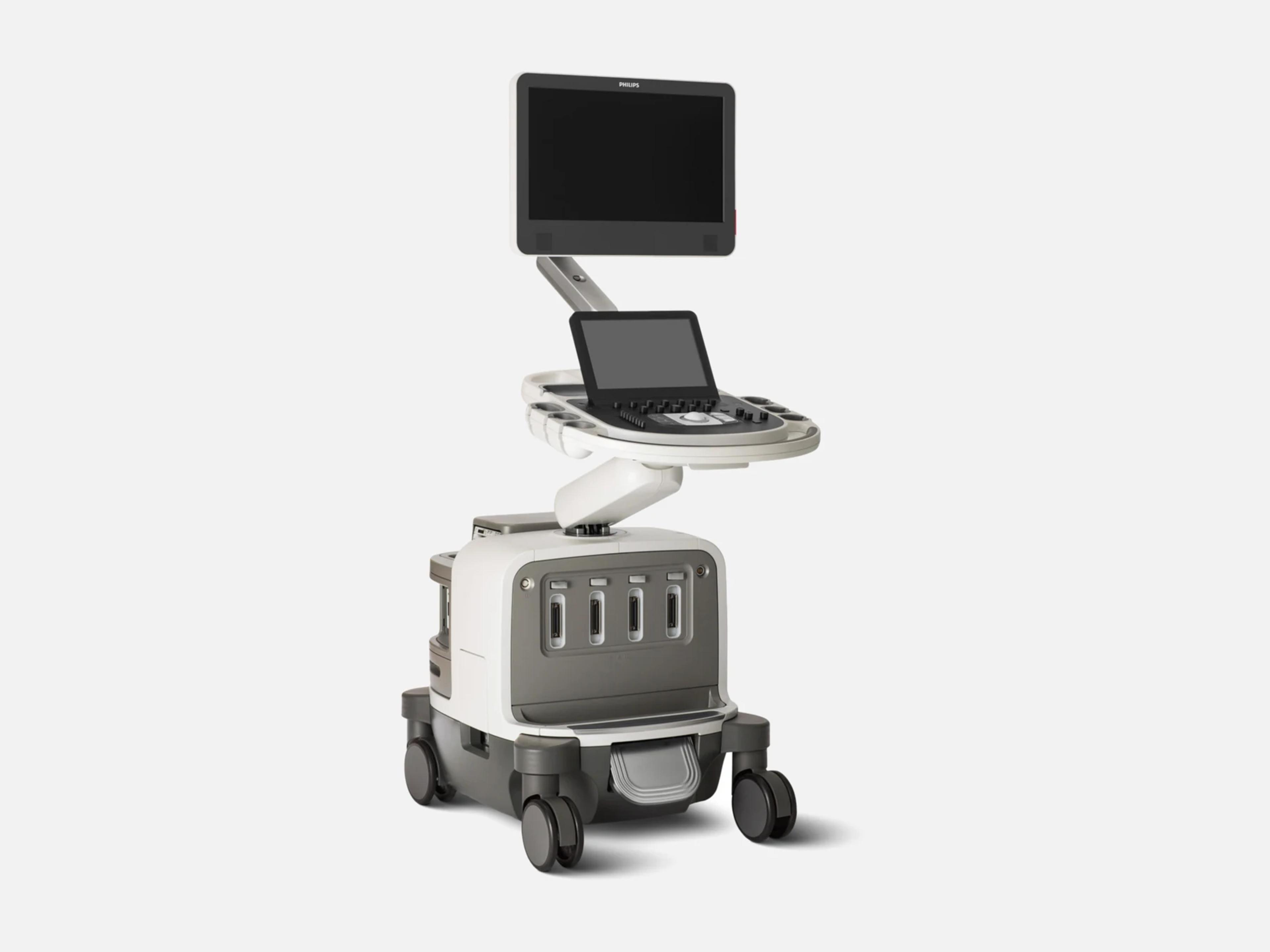
The Philips EPIQ CVx is a cardiology ultrasound system built on the EPIQ platform for diagnostic, pediatric and interventional echocardiography. It also serves fetal, transesophageal and stress echocardiography, and vascular, surgical and interventional imaging. Philips introduced it in 2018 with the EPIQ CVxi, built for the interventional lab; the Affiniti CVx shares its platform and transducers.
- Released
- 2018launched by Philips
- Probe ports
- 4universal connectors
- Display
- 54.9 cm OLED21.6 in; also LCD options
- Weight
- 104.3 kg230 lb, without peripherals
Compatible probes
Linear
- L12-3 · 3–12 MHz
- L12-5 50 · 5–12 MHz
- L15-7io · 7–15 MHz
- L18-5 · 5–18 MHz
- eL18-4
- eL18-4 EM
- XL14-3 · 3–14 MHz xMATRIX
Convex & microconvex
- C5-1 · 1–5 MHz
- C8-5 · 5–8 MHz
- C9-2 · 2–9 MHz
Phased
- S5-1 · 1–5 MHz
- S8-3 · 3–8 MHz
- S9-2 · 2–9 MHz
- S12-4 · 4–12 MHz
- X5-1 · 1–5 MHz xMATRIX
- X5-1c · 1–5 MHz xMATRIX
- X6-1 · 1–6 MHz xMATRIX
- X7-2 · 2–7 MHz xMATRIX
Specialty
- S7-3t · 3–7 MHz Transesophageal
- S8-3t · 3–8 MHz Transesophageal
- X7-2t · 2–7 MHz xMATRIX transesophageal
- X8-2t · 2–8 MHz xMATRIX transesophageal
- X11-4t · 4–11 MHz Mini 3D TEE; software 11.0 or higher
- D2cwc · 2–2 MHz Pedoff CW Doppler
- D2tcd · 2–2 MHz Pedoff PW Doppler
- D5cwc · 5–5 MHz Pedoff CW Doppler
- VeriSight Pro 3D intracardiac catheter
- VeriSight ICE Catheter Intracardiac catheter
Specifications
Display
- Monitor
- 54.9 cm (21.6 in) wide-format OLED on a fully articulating extension arm
- Monitor options
- LCD Pro 61 cm, OLED 54.9 cm or LCD 54.6 cm
- OLED brightness and color
235 cd/m² max luminance; contrast >22,550:1; 108% Adobe RGB; >178° viewing angleOLED monitor: maximum luminance 235 cd/m²; contrast ratio >22,550:1; color gamut 108% Adobe RGB, >1 billion colors; >178° viewing angle up/down and left/rightShow allShow less
- Touch screen
12-inch full-color capacitive; swipe, zoom, pan and rotate; user-configurableFull-color 12-inch capacitive touch screen with swipe, zoom, pan and rotate; user-configurable control layout; workflow controls (Patient, Review, Report, End Exam, Help) always present; touch-screen alphanumeric keyboardShow allShow less
- Image on touch screen
- Acquired image can stay on the touch screen when the monitor faces another clinician
Physical
- Weight
- 104.3 kg (230 lb) without peripheral devices
- Dimensions
- Width 60.6 cm (23.9 in); depth 109.2 cm (43 in); height 146–171.5 cm (57.5–67.5 in)
- Cart and mobility
Shock-absorbing casters with foot-pedal swivel, swivel-lock and brake controlsShock-absorbing casters with foot-pedal controls for 4-wheel swivel, 2-wheel swivel lock and 2-wheel brakes; integrated footrests; illuminated transducer connector and OEM bay; transducer and gel bottle holders; three high-capacity fans with automatic speed adjustment; monitor folds down to reduce height for transportShow allShow less
- Monitor articulation
Four-way; 87.6 cm (34.5 in) lateral and 17.8 cm (7 in) vertical rangeFour-way articulation: 87.6 cm (34.5 in) lateral and 17.8 cm (7 in) vertical adjustment range; monitor and control panel height adjust independentlyShow allShow less
- Control panel
- Moves up and down 25.4 cm (10 in) and rotates 180° from center
- Controls
Eight-slide TGC, iSCAN, two programmable acquire controls, pull-out backlit keyboardGraphical user interface with a reduced number of hard controls; primary controls clustered around the trackball; tri-state control lighting (active, available, unavailable); eight-slide TGC; iSCAN control; two programmable acquire controls; pull-out backlit alphanumeric keyboardShow allShow less
- Transducer ports
- Four universal, electronically switched; a dedicated CW (Pedoff) connector is available
Power & battery
- Power
- 100–240 V, 50/60 Hz; <600 VA depending on configuration; built-in AC line conditioner
- Battery
Battery back-up; transport mode with an extended battery of 60 minutes before rechargeIntegrated AC line conditioning and battery back-up; two levels of transport mode, with an extended battery of 60 minutes before recharge; the control panel runs on battery for adjustment during mobile exams; battery charging draws 24 WShow allShow less
- Boot time
- About 150 s from off; about 20 s from sleep (transport) mode
- Energy use
- On 554 W; ready to scan/standby 230 W; off 6 W; 2052.75 kWh per year
Connectivity & options
- Network
- Wired gigabit Ethernet; 2x2 802.11ac Wave 2 wireless, 2.4 and 5 GHz
- Wireless DICOM
- Sends studies to a reading station or PACS while the system is mobile
- DICOM
Worklist, MPPS, storage commitment, query/retrieve, print, up to 5 storage SCPs at onceModality Worklist, MPPS, storage commitment, query/retrieve (study-root), DICOM grayscale or color print, send to up to 5 storage SCPs concurrently, DICOM image and structured report export to removable media; USB storage. NetLink is a purchasable option; DICOM printing needs no option; query/retrieve needs the Ultrasound Query Retrieve or Multi-Modality Query Retrieve optionShow allShow less
- Inputs and outputs
Display port video, 1080p; USB and RS-232 data export; DVD drive if equippedDisplay port video export at full-screen 1920x1080 (1080p) or display area 1024x768; USB export of measurement and analysis data to off-line reporting software; RS-232 serial export of report data; transducer connector ports, USB and DVD media drive (if equipped) on the cartShow allShow less
- Peripherals
Up to two on-board devices, excluding report printersUp to two on-board peripheral devices, excluding report printers: DVD recorder (cart-dependent), small-format USB digital color printer; external large-format color printer supportedShow allShow less
- ECG
- One three-lead ECG input; automatic heart rate calculation and display
- Options
NetLink, Collaboration Live, SafeGuard, Security Plus and Government security optionsNetLink connectivity (standard on premium and high end); Collaboration Live; Government security; SafeGuard security; Security Plus; configurable Federal Information Processing Standard (FIPS) selectionShow allShow less
- Collaboration Live
Requires a contract and release 7.0.5 or higher; some functions need 9.0 or 10.0Requires a contract and release 7.0.5 or higher; diagnostic use and remote access by mobile device or browser require release 9.0 or higher; multi-party and system-to-system connections require release 10.0 or higherShow allShow less
Imaging & software
- Revision and software
Releases 5.0, 7.0, 7.0.5, 9.0, 10.0, 11.0, 12.0.x and VM14.0; Transcend PlusNamed releases: 5.0 (2019); 7.0 (2020); 7.0.5, 9.0 and 10.0 (minimums for Collaboration Live functions); 10.0.X; the VM11.0 update; 11.0 or higher for the X11-4t, 3D Auto TV and 3D Auto CFQ; 12.0.x; VM14.0; DICOM SR at v3.x and higher. Transcend Plus (announced August 27, 2025) is a marketing release name, not equated with a numbered releaseShow allShow less
- Operating system
- Windows 10 IoT Enterprise LTSB 2016
- Clinical applications
Adult, pediatric, fetal, TEE and stress echo; vascular; surgical and interventionalEchocardiography (adult, pediatric, fetal); transesophageal echocardiography (adult and pediatric); stress echocardiography; vascular (peripheral, cerebrovascular, temporal TCD and abdominal); abdominal vascular; surgical imaging; interventional imaging; perioperative; epicardial echocardiographyShow allShow less
- Imaging modes
2D, M-mode, PW, CW and color Doppler, TDI, Live 3D, Live xPlane, iRotate, contrast, MFI2D/B-mode; Hyper2D Imaging for xMATRIX; M-mode, M-mode color Doppler, M-mode tissue Doppler and Anatomical M-mode; Live 3D Echo; 3D imaging with color Doppler; Live xPlane; xPlane Doppler with the X8-2t; Tissue Harmonic Imaging (THI); Color Power Angio (CPA) and directional CPA; MicroFlow Imaging (MFI) and MFI-HD on eL18-4 and C5-1; MicroCPA; Color Compare mode; pulsed-wave Doppler with high PRF; steerable CW Doppler; color Doppler; Tissue Doppler Imaging (TDI); independent triplex; contrast echo (low MI, mid MI, LVO) and general-imaging contrast; 3D contrast on X5-1 and X5-1c; iRotate echo (X5-1, X5-1c, X7-2, X7-2t, X8-2t); 3D panoramic imaging. Availability depends on the transducer and configurationShow allShow less
- Imaging formats
WideSCAN, trapezoid and virtual apex sector; Dual Volume; MaxVue 16:9 full screen2D linear and curved WideSCAN with SonoCT; 2D linear trapezoid with SonoCT; 2D virtual apex sector; Dual Volume for full volume, 3D Zoom and iCrop; MaxVue full-screen 16:9 high-definition display formatShow allShow less
- Image processing
nSIGHT Plus architecture; SonoCT; XRES and Variable XRES; Image Boost; iSCAN; AutoSCANnSIGHT Plus imaging architecture (introduced for EPIQ CVx in December 2021); SonoCT real-time compound imaging; XRES and Variable XRES (adjustable noise reduction); Image Boost; iSCAN intelligent scanning; AutoSCAN with adaptive gain compensation (AGC), which adjusts image parameters including gain; iOPTIMIZE intelligent image optimization; coded beamforming; adaptive broadband flow imagingShow allShow less
- Digital channels
- Up to 7,071,744 (xMATRIX configuration) or 4,718,592 (non-xMATRIX)
- Dynamic range
- 320 dB maximum
- Transducer frequencies
- Up to 20 MHz
- Imaging depth
- 1.0 to 40 cm, depending on transducer, exam and system configuration
- Automation and AI
Auto Measure; AutoStrain LV, LA and RV; 2D Auto EF and 2D Auto EF AdvancedAuto Measure (automated Doppler, ventricular-length and 2D PLAX measurements); AutoStrain LV with automated EF and mid-layer strain; AutoStrain LA; AutoStrain RV; 2D Auto EF (non-contrast) and 2D Auto EF Advanced (contrast and non-contrast); Smart View Select; Smart (Doppler) View ID; Auto Doppler for vascular Doppler optimization; Recall SettingsShow allShow less
- 3D quantification
3D Auto MV, 3D Auto RV, 3D Auto LAA, 3D Auto TV, 3D Auto CFQ, Dynamic HeartModel3D Auto MV (mitral valve); 3D Auto RV (right-ventricular segmentation, border identification and view alignment); 3D Auto LAA (left atrial appendage); 3D Auto TV (tricuspid valve) and 3D Auto CFQ (mitral regurgitation volume and peak flow rate from 3D color flow), both requiring software 11.0 or higher; HeartModel and Dynamic HeartModel (LV and LA function from the same cardiac cycle)Show allShow less
- QLAB quantification
3DQ, 3DQ Advanced, GI 3DQ, Mitral Valve Navigator, a2DQ, aCMQ, CMQ Stress, IMT, SQCardiac 3D Quantification (3DQ); 3DQ Advanced; General Imaging 3DQ (GI 3DQ); Mitral Valve Navigator (MVN); a2DQ and a2DQ LA; aCMQ; CMQ Stress; Intima Media Thickness (IMT); Region of Interest (ROI) Quantification; Strain Quantification (SQ); HeartModel; High Q automatic Doppler analysisShow allShow less
- 3D rendering and review
Cardiac TrueVue, TrueVue Color, Cardiac TrueVue Glass, MultiVue, iSlice, AutoVueCardiac TrueVue, TrueVue Color and Cardiac TrueVue Glass rendering; MultiVue/Multislice live MPR alignment; iSlice automated 3D cropping into four MPR views; AutoVue standardized cardiac views in Live 3D; QuickVue cropping of Live 3D data in review or interventional imaging; TouchVue handling of 3D datasets on the touch screenShow allShow less
- Workflow
SmartExam protocols, QuickSAVE, stress echo with up to 10 stagesSmartExam protocols (stress echo, echo, abdominal, OB, vascular); QuickSAVE; stress echo with up to 10 stages and forty views per stage by five modesShow allShow less
- Presets
- EchoPEN for technically difficult patients; coronary setting for sector transducers
- Internal storage
1 TB plus 240 GB SSD on three drives; approximately 350 patient examsThree hard drives, 1 TB plus 240 GB SSD; combined 1 TB storage capacity, approximately 350 patient exams (assuming 40 images, 6 seconds of clips and reports per exam)Show allShow less
Environment
- Acoustic noise
- 37–41 dB in operation
Compliance
- FDA 510(k)
K182857 (11/9/2018), K202216 (9/2/2020), K233545 (11/30/2023), K240980 (10/7/2024)K182857 (November 9, 2018); K202216, EPIQ Series Diagnostic Ultrasound Systems (September 2, 2020; Class II, 21 CFR 892.1550; product codes IYN, IYO, ITX, OBJ); K233545 (November 30, 2023; the X11-4t on software 11.0 or higher); K240980 (October 7, 2024; 3D Auto TV and 3D Auto CFQ); K233788, K240850 and K251651 (listed for the Circular Edition VM11.0 update)Show allShow less
- Electrical safety
IEC 60601-1, 60601-1-2 (EMC), 60601-2-37; CAN/CSA 22.2 No. 60601-1; ANSI/AAMI ES60601-1IEC 60601-1; IEC 60601-1-2 (EMC); IEC 60601-2-37; CAN/CSA 22.2 No. 60601-1; ANSI/AAMI ES60601-1; EN60601-2-37 (EU only)Show allShow less
What to check when buying a used Philips EPIQ CVx
Confirm the control panel arm is fully secured
A recall named the EPIQ CVx for missing or loose screws at the base of the control panel arm, and one panel came off during transport.
How: Check the unit's serial against the recall's affected list, ask for the correction record, and look for missing or loose screws at the arm's base.
Test that the control panel swivel lock holds
A recall covers EPIQ CVx units built in a set date window whose control panel arm swivel lock could fail, letting the panel and monitor swing freely as the system is moved.
How: Ask for the correction record, engage the brake, confirm the lock button on the handle is not lit, and try to rotate the panel by the handle: a locked arm does not turn.
Check the monitor's mount on its arm
One EPIQ CVx monitor came off its articulation arm when misaligned screw threads sheared, and a tab-and-slot mount was added in January 2019.
How: On units built before January 2019, grip the monitor, move it through the arm's travel, and look for play or movement where it meets the arm.
Run electrical safety tests on system and probes
A patient reported a shock sensation from an X5-1c used with an EPIQ CVx, and a stand-alone leakage tester only indicates leakage on a TEE probe.
How: Have the system, each transducer and the ECG leads safety-tested, run each TEE probe's full safety test with this system, and reject any probe that fails.
Common questions about the Philips EPIQ CVx
Is the Philips EPIQ CVx FDA-cleared?
Yes. The EPIQ CVx and EPIQ CVxi had FDA 510(k) clearance when they launched in August 2018. The EPIQ 7C, CVx and CVxi series are cleared under K202216 (September 2, 2020), and K182857 (November 9, 2018) is also on the system's record.
Later clearances cover additions: K233545 (November 30, 2023) for the X11-4t mini 3D TEE on software 11.0 or higher, and K240980 (October 7, 2024) for 3D Auto TV and 3D Auto CFQ.
What is the difference between the Philips EPIQ CVx and EPIQ CVxi?
The EPIQ CVxi is tailored to the interventional (cath) lab, with a single-cable connection for full lab integration and EchoNavigator R3 control.
Philips introduced both in 2018. With Release 5.0 in 2019 the EPIQ CVxi gained diagnostic capabilities, so it can also work in the echo lab.
Do the EPIQ CVx and Affiniti CVx share transducers?
Yes. The EPIQ CVx and the Affiniti CVx share transducers, TEE transducers included. The Affiniti CVx launched in 2020 on the common platform first introduced with the EPIQ CVx.
How is the EPIQ CVx different from the EPIQ Elite?
The EPIQ CVx is the EPIQ family's cardiology system, listed in its Cardiology segment, while the EPIQ Elite sits in the Shared Service segment and is optimized for general imaging.
Both belong to the EPIQ platform, which also includes the EPIQ CVxi, EPIQ Elite Advanced, EPIQ 7 and EPIQ 5.
What is Transcend Plus on the EPIQ CVx?
Transcend Plus, announced on August 27, 2025, is a Philips release for the EPIQ CVx and Affiniti CVx. Its 510(k)-cleared additions include 2D Auto EF and 2D Auto EF Advanced.
It is a marketing release name, not equated with a numbered software release.