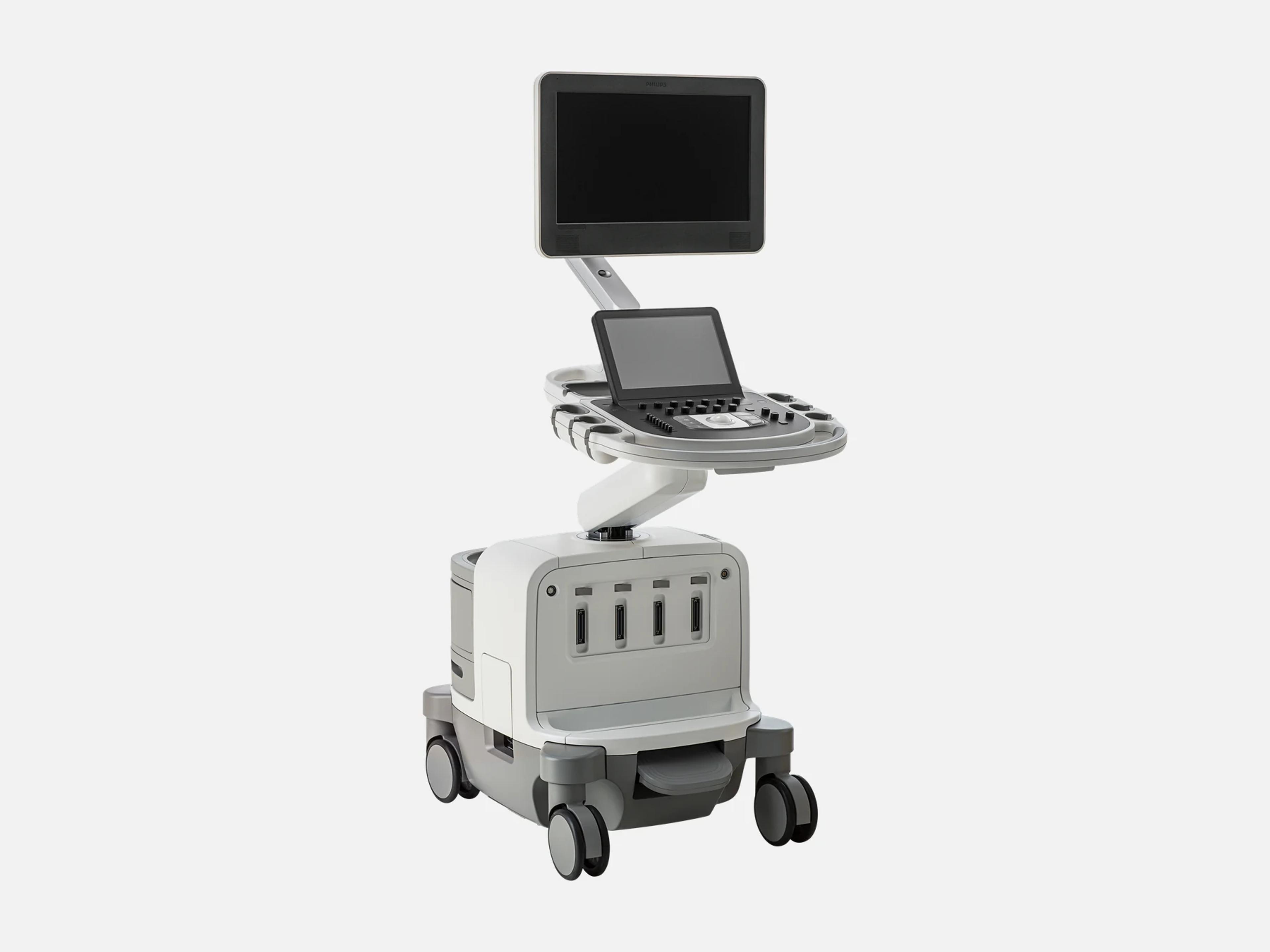
The Philips EPIQ 5 is a premium ultrasound system for women's health, vascular, general imaging and cardiology practices, with a 21.5-inch LCD monitor and four transducer ports. It comes as the EPIQ 5G for general imaging, shared service and radiology, the EPIQ 5C for cardiology and the EPIQ 5W for women's healthcare. Its EPIQ siblings include the EPIQ 7, EPIQ CVx and EPIQ Elite.
- Released
- 2013first FDA clearance
- Probe ports
- 4with ambient lighting
- Display
- 21.5-inchwide-screen LCD, 54.6 cm
- Weight
- 104.3 kg230 lb
Compatible probes
Linear
- L12-3
- L12-5 Fusion and navigation
- L12-5 50
- L15-7io
- L18-5
- eL18-4
- VL13-5 Used with the VPQ Q-App
- XL14-3 After the xMATRIX upgrade
Convex & microconvex
- C5-1 PureWave
- C8-5
- C9-2 PureWave
- mC7-2
- V6-2
- V9-2
- X6-1 After the xMATRIX upgrade
Phased
- S5-1 PureWave
- S8-3
- X5-1 After the xMATRIX upgrade
Endocavity
- C10-3v PureWave
- C10-4ec Prostate fusion and navigation
- 3D9-3v
Specialty
- X7-2t Transesophageal, 2D only, subject to an upgrade
- X8-2t After the xMATRIX upgrade
- S7-3t Transesophageal
- D2cwc
- D2tcd
- D5cwc
Specifications
Display
- Display
- 21.5-inch (54.6 cm) wide-screen LCD monitor
- MaxVue
- High-definition display mode
Physical
- Weight
- 104.3 kg (230 lb)
- Dimensions
- Width 60.6 cm; height 146–171.5 cm; depth 109.2 cm
- Probe ports
- Four transducer ports, with ambient lighting
- Control panel
- 180 degrees of movement; 25.4 cm height adjustment
- Controls
Tablet-like touch interface; control panel and monitor articulate (720° of freedom)Tablet-like touch interface; the control panel and LCD monitor both articulate, with 720° of freedom for use sitting or standing; the monitor folds down for transport.Show allShow less
- Transport
Sleep mode for moving; fold-down monitor; integrated cable hooks and catch traySleep mode for moving the system; the monitor folds down to reduce system height for transport; integrated cable hooks and catch tray.Show allShow less
Power & battery
- Power
- 100–240 V, 50/60 Hz, 600 VA
- Power consumption
- 25% less than Philips's legacy premium ultrasound (comparative, not a rating)
Connectivity & options
- DICOM
Worklist, MPPS, image and SR storage, storage commitment, query/retrieve, printDICOM worklist, MPPS, image and structured-report storage to the network, storage commitment, query/retrieve, DICOM print and export to CD/DVD/USB; DICOM networking is the purchasable Netlink DICOM 3.0 option, and printing needs no option.Show allShow less
- Network
Ethernet 10/100/1000 BaseT RJ-45; wireless 802.11 g/n through an optional adapterEthernet 10/100/1000 BaseT RJ-45; wireless 802.11 g/n only through an optionally provided adapter; Wireless DICOM, with availability varying by geography; IPv4 and IPv6 (Release 1.7.x).Show allShow less
- Multimodality Query Retrieve
View and compare DICOM images from other modalities; needs a Query Retrieve optionView and compare DICOM images from other modalities; needs the Ultrasound Query Retrieve or the Multi-Modality Query Retrieve option.Show allShow less
- Remote services
Remote desktop, iSSL, online support requests, utilization reports, proactive monitoringRemote desktop, iSSL technology, online support requests, utilization reports and proactive monitoring; availability varies by geography.Show allShow less
- xMATRIX
- Available as an upgrade path
Imaging & software
- Configurations
EPIQ 5G (general imaging, radiology), 5C (cardiology), 5W (women's healthcare)EPIQ 5G (general imaging, shared service and radiology), EPIQ 5C (cardiology) and EPIQ 5W (women's healthcare).Show allShow less
- Revision and software
Releases 1.0.x.x through 13.0.x; software 11.0 or higher in the K240980 clearanceNamed releases: 1.0.x.x, 1.1.x, 1.2.x.x, 1.4.x.x, 1.5.x.x, 1.7.x, 1.8.x, 2.0.x, 3.0.x, 4.0.x, 5.0.x (5.0, 5.0.1, 5.0.2), 6.0.x, 7.0.x, 9.0.x, 10.0.x, 11.0.x, 12.0.x and 13.0.x, the releases from 6.0.x on being EPIQ family releases whose scope includes EPIQ 5. 510(k) K240980 lists EPIQ 5 among the EPIQ models running software 11.0 or higher. Not a complete release or patch history.Show allShow less
- Imaging modes
B, M, PW/CW and color Doppler, Color Power Angio, harmonic, contrast, 3D/4D imagingB-mode, M-mode, Anatomical M-mode, PW Doppler, CW Doppler, color Doppler, Color Power Angio, Tissue Doppler PW and tissue Doppler, harmonic imaging, contrast imaging, 2D, 3D and 4D imaging, elastography, panoramic imaging and combined modes; availability varies by transducer and application.Show allShow less
- nSIGHT Imaging
- Multi-stage precision beamformer with massive parallel processing
- PureWave
- Supports PureWave crystal transducer technology
- Transducer frequency range
- 1.0–18.0 MHz across the EPIQ series (510(k) K182857)
- Image processing
- SonoCT, XRES
- Anatomical Intelligence
- Anatomical Intelligence Ultrasound (AIUS); AI Breast for whole breast ultrasound
- Elastography
- Strain and shear wave; ElastPQ point shear wave for liver; ElastQ Imaging
- MicroCPA
- Low-velocity micro-circulation flow visualization
- Contrast-enhanced ultrasound (CEUS)
- Supported; in the U.S., contrast is for cardiac use only
- TrueVue
- 3D display with a movable internal light source
- Image fusion and needle navigation
CT/MR/PET fusion with live ultrasound, automatic registration, needle navigationIntegrated fusion of CT, MR and PET with live ultrasound, automatic registration for fusion and navigation, and needle navigation; DICOM support for these needs PercuNav or the Fusion and Navigation option.Show allShow less
- Real Time iSCAN (AutoSCAN)
- Automatic continuous gain and TGC optimization
- Auto Doppler
- For vascular imaging: automated color box positioning and sample volume placement
- SmartExam
- Protocols with annotation, automatic mode switching and missed-view alerts
- Q-Apps, cardiac
a2DQ, aCMQ, a2DQ A.I., aCMQ A.I., AutoStrain LV/LA/RV, CMQ Stress, PQ, 3D Auto RV, MVAAuto 2D Quantification (a2DQ); Auto Cardiac Motion Quantification (aCMQ); Automated 2D Cardiac Quantification A.I. (a2DQ A.I.) and Automated Cardiac Motion Quantification A.I. (aCMQ A.I.) with ZeroClick technology; AutoStrain LV, LA and RV; CMQ Stress; Cardiac Parametric Quantification (PQ); Cardiac Quantification 3D Auto RV; 4D Mitral Valve Assessment (MVA).Show allShow less
- Q-Apps, general imaging, vascular and OB
IMT, VPQ, SQ, GI 3DQ, ROI, MVI, EA, EQ, FHNIntima Media Thickness (IMT), Vascular Plaque Quantification (VPQ), Strain Quantification (SQ), General Imaging 3D Quantification (GI 3DQ), Region of Interest (ROI), MicroVascular Imaging (MVI), Elastography Analysis (EA), Elastography Quantification (EQ) and Fetal Heart Navigator (FHN); QLAB runs on the system.Show allShow less
- Active native data
- Post-processing of exam parameters
- Intelligent software architecture
- Patient data stored on a separate partition
- Set-up Wizard
- For user configuration
Environment
- Acoustic noise
- 37–41 dB in a Philips noise test
Compliance
- FDA 510(k)
K240980 (2024-10-07), K182857 (2018-11-09), K132304 (2013-08-21)K240980, EPIQ Series Diagnostic Ultrasound System (decided 2024-10-07); K182857, Class II (decided 2018-11-09); K132304, EPIQ Diagnostic Ultrasound System (decided 2013-08-21).Show allShow less
- Safety standards
IEC 60601-1, -1-2, -2-37; ANSI/AAMI ES60601-1; C22.2 No. 60601-1 (EPIQ series)IEC 60601-1, C22.2 No. 60601-1, ANSI/AAMI ES60601-1, IEC 60601-2-37 and IEC 60601-1-2, listed for the EPIQ series in 510(k) K182857.Show allShow less
What to check when buying a used Philips EPIQ 5
Check the battery and its fault light
A reported EPIQ 5G that would not boot smelled burnt and sparked, and its battery, fitted by a third party, had self-ignited.
How: Ask who fitted the battery, and confirm the battery status light on the power supply is not blinking yellow, which signals a battery fault.
Check the control panel for wobble
Two recalls named EPIQ 5 control panel assemblies with loosening fasteners or missing screws that could let the assembly detach or break off.
How: Rock the control panel by hand, treat any wobble or looseness as a stop-use fault, and ask for the correction records for recalls Z-1380-2016 and Z-0947-2021.
Test the control panel swivel lock
Recall Z-2306-2021 named EPIQ 5G, 5C and 5W units built from February 2020 to May 2021 whose swivel lock could fail and let the control panel and monitor swing freely.
How: Engage the brake, confirm the lock button on the system handle is not lit, then push the control panel by the handle: it must not rotate.
Inspect the power cord for heat damage
A reported EPIQ 5 buzzed and melted its power cord after a power supply failure traced to an overheating board.
How: Run the system and listen for buzzing, then check the cord and plug for melted or heat-marked spots.
Common questions about the Philips EPIQ 5
Is the Philips EPIQ 5 FDA-cleared?
Yes. The EPIQ 5 is FDA-cleared under 510(k) K132304, the EPIQ Diagnostic Ultrasound System clearance dated August 21, 2013.
It is also named in K182857, a class II clearance dated November 9, 2018, and in K240980, dated October 7, 2024, which lists the EPIQ 5 among the EPIQ models running software 11.0 or higher.
How is the EPIQ 5 different from the EPIQ 7?
xMATRIX is available on the EPIQ 7 and comes to the EPIQ 5 as an upgrade path: the X5-1, X6-1, X8-2t and XL14-3 work on an EPIQ 5 after that hardware and software upgrade.
At software release 5.0.x, the EPIQ 7 can create 3D Presentation State instances, and only some EPIQ 5 configurations can.
How does the EPIQ 5 compare with the EPIQ Elite and EPIQ CVx?
The EPIQ Elite has a 24-inch HD MAX display, where the EPIQ 5 has a 21.5-inch wide-screen LCD monitor. The EPIQ CVx has a cardiology-focused interface and an OLED monitor.
All three are named in 510(k) K240980, the EPIQ series clearance dated October 7, 2024.