Philips Compact 5500 Series
Philips · Compact series
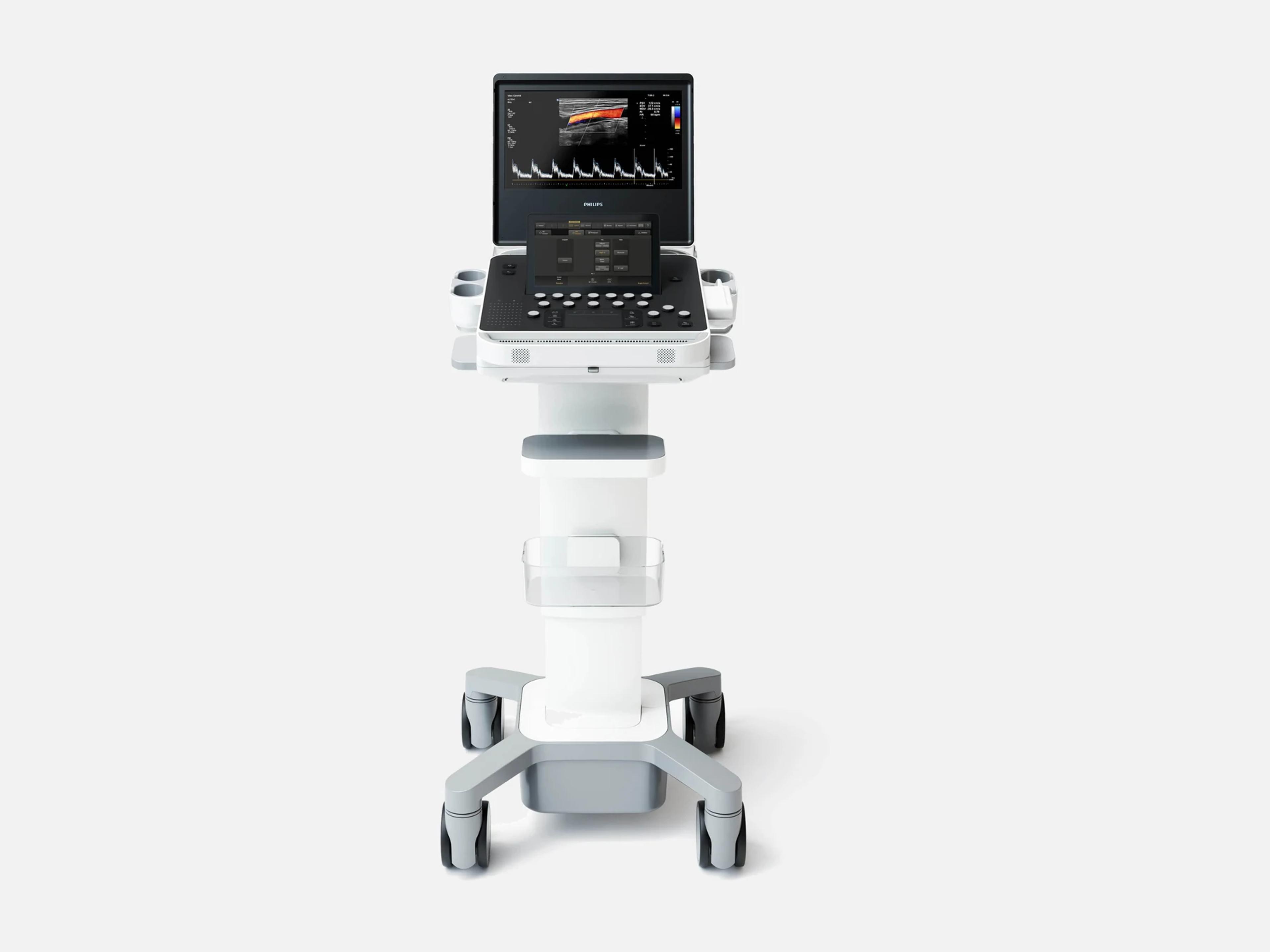
The Philips Compact 5500 Series is a portable, laptop-style ultrasound system for bedside use, offered in general imaging, point-of-care, cardiac and OB/GYN configurations. It weighs 10.57 kg with its internal battery, has a 15.6-inch LCD and can share transducers with the Philips EPIQ and Affiniti systems. It comes as the 5500G, 5500P, 5500W and cardiovascular 5500CV; the Compact 5300 Series is its sibling.
- Released
- 2022first FDA clearance
- Probe ports
- 1 imaging3 with multiport adapter
- Display
- 15.6-inch1920 × 1080 LCD
- Weight
- 10.57 kg23.3 lb, with battery
Compatible probes
Linear
- L12-3ERGO · 3–12 MHz Ergonomic handle; 5500G, 5500P, 5500CV
- L12-4 · 4–12 MHz
- L12-5 50 · 5–12 MHz 50 mm
- L15-7io · 7–15 MHz Intraoperative; 5500G, 5500P, 5500CV
- L18-5 · 5–18 MHz 5500G, 5500P, 5500CV
- eL18-4 · 4–18 MHz PureWave, Elevation Focus
Convex & microconvex
- C5-1 · 1–5 MHz
- C6-2 · 2–6 MHz
- C8-5 · 5–8 MHz 5500G, 5500P, 5500CV
- C9-2 · 2–9 MHz 5500G, 5500W, 5500CV
Phased
- S5-1 · 1–5 MHz 5500G, 5500P, 5500CV
- S4-2 · 2–4 MHz 5500G, 5500P, 5500CV
- S8-3 · 3–8 MHz 5500G, 5500P, 5500CV
Endocavity
- C9-4v · 4–9 MHz Endovaginal
- C10-3v · 3–10 MHz Endovaginal; 5500G, 5500W, 5500P
- 3D9-3v · 3–9 MHz Endovaginal volume; 5500G, 5500W
Specialty
- V6-2 · 2–6 MHz Mechanical volume; 5500G, 5500W
- X7-2t · 2–7 MHz Adult TEE, over 30 kg; 5500G, 5500P, 5500CV
- X8-2t · 2–8 MHz Adult TEE, over 30 kg; 5500G, 5500P, 5500CV
- D2cwc Non-imaging continuous wave, 2 MHz; 5500G, 5500P, 5500CV
- D2tcd Non-imaging pulsed wave, transcranial, 2 MHz; 5500G, 5500P, 5500CV
- D5cwc Non-imaging continuous wave, 5 MHz; 5500G, 5500P, 5500CV
Specifications
Display
- Display
- 15.6-inch landscape LCD, 1920 × 1080
- Touchscreen
- 10-inch full-color capacitive, swipe controls; tilts from flat to 60° vertical
- Auxiliary display output
- AUX display port, 1920 × 1080
Physical
- Weight
- 10.57 kg (23.3 lb) with the internal battery
- Dimensions
- Width 16.2 in, height 3.4 in, depth 16.0 in
- Probe ports
- One imaging connector for 2D/3D probes and a dedicated Pedoff Doppler connector
- Controls
- Touchscreen, trackpad, digital TGC and dedicated physical controls
- Control panel
- 5500CV: sealed, responsive to a gloved touch
- ECG and physio inputs
- One three-lead ECG input; physio inputs for ECG, respiration, pulse and phono
- Compact Cart
Base 488.8 × 488.8 mm; height adjusts 820–1001 mm; four 5-inch locking swivel wheelsBase 488.8 × 488.8 mm; vertical adjustment 820–1001 mm (32.2–39.3 in); four 5-inch locking swivel wheels, the rear two with steering locks.Show allShow less
- Compact Cart features
Slide-out keyboard drawer; holders for up to four transducers; Ethernet, two USBIntegrated Ethernet connector; integrated keyboard in a slide-out drawer; probe holders on both sides for up to four transducers; three storage bins (large, small and a rear handle tray); two USB connectors.Show allShow less
- Travel case
- Optional, sold separately; 63.2 × 60.2 × 33.3 cm, 9.1 kg empty
Power & battery
- Battery
- Internal, 14.4 VDC, 98 Wh; battery or AC powered; boots up from transport mode
- Scan time on battery
- Up to 30 minutes on the internal battery; up to 2.0 hours with optional cart batteries
- AC adapter
- Input 100–240 VAC, 50/60 Hz; output 24 VDC at 250 W
- Power
- 100–140 V, approximately 50–60 Hz, 250 VA
- Power consumption
- 310 VA; Compact Cart up to 660 VA depending on system configuration
- Operating power
- 144 W scanning, 90 W low-power/standby, 1 W off
- Cart power
Output 24 VDC at 250 W; Extended, Deluxe and Premium add 5 V at 1 WEvery cart: input 100–240 VAC, 50/60 Hz; output 24 VDC at 250 W. Extended, Deluxe and Premium carts also output 5 V at 1 W. The Standard cart holds an integrated AC adapter in its bottom compartment.Show allShow less
Connectivity & options
- Wired
- Gigabit Ethernet, two USB 3.0 connectors, DisplayPort video
- Wireless
- 802.11n; WPA2 Personal and Enterprise
- Storage
- 512 GB internal drive for patient studies
- Export
To removable media: DICOM, PC images, PDF reports; to a network share: PC images, PDFsDICOM images and structured reports, PC-format images and PDF reports export to removable media; PC images and loops and PDF reports also export to a network share.Show allShow less
- NetLink (DICOM) option
DICOM image and SR storage, Modality Worklist, MPPS, storage commitment, query/retrieveDICOM image and structured-report storage, Modality Worklist, MPPS, storage commitment and ultrasound query/retrieve. On Release 1.0.x, NetLink DICOM 3.0 is a purchasable option; DICOM printing does not require it.Show allShow less
- Collaboration Live
Multi-party tele-ultrasound; diagnostic use and remote access need release 2.0 or higherMulti-party tele-ultrasound. Diagnostic use, remote access by mobile device or browser, the multi-party feature and system-to-system connect need release 2.0 or higher and a contract; not intended for Q-Apps.Show allShow less
- Security options
Security Plus, SafeGuard application whitelisting, Government security optionSecurity Plus: access levels, hard-drive encryption, local or LDAP user management, password policies and audit-log export. SafeGuard: configurable application whitelisting. Government security option: removes the ability to create or configure remote-service functionality.Show allShow less
- Multiport adapter
- Optional, on Deluxe and Premium carts; switches among up to three imaging transducers
- Cart options
Standard, Extended (three batteries), Deluxe (multiport adapter), Premium (video printer)Standard, Extended, Deluxe and Premium carts. Extended adds three batteries; Deluxe adds a three-probe multiport adapter; Premium also includes a monochrome video printer. Every cart has an integrated keyboard in a slide-out drawer.Show allShow less
- Clinical options
Abdomen, Adult Cardiology, Breast, Fetal Echo, GYN, Musculoskeletal, OB, Vascular, POC…Abdomen, Adult Cardiology, Advanced Capabilities Limited, Breast, Fetal Echo, GYN, Musculoskeletal, OB, Pediatric Cardiology, Pediatric GI, Small Parts, TCD, Urology, Vascular and POC clinical options; QLAB Advanced Quantification Software is also an option type.Show allShow less
- Software options
Barcode Scanner SW, Digital Navigation Link, Transducer Element Check, Physio SW, STIC…Barcode Scanner SW, Digital Navigation Link, FlexVue, Transducer Element Check, Needle Visualization, Physio SW, Strain Elastography Option, STIC, TrueVue, Government Security, SafeGuard, Security PlusShow allShow less
Imaging & software
- Configurations
5500G, 5500P, 5500W and 5500CV; same hardware, differing in features, probes and licensesOffered in general imaging, point of care, cardiac and OB/GYN configurations: Ultrasound System 5500G, 5500P, 5500W and 5500CV. The 5500G is the primary configuration with the most available capabilities; all share the same hardware and software architecture and differ in features, transducer options and license options.Show allShow less
- Imaging modes
2D, 3D/4D, color, PW, CW and tissue Doppler, M-mode, harmonics, Color Power AngioB (2D), 3D/4D, Color Doppler, Continuous Wave Doppler, Pulse Wave Doppler, Tissue Doppler, M-mode including anatomical M-mode, tissue and contrast harmonics, Color Power Angio (CPA) and combined modes; availability depends on configuration and transducer.Show allShow less
- Imaging depth
- Up to 30 cm, transducer-dependent
- Maximum transducer frequency
- Up to 22 MHz
- Advanced imaging
2D/3D/4D, contrast, strain elastography, MicroFlow Imaging, needle visualization2D/3D/4D imaging, contrast-enhanced ultrasound, strain elastography, MicroFlow Imaging and needle visualization across general imaging, cardiac and OB/GYN applications.Show allShow less
- Strain elastography
- Breast on L12-5 50 and eL18-4; gynecological and pelvic on C10-3v and C9-4v
- Image optimization
AutoSCAN, iSCAN, iOPTIMIZE, SonoCT, xRes, WideSCAN, Smart TGC, Smart LGC, TACAutoSCAN (continuous gain and TGC adjustment), iSCAN (one-touch optimization), iOPTIMIZE (one-button performance optimization), SonoCT real-time compound imaging, xRes, WideSCAN (linear and curved 2D with SonoCT), Smart TGC preset curves, Smart LGC on cardiac sector transducers, and Tissue Aberration Correction with selected presets on the L12-5 50 mm, eL18-4 and L18-5.Show allShow less
- Doppler tools
Auto Doppler, Auto Flow Tracking, High Q, Color CompareAuto Doppler (automated Doppler settings; applications and controls depend on the transducer), Auto Flow Tracking (automatic angle correction as the sample volume moves), High Q (automatic Doppler analysis for general imaging) and Color Compare.Show allShow less
- Cardiac quantification
a2DQ, aTMAD, Auto Strain LV, Color Kinesis, Live xPlane Imaging, Live CompareAutomated Cardiac 2D Quantification (a2DQ), Automated Tissue Motion Annular Displacement (aTMAD), Auto Strain LV (automated 2D longitudinal strain; on the 5500CV with automated EF, mid-layer strain and one-button GLS), Color Kinesis, Live xPlane Imaging (two full-resolution planes at once) and Live Compare in the stress-echo workflow.Show allShow less
- 5500CV TEE 3D
- Live 3D, Live 3D color flow and Live xPlane Doppler with the X8-2t TEE; MultiVue
- 5500CV 3D quantification
- 3DQ, 3DQ Advanced, 3D Auto MV (mitral valve), 3D Auto LAA (left atrial appendage)
- iRotate TEE
- Rotates the 2D image without moving the transducer; for the X8-2t and X7-2t
- 3D/4D and OB tools
GI 3DQ, iSlice, TrueVue, GlassVue, TouchVue, FlexVue, STIC, aReveal, aBiometry Assist…General Imaging 3D Quantification (GI 3DQ) with iSlice volume slicing; TrueVue rendering with movable lighting; GlassVue; TouchVue touchscreen volume control; FlexVue on the 3D9-3v and V6-2; Spatio-Temporal Image Correlation (STIC); aReveal fetal-face clearing; aBiometry Assist; Fetal Heart Navigator.Show allShow less
- Quantification
IMT, ROI, MVI, Strain Elastography Analysis and Quantification, Strain QIntima Media Thickness (IMT) on user-selected frames, Region of Interest (ROI), MicroVascular Imaging (MVI) contrast analysis, Strain Elastography Analysis, Strain Elastography Quantification and Strain Q.Show allShow less
- Auto Measure
- AI-based Auto Measure; Version 2 added to the 5000 Compact family by K242800
- Workflow
SmartExam protocols, QuickSAVE exam settings, MaxVue full-screen formatSmartExam customizable exam protocols; QuickSAVE saves preferred system settings as individual exam types; MaxVue uses the entire monitor viewing area.Show allShow less
- Revision and software
Release 1.0.x; Compact 2.0 (VM11.0) with Auto Measure; Philips VM platformRelease 1.0.x applies to the 5500, 5500G, 5500W, 5500P and 5500CV; the software baseline for Auto Measure Version 2 is Compact 2.0 (VM11.0); part of the Philips VM platform product family. Collaboration Live's diagnostic and remote features need release 2.0 or higher.Show allShow less
- Operating system
- Windows 10 IoT Enterprise
- User interface
- Shares the architecture of the Philips EPIQ and Affiniti systems
Compliance
- FDA 510(k)
K222648 (2022-09-27), K242800 (2024-11-15); Class II, product code IYNK222648, decided 2022-09-27 (substantially equivalent): 5000 Compact Series Ultrasound Systems, naming Ultrasound System 5500 G, 5500 P, 5500 W and 5500 CV. K242800, decided 2024-11-15: adds Auto Measure Version 2. Class II, product code IYN, regulation number 892.1550.Show allShow less
- CE mark
- CE marked in Europe, announced June 2023
What to check when buying a used Philips Compact 5500 Series
Check recall Z-1757-2024 on multiport adapter carts
On affected units, a TEE probe left on the multiport adapter but not selected may keep receiving power with its temperature monitoring and control bypassed, and its head may overheat.
How: Systems built on or before December 20, 2023 and bought with a Deluxe or Premium cart are affected, so read the model label under the system and ask for proof that a Philips field engineer installed the correction.
Check any 3D9-3v probe against recall Z-2517-2023
The recall concerns listed 3D9-3v probes whose two-part chassis bond may fail, letting the probe come apart during clinical use.
How: Read the serial number printed on the probe's connector and check it against the recall list; an affected probe should have been taken out of use and exchanged by Philips.
Have every TEE probe leakage-tested on the system
A stand-alone tester can only indicate leakage, not diagnose it, and any failure on one calls for complete safety testing of the probe with the ultrasound system.
How: Ask for a leakage test on each X7-2t or X8-2t offered, and if a stand-alone test fails, require the full safety test on the system before purchase.
Inspect every probe's housing, lens, cable and connector
A probe with a cracked or damaged housing, lens, cable, strain relief or system connector must not be used.
How: Look over each part for cracks, and treat discoloration as a sign of a non-recommended disinfectant or of soaking deeper or longer than recommended.
Common questions about the Philips Compact 5500 Series
Is the Philips Compact 5500 Series FDA-cleared?
Yes. The Compact 5500 Series is FDA-cleared under 510(k) K222648, decided on September 27, 2022. K222648 names the Ultrasound System 5500 G, 5500 P, 5500 W and 5500 CV among the 5000 Compact Series Ultrasound Systems, as Class II devices with product code IYN.
A second clearance, K242800, decided on November 15, 2024, added the Auto Measure Version 2 measurement feature to the series without adding modes, presets, measurements or transducers. The original 510(k) cited the Philips Affiniti as its primary predicate and the Philips CX 50 as a reference device.
What is the difference between the Philips Compact 5500 Series and the 5500CV?
The 5500CV is the cardiovascular configuration of the Compact 5500 Series, built on the same hardware as the 5500G, 5500P and 5500W. It shares its architecture with the EPIQ CVx and Affiniti CVx and is compatible with their transducers. It works with the S12-4 for pediatric cardiac and neonatal head exams.
The 5500 Series is aimed at multispecialty use and the 5500CV at cardiology. The C10-3v, V6-2 and 3D9-3v are offered on other 5500 configurations but not on the 5500CV.
How is the Compact 5500 Series different from the Compact 5300 Series?
The Compact 5500 Series comes in general imaging, point-of-care, cardiac and OB/GYN configurations, and the Compact 5300 Series in general imaging, point-of-care and OB/GYN. All 5000 Compact Series configurations share the same hardware and differ in features, transducer options and license options.
The 5500 is the higher of the two models, with the wider choice of options and transducers: the C5-1, C9-2, C10-3v, eL18-4 and S5-1 are offered only on 5500 configurations.
Can the Philips Compact 5500 Series use EPIQ and Affiniti transducers?
Yes. Transducers can be shared across EPIQ, Affiniti and Compact 5000 Series systems, and every 5000 Compact Series configuration is compatible with existing Philips transducers cleared on the Affiniti. No new transducers were introduced with the series.