Philips Compact 5300 Series
Philips · Compact series
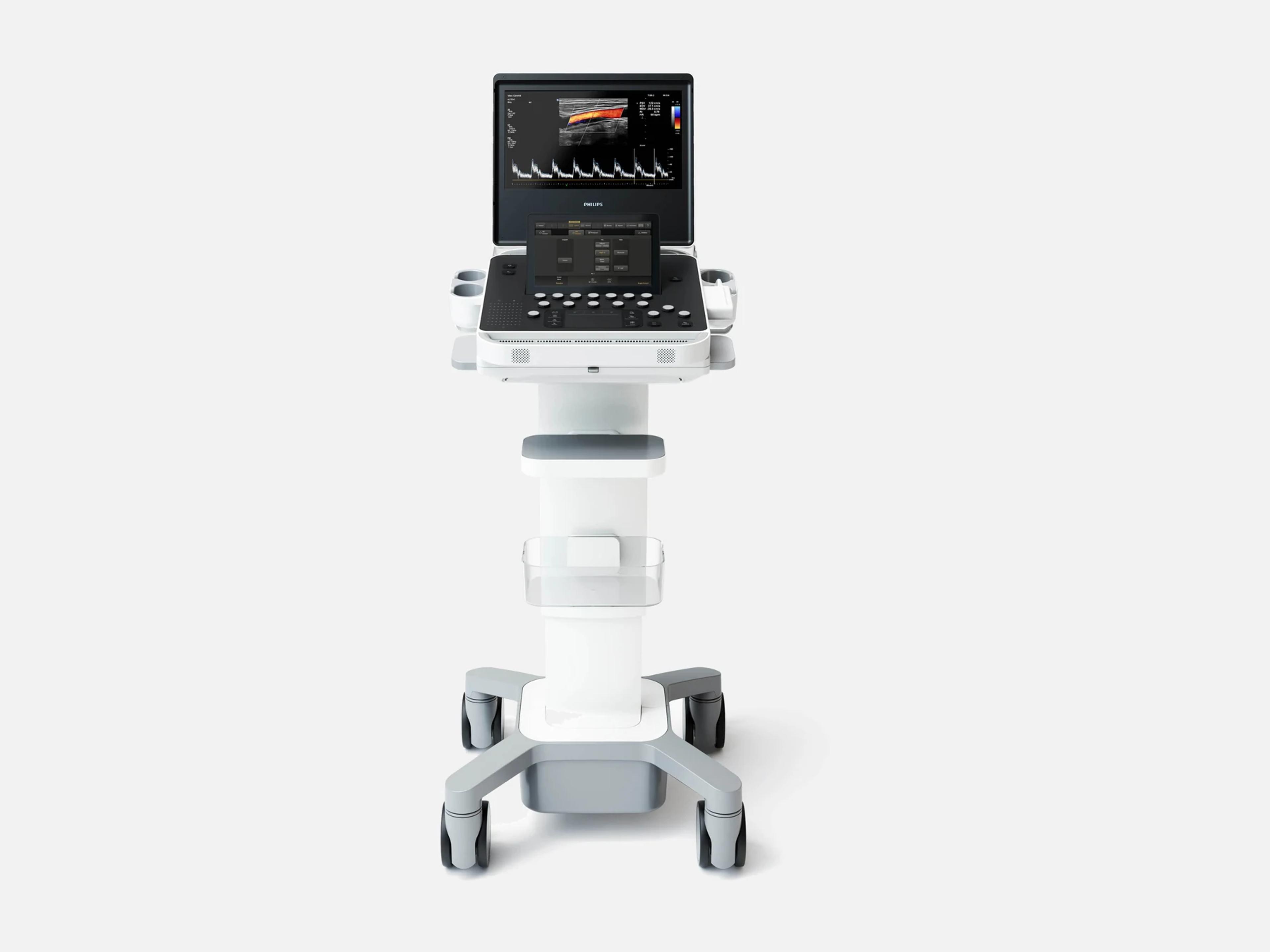
The Philips Compact 5300 Series is a portable ultrasound system offered in general imaging, point-of-care and OB/GYN configurations. It weighs 10.57 kg with its internal battery, has a 15.6-inch display and is cleared by the FDA as the 5300G, 5300P and 5300W. In the 5000 Compact Series it sits beside the 5500 Series, which adds a cardiac configuration, and the 5500CV for premium cardiology, all on the same hardware.
- Released
- 2022first FDA clearance
- Probe ports
- 1 + Pedoffup to 3 on multiport adapter
- Display
- 15.6-inch1920 x 1080 LCD
- Weight
- 10.57 kg23.3 lb, with battery
Compatible probes
Linear
- L12-3ERGO · 3–12 MHz Ergonomic handle; listed for 5300G and P
- L12-4 · 4–12 MHz Listed for 5300G, W and P
- L12-5 50 · 5–12 MHz 50 mm; listed for 5300G, W and P
- L15-7io · 7–15 MHz Intraoperative; listed for 5300G and P
- L18-5 · 5–18 MHz Listed for 5300G and P
Convex & microconvex
- C6-2 · 2–6 MHz Listed for 5300G, W and P
- C8-5 · 5–8 MHz Listed for 5300G and P
Phased
- S4-2 · 2–4 MHz Listed for 5300G and P
- S8-3 · 3–8 MHz Listed for 5300G and P
Endocavity
- C9-4v · 4–9 MHz Endovaginal; listed for 5300G, W and P
- 3D9-3v · 3–9 MHz Mechanical volume, endovaginal; listed for 5300G and W
Specialty
- V6-2 · 2–6 MHz Mechanical volume; listed for 5300G and W
- V9-2 PureWave; first to third trimester and pelvic floor
- X7-2t · 2–7 MHz Adult TEE, patients over 30 kg; listed for 5300G and P
- X8-2t · 2–8 MHz Adult TEE, patients over 30 kg; listed for 5300G and P
- D2cwc Non-imaging continuous wave, 2 MHz; listed for 5300G and P
- D2tcd Non-imaging pulsed wave, 2 MHz, transcranial; listed for 5300G and P
- D5cwc Non-imaging continuous wave, 5 MHz; listed for 5300G and P
Specifications
Display
- Display
- 15.6-inch LCD, 1920 x 1080
- Touchscreen
- 10-inch full-color capacitive touchscreen, adjustable from flat to 60° vertical
Physical
- Weight
10.57 kg (23.3 lb) with battery; 48.2 kg (106.3 lb) with premium cart and accessories10.57 kg (23.3 lb) including the internal battery (compact system); 48.2 kg (106.3 lb) with the premium cart, system, printer, power supply and multiport adapterShow allShow less
- Dimensions (compact system)
- Width 16.2 in, height 3.4 in, depth 16.0 in
- Probe ports
One imaging and one Pedoff connector; optional multiport adapter for up to three probesOne connector for imaging transducers (2D/3D) plus one for dedicated Pedoff Doppler transducers, with electronic switching between them; the optional multiport adapter, part of the deluxe and premium carts, switches between up to three imaging transducers; cart probe holders on both sides hold up to four transducersShow allShow less
- Controls
Trackpad with three programmable keys; sealed digital TGC; touchscreen keyboardTrackpad with three programmable keys; sealed control panel; sealed digital TGC with eight depth controls; touchscreen alphanumeric keyboard; integrated keyboard in a slide-out drawer on the cartsShow allShow less
- Compact cart (optional)
Base 19.2 x 19.2 in; vertical adjustment 32.2–39.3 in; four 5 in locking swivel wheelsBase 488.8 x 488.8 mm (19.2 x 19.2 in); vertical adjustment 820–1001 mm (32.2–39.3 in); four 5 in locking swivel wheels, the rear two with steering lock; standard, extended, deluxe and premium versionsShow allShow less
- Travel case (optional)
63.2 x 60.2 x 33.3 cm (24.90 x 23.70 x 13.10 in); 9.1 kg (20.1 lb) emptySold separately: 63.2 x 60.2 x 33.3 cm (24.90 x 23.70 x 13.10 in), 9.1 kg (20.1 lb) empty; holds the system, AC adapter, three imaging transducers (one linear, one convex, one sector), power cord and batteryShow allShow less
Power & battery
- Battery
- Internal 14.4 VDC, 98 Wh; three batteries on extended, deluxe and premium carts
- Battery scanning time
- Up to 30 minutes on the internal battery; up to 2.0 hours with optional cart batteries
- Power
Battery or AC; adapter 100–240 VAC, 50/60 Hz in, 24 VDC at 250 W out; system 310 VABattery or AC powered. AC adapter: input 100–240 VAC, 50/60 Hz; output 24 VDC at 250 W. Power consumption 310 VA; system rating 100–140 V, ~50–60 Hz, 250 VA; cart power consumption up to 660 VA, depending on system configurationShow allShow less
- Startup
Approximately 110 seconds from off; approximately 20 seconds from sleep modeApproximately 110 seconds from off and approximately 20 seconds from sleep mode; with transport mode disabled, imaging resumes immediately after the monitor lid is raisedShow allShow less
Connectivity & options
- Connectivity
Gigabit Ethernet, 802.11n wireless, two USB 3.0, AUX display output 1920 x 1080Wired gigabit Ethernet; 802.11n wireless networking with WPA2 Personal and WPA2 Enterprise security; two USB 3.0 connectors; auxiliary display output at 1920 x 1080Show allShow less
- DICOM
Image and SR storage, storage commitment, worklist, MPPS, query/retrieve, printingRelease 1.0.x supports image and structured-report storage, storage commitment, modality worklist, MPPS, query/retrieve and DICOM printing; NetLink DICOM 3.0 is a purchasable option, query/retrieve needs additional options, and DICOM printing needs noneShow allShow less
- ECG input
- One three-lead ECG input
- Collaboration Live
Multi-party tele-ultrasound for remote collaboration; requires a contractMulti-party tele-ultrasound for remote collaboration, with a contract required; remote access from a mobile device or browser, the multi-party feature and system-to-system connect require release 2.0 or higherShow allShow less
- Options
NetLink connectivity, Government and Safeguard security options, Security PlusNetLink connectivity option; Government security option; Safeguard security option; Security Plus feature, including hard drive encryption; Collaboration Live; optional multiport adapter; optional travel case. Configurations differ in features, transducer options and license optionsShow allShow less
Imaging & software
- Configurations
General imaging, point-of-care and OB/GYN; cleared as 5300G, 5300P and 5300WGeneral imaging, point-of-care and OB/GYN configurations; cleared as Ultrasound System 5300G, 5300P and 5300WShow allShow less
- Imaging modes
B (2D), 3D/4D, color, CW, PW and tissue Doppler, M-mode, harmonics, CPA, combined modesB (2D), 3D/4D, Color Doppler, Continuous Wave Doppler, Pulse Wave Doppler, Tissue Doppler, M-mode including anatomical M-mode, tissue and contrast harmonics, Color Power Angio (CPA) and combined modes; strain elastography; Live xPlane Imaging. Availability depends on configuration, transducer and licensingShow allShow less
- System architecture
Up to 4,718,592 digital channels; transducer frequencies up to 22 MHz; depth to 30 cmUp to 4,718,592 total digital channels; transducer frequencies up to 22 MHz; depths from the skin line (using zoom) to 30 cmShow allShow less
- Software features
3D quantification, Live xPlane Imaging, strain elastography, Color Compare3D quantification; Live xPlane Imaging, which produces two full-resolution imaging planes simultaneously; strain elastography; Color Compare; DICOM structured reportingShow allShow less
- OB/GYN features
- aReveal, Auto Biometry, TrueVue fetal-face imaging, FlexVue for early OB
- Cardiac features
- Auto Strain LV: automated EF, mid-layer strain and one-button GLS
- Auto Measure
Optional semiautomated adult echo 2D and Doppler measurements; Version 2 on Compact 2.0Optional AI-based feature for semiautomated adult echocardiography 2D and Doppler measurements; Auto Measure Version 2 is documented with the Compact 2.0 (VM11.0) software baselineShow allShow less
- Revision and software
Release 1.0.x; Compact 2.0 (VM11.0); part of the Philips VM platform familyA Release 1.0.x DICOM conformance statement covers the 5300, 5300 G, 5300 W and 5300 P; K242800 documents the Compact 2.0 (VM11.0) software baseline; the system belongs to the Philips VM platform product familyShow allShow less
- Operating system
- Windows 10 IoT Enterprise
- Storage
512 GB drive; approximately 350 patient exams512 GB drive for patient study storage; approximately 350 patient exams, assuming 40 images and 6 seconds of clips/reports per examShow allShow less
Compliance
- FDA 510(k)
K222648 (2022-09-27), K242800 (2024-11-15); Class II, 21 CFR 892.1550K222648 (decided 2022-09-27), 5000 Compact Series Ultrasound Systems, naming Ultrasound System 5300 G, 5300 P and 5300 W with the 5500 G, P, W and CV; K242800 (2024-11-15), adding Auto Measure Version 2. Class II, 21 CFR 892.1550Show allShow less
- Electrical safety
IEC 60601-1, -1-2 and -2-37; ANSI/AAMI ES60601-1; CAN/CSA 22.2 No. 60601-1; CE markedIEC 60601-1; IEC 60601-1-2; IEC 60601-2-37; ANSI/AAMI ES60601-1; CAN/CSA 22.2 No. 60601-1; CE MarkShow allShow less
What to check when buying a used Philips Compact 5300 Series
Confirm the multiport adapter correction was completed
On units built on or before December 20, 2023 and purchased with a Deluxe or Premium Cart, a TEE probe left connected but unselected on the multiport adapter could keep receiving power without temperature monitoring when other probes are swapped, risking patient burns.
How: Check the model-name label on the bottom of the system, and on an affected unit ask for the service record of field correction FCO79500569 under recall Z-1757-2024, since not every affected unit has been corrected.
Inspect any 3D9-3v probe against recall Z-2517-2023
Recall Z-2517-2023 covers 3D9-3v transducers used with Compact 5000 systems: the probe's two bonded parts may come apart, risking tissue damage and electric shock if the built-in safety measures also fail.
How: Look for separation at the housing's bonded joint, check the probe's serial number against the recall, and ask for its refurbishment records and electrical safety test result.
Have each TEE probe safety-tested with the system
A stand-alone leakage tester gives only an indication of leakage, and any failure on it means the TEE probe needs complete safety testing with the ultrasound system.
How: Ask for a leakage test result on each TEE probe offered, and confirm its connector pin protective cover is present on its lanyard.
Inspect every probe's housing, lens, cable and connector
A transducer with a cracked or damaged housing, lens, cable, strain relief or system connector must not be used.
How: Look over each part for cracks, splitting, fluid leaks and sharp edges or projections, and reject any probe that shows them.
Common questions about the Philips Compact 5300 Series
Is the Philips Compact 5300 Series FDA-cleared?
Yes. Its three configurations, the Ultrasound System 5300G, 5300P and 5300W, were cleared under 510(k) K222648 on September 27, 2022, together with the 5500 configurations, as Class II devices under 21 CFR 892.1550.
A later clearance, K242800, decided on November 15, 2024, added Auto Measure Version 2, an AI-based measurement feature, to the 5000 Compact Series and names the same three 5300 configurations.
How is the Philips Compact 5300 Series different from the 5500 Series?
All 5000 Compact Series configurations share the same hardware and a common software codebase; they differ in features, transducer options and license options, and the 5500G has the most available capabilities.
The 5300 Series comes in general imaging, point-of-care and OB/GYN configurations, and the 5500 Series adds a cardiac configuration. Both are multispecialty systems for general imaging, standard cardiology, OB/GYN and point of care, and the 5500 Series takes a wider range of PureWave and xMatrix transducers. The 5500CV is aimed at premium cardiology.
What is the difference between the Philips 5300G, 5300P and 5300W?
They are the three FDA-cleared configurations of the Compact 5300 Series, which is offered in general imaging, point-of-care and OB/GYN versions. They share the same hardware and differ in features, transducer options and license options.
The C6-2, C9-4v, L12-4 and L12-5 50 are listed for all three. The X7-2t and X8-2t TEE probes, the S4-2 and S8-3 sector probes, the non-imaging Doppler probes and the C8-5, L12-3ERGO, L15-7io and L18-5 are listed for the 5300G and 5300P; the V6-2 and 3D9-3v volume probes are listed for the 5300G and 5300W.
Does the Philips Compact 5300 Series use Affiniti transducers?
Yes, within its configurations. The 5000 Compact Series introduced no new transducers: it works with existing Philips transducers cleared on the Affiniti, and shares its transducers with other Philips products. Transducer options differ between configurations, so check that a probe is listed for the 5300 configuration it will run on.
Does the Philips Compact 5300 Series support PureWave transducers?
Yes, specific ones. The PureWave V9-2 is compatible with the Compact 5300 Series, and the X7-2t and X8-2t TEE transducers, built with PureWave and xMatrix Array technologies, are listed for the 5300G and 5300P.
Other PureWave transducers, including the C5-1, C9-2, C10-3v, eL18-4 and S5-1, are listed for 5500 configurations only.