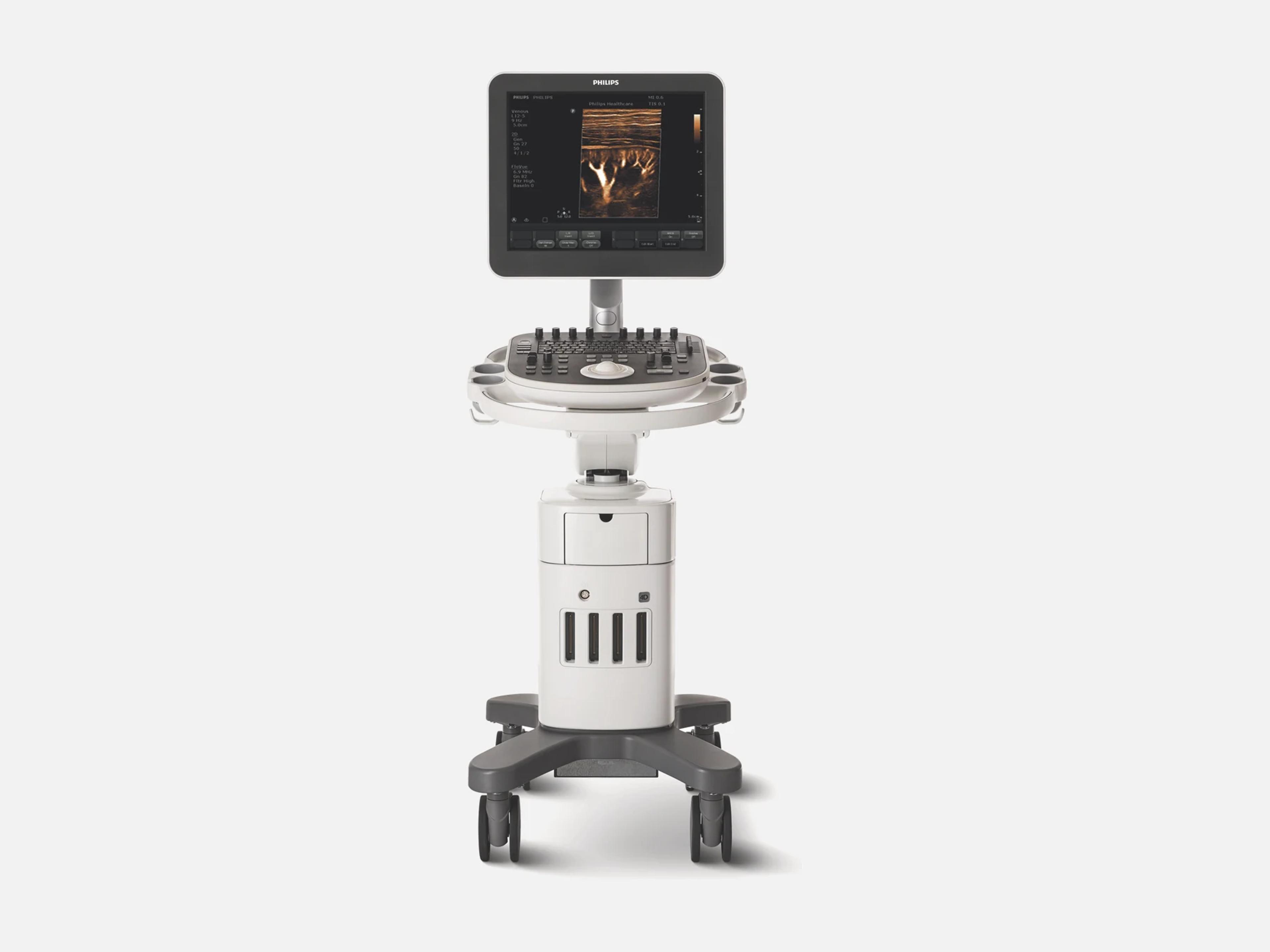
The Philips ClearVue 850 is a cart-based ultrasound system positioned around quantification and ergonomics. It is FDA-cleared for OB, GYN, fetal echo, abdominal and small-organ imaging and for adult and pediatric cardiac and cerebral vascular exams. Among the ClearVue 350, 550, 650 and 850, only the 850 has a height-adjustable console, stress echo, strain elastography, FloVue, IMT and iSlice.
- Released
- 2015first FDA clearance
- Probe ports
- Up to 4with a dedicated 4D port
- Display
- 19-inchIPS, on an articulating arm
- Weight
- 52 kg115 lb, including printer
Compatible probes
Linear
- L12-4
Convex & microconvex
- C5-2
Phased
- S4-1 Sector array
Endocavity
- C9-4v Endovaginal
- 3D9-3v Endovaginal 3D/4D volume array
Specialty
- V6-2 Volume array for abdominal and OB/GYN imaging
- D2cwc 2 MHz continuous-wave Doppler, via an external CW adapter
Specifications
Display
- Display
- 19-inch color monitor with an IPS panel, on an articulating arm
- Brightness control
- Adjustable, with automatic backlight stability (BLS) control
Physical
- Weight
- 52 kg (115 lb), including printer
- Dimensions
- Width 52 cm; depth 58.4 cm; maximum height 175 cm with articulating-arm display
- Control-panel height
- 83.7–103 cm
- Probe ports
- Up to four connected imaging transducers, selected electronically; a dedicated 4D port
- Controls
Height-adjustable panel, QWERTY keyboard, trackball with Select/Enter keys, soft keysHeight-adjustable control panel with an up/down mechanism, QWERTY keyboard, trackball with Select and Enter keys, and context-dependent soft keysShow allShow less
- Footswitch
- Three pedals: freeze, acquire and print
Power & battery
- Power
- 100–240 VAC; 50–60 Hz; power rating 450 VA; consumed power 300 VA
Connectivity & options
- DICOM (software 3.1)
Image storage, Storage Commitment, SR, Worklist, MPPS, print: each a purchasable optionSCU of Ultrasound Image Storage, Ultrasound Multiframe Image Storage, Storage Commitment Push Model, Comprehensive SR, Modality Worklist, Modality Performed Procedure Step, Basic Grayscale Print Management and Basic Color Print Management, each a purchasable option on software 3.1Show allShow less
- Ethernet
- 10BaseT, 100BaseT or 1000BaseT
- USB ports
- Three: two rear USB 3.0, one USB 2.0 at the front of the control panel
- Video output
- HDMI, SXGA 1280 × 1024 at 60 Hz, non-interlaced RGB; S-Video
- Export
- AVI and MPEG clips and BMP images to USB for PC viewing; CD/DVD or USB media export
- Storage
- 500 GB hard drive
- ECG input
- One three-lead ECG input
- CW Doppler adapter
- External CW adapter module on the SAM transducer connector
- Remote service
- Philips Remote Service Network; support requests and usage reports (ClearVue family)
Imaging & software
- Revision and software
3.1; a 3.3 release is also listed for the ClearVue 350/550/650/850 (November 2020)Software 3.1, whose DICOM conformance statement (Rev C) is dated 2015-06-08; a 3.3 release is also listed for the ClearVue 350/550/650/850, dated November 2020Show allShow less
- Imaging modes
2D, M-mode, Anatomical/Color M-mode, PW, high-PRF PW, CW, color Doppler, TDI, CPA, 3D/4D2D, M-mode, Anatomical M-mode, Color M-mode, PW Doppler, high-PRF PW Doppler, CW Doppler, color Doppler, Tissue Doppler Imaging, Color Power Angio, Directional Color Power Angio, freehand 3D and 3D/4D; also Tissue Harmonics, iSCAN, XRES and SonoCT, with FloVue and strain elastography in combined modesShow allShow less
- Combined modes
B+PWD; B+Color; B+Amplitude; B+M; B+M+Color; B+Color+PWD; B+Amplitude+PWD; B+CWD…B+PWD; B+Color; B+Amplitude; B+M; B+M+Color; B+Color+PWD; B+Amplitude+PWD; B+CWD; B+Color+CWD; B+Amplitude+CWD; B+FloVue+PWD. Color Doppler includes Color Amplitude Doppler.Show allShow less
- Duplex and Triplex
- Duplex: 2D and Doppler; Triplex: 2D, Doppler and color or CPA
- Clinical applications
Fetal/OB, Abdominal, Pediatric, Small Organ, Neonatal and Adult Cephalic, Trans-rectal…Fetal/OB, Abdominal, Pediatric, Small Organ (breast, thyroid, testicle), Neonatal Cephalic, Adult Cephalic, Trans-rectal, Trans-vaginal, Musculo-skeletal (conventional and superficial), GYN, Urology, Cardiac Adult, Cardiac Pediatric, Fetal Echo, Peripheral vessel, Cerebral VascularShow allShow less
- Transducer frequency range
- 1–12 MHz
- Channels
- 65,536 digitally processed channels
- Dynamic range
- 272 dB maximum; 170 dB full-time input
- Acquisition frame rate
Greater than 1128 frames/s in high-frame-rate modeGreater than 1128 frames/s in high-frame-rate mode; dependent on transducer, field of view, depth and angleShow allShow less
- 4D volume rate
- Up to 50 volumes/s
- Imaging depth
- Up to 30 cm, depending on examination and transducer
- Cineloop review
- Up to 1,200 frames of 2D and color; dual-buffer imaging up to 600 frames per buffer
- Image processing
SonoCT, XRES, 2D Opt, Microfine 2D focusing, Tissue Harmonic Imaging, Active ArraySonoCT real-time compound imaging; XRES adaptive image processing; 2D Opt signal processing with 2X multi-line parallel processing and spatial compounding; Philips Microfine 2D focusing; Tissue Harmonic Imaging with pulse inversion technology; Active Array transducer technology, with imaging circuitry built into the transducerShow allShow less
- Image optimization
AutoSCAN automatic gain, iSCAN for 2D, PW and color, SmartExam guided protocolsAutoSCAN identifies tissue type and continuously adjusts image gain; iSCAN optimizes 2D, PW Doppler and color imaging; SmartExam runs customizable, system-guided exam protocolsShow allShow less
- Field of view
Live Panoramic Imaging with distance measurement; trapezoidal imaging on linear arraysLive Panoramic Imaging: extended field of view with point-to-point distance measurement. Trapezoidal imaging: a linear array's field of view can expand by up to 21° on each side in vascular and general imagingShow allShow less
- Chroma and zoom
- Philips Chroma imaging (color maps); Philips high-definition zoom (write zoom)
- Doppler tools
Adaptive Doppler, Adaptive color Doppler, Intelligent Doppler, High Q automatic analysisAdaptive Doppler; Adaptive color Doppler; Intelligent Doppler, automatic angle-to-flow maintenance with the vascular and general-imaging packages on linear transducers only; High Q automatic real-time and retrospective Doppler tracingShow allShow less
- FloVue
- High-resolution blood-flow visualization; cleared on the ClearVue 850 as a combined mode
- Strain elastography
- Strain-based breast elastography, to assess relative tissue stiffness
- Stress echo
- Cardiac stress-echo imaging, with a Stress Echo protocol
- OB and volume tools
Auto AFI, Fetal Biometry Assist, Auto Face Reveal, Fetal STIC, Curved ROI, iSliceAuto AFI (automatic amniotic fluid index); Fetal Biometry Assist (FL, BPD, HC, OFD and AC); Auto Face Reveal (removes overlying tissue from a fetal-face volume); Fetal STIC with volume transducers; Curved ROI volume editing; iSlice volumetric displayShow allShow less
- QLAB
QLAB 10.4 Q-Apps, including GI 3DQ for 3D planes and IMT intima-media measurementQLAB 10.4 Q-Apps on the cart: GI 3DQ (General Imaging 3D Quantification) for viewing and measuring different planes of a 3D volume, and IMT, automated intima-media measurement with editable resultsShow allShow less
- Biopsy guidance
- Imaging for guidance of biopsy
Environment
- Operating environment
- 10–40 °C, 15–80% relative humidity, non-condensing
- Heat dissipation
- Less than 700 BTU/hour, fully loaded
Compliance
- FDA 510(k)
- K153480 (2015-12-16); Class II; 21 CFR 892.1550; product codes IYN, IYO, ITX
- Safety standards
- IEC 60601-1, IEC 60601-1-2 and IEC 60601-2-37, in non-clinical testing
What to check when buying a used Philips ClearVue 850
Check any 3D9-3v against recall Z-2517-2023
The probe's two bonded halves can come apart, a risk of tissue damage and electric shock, and a 3D9-3v reported as outside the recall broke in half during an exam.
How: Compare its serial number with the recall, confirm an affected probe was taken out of use and exchanged, and inspect every 3D9-3v's housing joint for separation.
Inspect each transducer's housing, cable and strain reliefs
Cracks, splitting, fluid leaks, sharp edges or projections mean the transducer must come out of use, and alcohol damage to a cable or strain relief is not covered by the warranty or service contract.
How: Examine every housing and the full length of each cable for cracks, splitting, leaks, sharp edges or projections, paying close attention to the strain reliefs.
Check transducer connectors for fluid ingress
A transducer immersed beyond its specified cleaning or disinfection level is an electrical shock risk, and fluid must not get into its connector.
How: Look for signs of fluid at each connector's electrical contacts, strain relief, housing and locking-lever shaft, and ask how deep each transducer was immersed for disinfection.
Get each transducer's manufacturing certificate by serial
Recall Z-2048-2025 concerns 3D9-3v probes refurbished beyond their useful life, and a transducer past its useful life needs performance testing.
How: Enter each transducer's serial number at transducer.philips.com, keep the certificates with the system papers, and run a visual inspection and an electrical safety test on any 3D9-3v.
Common questions about the Philips ClearVue 850
Is the Philips ClearVue 850 FDA-cleared?
Yes. The ClearVue 850 is FDA-cleared under 510(k) K153480, decided on December 16, 2015, as a Class II device under 21 CFR 892.1550 (product codes IYN, IYO and ITX). It is a prescription device.
How is the ClearVue 850 different from the ClearVue 650?
Among the ClearVue 350, 550, 650 and 850, only the 850 has the height-adjustable console, stress echo, strain elastography, FloVue, IMT and iSlice.
Its 510(k), K153480, adds the L12-5 and D2cwc transducers, with an additional indication for use, to the ClearVue 350/550/650 clearance (K120321), and FloVue is a new indication for use on the 850.
What does the ClearVue 850 add over the ClearVue 350 and 550?
Over the ClearVue 350/550, the ClearVue 850 adds the D2cwc and L12-5 transducers, a control panel with an up/down mechanism, and these software features: Live Panoramic Imaging, FloVue, strain elastography, the Curved ROI tool, the QLAB plug-ins IMT and GI 3DQ, and a stress echo protocol.