Philips ClearVue 350
Philips · ClearVue series
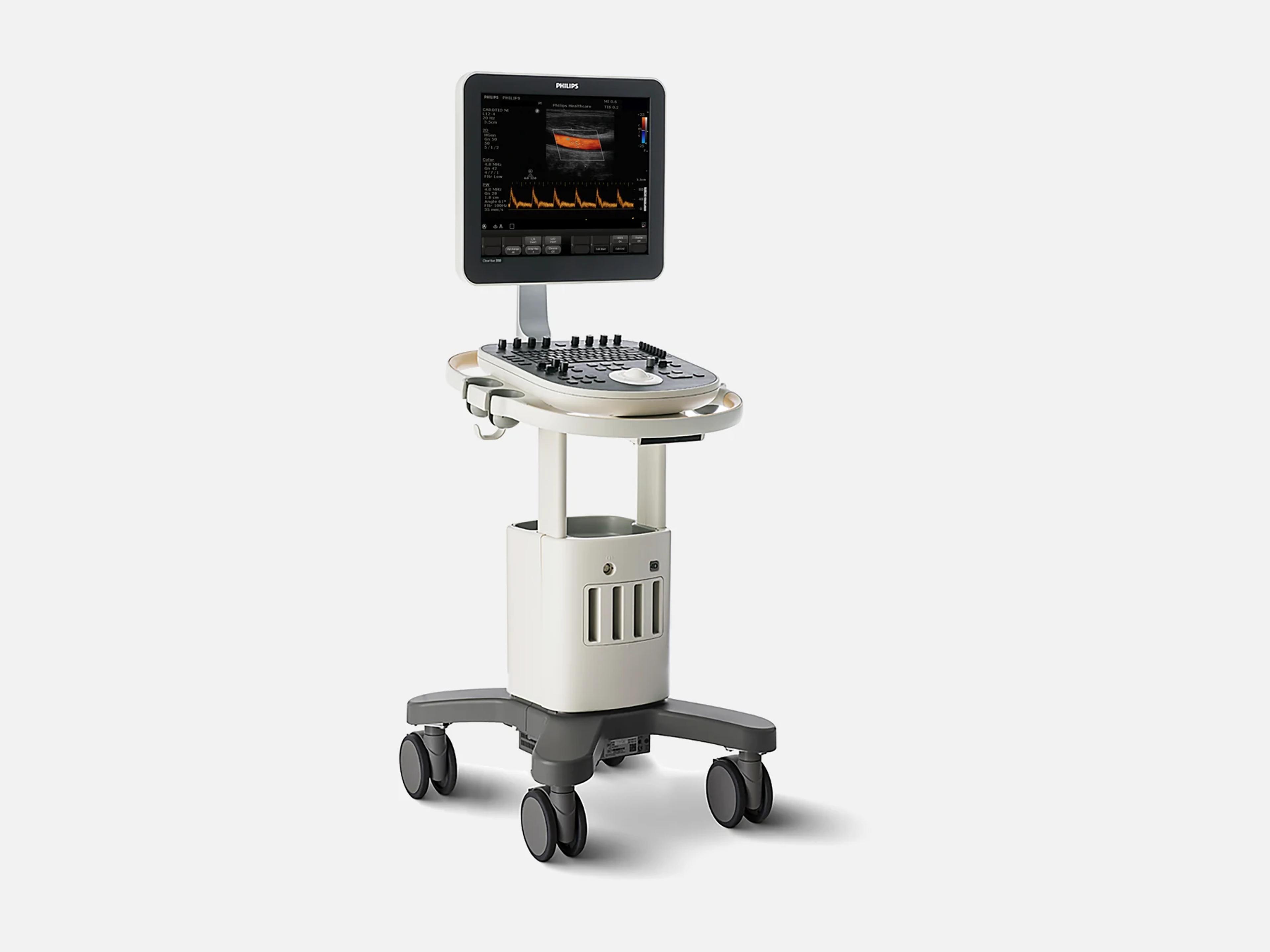
The Philips ClearVue 350 is an upgradeable, cart-based general imaging ultrasound system for hospitals, clinics and medical offices. It is FDA-cleared under 510(k) K120321 for obstetric, gynecological, cardiac and musculoskeletal exams, among others. Its ClearVue siblings are the 550, with an articulating display arm where the 350 has a tilt-swivel mount; the 650, with 3D/4D from the start; and the 850.
- Released
- 2012first FDA clearance
- Probe ports
- Three or fourby configuration
- Weight
- 56.43 kgtotal weight
Compatible probes
Linear
- L12-4 · 4–12 MHz
- L12-5 38 · 5–12 MHz Software 3.1 or higher
Convex & microconvex
- C5-2 · 2–5 MHz
Phased
- S4-1 · 1–4 MHz Sector array
Endocavity
- C9-4v · 4–9 MHz Endovaginal curved array
- 3D9-3v · 3–9 MHz Endovaginal volume array
Specialty
- V6-2 · 2–6 MHz Volume array
Specifications
Display
- Display
- 17-inch or 19-inch LCD, by configuration; fold-down, on a tilt-swivel mount
Physical
- Weight
- 56.43 kg total weight
- Probe ports
- Three or four transducer ports, depending on configuration
- Controls
- Buttons, knobs, TGC sliders and a trackball; logically grouped keys; one-button iSCAN
- Cart
- Cable management hooks and integrated storage
Power & battery
- Power
- AC 100–240 V ±10%, 50–60 Hz; 450 VA power requirement, 300 VA consumed
- System battery
- Button cell on the motherboard
Connectivity & options
- DICOM
Optional DICOM: image storage, storage commitment, SR, worklist, procedure step, printDICOM (SCU) services, each a purchasable option on release 3.1: Ultrasound Image Storage, Ultrasound Multiframe Image Storage, Storage Commitment Push Model, Comprehensive SR, Modality Worklist, Modality Performed Procedure Step, Basic Grayscale and Basic Color Print Management. Release 1.0 offered optional worklist and storage services, with CD/DVD and USB media.Show allShow less
- Ethernet
- RJ-45, 10/100/1000BaseT on release 3.1; DICOM networks through the networking option
- Storage and export
- Images and structured reports to network storage, CD/DVD or USB, from release 1.0
- Network security
No DICOM security (release 3.1); firewall accepts traffic only on the DICOM portDICOM security not implemented on release 3.1; the internal firewall accepts incoming traffic only on the configured DICOM listening port.Show allShow less
- Service features
Usage reports, Remote Desktop, proactive monitoring, Philips Remote Service NetworkUsage reports, Remote Desktop and proactive monitoring; connection to the Philips Remote Service Network; on-cart software maintenance tools.Show allShow less
- Imaging options
SonoCT, XRES, Tissue Harmonic Imaging with Pulse Inversion, panoramic imagingSonoCT image compounding; XRES, for artifact reduction; Tissue Harmonic Imaging with Pulse Inversion technology; panoramic imaging.Show allShow less
- 3D and fetal options
3D/4D upgrade; 3D fetal echo STIC; Auto Face Reveal fetal-face segmentation3D/4D imaging as an upgrade; 3D fetal echo STIC, which acquires multiple volumes and synchronizes them using a calculated heart rate; Auto Face Reveal fetal-face segmentation.Show allShow less
- Automation options
SmartExam; 2D iSCAN, Intelligent Doppler, Adaptive Doppler, Adaptive Color DopplerSmartExam protocols; advanced system automation: the 2D iSCAN option, Intelligent Doppler, Adaptive Doppler and Adaptive Color Doppler.Show allShow less
Imaging & software
- Imaging modes
2D, M-mode, Anatomical M-mode, CW, PW, HPRF PW, CFI, CPA, TDI, Triplex, freehand 3D2D, M-mode, Anatomical M-mode, CW Doppler, PW Doppler, HPRF PW, CFI, CPA, TDI, Triplex and freehand 3D; availability depends on the installed options and transducer.Show allShow less
- Imaging technologies
- Active Array technology, iSCAN image optimization, broadband beamforming
- AutoSCAN
- With the L12-5 38: identifies tissue type and adjusts gain continuously
- Clinical applications
Abdominal, Ob/Gyn, small parts, vascular, musculoskeletal, cardiac, pediatrics, urology…Abdominal, Ob/Gyn, small parts, vascular, musculoskeletal, cardiac, pediatrics, urology and Transcranial Doppler.Show allShow less
- Reports
- Configurable reports and analysis
- Revision and software
- Releases 1.0 (first), 2.0, 3.0, 3.1, 3.2 and 3.2.1 (China only)
Compliance
- FDA 510(k)
K120321, decided 2012-02-17, as the ClearVue 350/550 Diagnostic Ultrasound SystemK120321: received 2012-02-02, decided substantially equivalent on 2012-02-17, as the ClearVue 350/550 Diagnostic Ultrasound System; 21 CFR 892.1550; prescription device. FDA's establishment registration and device listing also names the ClearVue 350, with the ClearVue 550, 650 and 850, under K153480, the ClearVue 850's 510(k).Show allShow less
- Manufacturer
- Philips Ultrasound, Bothell, WA, USA
What to check when buying a used Philips ClearVue 350
Ask whether fluids ever got inside the system
Parts inside the system cannot be disinfected, so a unit contaminated internally with bodily fluids carrying pathogens must be reported to Philips service and disposed of as biohazardous material.
How: Ask the seller about the unit's history, and walk away from any system that has had bodily fluids inside it.
Reject probes with cracked housings, lenses or cables
A transducer with a cracked or damaged housing, lens, cable, strain relief or connector must not be used, and cable or strain-relief damage can also put noise or artifacts in the image.
How: Look over every part of each probe, with extra care at strain reliefs and cables, which are damaged when the system is pulled by a probe, when cart wheels run over them and when they are wiped with alcohol.
Ask how the probes were cleaned and disinfected
A transducer immersed beyond its specified cleaning or disinfection level must not be used, because of the risk of electrical shock.
How: Look for discoloration or damage from the wrong disinfectant, the wrong solution strength, or deeper or longer immersion, and for dried gel or disinfectant left on the probe.
Check any C5-2 against recall Z-2050-2025
An FDA recall covers some C5-2 transducers and calls for Philips to exchange the affected ones.
How: Check whether the probe is among the affected devices, and if it is, confirm the exchange was completed.
Common questions about the Philips ClearVue 350
Is the Philips ClearVue 350 FDA-cleared?
Yes. It is FDA-cleared under 510(k) K120321 as the ClearVue 350/550 Diagnostic Ultrasound System, found substantially equivalent on February 17, 2012, with the Philips HD11 as its predicate. It is a prescription device under 21 CFR 892.1550.
What exams is the Philips ClearVue 350 cleared for?
Its indications for use cover fetal and obstetric, abdominal, pediatric, small-organ (thyroid, scrotum, prostate and breast), neonatal and adult cephalic, transrectal, transvaginal, musculoskeletal (conventional and superficial), gynecological, adult, pediatric and fetal cardiac, and peripheral vessel exams, carotid included. They also cover biopsy guidance and monitoring follicle development in infertility care.
It can be used in hospitals, clinics and medical offices.
How does the Philips ClearVue 350 differ from the ClearVue 550, 650 and 850?
The ClearVue 550, cleared with the 350 under K120321, has more complete features and carries its display on an articulating arm, where the 350 has a tilt-swivel mount. Philips designed the 350 for office use with room to grow, and the 550 for quick scans in busy settings.
The ClearVue 650 includes 3D/4D from the start; on the 350, 3D/4D is an upgrade option.
Compared with the 350, 550 and 650 as cleared under K120321, the ClearVue 850 adds the L12-5 and D2CWC transducers and more software features and modes. Philips positions the 850 around quantification and ergonomics, with a height-adjustable console. On software 3.1 or higher, the ClearVue 350 also takes certain L12-5 38 variants.
Is the Philips ClearVue 350 discontinued?
Yes. The ClearVue 350 is no longer available from Philips. Its first software release was FDA-cleared on February 17, 2012. Philips began shipping ClearVue 350 and 550 systems from its Suzhou facility in the first quarter of 2013, and release 3.1 was documented in 2015.
Can a Philips ClearVue 350 on release 3.1 import data from older releases?
Yes. Release 3.1 imports data from ClearVue 350 releases 3.0, 2.0 and 1.0.