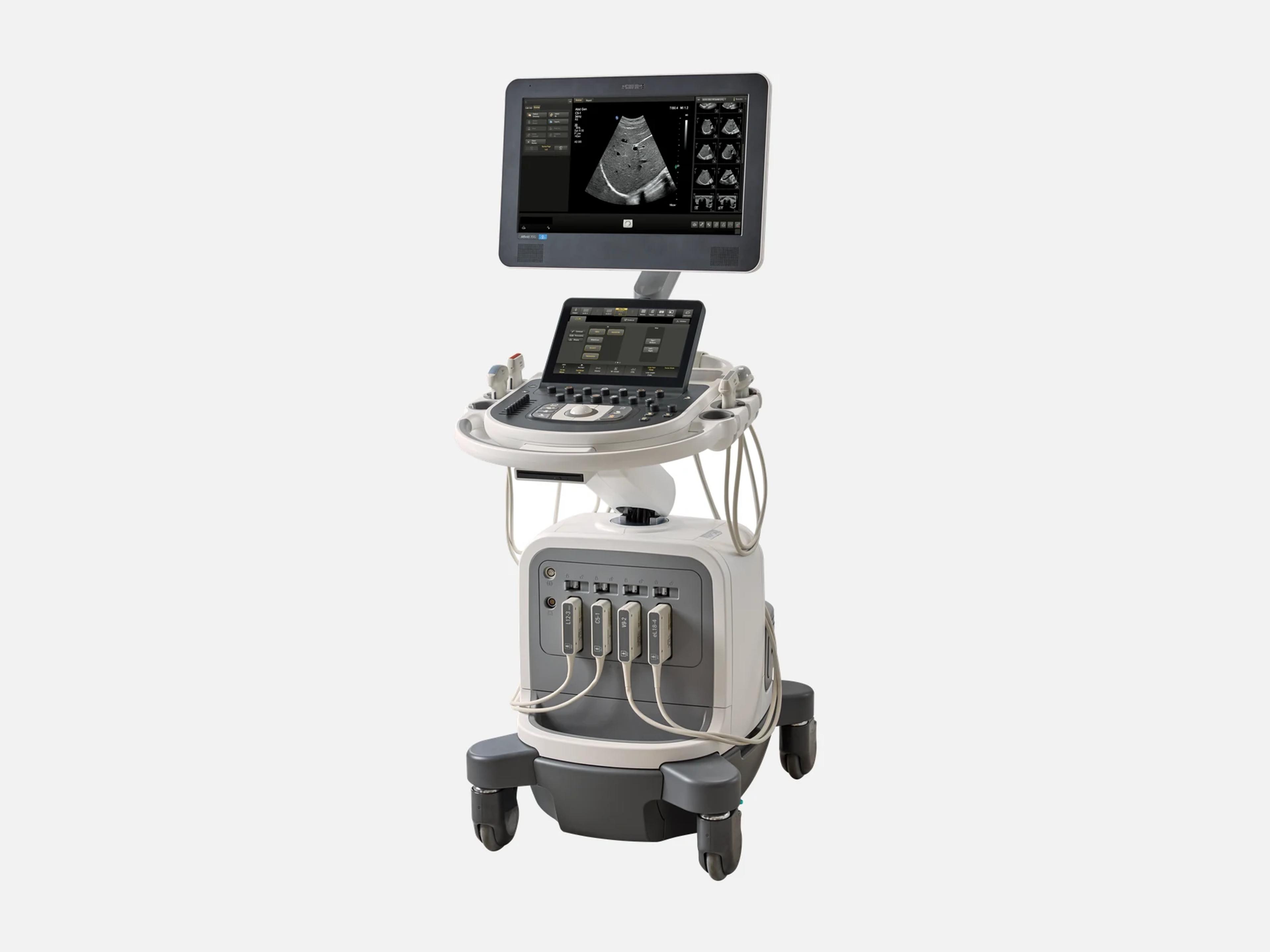
The Philips Affiniti 70 is a cart-based ultrasound system with configurations for general imaging, cardiology and women's healthcare. Its software automates cardiac ejection fraction and strain measurements, quantifies liver stiffness and fat, and renders 3D OB/GYN volumes. It sits at the top of the Affiniti family, above the Affiniti 50 and Affiniti 30, and is built on the same architecture as EPIQ.
- Released
- 2014first version launched
- Probe ports
- 4transducer ports
- Display
- 21.5-inch54.6 cm TFT/IPS monitor
- Weight
- 83.6 kg
Compatible probes
Linear
- eL18-4 PureWave
- mL26-8 Compact, ultra-high frequency
- L12-3
- L12-3ERGO
- L12-4
- L12-5 Also labeled L12-5 50
- L15-7io
- L18-5
Convex & microconvex
- C5-1 PureWave
- C9-2 PureWave
- mC12-3 PureWave, pediatric
- C6-2
- C8-5
- C9-4v
- mC7-2
Phased
- S5-1 PureWave
- X5-1 xMatrix
- S4-2
- S8-3
- S12-4
Endocavity
- C10-3v PureWave
- C10-4ec
- BP10-5ec
Specialty
- 3D9-3v Motorized 3D volume
- X7-2t xMatrix TEE; 3D depends on generation
- X8-2t Transesophageal
- S7-3t
- S8-3t
- V6-2
- V9-2
- VL13-5
- D2cwc
- D2tcd
- D5cwc
Specifications
Display
- Display
- 21.5-inch (54.6 cm) TFT/IPS monitor; articulates and folds down for transport
- Touch screen
- 12-inch (30.48 cm) full-color touchscreen: workflow controls, TGCs, image replication
Physical
- Weight
- 83.6 kg
- Dimensions
- Width 57.2 cm; height 142.2–162.6 cm; depth 98.3 cm
- Probe ports
- 4 transducer ports
- Controls
Knobs and buttons with a soft-key touch screen; control panel articulates 180°Physical knobs and buttons on the main control panel plus a touch screen with soft-key controls; the control panel articulates 180°; user interface and workflow shared with EPIQ Elite.Show allShow less
- Keyboard
- Touchscreen keyboard for patient data, annotations and system settings
- Cable management
- easy clip transducer cable management
Power & battery
- Power
- 100–240 V AC, 50/60 Hz; 450 VA, depending on system configuration
- Battery
For standby and moving the system, not for scanning; lithium-ion packThe battery supports standby and moving the system, not scanning. On 2020-era systems the default standby shutdown time is approximately 40 minutes, which is not a scanning time. In sleep mode the system sleeps in 2 seconds and returns to full functionality in 20 seconds. Lithium-ion battery pack.Show allShow less
Connectivity & options
- DICOM
DICOM worklist, storage, storage commitment, MPPS, query/retrieve and printingDICOM modality worklist; storage of images and structured reports to network storage, with storage commitment; performed-procedure reporting (MPPS); query/retrieve, including CT, NM, MR, mammography and ultrasound images from other systems; grayscale and color DICOM printing; structured reporting over a network share. Destination services need configuration.Show allShow less
- Network
- 10/100/1000 BaseT Ethernet; optional-adapter 802.11 g/n wireless (Release 1.8.x)
- Storage and export
CD, DVD and USB export; JPEG, AVI and DICOM files; patient data kept apart from the OSExport to CD-R, CD-RW, DVD-R, DVD+R, DVD-RW, DVD+RW and removable USB storage (Release 1.4.x.x); off-line image storage via network, DVR, DVD and USB devices in JPEG, AVI and DICOM formats; patient data stored on a partition separate from operating-system data.Show allShow less
- Security
Firewall, OS hardening, whitelisting, access controls, encryption, LDAP, audit loggingFive-layer defense in depth on EPIQ and Affiniti systems: firewall, operating-system hardening, malware protection by application whitelisting, access controls and patient-data encryption, configurable at rest and with DICOM/TLS in transit; LDAP authentication against institutional network accounts; audit logging.Show allShow less
- Service
Service Request button; remote services monitoring, which may need a service contractService Request button on the control panel for access to Philips support; Philips remote services monitoring, which may need a service contract and is not offered in all geographies; modular design for repair.Show allShow less
- Collaboration Live
Talk, text, screen sharing and video; contract required; Release 7.0.5 or higherTele-ultrasound from the system: talk, text, screen sharing and video streaming, under a contract. Release 7.0.5 or higher; diagnostic use and remote access by mobile device or browser need Release 9.0 or higher; multi-party sessions of up to six users and system-to-system need Release 10.0 or higher.Show allShow less
Imaging & software
- Revision and software
Release 1.0.x.x (Aug 2014) through 13.0.x (Apr 2025), and VM14.0; Elevate PlusRelease 1.0.x.x (August 2014), 1.4.x.x (April 2015), 1.5.x.x (January 2016), 1.7.x (November 2016), 1.8.x (May 2017), 2.0.x (February 2018), 3.0.x and 4.0.x (November 2018), 6.0, and 9.0 (announced November 2021); EPIQ and Affiniti family releases 11.0.x (August 2024) and 13.0.x (April 2025), which lists the Affiniti 70; Affiniti 70 software 5.0, 5.0.1, 5.0.2, 10.0, VM13.0 and VM14.0 (May 2026). In the US the system is named Affiniti 70 with Elevate Plus; Elevate Plus is not tied to a published release number.Show allShow less
- Operating system
- Windows 10 (Release 4.0)
- Image optimization
Precision Beamforming, Real-time iSCAN, Next Gen AutoSCAN, Tissue Specific PresetsPrecision Beamforming; Real-time iSCAN (AutoSCAN), which optimizes gain and TGC automatically and continuously; Next Gen AutoSCAN pixel-by-pixel real-time optimization; Tissue Specific Presets that adjust more than 7,500 parameters for the selected exam type; tissue aberration correction for sound-speed changes through fat layers when scanning with a PureWave transducer.Show allShow less
- Cardiac automation
Anatomical Intelligence Ultrasound (AIUS), Auto SWMS, Mitral Valve Navigator A.I.Anatomical Intelligence Ultrasound (AIUS) automation for GLS and 2D EF; Auto Segmental Wall Motion Scoring, which evaluates LV wall motion automatically in a 17-segment bullseye display; Mitral Valve Navigator A.I.Show allShow less
- Cardiology Q-Apps
IMT, ROI, Strain Quantification (SQ), a2DQ A.I., aCMQ A.I.Intima Media Thickness (IMT); Region of Interest (ROI); Strain Quantification (SQ); Automated 2D Cardiac Quantification A.I. (a2DQ A.I.), for automated 2D EF and volumes; Automated Cardiac Motion Quantification A.I. (aCMQ A.I.), for automated 2D global longitudinal strain.Show allShow less
- Echo tools (Elevate Plus)
2D Auto EF, 2D Auto Measure, 2D Auto Cine, Auto Strain LV, CV Doppler2D Auto EF; 2D Auto Measure; 2D Auto Cine, automatic stable-frame selection; Auto Strain LV, one-click LV global longitudinal strain; CV Doppler.Show allShow less
- Cardiac imaging
Stress echo, LVO contrast, Live 3D TEE, MicroTEE (pediatric)Stress echocardiography; Left Ventricular Opacification (LVO) cardiac contrast; adult echocardiography including Live 3D TEE; pediatric echocardiography including MicroTEE.Show allShow less
- General imaging Q-Apps
- IMT, GI 3DQ, ROI, MicroVascular Imaging (MVI), Vascular Plaque Quantification (VPQ)
- Auto Measure Abdomen
- AI anatomy recognition and automatic caliper placement for abdominal measurements
- Elastography
ElastPQ, ElastQ Imaging and Auto ElastQ shear wave; strain elastographyElastPQ point shear wave elastography, an absolute measure of tissue stiffness, for liver stiffness; ElastQ Imaging shear wave elastography with the C5-1, optional at Release 6.0; Auto ElastQ automated liver shear wave elastography; strain elastography without external compression, for relative tissue stiffness in small parts, breast and gynecology.Show allShow less
- Liver Fat Quantification
Attenuation (Atten) and Hepatorenal Index (HRI); from Release 9.0, C5-1 and mC7-2Liver Fat Quantification, introduced on Release 9.0 for the Affiniti 70 with the C5-1 and mC7-2, combines Attenuation Quantification (Atten) and Hepatorenal Index Quantification (HRI), which compares liver-parenchyma echoes with the adjacent renal cortex.Show allShow less
- Contrast-enhanced ultrasound (CEUS)
- Real-time liver-lesion enhancement and pediatric vesicoureteral-reflux assessment
- Flow imaging
MicroFlow Imaging (MFI), Flow Viewer, Auto DopplerMicroFlow Imaging (MFI) for assessing blood flow; Flow Viewer, a 3D-like view of vasculature and fetal heart flow; Auto Doppler, which places the color box and sample volume automatically for vascular imaging.Show allShow less
- 3D rendering
TrueVue, TrueVue Pro, TouchVue, GlassVue, FlexVue, FlexVue 2.0, MPR TouchTrueVue photorealistic 3D rendering for OB/GYN, with the 3D9-3v; TrueVue Pro, optional at Release 6.0, with TouchVue touchscreen sculpting, erasing and pinch zoom; GlassVue 3D rendering; FlexVue views of orthogonal planes within volumes (optional at Release 4.0) and FlexVue 2.0 (optional at Release 6.0), with Tissue Emphasis Control for intensity projections; MPR Touch, part of TrueVue core at Release 4.0.Show allShow less
- MaxVue
- In-core at Release 6.0
- Fusion and navigation
PercuNav image fusion and navigation; usable only with EPIQ series and Affiniti 70PercuNav image fusion and interventional navigation, usable only with EPIQ series systems and the Affiniti 70, and not available in all countries; automated registration of prior CT, MR or PET with live ultrasound, user-assisted co-registration, continuous patient tracking, a CT-only workflow and user-assisted ablation planning; Live Compare shows other-modality images beside live ultrasound. PercuNav Tumor Contour was optional at Release 6.0 and not then available in the USA.Show allShow less
- Needle visualization
- For interventional procedures; within Affiniti, only the Affiniti 70 has it
- Breast and small parts
AI Breast mapping with the eL18-4; Philips Precision BiopsyAnatomical Intelligence for Breast (AI Breast), from March 2020, maps the breast with the eL18-4 and electromagnetic tracking; Philips Precision Biopsy is part of the 2017 Affiniti 70 small-parts solution.Show allShow less
- Decision support
AI breast-lesion and thyroid-nodule classification on-cart; software 14.0 or higherAI decision support that classifies breast lesions and thyroid nodules, integrated on-cart or used off-cart, and supported on the Affiniti 70 running software version 14.0 or higher.Show allShow less
- Workflow
SmartExam guided protocols, Set-up Wizard, panoramic view, post-processing controlsSmartExam configurable exam protocols with annotation, mode selection and missed-view prompts; Set-up Wizard for user configurations out of the box; panoramic view of an extended anatomical landscape; post-acquisition image controls; Smart Calipers, an off-cart capability.Show allShow less
Compliance
- FDA 510(k)
- K172607 (2017)
What to check when buying a used Philips Affiniti 70
Inspect every transducer's housing, lens and cable
A transducer with a damaged housing, lens, cable, strain relief or system connector must not be used.
How: Examine each transducer offered with the unit end to end, from the acoustic window and housing to the cable, strain reliefs and connector, and reject any with cracks or damage.
Confirm the air filter is fitted and clean
The system must not be powered on without its air filter installed.
How: Inspect the system air filter before powering on, and clean it or fit a new one if it is worn out.
Common questions about the Philips Affiniti 70
Is the Philips Affiniti 70 FDA-cleared?
Yes. The Affiniti 70 is cleared under 510(k) K172607 (2017), which names it with the transducers cleared for it, among them the C5-1, C9-2, eL18-4 and S5-1.
Elevate Plus for EPIQ Elite and Affiniti received US 510(k) clearance, announced on June 2, 2026.
How is the Philips Affiniti 70 different from the Affiniti 50 and Affiniti 30?
As configured in 2020, the Affiniti 50 was the same physical system and software as the Affiniti 70, with fewer features or transducers. Within Affiniti, needle visualization is on the Affiniti 70 only, PercuNav fusion and navigation works only with the Affiniti 70 and EPIQ series systems, and at Release 6.0 TrueVue Pro was optional on the Affiniti 70 and unavailable on the Affiniti 50 and 30.
Under 510(k) K172607 (2017), the C5-1, C9-2, C10-3v, L12-3, eL18-4, S5-1 and S8-3t are cleared for the Affiniti 70 alone among Affiniti models, and others, such as the C10-4ec, L15-7io, L18-5, S7-3t, S12-4, X7-2t and VL13-5, for the Affiniti 70 and 50 but not the 30. The Affiniti 70 and 50 both have four transducer ports and the same listed dimensions; the Affiniti 70 weighs 83.6 kg and the Affiniti 50 weighs 82.6 kg.
How does the Philips Affiniti 70 compare with EPIQ?
Philips built Affiniti on the same architecture as EPIQ, and the Affiniti 70 shares its user interface and workflow with EPIQ Elite. Some features are kept for EPIQ Elite, among them xRes Pro+, 2D Auto LV, 2D Auto EF Advanced and 3D markers, and the HD MAX display is not available on the Affiniti 70.
In 2016 the Affiniti cart was smaller than EPIQ's, with locking casters in place of EPIQ's integrated brakes and control pedal.
What do Affiniti 70G, 70C and 70W mean?
They are configurations. At Release 1.8, the Affiniti 70G was the configuration for general imaging, shared service and radiology, the 70C for cardiology and the 70W for women's healthcare. From software 7.0, the cardiology-focused designation is Affiniti CVx, in place of 70C.
Philips also markets the Affiniti 70 with Elevate Plus in the US, an Affiniti 70 Elevate in India and a factory-refurbished Affiniti 70 Circular Edition. Affiniti 70 model numbers include 795210 and 795119.