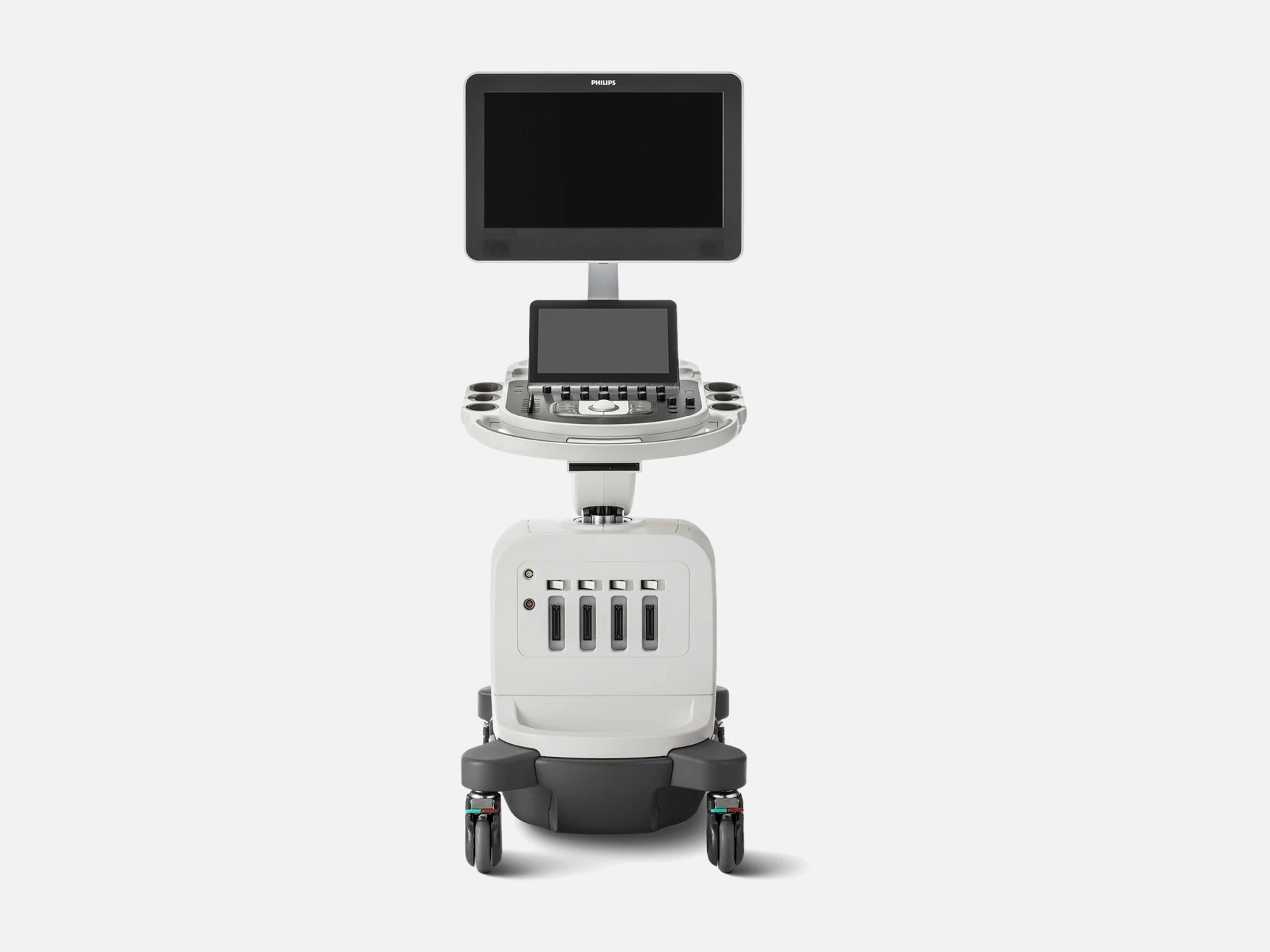
The Philips Affiniti 50 is a cart-based ultrasound system FDA-cleared for abdominal, cardiac, obstetric, gynecological, musculoskeletal, vascular, pediatric and small-organ exams. It sits below the Affiniti 70 in the family, sharing a higher Affiniti model's physical system and software with fewer features or transducers. Other Affiniti models include the Affiniti 30 and the cardiology-focused Affiniti CVx.
- Probe ports
- 4transducer ports
- Display
- 21.5-inch54.6 cm, articulating
- Weight
- 84.1 kgexcl. probes, peripherals
Compatible probes
Linear
- L15-7io Intraoperative
- mL26-8 Compact ultra-high-frequency
- VL13-5 3D/4D; listed in the 2016 and 2017 FDA tables
Convex & microconvex
- V6-2 3D/4D
Phased
- S4-2
- S8-3
- S12-4
Endocavity
- 3D9-3v 3D/4D
Specialty
- X7-2t Transesophageal; 2D only on the Affiniti 50
- S7-3t Transesophageal
- D2cwc Non-imaging CW pencil probe
- D5cwc Non-imaging CW pencil probe
Specifications
Display
- Monitor
- 54.6 cm (21.5 in) flat-panel TFT/IPS; articulates for viewing, folds down for transport
- Touch screen
- Tablet-style touchscreen with image replication and TGC controls
- MaxVue
- High-definition widescreen display for dual, side/side, biplane and scrolling modes
Physical
- Dimensions
- Width 57.2 cm, depth 98.3 cm (38.7 in), height 142.2–162.6 cm (56–64 in)
- Weight
84.1 kg excluding transducers, peripherals and accessories (2020 configuration)84.1 kg excluding transducers, peripherals and accessories, for the configuration in Philips's February 2020 manual; other Philips listings give 82.6 kg, 83.5 kg (184 lb) without peripheral devices, and 83.6 kg.Show allShow less
- Probe ports
- Four transducer ports, with one-handed transducer access
- Control panel
- Articulating, with 180 degrees of movement; centrally grouped controls
- Controls
Knobs, buttons, soft-key touchscreen, Service Request button, Support key, easy clipPhysical knobs and buttons on the main control panel plus a touch screen with soft-key controls; a Service Request button for Philips support; a Support key on the right side of the control panel; easy clip transducer-cable management.Show allShow less
- Casters
- Locking casters
- Model numbers
- 795208 and 795118; catalog code HC795208
Power & battery
- Power
- 100–240 V AC, 50/60 Hz; 450 VA, depending on system configuration
- Battery
Li-Ion battery in the power system; no scanning on battery power (2020 configuration)One Li-Ion battery in the power system plus a Li-Ion coin cell on the CPU board; for the configuration in the February 2020 manual, scanning is unavailable on battery power.Show allShow less
- Sleep and wake
- Sleeps in two seconds and returns to full functionality in seconds
Connectivity & options
- Network
Ethernet 10/100/1000 BaseT (RJ-45); 802.11 G/N wireless through an optional adapterEthernet 10/100/1000 BaseT (RJ-45); wireless 802.11 G/N through an optionally provided wireless adapter, with wired taking priority when both are configured.Show allShow less
- DICOM
Storage, commitment, worklist, MPPS, query/retrieve and print; some need optionsDICOM storage, storage commitment, modality worklist, MPPS, study-root query/retrieve and print, with network storage of images and Structured Reports in Release 13.0.x. Networked storage and worklist need the Netlink DICOM 3.0 option; query/retrieve needs Ultrasound Query Retrieve or Multi-Modality Query Retrieve; DICOM printing needs no option.Show allShow less
- Multimodality query retrieve
- Review of DICOM CT, NM, MR, mammography and ultrasound images on the system
- Structured reporting
- Measurements, images and reports transferred over a network share
- Storage and export
Local repository; network, DVR, DVD, CD and USB export; patient data on its own partitionLocal clinical data repository plus off-line storage via network, DVR, DVD and USB devices, and export to CD, DVD and removable USB media; images in standard formats such as JPEG, AVI and DICOM; patient data on a separate partition.Show allShow less
- Peripherals
- Optional ECG and printers
- Remote service
iSSL remote services, Virtual Visit remote desktop, OmniSphere utilization reportsRemote desktop (Virtual Visit), iSSL connection to the Philips remote services network, online support requests from the system, utilization reports and remote log-in for a biomedical engineer (OmniSphere), and proactive monitoring; not every service is available in every region, and some need a service contract.Show allShow less
- Options
PercuNav fusion and navigation; Koios DS breast and thyroid decision support (14.0+)PercuNav image fusion and interventional navigation (optional); Koios Decision Support (DS), AI computer-aided diagnosis for breast lesions and thyroid nodules, optional on software version 14.0 or higher.Show allShow less
Imaging & software
- Revision and software
Releases 1.0.x.x (2014) to 13.0.x (2025) and 14.0; marketed as Affiniti 50 Elevate PlusReleases 1.0.x.x (August 2014), 1.4.x.x (April 2015), 1.5.x.x (January 2016), 1.7.x (November 2016), 1.8.x (May 2017), 2.0.x (February 2018), 3.0.x and 4.0.x (November 2018), then Affiniti family releases from 5.0.x (May 2019) to 13.0.x (April 2025), including 10.0.x; FDA records also name software 5.0.1, 5.0.2, 11.0, VM13.0 and 14.0. Named upgrades include Affiniti Continuum 5.0, Release 9.0 and Elevate Plus. Philips announced US 510(k) clearance of Elevate Plus for the EPIQ Elite and Affiniti on June 2, 2026, and the product is marketed as Affiniti 50 Elevate Plus.Show allShow less
- Imaging modes
2D, M-mode, PW and CW Doppler, color Doppler, Color Power Angio, harmonic, tissue Doppler2D (B), M-mode, PW and CW Doppler, color Doppler (including color amplitude Doppler), Color Power Angio, harmonic imaging, tissue Doppler (TDI) and combined modes; the 2016 FDA indications table shared with the Affiniti 70 also lists SonoCT, XRES, panoramic imaging, contrast imaging for LVO, 3D/4D, elastography, ElastPQ for liver, biopsy guidance, follicle monitoring and PercuNav.Show allShow less
- Imaging technology
PureWave, precision beamforming, MicroFlow imaging, SonoCT, XRES, Tissue Specific PresetsPureWave imaging for technically difficult patients; precision beamforming with a wide dynamic range; MicroFlow imaging (MFI) for blood-flow assessment; SonoCT and XRES, application and transducer dependent; Tissue Specific Presets, which adjust over 7500 parameters to optimize the transducer for the exam type.Show allShow less
- Automation
Real-time iSCAN, SmartExam protocols, AIUS anatomy recognition, Auto DopplerReal-time iSCAN (AutoSCAN) continuous gain and TGC optimization in 2D, 3D or 4D; SmartExam guided exam protocols, with OB protocols for all trimesters; Anatomical Intelligence Ultrasound (AIUS) anatomy recognition and quantification; Auto Doppler color-box positioning and sample-volume placement for vascular imaging.Show allShow less
- Q-Apps
IMT, GI 3DQ, ROI, MVI, VPQ, SQ, FHN, a2DQ A.I., aCMQ A.I., Elastography AnalysisIntima Media Thickness (IMT), General Imaging 3D Quantification (GI 3DQ), Region of Interest (ROI), MicroVascular Imaging (MVI), Vascular Plaque Quantification (VPQ), Strain Quantification (SQ), Fetal Heart Navigator (FHN), a2DQ A.I. (2D ejection fraction and volumes), aCMQ A.I. (2D global longitudinal strain with EF) and Elastography Analysis; Elastography Quantification is not offered in the United States.Show allShow less
- Cardiac automation
AutoStrain LV (option), Auto SWMS, SWM v2, Smart Doppler View ID (11.0+), SVS v2 ContrastAutoStrain LV global longitudinal strain (optional on Affiniti 50 C/G in Release 5.0); Auto Segmental Wall Motion Scoring in a 17-segment bullseye display; SWM v2 and Auto EF with contrast (VM 13); Smart Doppler View ID on software 11.0 or higher; SVS v2 Contrast image selection on VM13.0 or higher.Show allShow less
- Elastography and liver
Auto ElastQ shear wave, strain elastography, Liver Fat Quantification (Release 9.0), HRIAuto ElastQ automated liver shear wave elastography with real-time quantitative measurements; strain elastography without external compression for small parts, breast and gynecology; Liver Fat Quantification, extended to the Affiniti 50 with Release 9.0; Hepatic Renal Index (HRI).Show allShow less
- Contrast
- Contrast-enhanced ultrasound with CEUS Auto Scan; 2016 FDA indications: contrast for LVO
- 3D/4D
3D/4D with TrueVue, GlassVue, FlexVue 2.0, TouchVue and Flow Viewer3D/4D imaging with TrueVue rendering and its movable internal light source, GlassVue adjustable-transparency rendering, FlexVue 2.0 and FlexVue with Orthogonal View, TouchVue touchscreen volume control, and Flow Viewer 3D visualization of vasculature and fetal heart architecture.Show allShow less
- OB automation
aBiometry Assist A.I. calipers (BPD, HC, AC, FL), aReveal A.I. face clearingaBiometry Assist A.I. automatic caliper placement for BPD, HC, AC and FL, with user confirmation or adjustment; aReveal A.I. automated removal of 3D data obscuring the fetal face.Show allShow less
Compliance
- FDA 510(k)
K260680 (2026) back to K160807 (2016-04-06); Class II, product code IYNK160807 (decided 2016-04-06); K163120 (2017-01-10); K172607 (2017-10-04); K181485 (2018-07-27); K182857 (2018-11-09); then clearances filed under the Affiniti series name: K201012 (2020-05-01), K233788 (2024), K240850 (2024), K251110 (2025), K251455 (2025) and K260680 (2026). Class II, product code IYN, 21 CFR 892.1550.Show allShow less
- Indications for use
Abdominal, cardiac, fetal/OB, gynecological, MSK, pediatric, vascular, small organ, TEE…Abdominal, Cardiac Adult, Cardiac other (Fetal), Cardiac Pediatric, Cerebral Vascular, Cephalic (Adult), Cephalic (Neonatal), Fetal/Obstetric, Gynecological, Intraoperative (Vascular), Intraoperative (Cardiac), Musculoskeletal (Conventional and Superficial), Urology, Pediatric, Peripheral Vessel, Small Organ (Breast, Thyroid, Testicle), Transesophageal (Cardiac), Transrectal, Transvaginal.Show allShow less
What to check when buying a used Philips Affiniti 50
Inspect the power cord, plug and power module
FDA reports on the Affiniti 50 describe a power cable producing a small flame, a plug prong burned off, burn marks in the power module and a shutdown with smoke and a burning smell.
How: Look for burn marks or scorching on the cord, the plug prongs and the rear power entry, and ask for the unit's power-module service history.
Have the internal battery and power supply inspected
An FDA report on the Affiniti 50 describes a battery with a hole in its case and a power supply damaged by the burning battery.
How: Have a biomed check the Li-Ion battery in the power system for a swollen, holed or damaged case, and the power supply for heat damage.
Check the monitor arm and tilt-swivel bracket
FDA reports on the Affiniti 50 describe monitor arms and brackets breaking or detaching, including during transport and on arrival.
How: Look for cracks, sheared screws, play or detachment at the arm, the bracket and the articulation knuckle, and push the cart to confirm the monitor holds position.
Test the control panel's swivel lock and arm
FDA reports on the Affiniti 50 describe control panels that would not lock during transport and an articulation arm that broke at its attachment point, and the arm assembly holds pressurized gas springs.
How: Swivel, raise and lower the panel through its travel, confirm it locks in place, and look for a loose or cracked arm where it attaches to the system.
Common questions about the Philips Affiniti 50
Is the Philips Affiniti 50 FDA-cleared?
Yes. The Affiniti 50 is FDA-cleared as a Class II ultrasound system (21 CFR 892.1550, product code IYN). 510(k)s naming it in the device name include K160807 (decided April 6, 2016), K163120 (January 10, 2017), K172607 (October 4, 2017), K181485 (July 27, 2018) and K182857 (November 9, 2018).
Later clearances are filed under the Affiniti series name and name the Affiniti 50 in their summaries, among them K201012 (May 1, 2020) and K260680 (2026).
What is the difference between the Philips Affiniti 50 and Affiniti 70?
The Affiniti 70 sits above the Affiniti 50 in the Affiniti family, and the 50 shares the physical system and software of the higher model with fewer features or transducers. In the Elevate Plus software, needle visualization is available only on the Affiniti 70, and AI-powered Auto Measure Abdomen is listed for the EPIQ Elite and Affiniti 70.
The 2017 FDA clearance K172607 listed the C5-1, C9-2, C10-3v, L12-3, eL18-4, S5-1 and S8-3t for the Affiniti 70 only. Release 5.0 later brought the S5-1 to the Affiniti 50, and Release 9.0 brought the C5-1 with its liver tools.
How is the Philips Affiniti 50 different from the Affiniti 30?
As of August 2020, MicroFlow Imaging and the aCMQ A.I. and a2DQ A.I. cardiac quantification apps were listed for the Affiniti 50 and 70 and not for the Affiniti 30.
The 2017 FDA clearance K172607 also listed transducers for the Affiniti 70 and 50 that it did not list for the 30: the C10-4ec, BP10-5ec, D2tcd, D5cwc, L15-7io, L18-5, S7-3t, S12-4, X7-2t and VL13-5.
When was the Philips Affiniti 50 released?
Philips launched the Affiniti family on August 30, 2014, with European availability later that year and a US launch planned for mid-2015. The Affiniti 50's first software release, 1.0.x.x, is documented on September 10, 2014.
What is the Philips Affiniti 50 Elevate Plus?
Affiniti 50 Elevate Plus is the name under which Philips offers the Affiniti 50 in the US. Philips announced US 510(k) clearance of Elevate Plus for the EPIQ Elite and Affiniti systems on June 2, 2026.