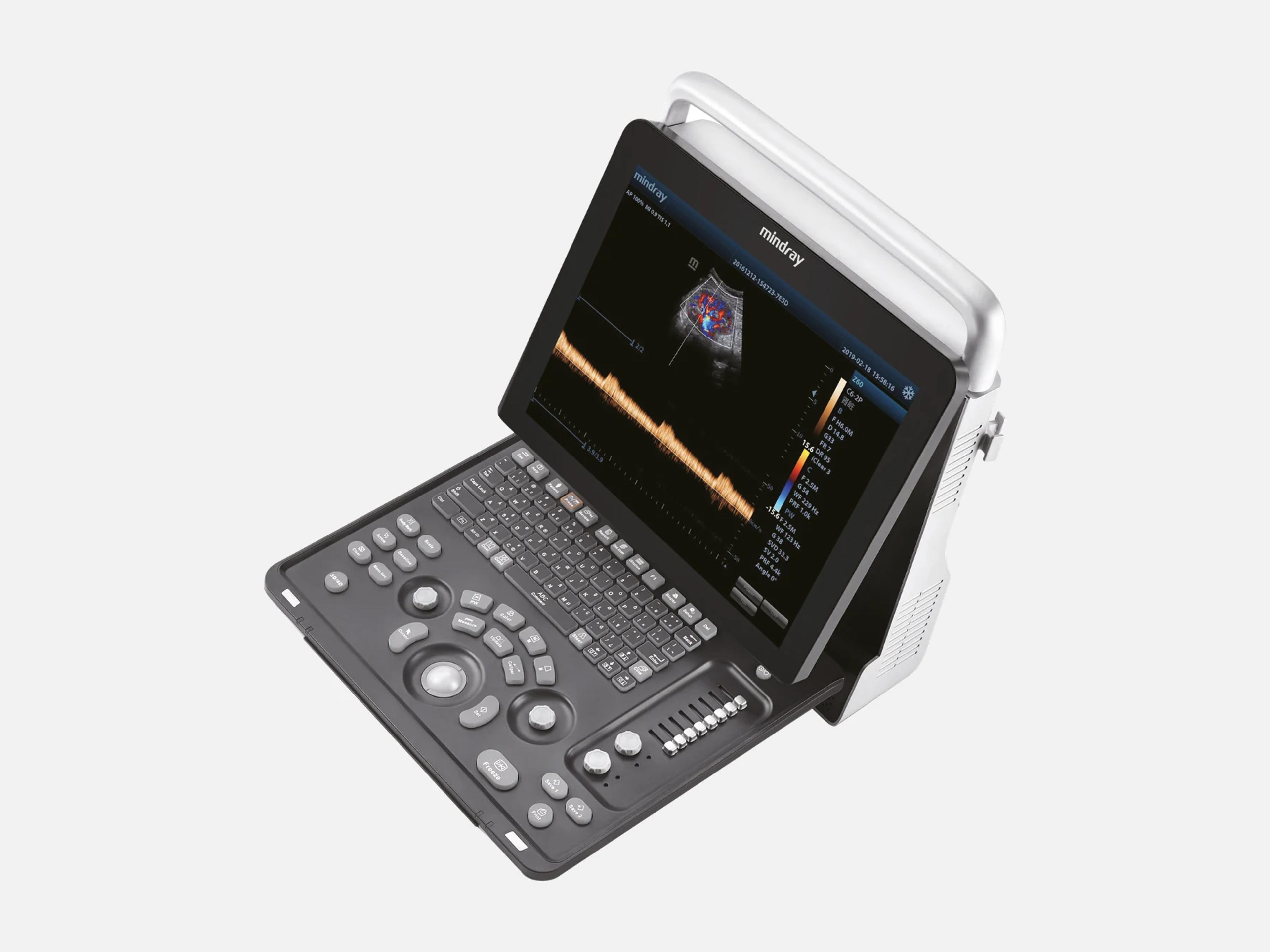
The Mindray Z60 is a portable color Doppler ultrasound system for private offices and primary care, with a 15-inch tilting LCD and up to 3 probe ports. Its indications span fetal, abdominal, small-organ, cardiac, peripheral vessel, transvaginal and urology exams, with 3D/4D, contrast and elastography options. It shares FDA clearance K200411, decided in April 2020, with the Z6, Z60T, Z60S, Z60 Pro and DP-60.
- Released
- 2020first FDA clearance
- Probe ports
- Up to 3universal connectors
- Display
- 15-inchfull-screen LCD with tilt
- Weight
- 8.2 ± 0.5 kgtwo-port setup, no battery
Compatible probes
Linear
- L14-6P
- 7L4BP Elastography (option)
- 75L38P Elastography (option)
- 7LT4P Intraoperative
Convex & microconvex
- C6-2P Contrast imaging (option)
- 3C5P Contrast imaging (option)
- 35C50P Contrast imaging (option)
- 6C2P
- D6-2P Volume probe for static 3D and 4D
Phased
- P7-3P Adult and pediatric cardiac
- 2P2P Adult and pediatric cardiac
Endocavity
- 6CV1P Transvaginal and transrectal
- V10-4BP Transvaginal and transrectal
- CB10-4P Bi-plane, transrectal
- 6LE7P Linear endocavity, transrectal
Specifications
Display
- Display
- 15-inch full-screen LCD; monitor tilt adjustable through 60 degrees
Physical
- Weight
- 8.2 ± 0.5 kg net, without battery, two-probe-port configuration
- Dimensions
- 147 ± 5 mm deep × 361 ± 5 mm wide × 358 ± 5 mm high
- Probe ports
- Up to 3 universal transducer connectors (ports A, B and C)
- Controls
Backlit panel, alphanumeric keys, trackball, Gain/iTouch knob, user-defined F1 keyBacklit control panel with alphanumeric keys, trackball and Set key, user-defined F1 key, Gain/iTouch knob, a multifunction knob, Caliper and Report controls, and dedicated keys including Patient, Probe, Review, Report, End Exam, iStation, Biopsy, Dual, Quad, Steer, Cine, Body Mark and 3D/4D; LCD brightness and contrast set with Fn plus the direction keys.Show allShow less
Power & battery
- Battery
- Rechargeable lithium-ion, model LI34I002A; battery pack listed as an option
- Charging
- Full charge from empty in less than 3 hours, with the system turned off
- Power
- 100–240 V~, 50/60 Hz; input 1.5–0.8 A; fuse 250 V~ T3.15AH; internal AC power adapter
Connectivity & options
- Connectivity
Network, USB, separate and composite video, VGA, remote and ECG ports; optional wirelessI/O panel: network port, USB ports, separate video output, composite video output, remote control port, ECG port and VGA signal output; wireless adapter available as an option; one-click image save and transfer to a local server or USB.Show allShow less
- DICOM
DICOM 3.0; DICOM Basic, with worklist, MPPS, Query/Retrieve and structured report optionsDICOM 3.0. DICOM Basic (task management, DICOM storage, print, storage commitment, media storage including DICOMDIR); further options DICOM worklist, MPPS, Query/Retrieve, and OB/GYN, Vascular and Cardiac Structured Reports, which require DICOM Basic.Show allShow less
- iStorage
Direct transfer of images and reports to a PC over a network cableDirect transfer of images and reports to a PC over a network cable; also supports printing through an iStorage server.Show allShow less
- Storage
500 GB internal hard disk; USB flash drive or USB hard disk; optional DVD drive500 GB internal hard disk; USB flash drive or removable USB hard disk; DVD±RW, DVD±R, CD-R/W and CD-R, with the DVD drive listed as an option.Show allShow less
- Peripherals
Officejet Pro 8100 printer; P93W-Z and UP-X898MD video printers; 971-SWNOM footswitchGraph/text printer Officejet Pro 8100; black-and-white video printers P93W-Z and UP-X898MD; USB footswitch 971-SWNOM, 2-pedal or 3-pedal.Show allShow less
- Options
Imaging options, 4D module, ECG module, DICOM packages, mobile cart, DVD driveFree Xros M; iScape View; Color/Power; PW; CW; HPRF (requires PW); Smart 3D; iLive (requires the 4D module or Smart 3D); Tissue Doppler Imaging; Color M; Contrast Imaging; Elastography; iNeedle; iWorks; IMT module; Smart Face (requires the 4D module); Smart OB; DICOM Basic, worklist, MPPS, Query/Retrieve, and OB/GYN, Vascular and Cardiac Structured Reports; footswitch; battery pack; mobile cart (UMT-150, UMT-160 or UMT-170); DVD drive; 4D module; wireless adapter; ECG module; ECG lead (requires the ECG module); ultrasound gel.Show allShow less
Imaging & software
- Imaging modes
B, M, Color, Power, PW, CW, TDI, iScape, Smart 3D, static 3D, 4D, contrast, elastographyB; M, Anatomical M and Color M (CM); Color and Power (Dirpower); PW and CW Doppler; iScape; Tissue Doppler Imaging (TDI); Smart 3D; Static 3D; 4D; Contrast Imaging; Elastography. Color/Power, PW, CW, Smart 3D, TDI, Color M, Contrast Imaging and Elastography are options. The cleared modes also include biopsy guidance and contrast imaging with a liver contrast agent.Show allShow less
- Imaging technologies
Dynamic Beam Forming, iBeam, iClear, PSHI, TSI, B Steer, Trapezoid Imaging, ColorizationDynamic Beam Forming; iBeam Spatial Compounding Imaging; iClear Speckle Reduction Imaging; Tissue Harmonic Imaging (PSHI); Tissue Specific Imaging (TSI); B Steer, Trapezoid Imaging, Colorization; iScape, Panoramic View; 3D/4D options.Show allShow less
- PSH
- Phase Shift Harmonic Imaging (purified harmonic imaging)
- iTouch
- Single-key image optimization in B and PW modes, from the Gain/iTouch knob
- iBeam
- Spatial compounding from multiple scanned angles into a single image
- iClear
- Speckle reduction based on auto structure detection; adjustable level
- B-Steer
- Scan-line steering for needle, nerve and small-vessel visibility, with linear probes
- ExFOV
- Extended field of view on convex and linear probes; trapezoid imaging on linear
- iScape
- Panoramic imaging; option (iScape View)
- Free Xros M
- Anatomical M scanning in B, Color, Power and TVI modes; option
- 3D/4D Flip & Sync
- Views a volume from any direction; 3D/4D key on the control panel
- iPage
- Volume data shown as multiple parallel 2D images
- iLive
- Ray-casting rendering with virtual lighting; option, needs the 4D module or Smart 3D
- Smart Face
- One-touch fetal face optimization that removes occlusions; option, needs the 4D module
- Smart OB
- Single-click auto measurement of BPD, OFD, HC, HUM, AC and FL; option
- OB measurements
- Fast OB Measurement and Fetal Growth Curve, subject to configuration and region
- IMT
- Auto measurement of anterior and posterior carotid wall thickness; IMT module option
- Elastography
- Natural Touch Elastography; option, on the 7L4BP, 75L38P and 7L4P probes
- iStation
- Patient data management, clipboard and onboard reporting
- iWorks
- Scan protocol; option
- iZoom
- Single-key full-screen image view
Environment
- Operating
- 0–40 °C; 30–85% RH, no condensation; 700–1060 hPa
- Storage and transport
- −20–55 °C; 30–95% RH, no condensation; 700–1060 hPa
Compliance
- FDA 510(k)
K200411 (2020-04-08); Class II; product code IYN, with ITX and IYOK200411, Z6/Z60/Z60T/Z60S/Z60 Pro/DP-60 Diagnostic Ultrasound System; decided 2020-04-08, substantially equivalent; Class II; product code IYN, with subsequent codes ITX and IYO.Show allShow less
- Equipment classification
- Portable equipment; mobile with the cart; continuous operation; main unit IPX0
What to check when buying a used Mindray Z60
Reject a hot, deformed or discolored battery
A lithium-ion battery that gives off an odor or heat, or is deformed or discolored, must not be used.
How: Remove the battery from its rear bay, inspect it, and confirm it is the battery specified for the system.
Have a biomed run electrical safety tests
Electrical performance, leakage included, can degrade with long use.
How: Use a safety analyzer to test protective earth resistance and ground, and enclosure and patient leakage.
Inspect each probe's lens, housing, cable and connector
A defective probe may cause electric shock, a probe with a cracked connector must not be used, and peeling, cracks or a loose acoustic lens mark the end of a probe's service life.
How: Look over each probe surface, cable sheath and connector for cracks, peeling, rifts, bumps, protruding parts, spilled liquid or a loose lens, and clean off dried gel, which can harden and degrade the image.
Feel each probe face for abnormal heat
A probe that gives off excessive heat may burn the patient.
How: During a test scan with each probe, check the probe face for abnormal heat.
Common questions about the Mindray Z60
Is the Mindray Z60 FDA-cleared?
Yes. The Mindray Z60 is FDA-cleared under 510(k) K200411, found substantially equivalent on April 8, 2020, as a class II device under product code IYN, with subsequent codes ITX and IYO. The same clearance names the Z6, Z60T, Z60S, Z60 Pro and DP-60.
What exams is the Mindray Z60 indicated for?
The Z60 is indicated for adults, pregnant women, pediatric patients and neonates. Its intended exams are fetal, abdominal, intraoperative (abdominal, thoracic and vascular), pediatric, small organ (breast, thyroid, testes), neonatal and adult cephalic, transrectal, transvaginal, musculoskeletal (conventional and superficial), adult and pediatric cardiac, peripheral vessel and urology. It is not intended for ophthalmic use.
What is the difference between the Mindray Z60 and the Z6?
The Z60 joined the Z6 family through 510(k) K200411, with the Z6 (K182603) as its primary predicate and the same intended uses.
The family's list of product differences has five items: B-Profile, B-Hist, Double Dist, Trace Length (Spline) and Parallel. The Z60 has all five, and the Z6 lacks Parallel. At introduction, UWN Contrast Imaging, Smart Face and Smart OB were Z60 features the Z6 did not offer.
How do the Z60T, Z60S, Z60 Pro and DP-60 differ from the Mindray Z60?
All of them share one operator manual and one 510(k) with the Z60 and the Z6. Where the Z60 has all five items on the family's list of product differences, the Z60T lacks Double Dist, the Z60S lacks B-Hist, the Z60 Pro lacks B-Profile and B-Hist, and the DP-60 lacks all but Parallel.
The DP-60 also has no adult and pediatric cardiac application and does not support the 2P2P, P7-3P and D6-2P transducers.
Does the Mindray Z60 support 3D and 4D imaging?
Yes. Its modes include Smart 3D, static 3D and 4D, with Smart 3D and the 4D module as options, and the D6-2P convex volume probe supports static 3D and 4D.
3D/4D Flip & Sync lets a volume be viewed from any direction, Smart Face is a one-touch fetal face optimization that requires the 4D module, and iLive ray-casting rendering requires the 4D module or Smart 3D.