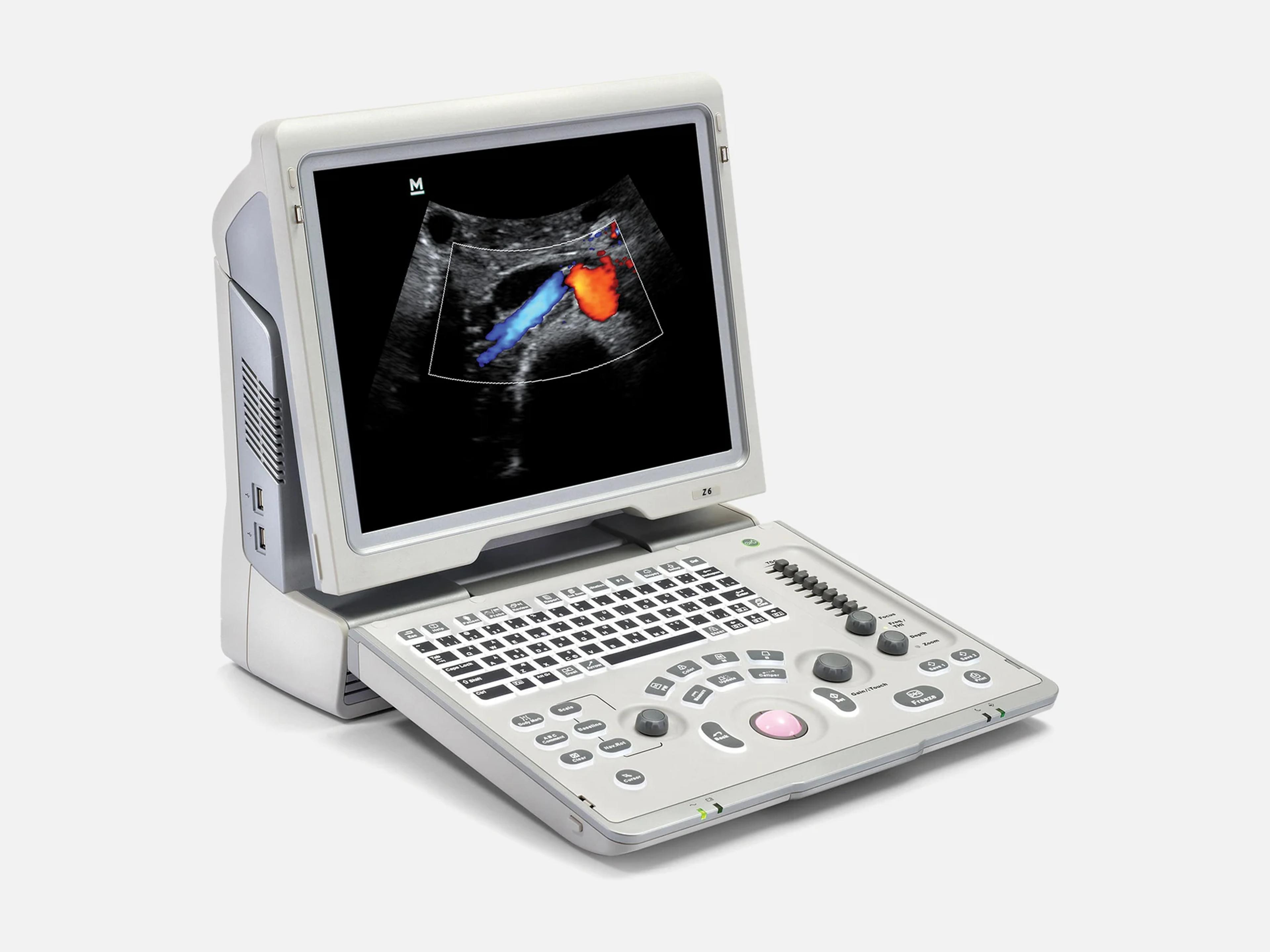
The Mindray Z6 is a portable color Doppler ultrasound system with a 15-inch tilting LCD, weighing no more than 8.8 kg with adapter and battery. It is FDA-cleared for fetal, abdominal, small-organ, musculoskeletal, cardiac, peripheral vessel and urology exams. Introduced in 2012, it shares a 2020 clearance, K200411, with the Z60, Z60T, Z60S, Z60 Pro and DP-60.
- Released
- 2012launched by Mindray
- Display
- 15-inch LCD1024 x 768, tilts up to 30°
- Weight
- ≤ 8.8 kgwith adapter and battery
Specifications
Display
- Display
- 15-inch LCD, 1024 x 768, tilt adjustable up to 30 degrees
Physical
- Weight
- ≤ 8.8 kg, including the AC/DC adapter and battery
- Dimensions (D x W x H)
- Folded 190 x 415 x 378 mm; unfolded 476 x 415 x 396 mm
- Probe ports
- Two sockets (A and B); one probe active at a time
- Controls
Folding backlit control panel, alphanumeric keyboard, trackball, 8-segment TGC slidersBacklit control panel that folds, released by two lock buttons; alphanumeric keyboard; trackball with adjustable backlight and sensitivity; 8-segment TGC sliders; user-defined keys (F1); dedicated keys including Patient, Probe, Review, Report, End Exam and iStation; optional USB footswitchShow allShow less
Power & battery
- Power
100-240 V~, 50/60 Hz, input 1.5-0.8 A; fuse 250 V~ T3.15AH100-240 V~, 50/60 Hz, input 1.5-0.8 A; fuse 250 V~ T3.15AH; runs on the lithium-ion battery when AC power is disconnectedShow allShow less
- Battery
Rechargeable lithium-ion, model LI34I002A, 14.8 V, 6600 mAh, in a bay at the backRechargeable lithium-ion battery, model LI34I002A, in a bay at the back of the system; 14.8 V, 6600 mAh; the battery pack is listed among the optionsShow allShow less
- Charging
- Under 3 hours from fully discharged, with the system off
Connectivity & options
- DICOM
DICOM 3.0; DICOM Basic; options: worklist, MPPS, Query/Retrieve, structured reportsDICOM 3.0; DICOM Basic (task management, storage, print, storage commitment, media storage including DICOMDIR); options: worklist, MPPS, Query/Retrieve, and OB/GYN, vascular and cardiac structured reportsShow allShow less
- Ports
Network, USB, video, composite video, VGA, remote control and ECG portsI/O panel: network port, USB ports, separate video output, composite video output, remote control port, ECG port and VGA output; two USB ports on the left sideShow allShow less
- Storage
System hard disk; USB flash drive or removable USB hard disk; optional DVD driveSystem hard disk; USB flash drive or removable USB hard disk; DVD±RW, DVD±R, CD-R/W and CD-R with the optional DVD driveShow allShow less
- File formats
- Single frames as BMP, JPG, TIFF or DCM; cines as AVI or DCM
- Quick Save
- One-push image transfer to local storage or directly to USB
- Peripherals
Officejet Pro 8100 printer; UP-X898MD and P93W-Z video printers; 971-SWNOM USB footswitchGraph/text printer Officejet Pro 8100; black-and-white video printers UP-X898MD and P93W-Z; USB footswitch 971-SWNOM, 2-pedal or 3-pedalShow allShow less
- Options
Imaging options, DICOM, 4D, ECG and IMT modules, battery pack, DVD drive, mobile cartFree Xros M, iScape module, Color/Power, PW, CW, HPRF (needs PW), Smart 3D, iLive, Tissue Doppler Imaging, Color M, Contrast Imaging, Elastography, iNeedle, iWorks, IMT module, application packages, DICOM modules, footswitch, battery pack, UMT-150 or UMT-160 mobile trolley, needle-guide bracket, DVD drive, 4D module, ECG moduleShow allShow less
Imaging & software
- Imaging modes
B, M, Color, Power (Dirpower), PW, CW, TDI, Smart 3D, 4D, Contrast Imaging, ElastographyB; M (M, Anatomical M, Color M); Color and Power (Dirpower); PW and CW Doppler; iScape; TDI; Smart 3D; Static 3D; 4D (4D module option); Contrast Imaging; Elastography; first cleared in 2012 with B, M, PW, CW, Color and Power/Dirpower and combined modesShow allShow less
- Features added in 2018
Contrast Imaging, TDI, 4D, Smart 3D, Color M, ECG, elastography, iNeedle, iWorksContrast Imaging (contrast agent for liver), TDI, 4D, Smart 3D, Color M, ECG, Free Xros M, iNeedle, MedSight, iWorks, iLive, ExFov, and elastography on the 75L38P and 7L4P probesShow allShow less
- PSHI
- Tissue Harmonic Imaging
- TSI
- Tissue Specific Imaging
- iBeam
- Spatial compounding imaging
- iClear
- Speckle reduction imaging
- iTouch
- One-button image optimization
- iZoom
- Enlarged image viewing from a distance
- iScape
- Panoramic view
- IMT
- Automatic carotid intima-media thickness measurement (IMT module option)
- iStation
- Clipboard and onboard reporting (patient information management)
- Other imaging features
- Dynamic beam forming, B Steer, Trapezoid Imaging, Colorization
Environment
- Operating
- 0-40 °C; 30-85% relative humidity, no condensation; 700-1060 hPa
- Storage and transport
- -20 to 55 °C; 30-95% relative humidity, no condensation; 700-1060 hPa
Compliance
- FDA 510(k)
K122010 (July 20, 2012); K182603 (November 14, 2018); K200411 (April 8, 2020)K122010 (July 20, 2012), Z6 Diagnostic Ultrasound System, regulation 892.1550, product code IYN; K182603 (November 14, 2018), a modification of K122010; K200411 (April 8, 2020), the combined Z6/Z60/Z60T/Z60S/Z60 Pro/DP-60 Diagnostic Ultrasound SystemShow allShow less
What to check when buying a used Mindray Z6
Have leakage current and grounding tested
Electrical performance can degrade with long use, and a multi-outlet strip can upset grounding and push leakage current past safety limits, putting patients and staff at risk of shock.
How: Have a biomedical technician run a full electrical safety inspection, leakage current included, with the Z6 on its own adapter and plugged straight into a grounded wall outlet.
Inspect each probe's lens, housing and cable
A probe with a cracked or scratched face, a loose lens or exposed wiring can give a patient an electric shock and has reached the end of its service life.
How: Under good light, look over each lens, housing and cable sheath for peeling, cracks, bumps, a loose acoustic lens or bare wire, and reject any probe that shows one.
Look for liquid damage and condensation
The Z6 is not waterproof, and liquid inside it, or condensation after a move from cold to warm, can cause electric shock, a short circuit or a malfunction.
How: Check the control panel, ports and vents for stains, residue or corrosion, and let a unit that arrives cold reach room temperature before powering it on.
Reject probes Mindray has not specified
An aftermarket probe Mindray has not specified for the Z6 can damage the system and, in the worst case, start a fire.
How: Confirm every probe offered with the system is a Mindray model specified for the Z6, and leave out any aftermarket or unbranded probe.
Common questions about the Mindray Z6
Is the Mindray Z6 FDA-cleared?
Yes. The Z6 Diagnostic Ultrasound System was cleared through 510(k) K122010 on July 20, 2012, under regulation 892.1550 with product code IYN, and a modification, K182603, was cleared on November 14, 2018.
The Z6 is also named in K200411, the combined Z6/Z60/Z60T/Z60S/Z60 Pro/DP-60 clearance of April 8, 2020. Its first 510(k) named the Mindray M5, M47, DC-7 and DP-6900 as predicate devices.
What exams is the Mindray Z6 cleared for?
The Z6 is cleared for use on adults, pregnant women, pediatric patients and neonates. Its cleared exams are fetal, abdominal, intraoperative (abdominal, thoracic and vascular), pediatric, small organ (breast, thyroid and testes), neonatal and adult cephalic, transrectal, transvaginal, musculoskeletal (conventional and superficial), adult and pediatric cardiac, peripheral vessel and urology.
Which probes are cleared for the Mindray Z6?
The Z6 was first cleared in 2012 with the 2P2P, 3C5P, 6C2P, 6CV1P, 6LE7P, 7L4P, 7L5P and 7LT4P transducers, all carried into its 2018 clearance, K182603. That clearance also includes the CB10-4P, L14-6P and V10-4BP, and it added the P7-3P, 75L38P, 35C50P and D6-2P.
K182603 also added elastography on the 75L38P and 7L4P.