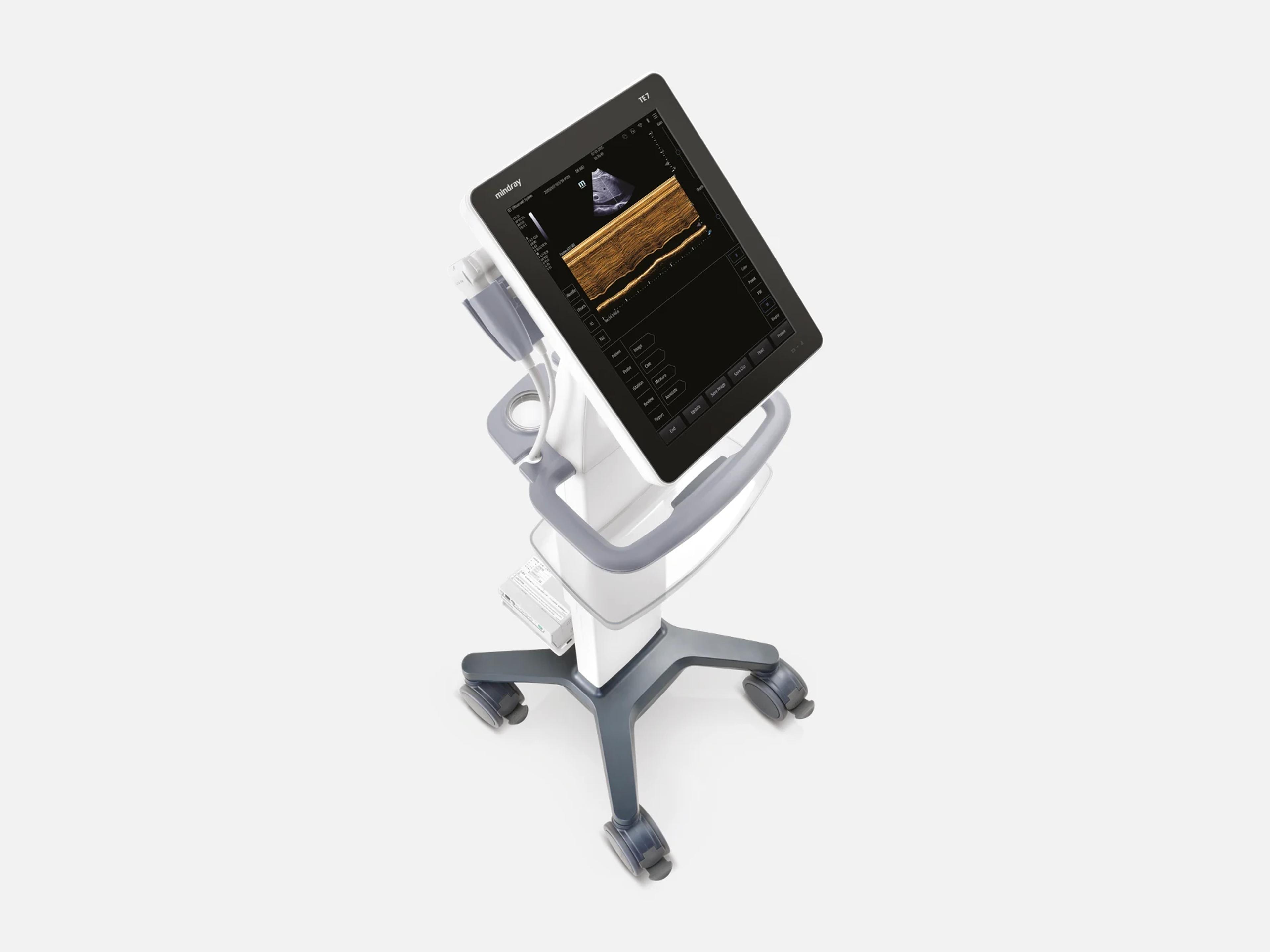
The Mindray TE7 is a portable point-of-care ultrasound system for use from routine exams to time-critical situations. It has a 15-inch touchscreen and up to 3 active transducer ports, and it can be configured with Auto EF, bedside TEE imaging, eSpacial Navi needle navigation, and Smart B-Line, Smart VTI and Smart IVC. Its family includes the TE5, TE7 Max, TE5 Max and TE9; the TE7 Max has a 21.5-inch display.
- Released
- 2015launched by Mindray
- Probe ports
- Up to 3one- or three-probe socket
- Display
- 15-inchhigh-resolution touchscreen
Compatible probes
Linear
- 7L4s
- 7LT4s
- L7-3s
- L9-3s
- L11-3VNs Works with eSpacial Navi needle navigation
- L12-3RCs 3 programmable buttons; earlier name L12-3RC
- L12-4s
- L14-5sp
- L14-6Ns
- L14-6s
- L20-5s
Convex & microconvex
- C4-1s
- C5-1s
- C5-2s
- C11-3s Micro-convex
Phased
- P4-2s
- P7-3s
- P10-4s
- SP5-1s
Endocavity
- V11-3ws Also written V11-3Ws
Specialty
- P7-3Ts Transesophageal
Specifications
Display
- Display
- 15-inch high-resolution touchscreen, seam-free, in a heads-up position
Physical
- Weight
- At most 7.2 kg with batteries, three-probe socket and one probe (15-inch screen)
- Dimensions
- 130±10 mm deep, 380±10 mm wide, 380±5 mm high, with probe holder (15-inch screen)
- Probe ports
- Up to 3 active transducer ports; one-probe or three-probe socket on the main unit
- Controls
Touchscreen with point-of-care protocols, iVocal voice control, USB footswitchTouchscreen operation with point-of-care protocols; second-generation iVocal voice recognition; L12-3RCs linear transducer with 3 programmable buttons; screen auto lock during cleaning; USB footswitch supported. iVocal voice-command control is listed for the Crystal Edition configuration.Show allShow less
- Cleaning design
Screwless design; seam-free touchscreen; screen lock for cleaning; removable dust filterLabels and screen designed for chemical disinfectants; seam-free touch screen; screen auto lock during cleaning; screwless design; removable dust filter; accessory management rack.Show allShow less
- Cart
- Adjustable height 50–61 in; base gets close to the bed; elevated transducer holders
- Mounting options
- Trolley (UMT-400/UMT-400Plus), wall mount, table stand, VESA connector, traveling case
Power & battery
- Battery
- Built-in lithium-ion, 14.8 V, 5800 mAh (single battery)
- Charging and standby
- 0 to 100% in less than 4 hours, off or in standby; more than 22 hours in standby
- Power
100-240 V~, 50/60 Hz; 19 Vdc to the main unit; 2.0 A (power adapter), 3.5 A (cart)100-240 V~, 50/60 Hz; 19 Vdc main unit direct input; power input 2.0 A with the power adapter, 3.5 A with the cart; retractable power cord.Show allShow less
Connectivity & options
- Ports
Network, USB, HDMI, serial port for the ECG module; four USB 3.0 on the Crystal EditionNetwork port; USB ports for storage, bar code reader, printer, footswitch and DVD recorder; HDMI; serial port for the ECG module. Four USB 3.0 ports in the TE7 Crystal Edition configuration.Show allShow less
- Wireless
- Built-in Wi-Fi, IEEE 802.11 b/g/n, WPA2-PSK; wired and wireless DICOM encryption
- DICOM
DICOM 3.0; options for Basic, Worklist, MPPS, structured reports and Query/RetrieveDICOM 3.0 conformance. Options: DICOM Basic (verify SCU and SCP, task management, Storage, Print, Storage Commitment, Media Storage including DICOMDIR); DICOM Worklist; DICOM MPPS; OB/GYN, Vascular, Cardiac, Breast and Small Parts structured reports; DICOM Query/Retrieve.Show allShow less
- Storage
- System hard disk; USB flash drive or removable USB hard disk; optical disk
- Cybersecurity
M-Secure: encryption, secure data wipe, anti-virus, OS hardening, access controlM-Secure Feature Suite: data encryption; wired and wireless DICOM encryption; secure data wipe; anti-virus; operating system hardening; access control.Show allShow less
- Peripherals
- Footswitch 971-SWNOM (2- or 3-pedal), external DVD R/W drive, iVocal microphone
- Software options
Clinical packages plus eSpacial Navi, CW, contrast, LVO, iNeedle, TDI, Smart 3D, IMT…Options for the TE7, TE5, TE7 Max, TE5 Max and TE9: eSpacial Navi, CW, Free Xros M, Contrast Imaging, Contrast Imaging QA, LVO, iNeedle, Tissue Doppler Imaging, Smart 3D, iScape View; Abdomen/General, Obstetrics, Gynecology, Cardiology, Small Parts, Urology, Vascular, Pediatrics, Nerve and Emergency & Critical packages; IMT, AutoEF, iVocal, iWorks, DVR Module, anti-virus, Smart IVC, Smart VTI, Smart B-line, Smart FHR OB1, Auto GA, Smart Bladder. FDA region only: Free Xros M, DICOM Small Parts SR, Smart FHR OB1, Auto GA and Smart Bladder.Show allShow less
Imaging & software
- Imaging modes
B, M, PW, Color, Power, THI, combined modes; optional CW, contrast, LVO, TDI, Smart 3DB, M, PW and CW Doppler, Color Doppler, Amplitude Doppler, Power/Directional Power, Tissue Harmonic Imaging, combined modes (B+M, PW+B, Color+B, Power+B, PW+Color+B, Power+PW+B), contrast imaging (LVO; liver), TDI, Color M, Smart 3D and iScape View. Optional: CW, Contrast Imaging, LVO, Tissue Doppler Imaging (needs the Cardiology Package), Smart 3D and iScape View.Show allShow less
- Contrast imaging
UWN+ CEUS (harmonic and fundamental signals); liver contrast on C5-1s, C4-1s, C5-2sUWN+ contrast-enhanced ultrasound (CEUS): second-generation ultra-wideband non-linear contrast imaging using both harmonic and fundamental signals. Liver contrast imaging with the C5-1s, C4-1s and C5-2s in the TE7/TE5 configuration.Show allShow less
- Cardiac tools
Auto EF (ejection fraction from 2D echo frames); TEE imaging at the bedsideAuto EF (automatic ejection fraction) recognizes diastole and systole frames in 2D echo data and calculates EDV, ESV and EF; TEE (transesophageal echocardiography) imaging at the bedside.Show allShow less
- Smart tools
Smart B-Line (B-line count and area), Smart VTI (VTI and cardiac output), Smart IVCSmart B-Line: automated count of B-lines and percentage of B-line area. Smart VTI: automated velocity time integral and cardiac output, with a CO/SV/VTI trend graph. Smart IVC: automated inferior vena cava measurement with a collapsibility/distensibility trend graph.Show allShow less
- Needle visualization
eSpacial Navi 4D magnetic needle navigation (L11-3VNs); iNeedle+ needle detectioneSpacial Navi (eSpacial Navigation) 4D magnetic needle navigation for in-plane and out-of-plane procedures, with the L11-3VNs transducer; iNeedle+ second-generation needle detection on linear and convex transducers.Show allShow less
- Measurement tools
- Double Dist, Depth, Parallel line, Spline length, Cross, Trace Len
- Workflow
iWorks auto workflow protocols; Z-Tracking records the probe used with each patientiWorks Auto Workflow Protocols, including emergency medicine protocols for abdomen, vascular and 38 other exams; Z-Tracking attaches the serial number of the transducer used during an exam to the patient's medical record.Show allShow less
- Training aid
- iScanHelper reference material for self-learning and training in scanning
- Crystal Edition features
- iZoom, PSH and Smart Track, in the Crystal Edition configuration
- Added with later clearances
Auto EF, eSpacial Navi, liver contrast (2018); Smart tools, Auto GA, iScape View (2021)In the TE7/TE5 configuration cleared on July 30, 2018: Auto EF, eSpacial Navi and liver contrast imaging. In the configuration cleared on March 23, 2021 for the TE7, TE5, TE7 Max, TE5 Max and TE9: Smart B-Line, Smart VTI, Smart IVC, Smart FHR OB1, Smart Bladder, Auto GA and iScape View.Show allShow less
- Revision and software
Crystal (2019), Crystal Series, Crystal Series 2.0; 04.03.02 on the Crystal EditionCrystal: a TE7 upgrade name Mindray published in April 2019. Crystal Series: a named TE7 upgrade. Crystal Series 2.0: the TE7's North American configuration name. Software 04.03.02: specified for the TE7 Crystal Edition in July 2021.Show allShow less
- Operating system
Windows 7 or Windows 10; Windows 10 from application software V4.0.0 (Rev22748)Windows 7 or Windows 10. Application software below V4.0.0 (Rev22748) runs on Windows 7 (V02.06.00 (Rev13235) or higher on the new CPU module); V4.0.0 (Rev22748) or higher runs on Windows 10 (V4.3.2A (Rev27321) or higher on the old CPU module). The version mapping is stated for the TE7/TE5 family as a whole.Show allShow less
- Application software
- V02.01.00, V02.06.00 (Rev13235), V03.00.00 (Rev17583), V4.0.0 (Rev22748) and others
Environment
- Operating environment
- 0 °C to 40 °C; 30% to 85% relative humidity, no condensation; 700 hPa to 1060 hPa
Compliance
- FDA 510(k)
K143472 (2015-01-02), K160381 (2016-03-09), K161525, K180912, K203391 (2021-03-23)K143472, TE7 Diagnostic Ultrasound System (decided 2015-01-02); K160381, TE7 Diagnostic Ultrasound System (2016-03-09); K161525, TE7 and TE5 (2016-07-13); K180912, TE7/TE5 (2018-07-30); K203391, TE7/TE5/TE7 Max/TE5 Max/TE9 (2021-03-23).Show allShow less
What to check when buying a used Mindray TE7
Check the internal battery's history and status
A lithium-ion battery installed or removed by inadequately trained personnel can overheat, catch fire or explode, and batteries left discharged through long standby, storage or transport can be permanently damaged.
How: Ask who last installed or removed the battery and how long the unit sat unused, then read the battery status in the top-right corner of the screen.
Have a biomed run the electrical safety tests
These tests show whether the enclosure, the accessories and the patient-applied parts are electrically safe before the unit goes into service.
How: With a safety analyzer, measure protective earth resistance, run the earth leakage test before the enclosure, patient and applied-part leakage tests, and inspect the plug, enclosure, accessories and labels.
Inspect each probe's head, lens and cable
Cracks, peeling or other surface defects on a probe, its cable or its connector can shock the patient, and a probe with peeling, rifts, bumps, cracks or a liquid spill should not be used.
How: Look for cracks or swelling of the probe head, peeling, rifts or bumps on the lens, and deterioration or erosion along the cable.
Inspect the power adapter, cord and plug
The system runs from its external power adapter, and a cracked adapter, a worn cable or a damaged plug fails the electrical safety inspection.
How: Look for wrinkles, cracks or wear on the cable, cracks or swelling on the adapter, a loose connection, bent or discolored plug pins and a damaged strain relief, and check that the plug stays cool in use.
Common questions about the Mindray TE7
Is the Mindray TE7 FDA-cleared?
Yes. The TE7 Diagnostic Ultrasound System is FDA-cleared under 510(k) K143472, decided January 2, 2015, and K160381, decided March 9, 2016.
Later clearances name it together with its siblings: K161525 (July 13, 2016) with the TE5, K180912 (July 30, 2018) as the TE7/TE5, and K203391 (March 23, 2021) with the TE5, TE7 Max, TE5 Max and TE9.
What is the difference between the Mindray TE7 and the TE7 Max?
The TE7 has a 15-inch display. The TE7 Max, which Mindray launched in North America on October 26, 2021, has a 21.5-inch, vertically oriented high-definition LED display.
Their measurement tools differ too. The TE7 has Double Dist, Depth, Parallel line, Spline length, Cross and Trace Len; the TE7 Max lacks Parallel line and Spline length, and the TE5 lacks Double Dist and Depth.
Is Mindray ending support for the TE7?
For units whose serial number starts with 7P, yes. Mindray's end-of-service notice SB 2235AC, dated December 12, 2024, sets December 31, 2025 as the end of parts support and repair center services for those units, and December 31, 2026 as the end of all technical support.
The notice covers that serial range only.
Are TE7 patient databases compatible across software versions?
Not downward. Patient databases from software V03.00.00 (Rev17583) or higher are not compatible with lower software versions, so check both systems' versions before moving patient data between TE7 units.