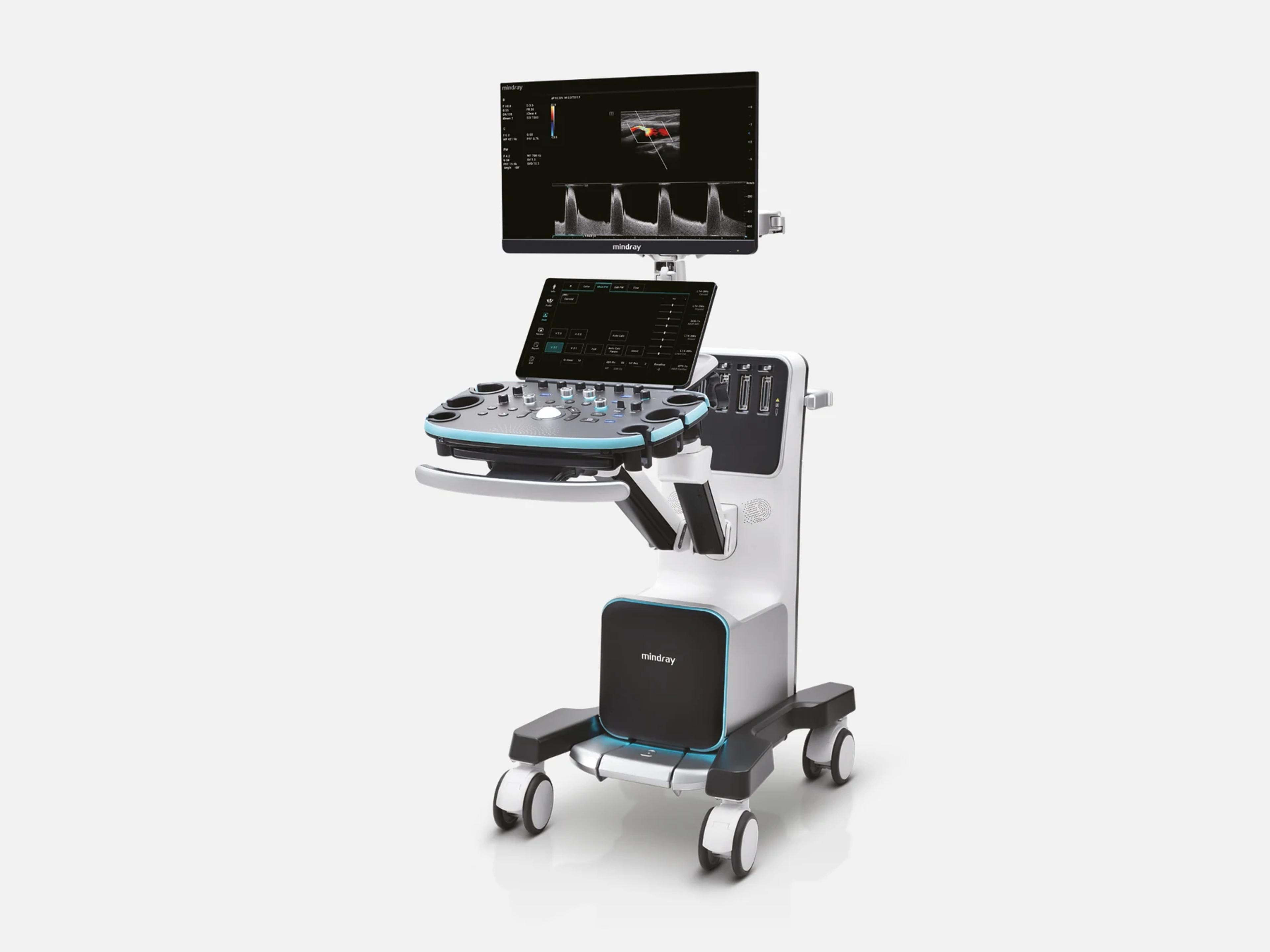
The Mindray Resona I9 is a cart-based general imaging ultrasound system for radiology, suited to vascular, women’s imaging and shared service work. It runs on the ZST+ platform, with a 15.6-inch touchscreen on a floating iConsole control panel, and folds to 1 m for transport. Its 2021 FDA clearance, K210699, also names the Resona I9T, a private-office system; the Resona I9 Elite Edition is a separate product.
Compatible probes
Linear
- L9-3s
- L14-3Ws
- L16-4Hs
- L20-5s
Convex & microconvex
- C6-2Gs
- SC6-1s Single crystal
- SC8-2s Single crystal
- C11-3s Micro-convex
Phased
- SP5-1s Single crystal
Endocavity
- V11-3Hs
- DE11-3Ws Volume
Specialty
- P7-3Ts Transesophageal
- CW2s Pencil, continuous wave
- CW5s Pencil, continuous wave
- ELC13-4s Bi-plane
- SD8-1s Single crystal volume
Specifications
Display
- Main monitor
23.8-inch LED, high resolution, bezel-less, adaptive brightness, on an adjustable arm23.8-inch LED monitor with a high-resolution display, bezel-less, with adaptive brightness adjustment, on a monitor support arm that adjusts for height and displacement, rotates, tilts and locks.Show allShow less
- Touchscreen
- 15.6-inch HD touchscreen, customizable, gesture-operated, on the floating control panel
Physical
- Dimensions
L 1020 ± 20 mm, W 550 ± 10 mm, H 1000 ± 20 mm, monitor and panel at minimum positionLength 1020 ± 20 mm, width 550 ± 10 mm, height 1000 ± 20 mm, with the monitor and control panel at their minimum position.Show allShow less
- Weight
- 105 kg ± 4 kg, standard configuration
- Mobility
3 full-lock and 1 double-lock caster; optional central brake; rear handle; folds to 1 m3 full-lock casters and 1 double-lock caster; optional central brake that locks the 3 full-lock casters; rear handle for pushing and moving; folds to a height of 1 m for transport.Show allShow less
- Controls
iConsole, adaptive layout, six E-ink keys; floating lockable panel; trackball; QWERTYiConsole intelligent control panel with an exam-specific adaptive layout and six customizable E-ink keys whose labels persist when powered off; full-space floating control panel, lifted or swiveled by its adjusting lever and lockable at any position; trackball; QWERTY keyboard; shortcut switching of the most recently used probes and exams.Show allShow less
- Transducer ports
S-type sockets; E- and U-type probes through PCM-ES01 / PCM-US01 adapters; pencil portElevated transducer sockets on the main unit with an S-type interface; E-type probes connect through the PCM-ES01 adapter and U-type probes through the PCM-US01 adapter; separate pencil probe port on the front I/O panel.Show allShow less
- Acoustic noise
- Modular for serviceability, with a small footprint
- Modular design
- Modular design for serviceability; small, modular footprint
Power & battery
- Power
100–240 VAC, 50/60 Hz, 650 VA; two auxiliary AC outputs, 300 VA maximumInput 100–240 VAC, 50/60 Hz, power consumption 650 VA; two AC auxiliary outputs for optional peripherals, 100–240 VAC, 50/60 Hz, 300 VA maximum auxiliary output.Show allShow less
- Battery
Optional battery assembly, 4-set or 8-set; 14.4 VDC, 6600 mAh per batteryOptional battery assembly, in two standby versions (4 sets or 8 sets of batteries); 14.4 VDC, 6600 mAh per single battery; a fully discharged battery charges in less than 6 hours; grasping the right handle shows the residual-power indicator.Show allShow less
Connectivity & options
- DICOM and network
Optional DICOM (storage, print, worklist, MPPS, query/retrieve, SR); HL7; Wi-Fi optionOptional DICOM package: Verify Connectivity, Storage, Print, Worklist, MPPS, Storage Commitment, Query/Retrieve and Structured Report, with OB/GYN, vascular, cardiac, breast, abdomen, small parts, pediatric and urology SR options (small-parts SR requires the DICOM base unit); HL7 query V2.3, V2.4, V2.5 and V2.6; wired network port; optional built-in wireless adapter for DICOM transfer over Wi-Fi, iStorage remote network storage and MedSight mobile-terminal interaction.Show allShow less
- I/O ports
Front: pencil probe, PCG, ECG/DC IN, USB, audio. Back: HDMI, VGA, S-Video, USB, networkFront I/O panel: pencil probe port, PCG input, ECG/DC IN (ECG leads or external ECG signal), high-speed USB, audio input/output. Back I/O panel: HDMI, VGA, S-Video output, high-speed USB, network port.Show allShow less
- Storage
- HDD and SSD standard; optional DVD; USB storage; optional iStorage network storage
- Hardware options
CW, 4D/TEE, ECG and PCG kits; Wi-Fi; battery; fusion kit; footswitch; barcode; DVD; DVRCW module kit; 4D/TEE module kit; built-in wireless adapter; battery assembly; ECG module kit (AHA); PCG transducer kit; ultrasound gel warmer; iClear+ dongle; 1D and 2D barcode scanners; footswitch (1-, 2- or 3-pedal); DVD assembly; iVocal microphone package; DVR module; Ultrasound Fusion Imaging Kit (magnetic positioning system controller, magnetic generator, 2 fusion imaging sensors, motion sensor support).Show allShow less
- Supported peripherals
Printers P95DW-N, UP-X898MD, UP-D25MD, OFFICEJET PRO 8100; barcode readers; footswitchesVideo printers P95DW-N (digital black and white), UP-X898MD (analog black and white) and UP-D25MD (digital color); graph/text printers including the OFFICEJET PRO 8100; barcode readers LS2208, DS4308 and HH1800; footswitches FS-81-SP-2 and 971-SWNOM.Show allShow less
Imaging & software
- Imaging modes
B, M, PWD, CWD, Color and Power Doppler, Smart3D, 4D, iScape View, TDI, Color M, V FlowB, M, PWD, CWD, Color Doppler, Amplitude (Power) Doppler, combined modes (B+M, PW+B, Color+B, Power+B, PW+Color+B, Power+PW+B), Tissue Harmonic Imaging, Smart3D, 4D (real-time 3D), iScape View panoramic imaging, TDI, Color M, Strain Elastography, contrast imaging (LVO and liver), V Flow, STE, STQ and Anatomical M Mode.Show allShow less
- Imaging platform
ZST+: channel-data processing in place of conventional beam-formingZONE Sonography® Technology+ (ZST+): channel data based processing in place of conventional beam-forming, with Total Recall Imaging, Sound Speed Compensation, Dynamic Pixel Focusing, Advanced Acoustic Acquisition and Enhanced Channel Data Processing.Show allShow less
- Sound Speed Compensation
- One-touch: detects tissue characteristics and sets the sound speed
- Application packages
Abdomen/General, OB, GYN, Cardiology, Small Parts, Urology, Vascular, Pediatrics, Nerve…Abdomen/General, Obstetrics, Gynecology, Cardiology, Small Parts, Urology, Vascular, Pediatrics, Nerve, Emergency & Critical and Pelvic Floor (requires the Gynecology Package), each an option.Show allShow less
- Elastography
Strain; STE shear wave; HiFR STE; Endocavity STE; STQ quantification (all options)Strain Elastography; STE (Sound Touch Elastography) shear wave elastography; HiFR STE, high-frame-rate 2D shear wave elastography with a motion stability index and reliability map (requires STE or Endocavity STE); Endocavity STE; STQ (Sound Touch Quantification). All are options.Show allShow less
- Contrast imaging
UWN+ CEUS; LVO; HiFR CEUS; Volume CEUS; TCMR; Chrono-Parametric; Micro Flow EnhancementUWN+ contrast imaging (second-generation Ultra-Wideband Non-Linear CEUS, using 2nd-harmonic and non-linear fundamental signals); LVO, left ventricular opacification (requires the Cardiology Package); HiFR CEUS; Volume CEUS (requires the 4D module); TCMR (Tissue-Contrast Mix Rendering); CEUS Chrono-Parametric Mode; Contrast Imaging QA; Micro Flow Enhancement for small-vessel perfusion.Show allShow less
- Flow imaging
V Flow vector flow; Glazing Flow; Ultra-Micro Angiography (UMA); CPP blood-flow ratioV Flow vector flow imaging, with color-coded arrows for blood cell velocity magnitude and direction (requires the Vascular Package); Glazing Flow, three-dimensional visualization of microvascular flow and vessel borders; Ultra-Micro Angiography (UMA), which separates tissue motion from low-velocity blood flow; CPP, the proportion of blood-flow pixels in a region of interest in Color or Power mode (not TDI).Show allShow less
- Liver tools
Fatty Liver Lab with USAT and HRI+; Smart HRI liver-to-renal-cortex brightness ratioFatty Liver Lab tool kit: USAT (ultrasound attenuation analysis) and HRI+ (HepatoRenal Index Plus, requires USAT); Smart HRI, liver steatosis assessment with automatic organ recognition and a liver-to-renal-cortex brightness ratio (requires the Abdomen/General Package).Show allShow less
- Cardiac tools
AutoEF, Tissue Tracking QA, TDI and TDI QA, Stress Echo, Smart VTI, Smart IVCAutoEF, automated ejection fraction from 2D echo clips; Tissue Tracking QA, 2D speckle-tracking left ventricular strain; Tissue Doppler Imaging; Stress Echo; Smart VTI (each requires the Cardiology Package); TDI QA (requires Tissue Doppler Imaging); Smart IVC (requires the Cardiology or Abdomen/General Package).Show allShow less
- Vascular tools
RIMT and IMT, R-VQS vessel wall analysis, V-Mapping varicosity mappingRIMT, real-time RF-data based intima-media thickness, and IMT; R-VQS vessel wall analysis, giving a vessel hardness coefficient and pulse wave velocity; V-Mapping, which draws vessel pathology on an anatomy map for preoperative varicosity assessment. Each requires the Vascular Package.Show allShow less
- Obstetric tools
Smart OB, Smart NT, Smart Fetal HR, Smart Planes CNS and FH, Smart ICV, Smart FaceSmart OB, Smart NT, Smart Fetal HR and FH Tissue Tracking QA (each requires the Obstetrics Package); Smart Planes CNS, Smart Planes FH and Smart Face (each requires the 4D module and the Obstetrics Package); Smart ICV (requires Smart Planes CNS).Show allShow less
- Gynecology tools
IOTA ovarian tumor analysis, IVF, Smart FLC follicle calculation, Smart PelvicIOTA (International Ovarian Tumor Analysis); IVF (requires the Gynecology Package); Smart FLC, Smart Follicles Calculation (requires the 4D module and the Gynecology Package); Smart Pelvic (requires the Pelvic Floor Package).Show allShow less
- 3D/4D tools
Smart 3D, Smart Scene 3D, iLive, Color 3D, STIC, SCV+, Niche, iPage+, Smart VolumeSmart 3D; 3D-Print Format; Smart Scene 3D, which sets the 3D/4D ROI and render modes for the recognized anatomy; Color 3D, STIC, SCV+, Niche, iPage+ and Smart Volume; Smart V Trace (requires Smart Volume); iLive (requires the 4D module or Smart 3D). Smart Scene 3D, Color 3D, STIC, SCV+, Niche, iPage+ and Smart Volume require the 4D module.Show allShow less
- Breast and thyroid
Smart Breast BI-RADS lesion analysis; Smart Thyroid TI-RADS nodule analysisSmart Breast: BI-RADS-based automatic lesion detection, measurement, annotation, analysis and reporting; Smart Thyroid: thyroid nodule analysis and reporting with multi-plane TI-RADS classification.Show allShow less
- Fusion and needle guidance
CT/MRI fusion, Endocavity Fusion, Fusion RESP, Needle Navigation, iNeedle, Biopsy GridUltrasound Fusion Imaging, CT/MRI navigation with the magnetic positioning Ultrasound Fusion Imaging Kit; Endocavity Fusion Imaging; Fusion RESP respiration compensation and Needle Navigation (each requires Ultrasound Fusion Imaging); iNeedle; Biopsy Grid.Show allShow less
- More options
Smart Bladder, Smart B-line, Smart Hip, Smart Trace, iWorks, iVocal, iClear+, Free Xros MSmart Bladder (requires the Abdomen/General or Urology Package); Smart B-line; Smart Hip (requires the Pediatrics Package); Smart Trace; iWorks auto workflow protocols; iVocal voice option, with the iVocal microphone package; iClear+ (requires the iClear+ dongle); Free Xros M; Free Xros CM.Show allShow less
- Operating system
- Windows, with Windows Defender and a security-software option, or Linux, with ClamAV
- Software enhancement
- Living Technology software-enhancement program
Environment
- Operating conditions
- 0–40 °C, 20–85% relative humidity (non-condensing), 700–1060 hPa
- Storage and transport conditions
- −20 to 55 °C, 20–95% relative humidity (non-condensing), 700–1060 hPa
- Ingress protection
- Main unit IPX0; probes IPX7; footswitch IPX8
Compliance
- FDA 510(k)
K240684 (2024-06-17), K210699 (2021-06-10)K240684 (decided 2024-06-17) and K210699 (decided 2021-06-10), both substantially equivalent; System, Imaging, Pulsed Doppler, Ultrasonic; regulation 892.1550; product code IYN. K210699's main predicate: Resona 7 (K171233), with the thoracic/pleural exam on MX7 (K200001).Show allShow less
What to check when buying a used Mindray Resona I9
Have a biomed run electrical safety tests
Long use can degrade the system's electrical and mechanical performance, including leakage, which these tests measure.
How: Ask for protective earth resistance, earth, enclosure and patient leakage, mains-on-applied-part leakage and patient auxiliary readings from a safety analyzer.
Inspect every probe cable and connector pin
A probe with surface defects, cracks or peeling can give the patient an electric shock.
How: Look for deterioration or erosion along each cable and for bent, broken or missing pins, and keep the connector dry because it is not waterproof.
Check each probe for abnormal surface heat
A probe that gives off excessive heat can burn the patient.
How: Scan with each probe after power-on and reject any whose face runs abnormally hot.
Inspect the enclosure for cracks and spill residue
The system is not waterproof, and a safety inspection fails a unit with enclosure damage, fluid residue or loose or missing parts.
How: Check every cover, connector, switch and accessory for cracks, distortion, dirt or damage, and look for residue from spilled fluid.
Common questions about the Mindray Resona I9
Is the Mindray Resona I9 FDA-cleared?
Yes. The Resona I9 is FDA-cleared under 510(k) K210699, decided on June 10, 2021, and K240684, decided on June 17, 2024, both as substantially equivalent. It is classed as a pulsed Doppler ultrasonic imaging system (product code IYN, regulation 892.1550), and its 2021 clearance named the Resona 7 as its main predicate.
Does the Resona I9 accept Mindray probes with E-type or U-type connectors?
Yes, through probe adapters. The Resona I9's own sockets are S-type: E-type probes connect through the PCM-ES01 adapter and U-type probes through the PCM-US01.
The P7-3TE, SC6-1E, SD8-1E and SP5-1E connect through the PCM-ES01, and the P7-3TU and SP5-1U through the PCM-US01.
When did the Mindray Resona I9 come out?
Mindray launched the Resona I9 worldwide in June 2021, and launched it in North America, for the radiology market, on May 23, 2022.