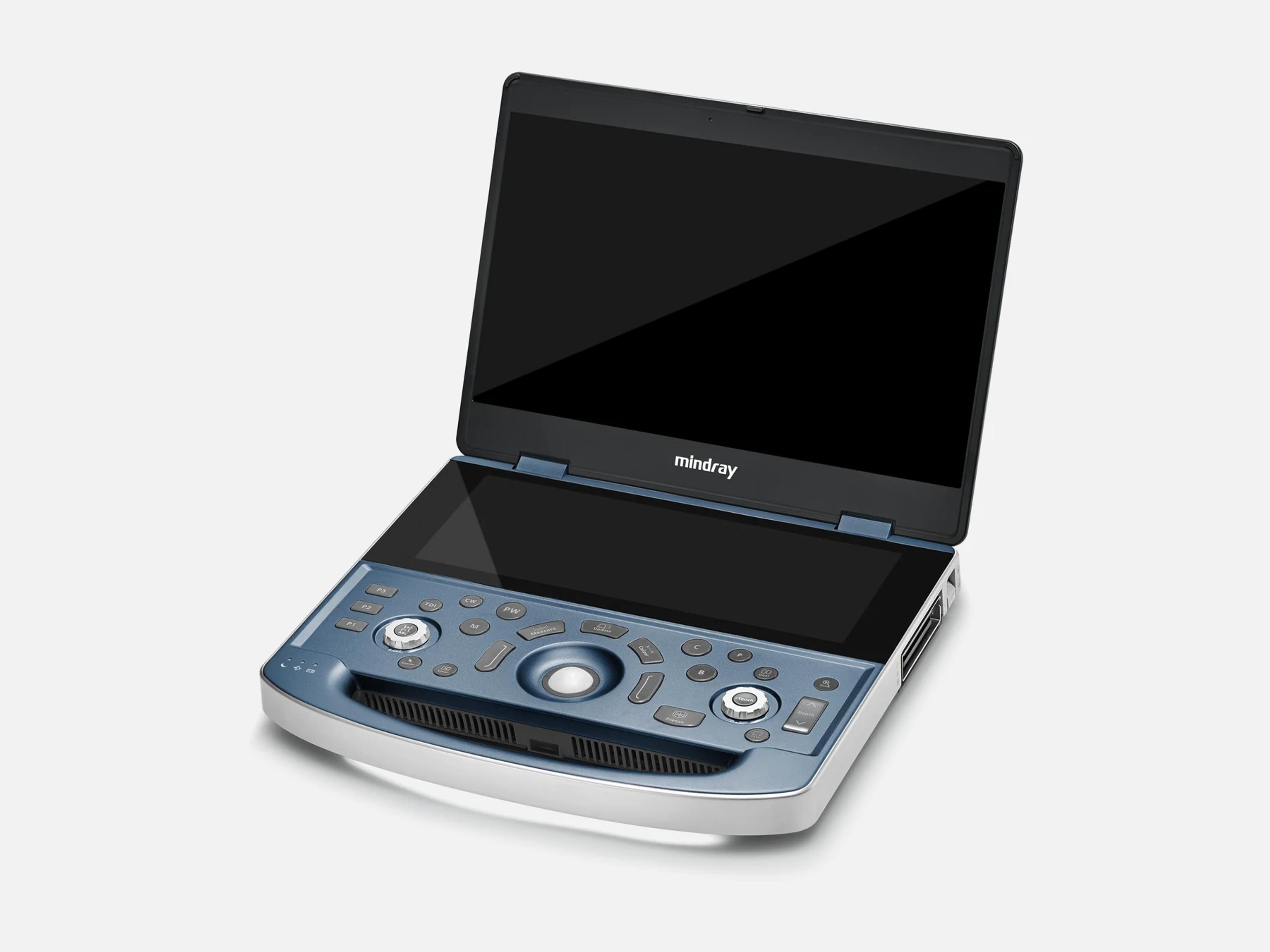
The Mindray MX7 is a laptop-format ultrasound system on Mindray's ZST+ platform, made for general imaging and cardiovascular work in clinic and office settings. It weighs less than 4.0 kg with its batteries and pairs a 15.6-inch monitor with a 12.3-inch touch screen; 3D/4D imaging is optional. It shares its 510(k) clearances and operator's manual with siblings including the MX8, ME7 and ME8.
- Released
- 2020first FDA clearance
- Probe ports
- 1active, on the main unit
- Display
- 15.6-inch1920 × 1080 color LED
- Weight
- under 4.0 kgincluding batteries
Compatible probes
Linear
- L12-3RCs
- L13-3s
- L14-3Ws
- L14-6Ns
- L15-3RCs
- L20-5s
- L24-6Hs
- L24-6RCs
Convex & microconvex
- C5-1s
- C11-3s Micro-convex
- D7-2s Volume convex; needs 4D software
Phased
- P4-2s
Endocavity
- V11-3s
- DE11-3s Endocavity volume; needs 4D software
Specialty
- CW2s Non-imaging CW
Specifications
Display
- Display
- 15.6-inch color LED monitor, 1920 × 1080; folds down onto the main unit and tilts
- Touch screen
- 12.3-inch, 1920 × 720; configurable layout that changes with application and imaging mode
- Secondary display
- On the main unit: battery capacity, AC power status and product model
Physical
- Weight
- Less than 4.0 kg including batteries; main unit 6.6 lb
- Dimensions
- (322 ± 5) × (364 ± 5) × (44 ± 3) mm (D × W × H); main unit 1.7 in thick
- Housing
- Magnesium alloy shell
- Probe ports
One active port on the main unit; the optional extension module gives two connectionsOne active transducer port on the main unit, with a locking lever; it takes a probe or the probe extension module. The optional extension module, on the mobile cart, provides two probe connections. The optional Probe Adapter PCM-CWS01 connects to the port and takes a CW-connector probe.Show allShow less
- Controls
Trackball or trackpad; dedicated B, Color, Power, M, PW, CW and TDI keys; iTouchControl panel with trackball or trackpad; dedicated B, Color, Power, M, PW, CW and TDI keys; iTouch; user-defined keys; voice control through the optional iVocal or iVocal Plus microphone.Show allShow less
Power & battery
- Battery
Built-in lithium-ion, 14.4 V, 6600 mAh per battery; full charge in less than 4 hoursBuilt-in lithium-ion battery; 14.4 V, 6600 mAh per battery; a full charge from 0 to 100% takes less than 4 hours with the system off or in standby.Show allShow less
- Optional battery (U-Bank)
U-Bank pack of 2 or 4 batteries, 19 V DC; up to 8 hours continuous scanningOptional U-Bank external battery pack (2 or 4 batteries); 19 V DC; 26400 mAh or 13200 mAh; a charge from 0 to 100% takes about 5 hours with the system off or in standby; up to 8 hours continuous scanning with the U-Bank.Show allShow less
- Power
- 100–240 V AC, 50/60 Hz; input 2.0–1.0 A (cart 4.4–2.5 A); external power adapter
Connectivity & options
- I/O ports
- S-Video output, wired network port, HDMI, USB ports, power input
- Wireless LAN
- Through the optional WiFi module
- DICOM
Storage, print, worklist, MPPS, storage commitment, query/retrieve, structured reportsDICOM Basic option (Verify SCU and SCP, task management, Storage, Print, Storage Commitment, Media Storage including DICOMDIR); DICOM Worklist, MPPS and Query/Retrieve; structured reports for OB/GYN, Vascular, Cardiac, Breast and Abdomen. Availability depends on the installed options.Show allShow less
- DICOM conformance statement
- Revision 4.0, released 05-2025, shared with the ME8 and MX8; part H-046-018713-00
- HL7
- Query service; protocol versions V2.3, V2.4, V2.5 and V2.6
- Network services
Presets for iStorage, MedTouch/MedSight, Remote Maintenance, Q-Path, eGateway and moreNetwork presets for iStorage, MedTouch/MedSight, Remote Maintenance, Q-Path, eGateway, MIOT, X-Link and HD Access Server; X-Link availability depends on configuration.Show allShow less
- Security
Drive encryption of patient data, secure wipe, Windows Defender, VPN and TLS encryptionDrive encryption of patient data on the hard disk (Factory Default or User Define); secure data wipe; Windows Defender installed; transmission encryption (VPN configuration, TLS).Show allShow less
- Storage
- 128 GB SSD (2020 configuration); USB storage devices; external DVD R/W drive supported
- Supported peripherals
Video printers P95DW-N, UP-X898MD, UP-D25MD; DVD drive GP60NB60; barcode reader HH1800Video printers P95DW-N, UP-X898MD and UP-D25MD; external DVD R/W drive GP60NB60; barcode readers including HH1800; footswitches 971-SWNOM (2 or 3 pedals) and FS-81-SP-2 (1 pedal).Show allShow less
- ECG and physiological signals
- Optional ECG module on a USB port; ECG and respiratory waveform display
- Mobile cart
Optional MT2 or MT3; MT3 adds a lifting column and a peripheral outlet (max 240 VA)Optional MT2 or MT3 mobile trolley. The MT3 has a lifting column for height adjustment, a power outlet for peripherals (maximum output 240 VA) and an optional retractable power cable; a probe extension module is optional; the U-Bank can be installed in place of the main unit tray.Show allShow less
- Hardware options
Mobile cart, ECG module, WiFi module, Probe Adapter PCM-CWS01, U-Bank, footswitchMobile Cart, ECG module, Multilingual controls overlay, Dust-proof cover, WiFi module, Probe Adapter PCM-CWS01, U-Bank, Barcode Reader, Air Capsule, iVocal Microphone, iVocal Plus Microphone Array, Magnetizer package, Footswitch, Main unit cover, Display cover.Show allShow less
- Standard configuration
Main unit, power adapter, built-in batteries, system software, traveling case, cablesMain unit, power adapter, built-in batteries, system software, traveling case, accessories, operator's manuals, user-defined label, cables.Show allShow less
Imaging & software
- Platform
- ZONE Sonography® Technology+ (ZST+) virtual beamforming architecture
- Imaging modes
- B, Color, Power, M, Color M (CM), Anatomical M, PW/CW and TDI
- Anatomical M-mode
- Free Xros M (linear) and Free Xros CM (curved)
- 3D/4D imaging
- Optional: Static 3D, 4D, Smart 3D and 3D-Print Format, with iLive Technology
- Contrast imaging
UWN+ contrast-enhanced ultrasound (harmonic and fundamental signals); LVO; liver useUltra-Wideband Non-Linear (UWN+) contrast-enhanced ultrasound using both harmonic and fundamental signals; LVO (Left Ventricular Opacification); the 2024 clearance lists contrast imaging for left-ventricular opacification and liver applications.Show allShow less
- Elastography
- Natural Touch Elastography for soft-tissue elasticity and stiffness; Strain Elastography
- AutoEF
- Recognizes the A2C or A4C view, the endocardial border, and diastole and systole frames
- Tissue Doppler Imaging (TDI)
- TVI, TEI, TVD and TVM; real-time and offline comparison; TDI Quantitative Analysis
- Tissue Tracking QA
- Tissue Tracking Quantitative Analysis, with TTQA-RV for the right ventricle
- Stress Echo
- Multiple load protocols and wall motion scoring
- RIMT
- Real-time intima-media thickness measurement based on RF data
- iScape View
- Panoramic imaging
- iZoom
- Full-screen image zoom
- iTouch
- Automatic image-parameter optimization
- TSI (Tissue Specific Imaging)
- Image optimization matched to tissue properties
- iBeam
- Standard feature in the 2020 configuration
- iWorks
- Protocol-based workflow (Auto Workflow Protocol)
- Living Technology™
- Mindray's software-update approach for the MX7
- Imaging options
Contrast imaging, Contrast Imaging QA, Low MI Contrast, Strain Elastography, Smart Face…iScape View, Contrast imaging, Contrast Imaging QA, Low MI Contrast, Strain Elastography, Smart 3D, Smart Face; Smart Face and Face+ availability depends on configuration.Show allShow less
- Analysis and measurement options
Smart VTI, Smart IVC, Smart B-line, Smart OB, Smart NT, Auto GA, Auto DFR, Smart Bladder…TDI QA, Tissue Tracking QA, TTQA-RV, Smart VTI, Smart IVC, Smart B-line, R-VQS, Auto VM, Smart FV, Smart OB, Smart NT, Smart FHR OB1, Auto GA, Auto DFR, Smart Bladder; availability depends on configuration.Show allShow less
- Workflow and guidance options
HD Access Works, VA Grid, UR Grid, iNeedle, eSpacial Navi, iVocal (Plus), DVR ModuleHD Access Works, VA Grid, UR Grid, iNeedle, eSpacial Navi, iVocal, iVocal Plus and DVR Module; HD Access Works is a vascular workflow-template option, and UR Grid and iVocal Plus availability depends on configuration.Show allShow less
- Application packages
Abdomen/General, Obstetrics, Gynecology, Cardiology, Small Parts, Urology, Vascular…Abdomen/General, Obstetrics, Gynecology, Cardiology, Small Parts, Urology, Vascular, Pediatrics, Nerve and Emergency&Critical packages.Show allShow less
Environment
- Operating environment
- 0 °C to 40 °C; 20% to 85% RH, no condensation; 700 hPa to 1060 hPa
- Storage and transport environment
- -20 °C to 55 °C; 20% to 95% RH, no condensation; 700 hPa to 1060 hPa
Compliance
- FDA 510(k)
K251192 (2025-08-22), K241432 (2024-09-12), K212900 (2021-11-05), K200001 (2020-04-09)K251192 (decided 2025-08-22); K241432 (2024-09-12); K212900 (2021-11-05); K200001 (2020-04-09). Class II, 21 CFR 892.1550, product codes IYN, IYO and ITX; each clearance names the MX7 together with sibling models as one diagnostic ultrasound system.Show allShow less
- Electrical safety classification
Class I + internally powered; Type-BF, non-defibrillation-proof applied partClass I equipment and internally powered equipment; Type-BF applied part; non-defibrillation-proof applied part; continuous operation.Show allShow less
- Ingress protection
- Main unit IPX0; foot switch IPX8; power adapter IP22
What to check when buying a used Mindray MX7
Have a biomed run electrical safety tests
Long use can degrade the system's electrical and mechanical performance through leakage, distortion and abrasion.
How: Ask for a safety-analyzer test of protective earth resistance and earth leakage, run before the enclosure, patient and mains-on-applied-part leakage tests.
Inspect the power cord, plug and adapter
Damage to the power cable, plug or external adapter fails the electrical-safety inspection.
How: Look for wrinkles, cracks or deterioration on the cable, cracks or swelling on the adapter, broken, bent or discolored plug pins and a damaged strain relief, then feel by hand for looseness and check that the plug stays cool in use.
Listen and smell for overheating after power-on
Unusual sounds or smells after power-on can signal overheating.
How: Listen for rattles inside the case and smell the ventilation holes for burning or smoke; clicks at start-up or when switching transducers are expected.
Accept only Mindray probes with the unit
An aftermarket probe Mindray does not specify can damage the system and, at worst, cause a fire.
How: Confirm that every probe offered with the MX7 is a Mindray-provided probe.
Common questions about the Mindray MX7
Is the Mindray MX7 FDA-cleared?
Yes. The MX7 is FDA-cleared under 510(k) as a class II device (21 CFR 892.1550, product codes IYN, IYO and ITX).
Its first clearance, K200001, was decided on April 9, 2020, followed by K212900 on November 5, 2021, K241432 on September 12, 2024 and K251192 on August 22, 2025. Each clears the MX7 together with sibling models as one diagnostic ultrasound system.
Does the Mindray MX7 have 4D imaging?
Only as an option. 3D/4D imaging, offered with iLive Technology, is optional on the MX7. Clearance K241432 (September 2024) added real-time 4D to the earlier MX7 clearance, K212900, so a unit cannot be assumed to have 4D from its model name.
The D7-2s and DE11-3s volume probes need the 4D software to run.
Which Mindray models share the MX7's FDA clearances and manual?
The MX7 shares its 510(k) clearances and its operator's manual with the MX7T, MX7P, MX7W, MX8, MX8T, ME7, ME8, Anesus ME7, Anesus ME7T, Vaus7, Vaus8, Zeus, Nuda, Aquila and Malody. Its advanced-volume operator's manual is titled MX7/ME8.
Can I update the software on a Mindray MX7 myself?
No. Customer patching is not supported: software and hardware version updates reach owners only through Mindray service engineers or engineers acting for Mindray. The MX7's software-update approach is called Living Technology.
Cybersecurity end of support and end of life follow the device's own lifecycle.