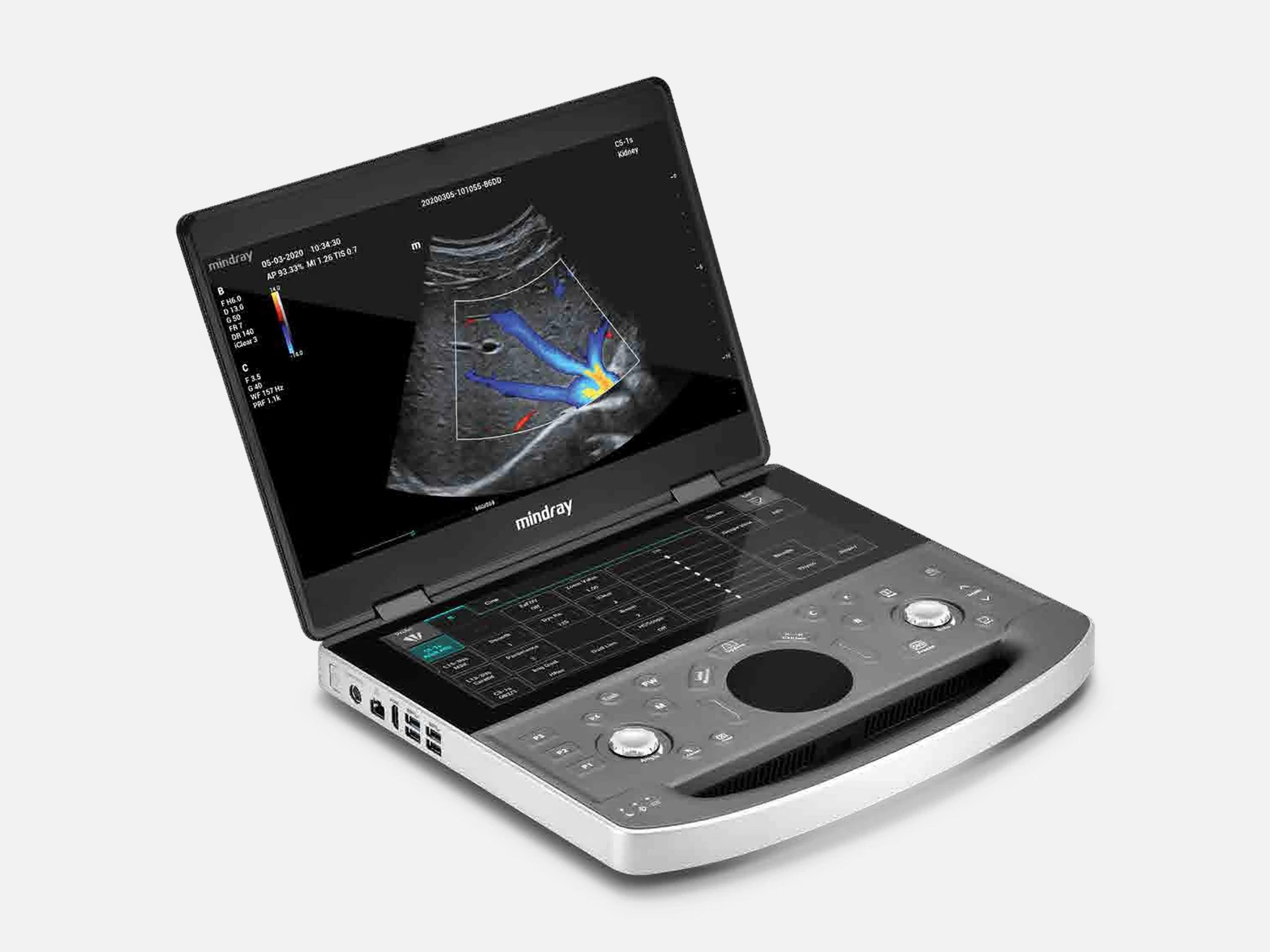
The Mindray ME8 is a laptop point-of-care ultrasound system suited to emergency medicine, critical care, anesthesia and ultrasound-guided procedures. It weighs less than 4.0 kg including batteries and has a 15.6-inch LED monitor, a 12.3-inch touch screen and the ZST+ software-based beamformer. Its 510(k) device family includes the MX7, MX8 and ME7; the MX8 has specialized MSK and Cardiovascular configurations.
- Released
- 2021launched by Mindray
- Probe ports
- 13 on the optional cart
- Display
- 15.6-inchLED, 1920 × 1080
- Weight
- under 4.0 kgincluding batteries
Compatible probes
Linear
- L9-3s
- L11-3VNs eSpacial Navi™ enabled
- L12-3RCs
- L12-3VNs eSpacial Navi™ enabled
- L14-6Ns
- L16-4Hs Intra-operative
- L20-5s
Convex & microconvex
- SC5-1Ns
- C11-3s Microconvex
Phased
- SP5-1Ns
- P8-2s
- P10-4s
Endocavity
- V11-3Hs
Specialty
- P7-3Ts Transesophageal
- P8-3Ts Transesophageal
- CW2s Non-imaging, cardiac; 2 MHz bandwidth
Specifications
Display
- Display
- 15.6-inch LED monitor, 1920 × 1080, on a 185-degree hinge
- Touch screen
- 12.3-inch, 1920 × 720, multi-gesture, with configurable presets
- Secondary display
- Shows battery capacity, AC power status and the product model
Physical
- Weight
- Less than 4.0 kg including batteries; main unit 6.6 lb (3 kg)
- Dimensions
- (322±5) × (364±5) × (44±3) mm (D × W × H); 1.7 in thick
- Probe ports
One on the main unit; up to two with the dual extender; three on the optional cartOne probe port on the main unit, with a probe locking lever, that takes a probe or a probe extend module; the dual probe extender connects up to two transducers; the optional cart has three transducer ports.Show allShow less
- Housing
- Magnesium-alloy shell
- Control panel
- Sealed, fluid-resistant and lockable; trackball or trackpad configurations
- Cart
Optional, with three probe ports, 320 mm lifting range and 3 storage basketsOptional mobile cart, with power supply and retractable cable, with power supply and no retractable cable, or with neither; three transducer ports; 320 mm lifting range; 3 storage baskets; vertical cable routing.Show allShow less
Power & battery
- Battery
Built-in lithium-ion, 14.4 V, 6600 mAh; 0–100% in under 4 hours when off or in standbyBuilt-in lithium-ion battery, standard: 14.4 V, 6600 mAh for a single battery; charges from 0 to 100% in less than 4 hours with the system powered off or in standby.Show allShow less
- Battery service life
- 5 years (lithium-ion battery)
- U-Bank external battery
Optional, 2 or 4 batteries: up to 8 hours of continuous scanning; 19 V DCOptional U-Bank external battery with 2 or 4 batteries: up to 8 hours of continuous scanning; 19 V DC; 26400 mAh or 13200 mAh; about 5 hours to charge from 0 to 100% when powered off or in standby.Show allShow less
- Power input
- 100–240 V AC, 50/60 Hz; main unit 2.0–1.0 A; cart 4.4–2.5 A
Connectivity & options
- DICOM
DICOM 3.0: worklist, MPPS, storage commitment, storage, print, query/retrieveDICOM 3.0: modality worklist, MPPS, storage commitment, storage of ultrasound images and structured reports to network or removable media, networked print, query/retrieve.Show allShow less
- Network
- Ethernet 10/100/1000BASE-T, single interface; optional WiFi module
- Video and data ports
S-Video output, network port, HDMI, USB (disk, barcode reader, printer, footswitch, DVD)S-Video output; network port; HDMI; USB ports for a USB disk, bar code reader, printer, footswitch and DVD recorder.Show allShow less
- eGateway
- Sends images, reports and demographics to electronic patient records
- M-Secure
Encryption, DICOM encryption, secure data wipe, anti-virus, OS hardening, access controlM-Secure Feature Suite: data encryption, wired and wireless DICOM encryption, secure data wipe, anti-virus, operating system hardening and access control.Show allShow less
- Z-Tracking™
- Attaches the serial number of the probe used in an exam to the patient's medical record
- Supported peripherals
Printers P95DW-N, UP-X898MD, UP-D25MD; DVD drive GP60NB60; footswitches; barcode readersVideo printers P95DW-N, UP-X898MD and UP-D25MD; external DVD R/W drive GP60NB60; footswitch 971-SWNOM (2- or 3-pedal) or FS-81-SP-2 (1-pedal); barcode readers.Show allShow less
- Standard configuration
Main unit, adapter, built-in batteries, system software, traveling case, accessoriesMain unit, power adapter, built-in batteries, system software, traveling case and accessories: operator's manuals, a user-defined label and cables.Show allShow less
Imaging & software
- Imaging modes
B, M, PW, CW, Color and Amplitude Doppler, THI, TDI, 4D, contrast; by configurationB, M, PWD, CWD, Color Doppler, Amplitude Doppler (Power Doppler), combined modes (B+M, PW+B, Color+B, Power+B, PW+Color+B, Power+PW+B), Tissue Harmonic Imaging, iScape, TDI, color M, Smart 3D, 4D (real-time 3D), Strain Elastography and contrast imaging (LVO, liver). The modes span the MX7, MX8 and ME8 family, and a unit's functions depend on the configuration purchased.Show allShow less
- Beamformer
- ZONE Sonography® Technology+ (ZST+), software-based
- TEE imaging
- Transesophageal echocardiography (TEE)
- Smart tools
Auto EF, Smart VTI, Smart IVC, Smart B-line, Smart Bladder, Smart FHR, Auto GAAuto EF calculates EDV, ESV and EF from 2D echo data for left ventricular function; Smart VTI automates VTI and cardiac output measurement; Smart IVC measures the inferior vena cava; Smart B-line counts B-lines and the percentage of area they cover; Smart Bladder measures bladder volume before and after voiding; Smart FHR calculates fetal heart rate from B-mode data; Auto GA measures the gastric antrum with AI-powered pattern recognition.Show allShow less
- Needle guidance
iNeedle+™ needle visibility; eSpacial Navi™ 4D magnetic needle navigationiNeedle+™ detects the needle angle and improves needle visibility on linear and convex transducers during interventional procedures; eSpacial Navi™ (eSpacial Navigation™) gives 4D magnetic needle navigation for in-plane or out-of-plane procedures.Show allShow less
- HD Scope
- Improves detail, contrast and the definition of tissue boundaries
- iWorks™
- Protocol-based workflow
- Optional software
- Free Xros M, Free Xros CM, Stress Echo, TDI QA, Tissue Tracking QA; by configuration
Environment
- Operating
- 0 °C to 40 °C; 20% to 85% RH, non-condensing; 700 hPa to 1060 hPa
- Storage and transport
- -20 °C to 55 °C; 20% to 95% RH, non-condensing; 700 hPa to 1060 hPa
Compliance
- FDA 510(k)
K251192 (2025-08-22), K241432 (2024-09-12), K212900 (2021-11-05), K200001 (2020-04-09)K251192 (decided 2025-08-22), K241432 (2024-09-12), K212900 (2021-11-05) and K200001 (2020-04-09), the earliest naming the ME8; each clears a device family that includes the ME8. Class II, 21 CFR 892.1550, product codes IYN, IYO, ITX.Show allShow less
- Safety classification
Class I and internally powered; Type-BF applied part; main unit IPX0, adapter IP22Class I equipment and internally powered equipment; Type-BF applied part; main unit IPX0, power adapter IP22; portable equipment, and mobile equipment when installed on the mobile cart.Show allShow less
What to check when buying a used Mindray ME8
Check the internal battery's health and history
Battery work by inadequately trained personnel can cause excessive temperatures, fire or explosion, and a unit left in standby through storage or transport drains its batteries and damages them permanently.
How: Have a technician run the battery health status test, and ask who last installed the battery, since only Mindray technical staff or Mindray-trained engineers may install or remove it.
Inspect each probe head and cable
A probe with a damaged or scratched surface or exposed wiring must not be used, and a defective transducer can cause an electric shock.
How: Look for cracks or swelling on the head and for aging, blistering, deterioration or erosion along the cable, and ask whether any probe was knocked or dropped.
Have a biomed run electrical safety tests
Electrical and mechanical performance can degrade with long use, through leakage, distortion and abrasion, so an older unit needs measuring.
How: Ask for a safety-analyzer report with protective earth resistance and earth leakage results, and check that every label from Mindray or the previous facility is present and legible.
Reject aftermarket probes Mindray does not specify
Probes other than those Mindray specifies can damage the system and, in the worst case, cause a fire.
How: Confirm every probe offered with the unit is a Mindray model specified for it.
Common questions about the Mindray ME8
Is the Mindray ME8 FDA-cleared?
Yes. The ME8 is FDA-cleared through 510(k) as a Class II device under 21 CFR 892.1550, product codes IYN, IYO and ITX. Its most recent clearance is K251192, decided on August 22, 2025; earlier clearances naming it are K241432 (September 12, 2024), K212900 (November 5, 2021) and K200001 (April 9, 2020), the earliest on record. Each one clears a family of Mindray systems that includes the ME8.
What exams is the Mindray ME8 cleared for?
The clearance covers adults, pregnant women, pediatric patients and neonates. Its cleared exams are ophthalmic, fetal, abdominal, pediatric, small organ (breast, thyroid, testes), neonatal and adult cephalic, trans-rectal, trans-vaginal, musculoskeletal (conventional and superficial), thoracic/pleural, adult and pediatric cardiac, peripheral vessel and urology, plus intra-operative (abdominal, thoracic, vascular), laparoscopic and trans-esophageal (cardiac) use.
The intra-operative and trans-esophageal applications came with K212900 in 2021.
How does the Mindray ME8 differ from the MX8?
The ME8 is marketed for point-of-care ultrasound, while the MX8 has specialized MSK and Cardiovascular configurations. Both sit in one 510(k) device family with the MX7, MX7T, Vaus7, Zeus, ME7, Anesus ME7, Anesus ME7T, MX7P, MX7W, MX8T, Vaus8, Nuda, Aquila and Malody, and one operator's manual covers all of those model names.
What warranty comes with a new Mindray ME8?
A new ME8 bought directly from Mindray North America carries a standard five-year warranty covering parts, including the cart, scan module and standard transducers; warranties through Mindray's agents can vary. The ME8 is also a covered system under Mindray's portable Ultrasound Support Plan, a mail-in warranty for new systems bought directly through Mindray.
Support includes technical telephone help and mail-in service, with a loaner while the system is under warranty.
Are software updates free on the Mindray ME8?
For a system under warranty, yes. The standard warranty includes software updates, and Mindray's Living Technology updates come at no charge for systems under warranty, installation not included; new application packages and hardware upgrades are optional purchases.
Owners cannot patch the system themselves: Mindray evaluates every update or patch, and only its service engineers, or engineers it designates, notify owners of software and hardware version updates.