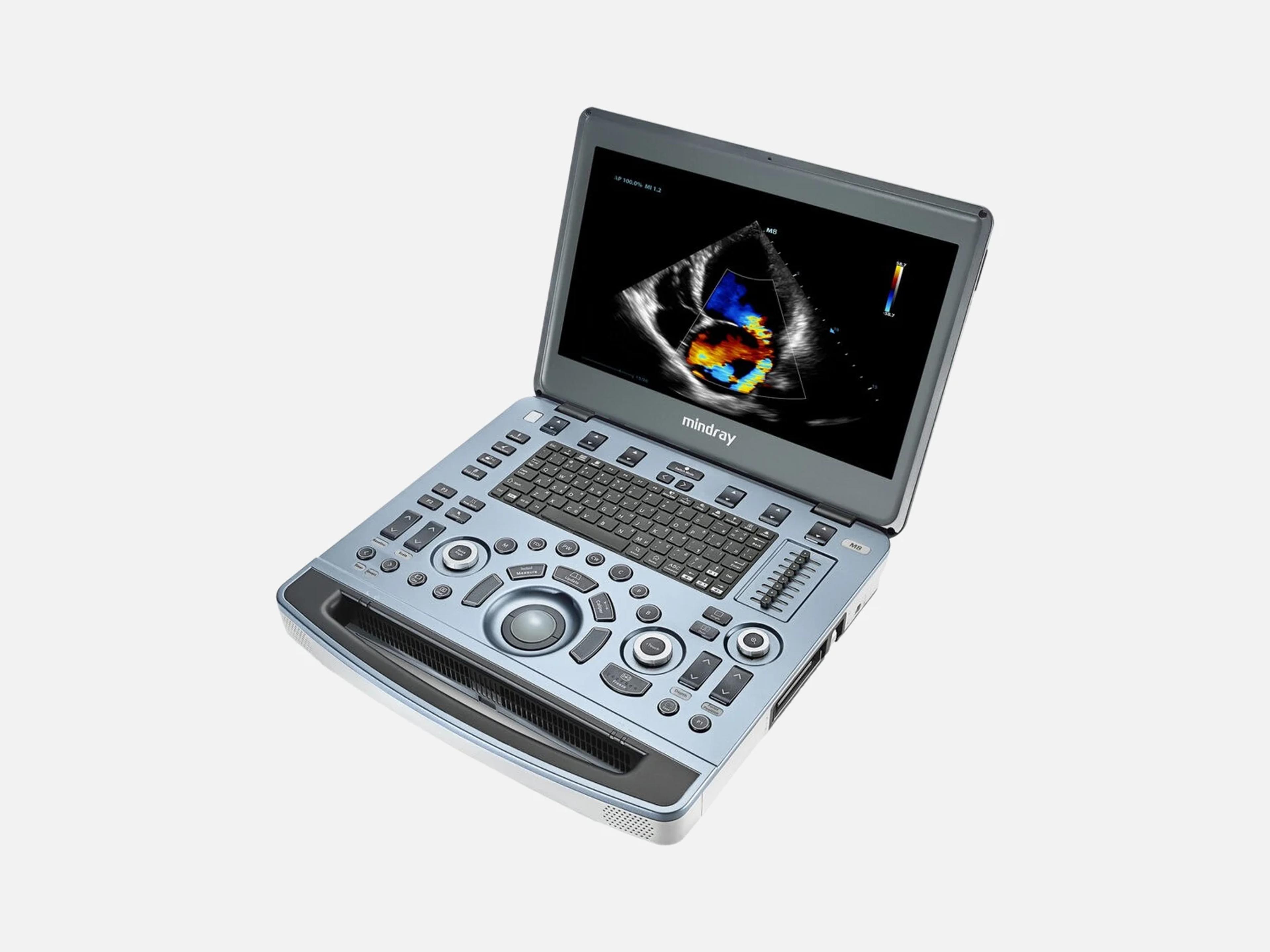
The Mindray M8 Elite is a portable ultrasound system for the bedside, the office and the interventional suite, focused on vascular, women's imaging and shared service applications. It has a 15.6-inch LED monitor and a built-in battery for 90 minutes of scanning, and weighs under 6.5 kg. The FDA first cleared it in 2017 under K171034, as a new model added beside the M9, M9CV and M9T.
- Released
- 2017first FDA clearance
- Probe ports
- 1 + pencil3 with optional extender
- Display
- 15.6-inchLED, 1920×1080, 16:9
- Weight
- under 6.5 kgincluding built-in battery
Compatible probes
Linear
- L9-3s
- L12-4s
- L14-6Ns
- L14-6Ws
- L16-4Hs
- L20-5s
Convex & microconvex
- C5-1s
- C6-2Gs
- C11-3s Micro-convex
- D7-2s · 2.6–8.2 MHz Volume convex
Phased
- P10-4s
- P8-2s · 2.6–8.2 MHz
- SP5-1s Single crystal
Endocavity
- V11-3Ws
Specialty
- P7-3Ts Adult transesophageal
- P8-3Ts Pediatric transesophageal
- CW2s Non-imaging, CW 2.0 MHz
- CW5s Non-imaging, CW 5.0 MHz
Specifications
Display
- Display
- 15.6-inch high-resolution LED monitor, 16:9, 1920×1080
Physical
- Dimensions (D × W × H)
- (362±5) × (390±5) × (59±3) mm
- Weight
- 12.8 lb (6 kg); under 6.5 kg including the built-in battery
- Probe ports
Main probe port and pencil probe port; optional PEM-51 module extends main port to threeOne main probe port, which takes a probe or the PEM-51 probe extend module, and a separate pencil probe port; the PEM-51 extends the main port to three active transducer portsShow allShow less
- Controls
Spill-resistant keyboard in a magnesium alloy case; trackball; user-defined P5–P8 keysSpill-resistant keyboard in a magnesium alloy case, with alphanumeric keys, a trackball and user-defined P5–P8 keysShow allShow less
- Cart
UMT-500, UMT-500Plus (lifting column, 2 USB ports) or MT5; 32–42 inch adjustable heightUMT-500 or UMT-500Plus trolley (the UMT-500Plus has a lifting column and 2 USB ports), or the MT5 passive mobile trolley; 32–42 inch adjustable heightShow allShow less
Power & battery
- Power
- 100–240 V AC, 50/60 Hz; power input 2.0 A
- Battery
Built-in: 90 minutes of scanning (over 3 hours with cart); 14.8 V, 5800 mAhBuilt-in internal battery: 90 minutes of scanning (over 3 hours with cart); 14.8 V, 5800 mAh; charges from empty to full in under 4 hours when off or in standby; not user-removableShow allShow less
- Cart battery
- 14.8 V, two 6600 mAh batteries
Connectivity & options
- Ports
- HDMI, two USB and an ECG port on the main unit
- Network
- Wi-Fi (standard configuration); wired LAN
- DICOM
DICOM Basic option; Worklist, MPPS, SR, Query/Retrieve and storage commitment add-onsDICOM Basic (option). DICOM Worklist, MPPS, OB/GYN SR, Vascular SR, Cardiac SR, Query/Retrieve and Breast SR require DICOM Basic; Worklist, storage commitment and Query/Retrieve are separately installed modulesShow allShow less
- Storage and export
Hard disk, USB drive or optical disk; BMP, JPG, TIFF, AVI, MP4 and DICOM exportSystem hard disk, USB flash drive, removable USB hard disk or optical disk; PC-compatible export as BMP, JPG, TIFF, multi-frame AVI (or MP4 when Mac OS is selected) and DICOMShow allShow less
- Clinical packages (options)
Cardiology, Obstetrics, Gynecology, Vascular, Nerve, Emergency & Critical, and moreAbdomen/General, Obstetrics, Gynecology, Cardiology, Small Parts, Urology, Vascular, Pediatrics, Nerve and Emergency & Critical packages, plus iWorks and iNeedle; Smart OB and Smart NT require the Obstetrics packageShow allShow less
- Automated tools (options)
- AutoEF and Smart VTI (each requires the Cardiology package), Smart IVC and Smart B-line
- Cardiac options
- Stress Echo, Tissue Tracking QA, LVO contrast; each needs the Cardiology package
- Tissue Doppler, contrast and elastography (options)
Tissue Doppler Imaging, TDI QA, Contrast Imaging, Contrast Imaging QA, ElastographyTissue Doppler Imaging; TDI QA (requires Tissue Doppler Imaging); Contrast Imaging; Contrast Imaging QA (requires Contrast Imaging); ElastographyShow allShow less
- 3D/4D (option)
- 4D Function; iPage and Smart Volume require it
Imaging & software
- Imaging modes
B, M, PW, CW, Color, Power, TDI, Color M, THI, iScape, Elastography, contrast, 4DB, M, PWD, CWD, Color Doppler, Amplitude Doppler, combined modes (B+M, PW+B, Color+B, Power+B, PW+Color+B, Power+PW+B), Tissue Harmonic Imaging, iScape, TDI, Color M, Elastography, contrast imaging (LVO and liver), Smart 3D and 4D (real-time 3D)Show allShow less
- Image tools
Echo Boost, iBeam, iClear, iTouch, iZoom full-screen zoomEcho Boost; iBeam and iClear in the B-mode menu; iTouch, on a combined gain and iTouch control; iZoom full-screen zoomShow allShow less
- Transducer technology
- Single crystal transducers with 3T technology
- Patient data
- iStation patient data management
Compliance
- FDA 510(k)
K171034 (July 10, 2017), K210416 (June 10, 2021), K230768 (June 9, 2023)K171034 (July 10, 2017), which added the M8 Elite as a new model; K210416 (June 10, 2021); K230768 (June 9, 2023). Class II, 21 CFR 892.1550Show allShow less
- Safety classification
- Portable; mobile on the cart; main unit IPX0, probes IPX7
What to check when buying a used Mindray M8 Elite
Feel every probe for abnormal heat while scanning
A probe that gives off excessive heat can burn the patient.
How: Scan with each probe offered and check its surface for abnormal heat, and reject any probe that runs hot.
Inspect the power cable and adapter
Cracks, wrinkles, deterioration or swelling on the power adapter or its cable are faults to fix before the system is used.
How: Look along the whole cable and over the adapter body, and confirm the plug connection is secure.
Start the unit and watch for overheating
Unusual sounds or smells after power-on can point to overheating, and an error message that stays on screen points to a system fault.
How: Watch the start-up for an OPERATING SYSTEM NOT FOUND message or any error that persists; clicks at start-up or when switching probes are normal.
Confirm the internal battery still holds a charge
Leaving the system in standby for a long period, storage and transport included, discharges the batteries and damages them permanently.
How: Run the unit on battery and watch for a battery communication error; only Mindray or its approved engineers fit or remove the internal battery.
Common questions about the Mindray M8 Elite
Is the Mindray M8 Elite FDA-cleared?
Yes. The M8 Elite was cleared under 510(k) K171034 on July 10, 2017, the submission that added it as a new model beside the M9, M9CV and M9T.
Two later clearances extended the same family: K210416 on June 10, 2021 added transducers and features, and K230768 on June 9, 2023 added the P8-2s transducer. It is a Class II device under 21 CFR 892.1550.
What exams is the Mindray M8 Elite cleared for?
Its K171034 clearance, shared with the M9, M9CV and M9T, is for adults, pregnant women, pediatric patients and neonates, on prescription. The cleared exams are fetal, abdominal, intra-operative, pediatric, small organ (breast, thyroid and testes), neonatal and adult cephalic, trans-rectal, trans-vaginal, musculoskeletal (conventional and superficial), adult and pediatric cardiac, trans-esophageal cardiac, peripheral vessel and urology.
How is the Mindray M8 Elite related to the M9?
They share a clearance: the M8 Elite was added beside the M9, M9CV and M9T under K171034 in 2017, and the family's 2021 and 2023 clearances also name the M10, M10CV, Crius M10, M11, M11CV, Crius M11, Operus M11 and M9 Premium. One operator's manual serves the whole family.
Where the family's models differ, the M8 Elite has the Double-Dist, Color Vel and Spline Length measurement tools and does not have B-Profile or B-Histogram.