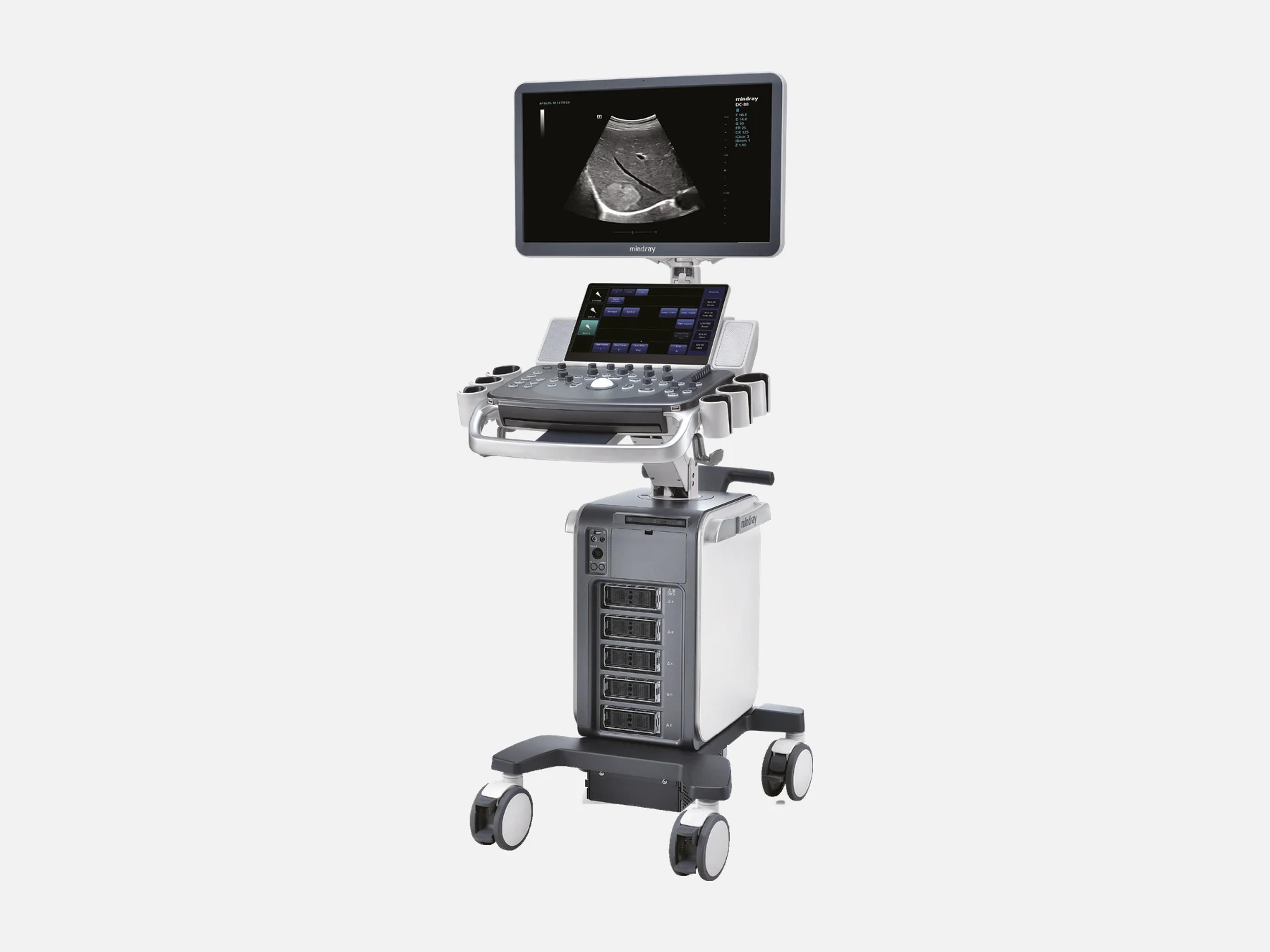
The Mindray DC-88 is a diagnostic ultrasound system for vascular, general imaging and women’s health applications, weighing under 85 kg with built-in batteries. Its 2020 FDA clearance, K201693, includes fetal, abdominal, small organ, cephalic, cardiac, trans-esophageal, peripheral vessel and urology exams. It shares that clearance with the DC-88S, DC-90, DC-95 and DC-80A, and its predicate device is the DC-80.
- Released
- 2019first FDA clearance
- Weight
- <85 kgwith built-in batteries
Compatible probes
Linear
- L9-3E
- L12-3E
- L14-5WE
- L16-4HE
- L20-5E
Convex & microconvex
- C6-2GE
- C7-3E
- C11-3E
- SC6-1E
- SD8-1E 4D convex volume
Phased
- SP5-1E
- P7-3E
- P10-4E
Endocavity
- V11-3HE
Specialty
- P7-3TE Transesophageal (TEE)
- CW2s Pencil probe
- CW5s Pencil probe
Specifications
Display
- Main monitor
21.5-inch and 23.8-inch configurations, on an adjustable supporting armMain monitor on a supporting arm, in 21.5-inch and 23.8-inch monitor configurations. It rotates 90° left and 150° right with the arm and tilts 20° backward and forward to horizontal; the arm adjusts height and displacement.Show allShow less
- Touch screen
Touch panel for system control; mapping mode; configurable two-finger gesturesTouch screen panel for operator control of the system; a swipe gesture maps the monitor image onto the touch screen (mapping mode); two-finger gestures are configurable.Show allShow less
Physical
- Weight
- <85 kg, including built-in batteries
- Dimensions (L × W × H, folded)
825 × 510 × 1090 mm, ±5 mm; display width 533 mm (21.5-inch) or 575 mm (23.8-inch)21.5-inch monitor, folded: 825±5 mm (L) × 510±5 mm (main unit) / 533±5 mm (display) (W) × 1090±5 mm (H). 23.8-inch monitor, folded: 825±5 mm (L) × 510±5 mm (main unit) / 575±5 mm (display) (W) × 1090±5 mm (H).Show allShow less
- Probe ports
Transducer sockets on the main unit; a separate pencil probe port on the physio panelTransducer sockets on the main unit, each locked by turning the lock handle 90° clockwise; a separate pencil probe port on the physio panel.Show allShow less
- Controls
8-segment TGC sliders, trackball, keyboard; panel rotates ±90° and moves up/downMain control panel with 8-segment TGC sliders, trackball and keyboard; the control panel rotates ±90° and moves up and down by a control lever; USB foot switch supported.Show allShow less
Power & battery
- Power supply
100-240 V~, 50/60 Hz, 630 VA; auxiliary outlet 100-240 V~, 50/60 Hz, 240 VA max100-240 V~, 50/60 Hz, 630 VA power consumption; fuses T5AH 250Vac and T10AH 250Vac; auxiliary outlet 100-240 V~, 50/60 Hz, 240 VA maximum.Show allShow less
- Built-in battery
- Optional; DC 14.8 V, 6600 mAh; standby no less than 24 hours when fully charged
- Not supported on battery
- Static 3D, STE, STQ, STIC and 4D continuous capturing, self-test, DVR recording
Connectivity & options
- I/O panel
USB, HDMI, network, VGA, S-Video, left and right audio outputsI/O panel: USB ports, HDMI, network port, VGA, S-Video, left and right audio outputs; external HDMI/VGA devices should be set to 1280x1024.Show allShow less
- Physio panel
- USB, pencil probe, MIC and ECG lead / external ECG input ports; PCG input reserved
- Wireless
- Built-in wireless adapter; wireless LAN; hotspot for DICOM, iStorage and network print
- DICOM
DICOM Basic; Worklist, Query/Retrieve, MPPS and structured reports as optionsDICOM Basic, with DICOM Worklist, Query/Retrieve, MPPS and Abdomen, OB/GYN, Cardiac, Vascular and Breast structured reports as options; service presets for Storage, Print, Worklist, MPPS, Storage Commitment and Query/Retrieve. OB-GYN, echocardiography, vascular, breast and abdomen report templates are supported.Show allShow less
- DICOM services (SCU)
Worklist FIND, MPPS, Storage Commitment, Q/R FIND and MOVE, color and grayscale printModality Worklist FIND, Modality Performed Procedure Step, Storage Commitment Push Model, Study Root Query/Retrieve FIND and MOVE, Basic Color Print Management and Basic Grayscale Print Management.Show allShow less
- DICOM storage classes
Ultrasound Image, Ultrasound Multi-frame Image, Secondary Capture Image…Ultrasound Image, Ultrasound Multi-frame Image, Secondary Capture Image, Encapsulated PDF, Raw Data and Enhanced US Volume Storage; the Storage SCP is restricted to Query/Retrieve operation.Show allShow less
- Storage and export
Hard disk, USB drives, DVD-RW drive; export as BMP, JPG, TIFF, PNG, AVI and DCMSystem hard disk; USB flash drive and removable USB hard disk; DVD+R, DVD+RW, DVD-R, DVD-RW, CD-RW and CD-R in a DVD-RW drive. Native FRM/CIN files; export as BMP, JPG, TIFF, PNG and DCM (single frame) and AVI and DCM (cine).Show allShow less
- Storage drives
- 128G SSD plus 1T HDD, for the system family in the 2019 clearance
- Supported peripherals
B/W, color and graph/text printers; USB foot switches; bar code readersPrinters: P95DW-N (B/W digital), P93W-Z (B/W analog), UP-D25MD (color digital), OFFICEJET PRO 8100 (graph/text) and UP-X898MD. USB foot switches: FS-81-SP-2 (1-pedal) and 971-SWNOM (2- and 3-pedal). Bar code readers: LS2208 and DS4308.Show allShow less
- Hardware options
ECG, battery, CW and 4D modules, gel warmer, wireless adapter, fusion imaging module…ECG (with DC-IN cable and three-cable lead), built-in battery, CW module, 4D module, ultrasound gel warmer, built-in wireless adapter, iClear+ dongle, fusion imaging module (1 magnetic navigation controller, 1 magnetic generator, 2 fusion imaging sensors), DVR module, anti-virus software and built-in DVD recorder.Show allShow less
Imaging & software
- Imaging modes
B, M, PWD, CWD (option), Color and Amplitude Doppler, Tissue Harmonic, Smart 3D, 4D…B, M, PWD, CWD, Color Doppler, Amplitude Doppler, Tissue Harmonic Imaging, Smart 3D, 4D, iScape, TDI, Color M, Biopsy Guidance, Elastography, Contrast imaging (contrast agent for liver), Contrast imaging (contrast agent for LVO), STE, STQ, Ultrasound Fusion Imaging and GYN/Pelvic; combined modes B+M, PW+B, Color+B, Power+B, PW+Color+B and Power+PW+B. CW imaging is an option.Show allShow less
- Image optimization
iBeam, TSI, iTouch, HR Flow, Smart Track, iZoomiBeam (Spatial Compound Imaging), TSI (Tissue Specific Imaging), iTouch (Auto Image Optimization), HR Flow (High Resolution Flow), Smart Track and iZoom (full-screen zoom).Show allShow less
- Other imaging features
- Dehaze; iLive with Hyaline; UWN+ CEUS
- Advanced imaging options
iClear+, iScape View, Smart 3D, Free Xros M, Free Xros CM, Tissue Doppler Imaging…iClear+ (with iClear+ Dongle), iScape View, Smart 3D, Free Xros M, Free Xros CM, Tissue Doppler Imaging, TDI QA, Smart Volume, Strain Elastography, STE, STQ, Tissue Tracking QA, iWorks, Stress Echo, SCV+, STIC, Color 3D, Niche, iLive, iNeedle, iPage+, Contrast Imaging, Contrast Imaging QA, LVO, Ultrasound Fusion Imaging, Fusion RESP and Glazing Flow.Show allShow less
- Measurement and automation options
Smart Planes CNS, Smart Planes FH, Smart Face, Smart OB, IMT, RIMT, Smart NT, IVF…Smart Planes CNS, Smart Planes FH, Smart Face, Smart OB, IMT, RIMT, Smart NT, IVF, Smart FLC, AutoEF, Smart Pelvic and V-Mapping, each requiring its application package; Smart Planes, Smart Face and Smart FLC also need the 4D module.Show allShow less
- Measurement tools
- B-Histogram, B-Profile, Trace Len (Spline), Parallel; no Color Vel or Double dist
- Application packages
Abdomen/General, Obstetrics, Gynecology, Cardiology, Small Parts, Urology, Vascular…Abdomen/General, Obstetrics, Gynecology, Cardiology, Small Parts, Urology, Vascular, Pediatrics, Nerve and Emergency&Critical packages, each listed as an option.Show allShow less
- Features added in the 2020 clearance
Glazing Flow, Fusion RESP, RIMT, Smart Planes FH, Transducer Element Check…Glazing Flow, Fusion RESP, RIMT, Smart Planes FH and the Transducer Element Check function, plus Ultrasound Fusion Imaging for the C5-1E, SP5-1E, SC5-1E, L14-5WE and SC6-1E.Show allShow less
- Operating system
- Upgraded from Windows 7 to Windows 10 in the 2020 clearance; anti-virus software added
Environment
- Operating
- 0°C to 40°C, 30% to 85% RH (no condensation), 700 to 1060 hPa
- Storage and transport
- -20°C to 55°C, 20% to 95% RH (no condensation), 700 to 1060 hPa
Compliance
- FDA 510(k)
K201693 (2020-08-21), K190206 (2019-03-08); Class II, 21 CFR 892.1550K201693 (decided 2020-08-21), one submission for the DC-90, DC-90S, DC-90Q, DC-95, DC-95S, DC-88, DC-88S, DC-80A, DC-80A Exp, DC-80A Pro, DC-8X, DC-8Q, DC-81 and DC-82; K190206 (decided 2019-03-08). Class II, 21 CFR 892.1550, product codes IYN, IYO, ITX and LLZ.Show allShow less
- Safety classification
Class I / internally powered; Type-BF; unit IPX0, probes IPX7, foot switch IPX8Externally powered Class I equipment plus internally powered equipment; Type-BF applied part; main unit IPX0, probes IPX7, foot switch IPX8.Show allShow less
What to check when buying a used Mindray DC-88
Have a biomed run electrical safety tests
Electrical and mechanical performance may degrade with long use, and leakage is one of the signs.
How: With a safety analyzer, test protective earth resistance, then earth leakage ahead of the enclosure, patient, mains-on-applied-part and patient auxiliary tests.
Feel each probe's surface for abnormal heat
A probe that gives off excessive heat may burn the patient.
How: Scan with each probe in turn after power-on and stop using any probe whose surface runs abnormally hot.
Confirm every probe offered is a Mindray probe
Aftermarket probes may damage the system, and the worst case is fire.
How: Check the maker and model of each probe and set aside any aftermarket probe.
Inspect the power cord, plug and strain relief
A cracked, loose or deteriorated cord or plug is an electrical fault on a system that runs from AC power.
How: Look for wrinkles, cracks and a damaged strain relief, check that no plug pin is broken, bent or discolored, and feel the plug for warmth while the system runs.
Common questions about the Mindray DC-88
Is the Mindray DC-88 FDA-cleared?
Yes. The DC-88 is FDA-cleared under 510(k) K201693, decided on August 21, 2020, as a Class II device (21 CFR 892.1550, product codes IYN, IYO, ITX and LLZ). It is also named in an earlier clearance, K190206, decided on March 8, 2019.
What exams is the Mindray DC-88 cleared for?
Under K201693, the DC-88 is cleared for adults, pregnant women, pediatric patients and neonates, in fetal, abdominal, intra-operative (abdominal, thoracic and vascular), pediatric, small organ (breast, thyroid and testes), neonatal and adult cephalic, trans-rectal, trans-vaginal, musculo-skeletal (conventional and superficial), adult and pediatric cardiac, trans-esophageal (cardiac), peripheral vessel and urology exams.
How does the Mindray DC-88 differ from the DC-88S and DC-90?
All three are named separately in one 510(k), K201693. In measurement tools, the DC-88 has B-Histogram, B-Profile, Trace Len (Spline) and Parallel but not Color Vel or Double dist; the DC-90 has all six, and the DC-88S lacks Parallel as well.
Is the Mindray DC-88 related to the DC-80?
Yes. The DC-80 (K192152) is the primary predicate device for K201693, the clearance that includes the DC-88, with an earlier DC-80 clearance (K173471) and the Resona 7 (K171233) as reference devices. The DC-88's family is described there as having the same probes, indications for use and modes of operation as that DC-80.
What are the Mindray DC-88 EXP, PRO and NOVA?
They are model names that share one DICOM conformance statement (version V3.0, January 17, 2020) with the DC-88, DC-88S and DC-88T, together with DC-80A, DC-90 and DC-95 variants.