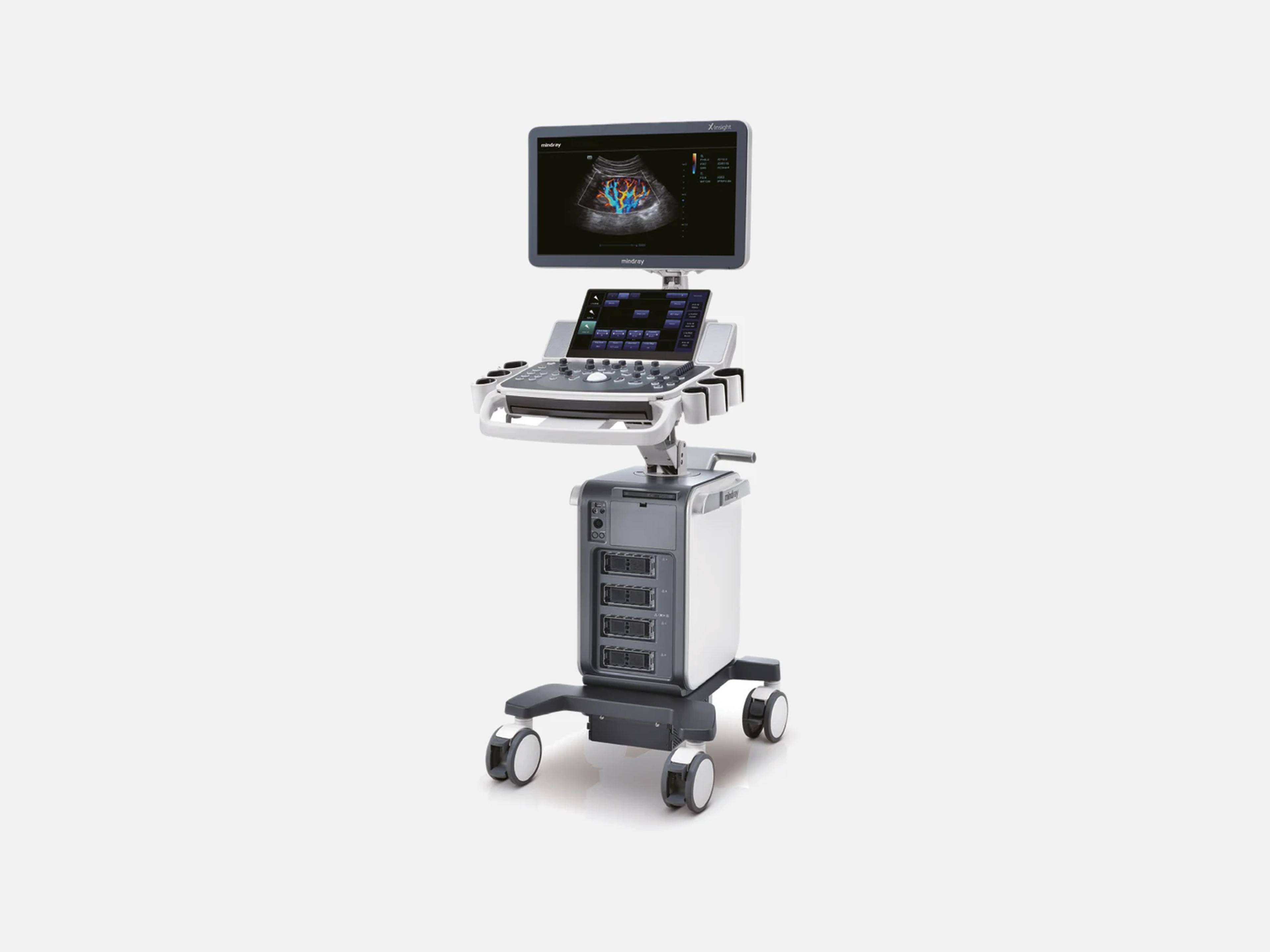
The Mindray DC-70 is a cart-based ultrasound system for obstetrics and gynecology, abdominal and cardiology work, introduced in the mid-range segment. Its X-Insight version offers Smart Planes CNS, Smart Face and Smart FLC, with a 21.5-inch or 23.8-inch monitor and a 13.3-inch touch screen. It shares one 510(k) device name and operator's manual with the DC-70T, DC-70 Pro, DC-70 Exp, DC-70S, DC-75 and DC-78.
- Released
- 2014first version launched
- Display
- 21.5-inchor 23.8-inch; 1920×1080
- Weight
- Under 85 kgwith built-in batteries
Compatible probes
Linear
- L9-3E
- L12-3E
- L13-3WE Added in K211337
- L14-3WE Added in K211337
- L14-5WE Added in K181637
- L14-6NE
- L14-6WE
- L16-4HE Added in K181637
- L20-5E Added in K181637
- LM14-6E
Convex & microconvex
- C5-1E
- C5-2E
- C7-3E
- C11-3E
- SC6-1E Added in K181637
- D6-2E
- D6-2NE
- D7-2E
- SD8-1E Added in K181637
Phased
- P4-2E
- P7-3E
- P10-4E
- SP5-1E
Endocavity
- 6LB7E Added in K181637
- CB10-4E
- DE10-3E
- DE10-3WE Added in K211337
- DE11-3E
- DE11-3WE Added in K211337
- V11-3E
- V11-3BE
- V11-3HE
- V11-3HBE Added in K211337
- V11-3WE
Specialty
- P7-3TE
- P7-3Ts Added in K211337; used with the PCM-SE01 probe adapter
- CW2s Added in K211337
- CW5s
- ELC13-4s Added in K211337; used with the PCM-SE01 probe adapter
- LAP13-4Cs Added in K211337; used with the PCM-SE01 probe adapter
Specifications
Display
- Monitor
- 21.5-inch or 23.8-inch Full HD monitor, 1920×1080
- Touch screen
X-Insight: 13.3-inch multi-gesture, adjustable angle, 1920×1080; 2014 launch: 10.4-inchDC-70 with X-Insight: 13.3-inch ultra-slim multi-gesture touch screen with angle adjustment, 1920×1080, with two-finger pinch zoom in touch screen mapping mode. The 2014 launch configuration specified a 10.4-inch gesture-sensitive multi-touch screen.Show allShow less
- Monitor arm
Dual-wing floating arm; folds down for transport; rotates 90° left and 150° rightDual-wing (eagle-wing) floating monitor arm; folds down to reduce system height for transport; the monitor rotates 90° left and 150° right with the supporting arm, and tilts 20° backward and forward to horizontal.Show allShow less
Physical
- Weight
- Less than 85 kg including built-in batteries
- Dimensions
Folded, ±5 mm: 825 L × 1090 H; display 533 W (21.5-inch) or 575 W (23.8-inch)Folded, 21.5-inch monitor: 825±5 mm (L) × 510±5 mm (main unit) / 533±5 mm (display) (W) × 1090±5 mm (H). Folded, 23.8-inch monitor: 825±5 mm (L) × 510±5 mm (main unit) / 575±5 mm (display) (W) × 1090±5 mm (H).Show allShow less
- Controls
- Panel rotates ±90° left/right, height-adjustable by lever; keyboard and touch screen
- Probe ports
- Transducer sockets on the main unit, plus a pencil probe port on the physio panel
Power & battery
- Power
- 220–240 V AC or 100–127 V AC, 50/60 Hz, 630 VA; peripheral outlet up to 240 VA
- Battery
Optional, built-in, DC 14.8 V; charges in under 4 h; at least 24 h standbyThe built-in battery is an option; DC 14.8 V. It charges from 0 to 100% in less than 4 hours with the system off or in standby, and a full charge gives no less than 24 hours of standby. On battery power, static 3D, STE, STQ, STIC, 4D continuous capturing, self-test and DVR recording are not supported; on systems that work only from external power, the battery supports standby only. Battery-powered scanning is configurable in the configuration documented by K211337.Show allShow less
Connectivity & options
- DICOM
DICOM Basic option; Worklist, Query/Retrieve, MPPS and Structured Reports need itDICOM Basic is an option; DICOM WorkList, Query/Retrieve, MPPS and Structured Reports (Abdomen, OB/GYN, Cardiac, Vascular, Breast) each require DICOM Basic.Show allShow less
- Networking
iStorage sends images and reports to a PC server; MedTouch/MedSight; wireless optioniStorage sends images and reports to a remote PC server; data can be sent to MedTouch/MedSight devices; a built-in wireless adapter is an option.Show allShow less
- I/O ports
Rear: USB, HDMI, network, VGA, S-Video, audio out; physio: USB, pencil probe, mic, ECGRear I/O panel: USB ports, HDMI, network port, VGA output, S-Video output, left/right audio output. Physio panel: USB port, pencil probe port, microphone port, ECG lead / external ECG input. USB/MIC port on the control panel.Show allShow less
- Storage
Hard disk; USB flash drive and USB hard disk; DVD-RW drive (DVD±R/RW, CD-R/RW)System hard disk; USB flash drive and removable USB hard disk; DVD+R, DVD+RW, DVD-R, DVD-RW, CD-RW and CD-R media; DVD-RW drive on the main unit.Show allShow less
- Peripherals
B/W and color video printers, USB foot switches (1-, 2- and 3-pedal), bar code readersB/W digital video printers P95DW-N and UP-D898MD; B/W analog video printers UP-X898MD and P93W-Z; color digital video printer UP-D25MD; USB foot switches FS-81-SP-2 (1-pedal) and 971-SWNOM (2- and 3-pedal); bar code readers LS2208 and DS4308.Show allShow less
- Hardware options
ECG, battery, DVR, DVD recorder, CW and 4D modules, gel warmer, wireless, fusion imagingECG (with DC-IN cable and three-cable lead), built-in battery, DVR module, built-in DVD recorder, CW module, 4D module, gel warmer, built-in wireless adapter, probe adapter (PCM-SE01), fusion imaging module (with or without cart).Show allShow less
- Application packages
Abdomen/General, Obstetrics, Gynecology, Cardiology, Small Parts, Urology, Vascular…Options: Abdomen/General, Obstetrics (Smart OB requires it), Gynecology, Cardiology, Small Parts, Urology, Vascular, Pediatrics, Nerve, Emergency & Critical.Show allShow less
Imaging & software
- Imaging modes
B, M, PWD, CWD, Color and Amplitude Doppler, THI, Smart 3D, 4D, iScape, TDI, Color MB, M, PWD, CWD, Color Doppler, Amplitude Doppler (Power/Dirpower), combined modes (B+M, PW+B, Color+B, Power+B, PW+Color+B, Power+PW+B), Tissue Harmonic Imaging, Smart 3D, 4D (real-time 3D), iScape View, TDI, Color M, Biopsy Guidance, Strain Elastography, STE, STQ, contrast imaging (liver; LVO).Show allShow less
- Contrast imaging
- Liver and LVO contrast imaging
- Elastography
Strain Elastography, STE with reliability map, STQ, Natural Touch ElastographyStrain Elastography, Sound Touch Elastography (STE) with reliability map and Sound Touch Quantification (STQ) as options, and Natural Touch Elastography. STE and STQ are documented in K211337 on the SC6-1E, L12-3E, L9-3E and C5-1E.Show allShow less
- Imaging engine
- X-Engine: GPU and CPU for multi-core parallel processing
- Transducer technology
3T (triple-matching layers, total-cut design, thermal control); ComboWave linear3T transducer technology (Triple-matching layers, Total-cut design, Thermal control) on single crystal volume, convex and phased array transducers; ComboWave linear transducers use a composite piezoelectric material, integrated with 3T technology.Show allShow less
- OB/GYN tools
Smart Planes CNS, Smart Planes FH, Smart Face, Smart FLC, Smart OB/NT, Smart PelvicSmart Planes CNS (standard CNS planes and measurements from a 3D fetal brain volume; needs the 4D module and Obstetrics Package), Smart Planes FH, Smart Face (one-touch fetal face optimization; 4D module and Obstetrics Package), Smart FLC (automatic follicle count and volume; 4D module and Gynecology Package), Smart OB/NT, Smart Pelvic (pelvic floor imaging; Gynecology Package).Show allShow less
- 3D rendering
iLive multi-light volume rendering, Glazing Flow 3D color flow, HyalineiLive: volume rendering simulating multiple light sources (option; needs Smart 3D or the 4D module). Glazing Flow: color Doppler flow displayed in 3D visualization (option). Hyaline rendering.Show allShow less
- Auto EF
- Automatic EDV, ESV and EF from 2D echo; needs the Cardiology Package
- Analysis tools
- Auto IMT, RIMT, TT QA, Tissue Tracking, Smart Track, V-Mapping, Respiratory Wave
- Workflow tools
iWorks scan protocols, user-definable; iTouch; iCompare side-by-side image reviewiWorks built-in standard scan protocols with user-defined capability; iTouch; iCompare side-by-side comparison of real-time ultrasound with prior DICOM, CT, MRI, mammography, X-ray or ultrasound images on the system.Show allShow less
- Image processing
- iClear+ (with iClear+ Dongle), Echo Boost, HR Flow
- Fusion imaging
- Ultrasound Fusion Imaging and Fusion RESP on SC6-1E, C5-1E, SP5-1E and L14-5WE
- Software options
Smart 3D, Free Xros M/CM, TDI, Stress Echo, STIC, Color 3D, iNeedle, IVF, Niche, SCV+…Smart 3D; Free Xros M; Free Xros CM; Tissue Doppler Imaging; TDI QA; IMT; RIMT; Smart Volume; Strain Elastography; STE; STQ; Contrast Imaging; Contrast Imaging QA; LVO; Tissue Tracking QA; iWorks; Smart NT; Smart FLC; Auto EF; Stress Echo; iClear+ (with iClear+ Dongle); SCV+; STIC; Color 3D; Niche; Smart Face; Smart Planes CNS; Smart Planes FH; Glazing Flow; iLive; iPage+; iNeedle; IVF; Ultrasound Fusion Imaging; Fusion RESP; Smart Pelvic; V-Mapping; iScape View; Transducer Element Check.Show allShow less
- Operating system
- Windows 10 in the K211337 configuration, upgraded from Windows 7
Environment
- Operating
- 0–40 °C; 30–85% RH, no condensation; 700–1060 hPa
- Storage and transport
- −20–55 °C; 20–95% RH, no condensation; 700–1060 hPa
Compliance
- FDA 510(k)
K211337 (2021-07-01), K181637 (2019-01-09), K163690 (2017-04-20), K150204 (2015-04-10)K211337 (Class II, decided 2021-07-01); K181637 (2019-01-09); K163690 (2017-04-20); K150204 (2015-04-10). All Substantially Equivalent decisions; regulation number 892.1550.Show allShow less
What to check when buying a used Mindray DC-70
Have electrical safety tests run with an analyzer
Protective earth resistance, earth leakage and enclosure leakage show whether the system is electrically safe to use on patients.
How: Ask a biomed to run the tests with a safety analyzer, measuring earth leakage before any other leakage test.
Inspect the power cord and plug
A broken, bent or discolored pin, a damaged strain relief or a plug that warms in use is a fault on the AC supply.
How: Check the pins, plug body, strain relief and cord for damage or deterioration, and feel the plug for warmth while the system runs.
Inspect every probe's cable, head and lens
A defective probe can give the patient an electric shock, and peeling, rifts, bumps, cracks or liquid spill end a probe's service life.
How: Look along each cable for deterioration or erosion, and at each head for cracks or swelling.
Feel each probe's surface for abnormal heat
A probe that gives off excessive heat can burn the patient.
How: Scan with each probe in turn and check its face for unusual warmth.
Common questions about the Mindray DC-70
Is the Mindray DC-70 FDA-cleared?
Yes. The DC-70 is FDA-cleared through 510(k), with Substantially Equivalent decisions under K150204 (April 10, 2015), K163690 (April 20, 2017), K181637 (January 9, 2019) and K211337 (July 1, 2021), the last as a Class II device, under regulation number 892.1550.
When did the Mindray DC-70 come out?
Mindray announced the DC-70's worldwide release in 2014, with U.S. availability scheduled for early 2015. It was introduced in the mid-range segment, with technology inherited from Mindray's DC-8 and M9.
Can the Mindray DC-70 scan on battery power?
Only with the optional built-in battery, and with limits. On battery power the system does not support static 3D, STE, STQ, STIC, 4D continuous capturing, self-test or DVR recording, and on a system that works only from external power the battery supports standby alone.
Battery-powered scanning is a configurable setting in the K211337 configuration. A full charge takes less than 4 hours with the system off or in standby and gives at least 24 hours of standby.
Do the DC-75 and DC-78 share the DC-70's FDA clearance?
Yes. The DC-70, DC-70T, DC-70 Pro, DC-70 Exp, DC-70S, DC-75 and DC-78 share one 510(k) device name and one operator's manual, and the DC-75, DC-78 and DC-70S were added as new models under K163690. K181637 covers all seven under that device name.
Which operator's manual goes with a used Mindray DC-70?
The one that matches the system's software revision. There is a DC-70 (Basic) operator's manual, revision 3.0 of January 2024, and a DC-70 X-Insight (Advanced) operator's manual, revision 1.0 of August 2021; a DC-70 Advanced manual from September 2016 belongs to Mindray's legacy ultrasound products.