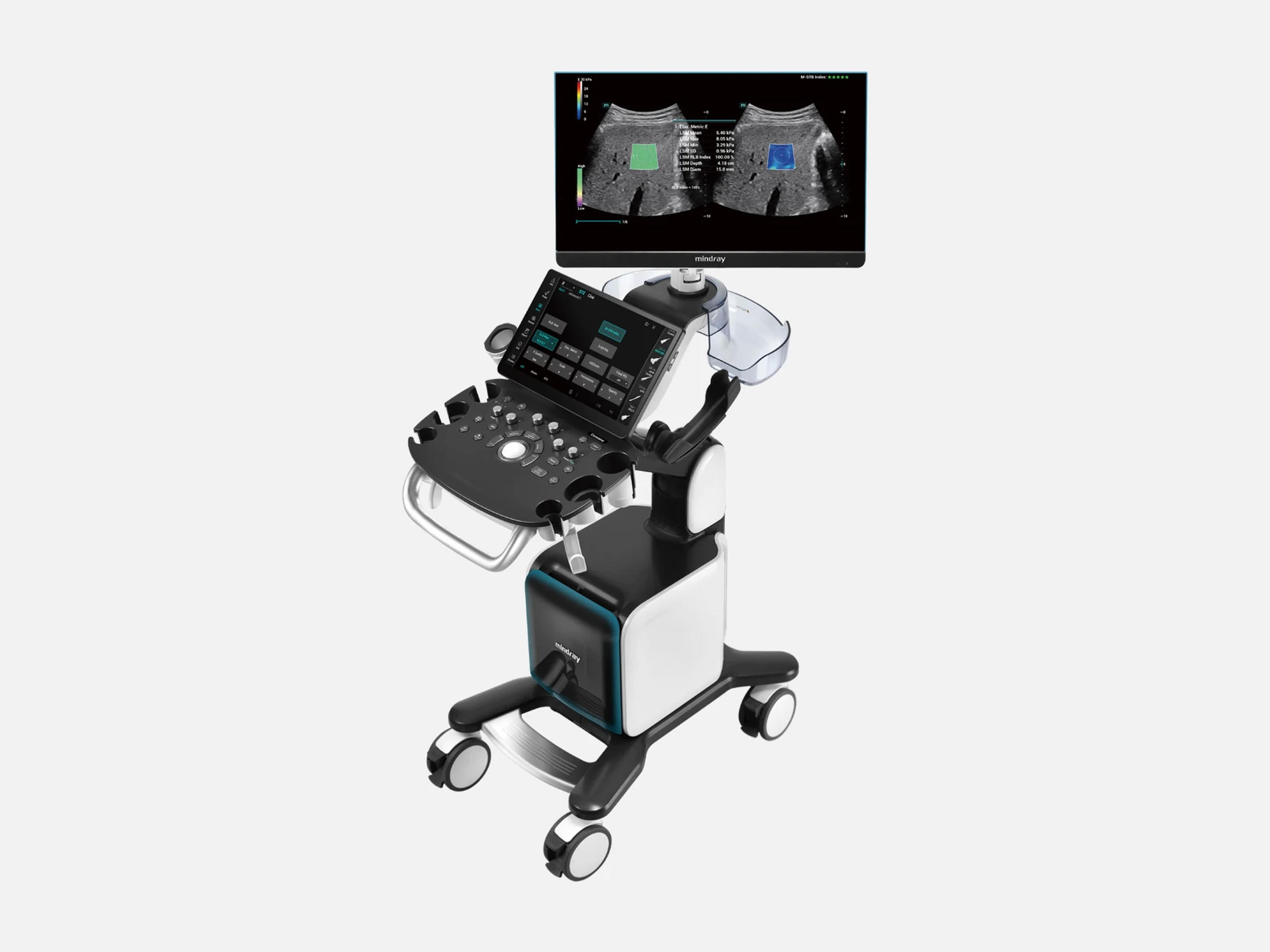
The Mindray Consona N9 is a cart-based ultrasound system for women's health, radiology and cardiovascular imaging, in the private office portfolio of Mindray North America. It has a monitor of up to 23.8 inches, a 15.6-inch touchscreen, a floating control panel and options for 4D, elastography and contrast imaging. It is paired with the more compact Consona N6 and shares 510(k) K221300 with the Consona N8 and N7.
- Released
- 2022first FDA clearance
- Display
- 23.8-inchor 21.5-inch configuration
- Weight
- ≤65.0 kgstandard configuration
Compatible probes
Linear
- L9-3
- L13-3N
- L16-4Hs Intra-operative; connects through Probe Adapter PCM-SA01
Convex & microconvex
- SC5-1N Single crystal
- C11-3 Microconvex
- V11-3
- V11-3B
- V11-3HB
Phased
- SP5-1N Single crystal
- P8-2
- P8-2Ts Connects through Probe Adapter PCM-SA01; uses the Multi-function hardware module
Endocavity
- V11-3H
- DE11-3 4D volume; needs the Multi-function hardware module
Specialty
- D7-2 4D volume; needs the Multi-function hardware module
- SD8-1 Single crystal 4D volume; needs the Multi-function hardware module
- CW2s Non-imaging pencil (CW); needs the Multi-function hardware module
- CW5s Non-imaging pencil (CW); needs the Multi-function hardware module
Specifications
Display
- Main monitor
- 23.8-inch high-resolution LED (FHD), or a 21.5-inch monitor configuration
- Touch screen
- Up to 15.6-inch HD touchscreen
- Monitor arm
Dual-wing floating arm; rotates 90° left, 180° right; tilts 20° back and forwardDual-wing floating arm with height and displacement adjustable on the support arm; rotates 90° to the left and 180° to the right with the arm; tilts 20° backward and forward to horizontal; lockable in the horizontal position for moving the system.Show allShow less
Physical
- Weight
- ≤65.0 kg, standard configuration
- Dimensions
L 840±40 × W 542±10 × H 988±20 mm (23.8-inch monitor, minimum position)With monitor and control panel at their minimum position: L 840±40 mm × W 542±10 mm × H 988±20 mm with the 23.8-inch monitor; L 840±40 mm × W 513±10 mm × H 988±20 mm with the 21.5-inch monitor. Maximum height 67.7 in.Show allShow less
- Controls
Gesture touchscreen; floating panel turns 80° each way, rises and lowers within 300 mmCustomizable gesture-powered touchscreen (two-finger gesture operation; mapping mode); fully adjustable floating control panel that rotates 80° left and right and moves up and down within 300 mm on its adjusting lever; waterproof control panel for disinfection (water and dust proof); QWERTY keyboard.Show allShow less
- Ergonomic features
Adjustable height, storage space, low noise, magnetic cable-management cover, foot restAdjustable height; storage space; low noise; ease of transportation; magnetic protective cover for cable management; ergonomic foot rest.Show allShow less
Power & battery
- Power
100 to 240 VAC, 50/60 Hz, 6.2 to 2.0 A; auxiliary output 240 VA max for peripheralsPower input 100 to 240 VAC, 50/60 Hz, 6.2 to 2.0 A. Auxiliary AC output for optional peripherals: 100 to 240 VAC, 50/60 Hz, 240 VA maximum.Show allShow less
- Battery
Optional built-in lithium-ion, 14.4 VDC, 6600 mAh; standby at least 24 hBuilt-in lithium-ion batteries (an option), 14.4 VDC, 6600 mAh. On battery, standby not less than 24 hours; charges from 0 to 100% in less than 4 hours when powered off or in standby.Show allShow less
Connectivity & options
- DICOM
Optional: Storage, Print, Worklist, MPPS, Storage Commitment, Query/Retrieve, SROptional DICOM package: Verify Connectivity, DICOM Storage, DICOM Print, DICOM Worklist, MPPS, Storage Commitment, Query/Retrieve, Structured Report, DICOM Medium Storage (DICOMDIR Review) and DICOM Task Management. Options: DICOM Basic, DICOM Worklist (requires DICOM Basic), DICOM MPPS, DICOM Query/Retrieve, and OB/GYN, Vascular, Cardiac, Breast, Abdomen and Small Parts SR. Conformance statement V3.0 against DICOM 3.0.Show allShow less
- HL7
- Query protocol versions V2.3, V2.4, V2.5 and V2.6
- Wireless
- Optional built-in wireless network card, IEEE 802.11 ac/a/b/g/n
- Rear I/O panel
HDMI, VGA, S-Video, remote (video printer), high-speed USB, networkHDMI port; VGA port; S-Video port; remote port (analog video printer control); high-speed USB port (USB disk, bar code reader, printer, footswitch, DVD recorder); network port (router, workstation, server).Show allShow less
- Front I/O panel
- Probe port(s), a separate pencil probe port, ECG/PCG input and output
- Probe adapter
- Optional Probe Adapter PCM-SA01 for the L16-4Hs, L20-5s, P7-3Ts, P8-2Ts and P8-3Ts
- Hardware options
QWERTY keyboard, batteries, Multi-function hardware module, ECG and PCG modules…QWERTY keyboard; built-in batteries; Multi-function hardware module (supports CW, 4D and TEE probes); Sound Touch Elastography drive Module; ECG module and ECG cables; PCG module (requires the ECG module); built-in wireless network card; ultrasound gel warmer; 1-, 2- and 3-pedal footswitches (USB interface); external DVD recorder.Show allShow less
- Peripherals supported
Video, photo and text printers; DVD-RW drive; barcode readers; footswitches; microphoneGraph/text printer L130; B/W digital video printers P95DW-N and UP-D898MD; B/W digital and analog video printer UP-X898MD; digital color video printer UP-D25MD; photo printers CP1500, CP1300 and DP-QW410; DVD-RW drive GP70N; barcode readers LS2208, DS4608, HS-1M, HS-1R and HH1800; footswitches FS-81-SP-2 (1-pedal) and 971-SWNOM (2- and 3-pedal); iVocal microphone XPD2.Show allShow less
Imaging & software
- Imaging modes
B, M, PWD, CWD, Color, Amplitude Doppler, THI, Smart 3D, 4D, iScape View, TDI, Color M…B, M, PWD, CWD, Color Doppler, Amplitude Doppler; combined modes B+M, PW+B, Color+B, Power+B, PW+Color+B and Power+PW+B; Tissue Harmonic Imaging; Smart 3D; 4D (real-time 3D); iScape View; TDI; Color M; Strain Elastography; STE; STQ; contrast imaging (contrast agent for LVO and for liver). CW and 4D require the Multi-function hardware module; STQ requires the Sound Touch Elastography drive Module.Show allShow less
- Software platform
- ZST+ (ZONE Sonography Technology+); upgrades through Living Technology
- Clinical application packages
Abdomen/General, Obstetrics, Gynecology, Cardiology, Small Parts, Urology, Vascular…Abdomen/General Package, Obstetrics Package, Gynecology Package, Cardiology Package, Small Parts Package, Urology Package, Vascular Package, Pediatrics Package, Nerve Package, Emergency&Critical Package.Show allShow less
- Imaging technologies
PSH, iClear, NTE, HD Scope, Glazing Flow, HR Flow, STE/STQ, iBeam, UMW+ Contrast Imaging…PSH; iClear; NTE; HD Scope (High Definition Scope, B-mode processing within an ROI); Glazing Flow; HR Flow (High Resolution Flow, microvascular flow); STE/STQ; iBeam; UMW+ Contrast Imaging; iTouch+ (real-time dynamic image optimization).Show allShow less
- Cardiovascular and vascular tools
AutoEF (ejection fraction), TTQA (myocardial synchronization), RIMT, R-VQSAutoEF (ejection fraction from diastole and systole frames); TTQA (myocardial synchronization evaluation with quantitative analysis); RIMT (RF-data based real-time IMT measurement); R-VQS (vascular hardness coefficient and pulse wave velocity).Show allShow less
- OB/GYN tools
Smart Scene 3D, Smart Face, Smart OB, Smart Planes CNS, Smart FLC 2D/3D, Smart Fetal HR…Smart Scene 3D; Smart Face (removes occlusions over the fetal face with one click); Smart OB (fetal biometrics); Smart Planes CNS (fetal central nervous system recognition and measurement); Smart FLC 2D/3D (follicle counting and measurement); Smart Fetal HR; Smart Pelvic (2D/3D pelvic floor measurements); iLive; iLive+.Show allShow less
- Smart tools
Smart HRI, Smart Bladder, Smart Hip, Smart B-line, Smart Calc, Smart Breast, Smart ThyroidSmart HRI (recognizes liver and renal cortex and calculates the brightness ratio); Smart Bladder (three diameters and bladder volume); Smart Hip (a/β angles for Graf classification); Smart B-line (pulmonary edema assessment); Smart Calc (automatic trace, measurement and calculation); Smart Breast (BI-RADS analysis); Smart Thyroid (TI-RADS analysis).Show allShow less
- Workflow and training
iWorks, iScanHelper, Smart Vue, iHelper (Remote Assistance, Quick Guide)iWorks (standardized step-by-step scanning protocols); iScanHelper (guided scanning tool); Smart Vue (standard-plane recognition and restoration); iHelper (Remote Assistance, iScanHelper, Quick Guide and Operator's Manual).Show allShow less
- 3D/4D options
Smart 3D, iPage+, SCV+, STIC, Color 3D, Smart Scene 3D, iLive, Niche, Smart Volume…Smart 3D; iPage+, SCV+, STIC, Color 3D and Smart Scene 3D (each requires 4D); iLive (requires 4D or Smart 3D); Niche; Smart Volume; Smart V Trace (requires Smart Volume); Smart Planes CNS and Smart Face (each requires 4D and the Obstetrics Package); Smart ICV (requires Smart Planes CNS).Show allShow less
- Cardiac, contrast and elastography options
TDI, TDI QA, Contrast Imaging, Contrast Imaging QA, LVO, Strain Elastography, STE, STQ…Tissue Doppler Imaging (requires the Cardiology Package); TDI QA (requires Tissue Doppler Imaging); Contrast imaging; Contrast Imaging QA (requires Contrast Imaging); LVO (requires the Cardiology Package); Strain Elastography; STE; STQ (requires the Sound Touch Elastography drive Module); Stress Echo and Tissue Tracking QA (each requires the Cardiology Package).Show allShow less
- Measurement options
Smart Pelvic, Smart FLC, IVF Plus, IVF, Smart OB, Smart Fetal HR, Smart NT, IMT, R-VQS…Smart Pelvic, Smart FLC, IVF Plus and IVF (each requires the Gynecology Package); Smart OB and Smart Fetal HR (each requires the Obstetrics Package); Smart NT; IMT, R-VQS and V-Mapping (each requires the Vascular Package); RIMT; AutoEF (requires the Cardiology Package); Smart Hip (requires the Pediatrics Package); Smart HRI (requires the Abdomen/General Package); Smart Bladder (requires the Abdomen/General or Urology Package); Smart Trace; CPP; Smart B-line.Show allShow less
- Other software options
iScape View, Free Xros M, Free Xros CM, Ultra-Micro Angiography, Glazing Flow, iNeedle…iScape View; Free Xros M; Free Xros CM; Ultra-Micro Angiography; Glazing Flow; iNeedle; iWorks; DVR Module; iVocal (requires the Microphone material kit); ClamAV.Show allShow less
Environment
- Operating
- 0 °C to 40 °C; 20% to 85% relative humidity, no condensation; 700 to 1060 hPa
- Storage and transport
- -20 °C to 55 °C; 20% to 95% relative humidity, no condensation; 700 to 1060 hPa
Compliance
- FDA 510(k)
- K221300 (2022-09-29); Class II, 21 CFR 892.1550; product codes IYN, IYO, ITX
- Electrical safety and ingress protection
Class I and internally powered; ECG type CF, probes BF; IPX0 unit, IPX7 probes…Externally powered Class I equipment and internally powered equipment; ECG is a type CF applied part, PCG and ultrasound probes type BF; main unit IPX0, probes IPX7, footswitch IPX8; continuous operation; not permanently installed.Show allShow less
What to check when buying a used Mindray Consona N9
Have a biomed run the electrical safety inspection
Electrical and mechanical performance, leakage included, can degrade with long use, and image sensitivity and precision can worsen with it.
How: With a safety analyzer, test protective earth resistance and earth, enclosure and patient leakage, and reject a power cord or plug with cracks, swelling, bent or discolored pins, or warmth in use.
Inspect every probe's lens, housing, cable and pins
A defective probe can give the patient an electric shock, and a probe with surface damage, scratches or exposed wiring must not be used.
How: Look for cracks, peeling, bumps or a loose acoustic lens on the head, deterioration on the cable, bent or missing connector pins, and rough or sharp edges on any insertable part.
Confirm every probe offered is a Mindray probe
Aftermarket probes can damage the system or cause a fire.
How: Confirm each probe quoted with the unit is a Mindray probe, and leave any aftermarket probe out of the purchase.
Check for burning smells, rattles and taped notes
A burning or smoky smell, above all from the ventilation holes, or an unusual sound after power-on can signal overheating.
How: Smell the ventilation holes, listen for rattles inside the case, and read any note taped to the system for a reported problem.
Common questions about the Mindray Consona N9
Is the Mindray Consona N9 FDA-cleared?
Yes. The Consona N9 is FDA-cleared under 510(k) K221300, decided on September 29, 2022, as a Class II device (21 CFR 892.1550, product codes IYN, IYO and ITX). The Consona N8 and N7 were cleared in the same 510(k).
What exams is the Mindray Consona N9 cleared for?
It is cleared for adults, pregnant women, pediatric patients and neonates in fetal, abdominal, intra-operative, pediatric, small-organ (breast, thyroid, testes), neonatal and adult cephalic, transrectal, transvaginal, musculoskeletal (conventional and superficial), thoracic and pleural, adult and pediatric cardiac, transesophageal, peripheral vessel and urology exams.
It is intended for use in a hospital or medical clinic, and it is not intended for ophthalmic use.
When was the Mindray Consona N9 launched in the US?
Mindray North America launched the Consona N9 in 2024, together with the more compact Consona N6, as the Consona-Series for its private office portfolio. Its FDA clearance, K221300, dates from September 29, 2022.
What warranty comes with a new Mindray Consona N9?
Bought directly from Mindray North America, a new Consona N9 carries a standard 5-year warranty on the system and parts, standard transducers and on-site labor for cart repairs, with software performance updates through Living Technology. Specialty transducers, TEE and 4D among them, have one-year coverage, and warranties from Mindray's authorized agents can differ.
Which model names belong to the Consona N9 series?
The Consona N9 series includes the Consona N9, Consona N9 Pro, Consona N9 Super, Consona Nova, Consona N9S, Consona N9T, Consona NI, Consona NT, Nuewa N9, Recho N9, Consona N9 Exp, Consona N9 Elite and Resona N9. Its 510(k), K221300, names them together.