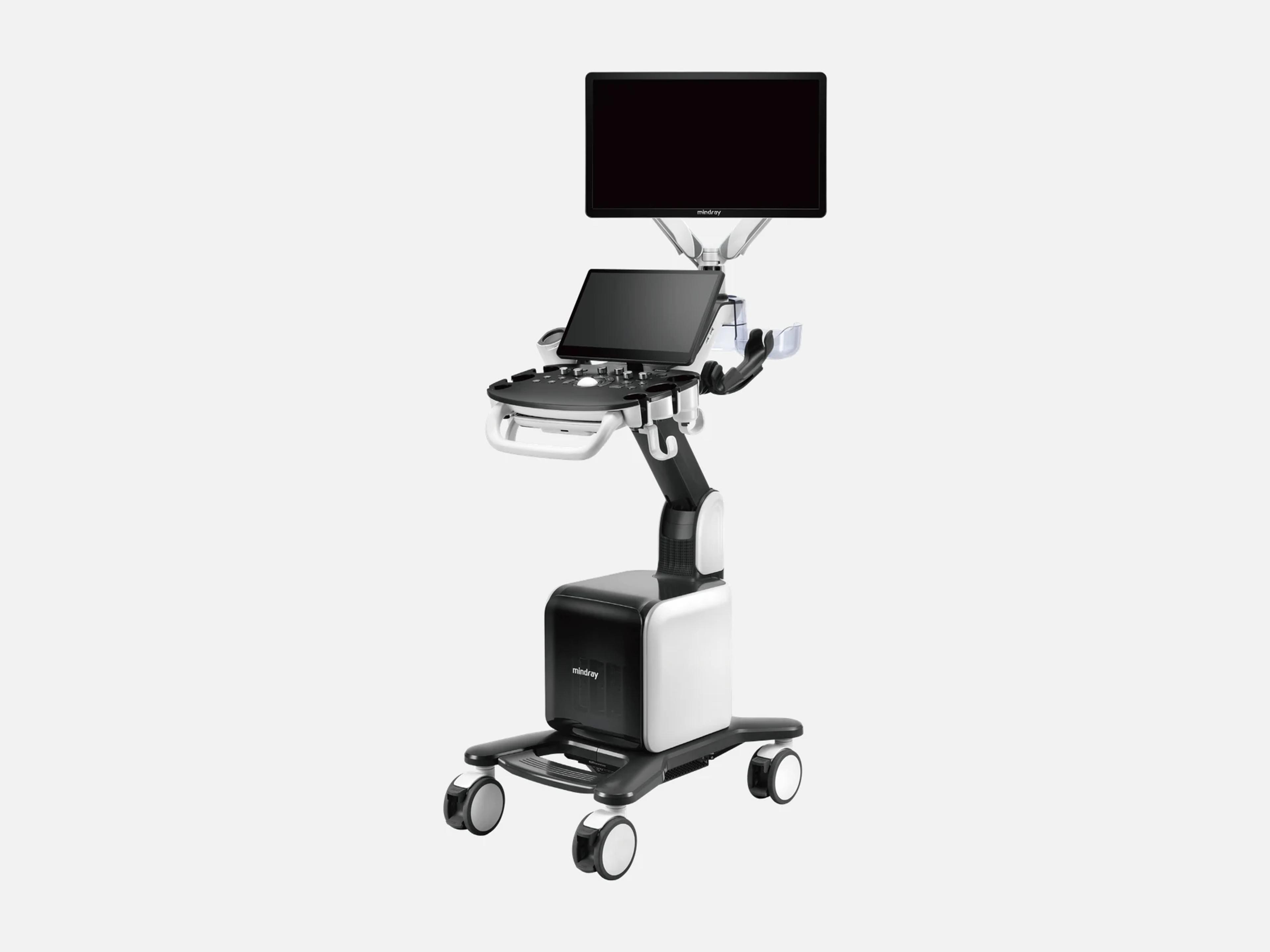
The Mindray Consona N8 is a diagnostic ultrasound system for general imaging, women's health and cardiovascular use, designed for primary care users. It is built on the ZST+ platform, which processes channel data in place of conventional beam-forming, and has a 21.5-inch FHD monitor and a touch screen of up to 15.6 inches. It belongs to the Consona N Series, alongside the N9.
- Released
- 2022first FDA clearance
- Display
- 21.5-inchFHD monitor
Compatible probes
Linear
- L9-3
- L13-3N
- L16-4Hs
Convex & microconvex
- C5-1
- SC5-1N
- C11-3
- V11-3
- V11-3B
- V11-3H
- V11-3HB
Phased
- SP5-1N
- P8-2
- P8-2Ts
Specialty
- D7-2 4D volume
- DE11-3 4D volume
- SD8-1 4D volume
- CW2s Pencil
- CW5s Pencil
Specifications
Display
- Display
- 21.5-inch FHD monitor
- Touch screen
- Up to 15.6 inches
- Monitor arm
- Dual-wing floating arm
Physical
- Control panel
- Rotatable; water and dust proof
- Height adjustment
- Adjustable height
- Ergonomics
- Noise-reduced design; storage space
Power & battery
- Battery
- Built-in battery available
Connectivity & options
- DICOM
Optional: Image Storage, Print, MPPS, Worklist, Storage Commitment, Q/R, SR, TLS, HL7Optional DICOM package. Applications: Image Storage, Print, MPPS, Worklist, Storage Commitment, DICOMDIR Review, Q/R and Task Management; Structured Report sending; DICOM TLS (default port 2346); HL7 query.Show allShow less
Imaging & software
- Imaging platform
- ZST+, channel data based processing in place of conventional beam-forming
- Imaging modes (N9/N8/N7 clearance)
B, M, PWD, CWD, Color and Amplitude Doppler, Tissue Harmonic Imaging, Smart 3D, 4D…Cleared for the Consona N9/N8/N7 series: B, M, PWD, CWD, Color Doppler, Amplitude Doppler, combined modes (B+M, PW+B, Color+B, Power+B, PW+Color+B, Power+PW+B), Tissue Harmonic Imaging, Smart 3D, 4D (Real-time 3D), iScape View, TDI, Color M, Strain Elastography, STE, STQ, contrast imaging with a contrast agent for LVO or for the liver.Show allShow less
- Imaging technologies
- PSH, iClear, NTE, HD-Scope, Glazing flow, HR Flow, STE/STQ, iBeam, UMW+ Contrast Imaging
- Software features
- iTouch⁺ (real-time dynamic image optimization); AutoEF; TTQA; RIMT; R-VQS; iLive
- Smart tools
Smart HRI, Smart Hip, Smart Calc, Smart Breast (BI-RADS), Smart Thyroid (TI-RADS)…Smart HRI; Smart Hip; Smart Calc; Smart Breast (BI-RADS); Smart Thyroid (TI-RADS); Smart Scene 3D; Smart Face; Smart OB; Smart Planes CNS; Smart FLC 2D / 3D; Smart Fetal HRShow allShow less
- Scanning guidance
iScanHelper guided practice; iWorks standardized protocols; Smart Vue plane recognitioniScanHelper, a scanning tool for practicing skills by following step-by-step guidance; iWorks, a standardized protocol that scans step by step without plane omission; Smart Vue, which recognizes the standard plane and restores it automaticallyShow allShow less
Compliance
- FDA 510(k)
K221300 (decided 2022-09-29), Class II; product codes IYN, IYO, ITXK221300, decided 2022-09-29 (substantially equivalent); Class II; product codes IYN, IYO, ITX. Consona N8-named devices in the clearance: Consona N8, Consona N8 Pro, Consona N8 Super, Consona N8S, Consona N8 Exp, Consona N8 Elite, Consona N8T.Show allShow less
What to check when buying a used Mindray Consona N8
Inspect each probe's housing, cable and lens
A probe with peeling, cracks, bumps or a loose acoustic lens can cause electric shock or injury and has to be taken out of use.
How: Look over the housing, cable sheath and lens face for peeling, cracks, bumps, protruding parts, leaked liquid or yellowed plastic, and check that the lens sits firm.
Check probe connectors and lens seals for fluid
The probe connector is not waterproof, so fluid in it can cause electric shock or a malfunction, and long soaking can swell the lens sealant and let solution reach the parts it protects.
How: Ask how the probes were soaked, since only the part below the strain relief may go in, and look for fluid residue in each connector and swelling around each lens.
Ask whether any probe was dropped or knocked
A probe must not take mechanical shock, and a defective probe can give the patient an electric shock.
How: Ask the seller about every probe offered with the unit, and look for chips or dents that show a knock.
Inspect any needle-guided brackets for corrosion
Repeated disinfection degrades a bracket's performance and safety, and its stainless steel can corrode where blood or tissue residue was left.
How: Look over each bracket offered with the unit for corrosion and dried blood or tissue residue.
Common questions about the Mindray Consona N8
Is the Mindray Consona N8 FDA-cleared?
Yes. The Consona N8 is FDA-cleared under 510(k) K221300, decided substantially equivalent on September 29, 2022, as a Class II device with product codes IYN, IYO and ITX.
What exams is the Mindray Consona N8 FDA-cleared for?
Under K221300 it is FDA-cleared for adults, pregnant women, pediatric patients and neonates, in fetal, abdominal, intra-operative, pediatric, small organ (breast, thyroid, testes), neonatal cephalic, adult cephalic, trans-rectal, trans-vaginal, musculoskeletal (conventional and superficial), thoracic/pleural, adult and pediatric cardiac, trans-esophageal, peripheral vessel and urology exams. These indications apply to every device in the clearance, the Consona N8 among them.
How does the Mindray Consona N8 differ from the Consona N9?
Their transducer lists match apart from the C5-1, which is listed for the Consona N8 and not for the Consona N9. Smart Bladder and Smart B-line are listed for the Consona N9 and not for the Consona N8.
How does the Mindray Consona N8 differ from the Consona N7?
Smart Hip, Smart Breast, Smart Thyroid, Smart Planes CNS and R-VQS are listed for the Consona N8 and not for the Consona N7.
The transducer lists differ as well. The C5-1, SC5-1N, V11-3H, SP5-1N, SD8-1, L13-3N and L9-3 are listed for the Consona N8 only, and the C6-1, P4-2 and L13-3 for the Consona N7 only; both lists include the C11-3, V11-3HB, V11-3, V11-3B, P8-2, P8-2Ts, DE11-3, D7-2, L16-4Hs, CW5s and CW2s. The SC5-1N and SP5-1N are single crystal transducers.
Are the Mindray Consona N8 Pro and N8 Elite FDA-cleared?
Yes. The Consona N8 Pro, Consona N8 Super, Consona N8S, Consona N8 Exp, Consona N8 Elite and Consona N8T are device names in the same 510(k), K221300, as the Consona N8.