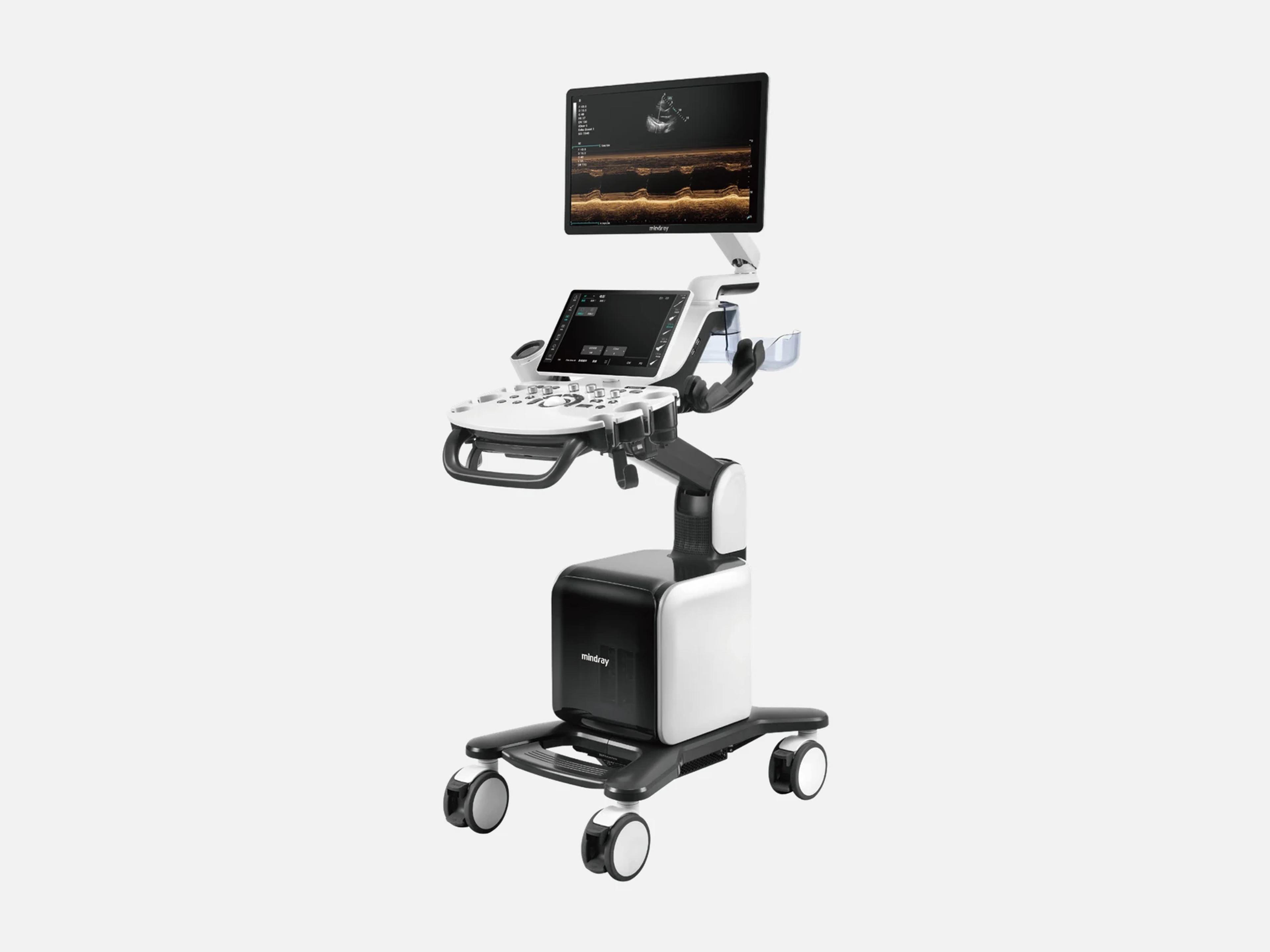
The Mindray Consona N7 is a primary care diagnostic ultrasound system for general imaging, women's health and cardiovascular work in hospitals and clinics. Built on the ZST+ channel-data platform, it pairs a 21.5-inch full HD monitor with a 13.3-inch full HD touch screen and measures fetal biometrics and ejection fraction automatically. It shares FDA clearance K221300 with its siblings, the Consona N9 and N8.
- Released
- 2022first FDA clearance
- Display
- 21.5-inchfull HD main monitor
Compatible probes
Linear
- L13-3
- L16-4Hs
Convex & microconvex
- C6-1
- C11-3
Phased
- P4-2
- P8-2
- P8-2Ts
Endocavity
- V11-3
- V11-3B
- V11-3HB
Specialty
- D7-2 4D volume
- DE11-3 4D volume
- CW2s Pencil
- CW5s Pencil
Specifications
Display
- Main monitor
- 21.5-inch full HD, on a lifting monitor arm
- Touch screen
- 13.3-inch full HD
Physical
- Controls
- Rotatable control panel; adjustable height; water- and dust-proof panel
- Ergonomic design
- Noise-reduced design; storage space
Power & battery
- Battery
- Built-in battery
Connectivity & options
- DICOM
Optional DICOM package; Worklist, MPPS and Query/Retrieve are separate optionsOptional DICOM package with Image Storage, Print, MPPS, Worklist, Storage Commitment, DICOMDIR Review, Query/Retrieve and Task Management, of which Worklist, MPPS and Query/Retrieve are each a separate option; Structured Report sending; DICOM/HL7 presetShow allShow less
Imaging & software
- Imaging platform
- ZST+: channel-data-based processing in place of conventional beam-forming
- Imaging modes
Cleared for the N9/N8/N7 series: B, M, PWD, CWD, Color Doppler, Amplitude Doppler, 4D…As cleared for the Consona N9/N8/N7 series, which the clearance does not break out per model: B, M, PWD, CWD, Color Doppler, Amplitude Doppler, combined modes (B+M, PW+B, Color+B, Power+B, PW+Color+B, Power+PW+B), Tissue Harmonic Imaging, Smart 3D, 4D (Real-time 3D), iScape View, TDI, Color M, Strain Elastography, STE, STQ, and contrast imaging (contrast agent for LVO; contrast agent for liver)Show allShow less
- Imaging technologies
- PSH, iClear, iBeam, HD Scope, HR Flow, NTE
- Transducer technology
- ComboWave transducers, designed to improve imaging sensitivity
- iTouch+
- Real-time dynamic image optimization
- Smart Calc
- Trace, measurement and calculation tool; target-contour recognition is semi-automatic
- Smart OB
- Automatic measurement of fetal biometrics
- Smart Face
- One-click automatic removal of occlusions over the fetal face
- Smart Scene 3D
- Obstetric toolset built on ZST+, with Smart Planes CNS, Smart Fetal HR and Smart Face
- Smart FLC 2D / 3D
- Automatic follicle counting and measurement in 2D/3D mode
- AutoEF
- Automatic ejection fraction from diastole and systole frames
- TTQA
- Myocardial synchronization evaluation with quantitative analysis
- RIMT
- RF-data-based real-time IMT measurement
- NTE
- ROI stiffness display with Shell quantitative assessment
- Smart HRI
- Automatic recognition of liver and renal cortex, with brightness ratio calculation
- Smart Vue
- Automatic recognition and restoration of the standard plane
- iWorks
- Standardized step-by-step scanning protocol, with no plane omitted
- iScanHelper
- Step-by-step guidance for practicing scanning skills
- iStation
- Patient information management
Compliance
- FDA 510(k)
K221300 (2022-09-29), shared with the Consona N9 and N8; Class IIK221300, decided 2022-09-29 as substantially equivalent, covering the Consona N9/N8/N7 series; Regulatory Class II; product codes IYN, IYO and ITXShow allShow less
What to check when buying a used Mindray Consona N7
Reject probes with cracks, peeling or loose lenses
A probe with peeling, rifts, bumps, cracks or liquid spill has reached the end of its service life, and a faulty probe can shock or injure the patient.
How: Examine each probe's surface, acoustic lens and cable sheath for peeling, cracks, protruding parts or a loose lens, and look over every cable and connector for damage and wear.
Ask whether any probe was dropped or knocked
A probe that has taken a hard knock can be defective, and a defective probe can give the patient an electric shock.
How: Ask the seller about the history of every probe offered with the unit, and treat any probe with impact marks as suspect.
Check the console for liquid and disinfectant damage
Liquid spilled into the system can cause malfunction or electric shock, and disinfectant on connectors or metal parts can corrode them.
How: Inspect the connectors, the metal parts and the areas that must not be disinfected for residue, corrosion or damage; those areas include the USB ports, main screen, trackball area, monitor arm, keyboard, cable hooks, intracavity probe holder and gel heater.
Look for liquid damage on every probe connector
The probe connector is not waterproof, and one that has been immersed in water or disinfectant can cause electric shock or malfunction.
How: Look at each probe connector for fluid residue or staining, and ask how the probes were cleaned and disinfected.
Common questions about the Mindray Consona N7
Is the Mindray Consona N7 FDA-cleared?
Yes. The Mindray Consona N7 is FDA-cleared under 510(k) K221300, found substantially equivalent on September 29, 2022, as a Class II device with product codes IYN, IYO and ITX. The Consona N9 and N8 share the same clearance, and the N7's entry in the FDA's GUDID device database carries K221300 and marks the device as in commercial distribution.
What exams is the Mindray Consona N7 cleared for?
The Consona N7 is cleared as a general-purpose diagnostic ultrasound system for use by qualified, trained healthcare professionals in a hospital or medical clinic.
Under K221300, which it shares with the Consona N9 and N8, it is cleared for adults, pregnant women, pediatric patients and neonates in fetal, abdominal, intra-operative, pediatric, small organ (breast, thyroid, testes), neonatal and adult cephalic, trans-rectal, trans-vaginal, musculoskeletal (conventional and superficial), thoracic/pleural, adult and pediatric cardiac, trans-esophageal, peripheral vessel and urology exams.
What is the difference between the Consona N7, N8 and N9?
The Consona N8 and N9 are listed with Smart Hip, Smart Breast, Smart Thyroid and R-VQS, which the N7 is not, and the N9 also with Smart Bladder and Smart B-line. The N7 is listed with NTE, which the N8 and N9 are not.
Among transducers, the N7 is listed with the C6-1, P4-2 and L13-3, which the N8 and N9 are not, while the N8 and N9 are listed with the SC5-1N, V11-3H, SP5-1N, SD8-1, L13-3N and L9-3, and the N8 also with the C5-1. All three are listed with the C11-3, V11-3, V11-3B, V11-3HB, P8-2, P8-2Ts, DE11-3, D7-2, L16-4Hs, CW5s and CW2s.
Are the Consona N7 Pro, N7 Super and N7 Elite FDA-cleared?
Yes. The device names cleared under K221300 include the Consona N7, Consona N7 Pro, Consona N7 Super, Consona N7S, Consona N7 Exp, Consona N7 Elite and Consona N7T, each named separately.