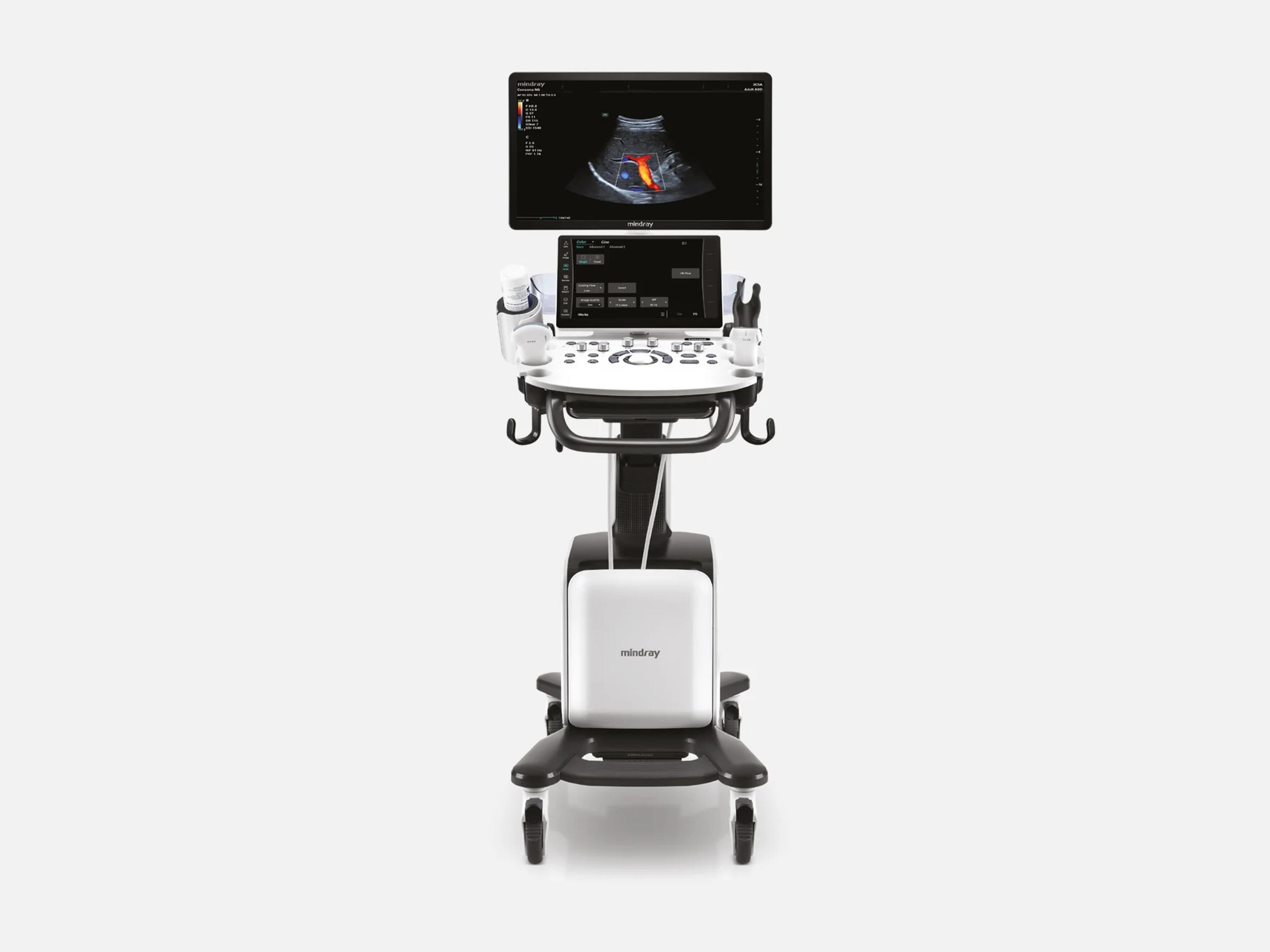
The Mindray Consona N6 is a cart-based ultrasound system designed for office settings and shared-service facilities, used in general imaging, cardiovascular and women's health exams. It weighs up to 65.0 kg in standard configuration and pairs a 21.5-inch LED monitor with a 13.3-inch touchscreen. It is the more compact sibling of the Consona N9, and its FDA clearance, K221496, spans ten trade names.
- Released
- 2022first FDA clearance
- Display
- 21.5-inchhigh-resolution LED monitor
- Weight
- ≤65.0 kgstandard configuration
Compatible probes
Linear
- L13-3
- 7L4B
- L9-3
- 6LE7
- 7LT4
- L13-3N
- L14-3W
- L16-4Hs Via PCM-SA01 adapter
- L20-5s Via PCM-SA01 adapter
Convex & microconvex
- C6-1
- 3C5A
- C5-1
- SC5-1N
- C6-2
- C11-3
- DE11-3
- SD8-1
- D6-2B
Phased
- P4-2
- SP5-1N
- P8-2
- P10-4
Endocavity
- V10-4
- V10-4B
- V11-3
- V11-3B
- V11-3H
- V11-3HB
- 6CV1
Specialty
- D7-2 4D volume
- ELC10-4 Bi-plane, convex and linear
- CW2s Pencil probe
- CW5s Pencil probe
- P7-3Ts Transesophageal; via PCM-SA01 adapter
- P8-3Ts Transesophageal; via PCM-SA01 adapter
- P8-2Ts Via PCM-SA01 adapter
Specifications
Display
- Display
- 21.5-inch high-resolution LED monitor on a support arm
- Touch screen
13.3-inch HD touchscreen with configurable two-finger gestures and a mapping mode13.3-inch HD touchscreen, gesture-powered and customizable; a mapping mode mirrors the main-screen image on the touch screen; configurable two-finger gesturesShow allShow less
- Brightness
- Brightness Auto Adjustment matches main and touch screen brightness to the surroundings
Physical
- Weight
- ≤65.0 kg (standard configuration)
- Dimensions
840±40 mm long, 513±10 mm wide, 994±20 mm high at lowest position; 60-inch max heightLength 840±40 mm, width 513±10 mm, height 994±20 mm with the monitor and control panel at their minimum positions; 60-inch maximum heightShow allShow less
- Monitor and control panel adjustment
Monitor: 90° rotation, 20° tilt. Control panel: 80° rotation, 300 mm up and downMonitor rotates 90° left to right and tilts 20° backward and forward to horizontal; the control panel rotates left and right in 80° and moves up and down within 300 mm, with a lever for lifting or swiveling itShow allShow less
- Controls
Trackball, iTouch+ key, P1/P2 and iHelper keys; floating, waterproof control panelKey control panel with trackball, Depth/Zoom knob, iTouch+ key (press to optimize the image), user-defined P1/P2 keys and iHelper key; 13.3-inch touch screen; fully adjustable floating control panel; waterproof control panel; QWERTY keyboard (option); 1-, 2- and 3-pedal USB footswitches (options)Show allShow less
- Probe ports
4-probe or 3-probe socket block on the front panel, plus a pencil probe portFront I/O panel probe socket block: a 4-probe socket or a 3-probe socket; a separate pencil probe port; ECG/PCG inputShow allShow less
- Ergonomic hardware
Foot rest, handle, casters, cable hanger, intracavitary probe holder; gel warmer (option)Magnetic protective cover for cable management; ergonomic foot rest; handle and casters; probe cable hanger; intracavitary probe holder; ultrasound gel warmer (option)Show allShow less
Power & battery
- Power
- 100–240 VAC, 50/60 Hz, 6.2–2.0 A input; AC auxiliary output for peripherals, 240 VA max
- Battery
- Built-in lithium-ion batteries (option), 14.4 VDC, 6600 mAh
- Battery operation
Continuous use at least 1 hour; standby at least 24 hours; full charge under 4 hoursContinuous operation on battery not less than 1 hour (60 minutes of scanning); standby on battery not less than 24 hours; charges from 0 to 100% in less than 4 hours with the system off or in standbyShow allShow less
Connectivity & options
- Connectivity
HDMI, VGA, S-Video, remote printer port, high-speed USB, network; optional wireless cardBack panel: HDMI, VGA, S-Video, remote port (analog video printer control), high-speed USB and network port; more USB ports on the unit; built-in wireless network card (option) for connection to a router, phone, tablet, ultrasound workstation or serverShow allShow less
- DICOM
Optional DICOM Basic, Worklist, MPPS, Query/Retrieve and structured reportsDICOM package (option): DICOM Basic, Worklist, MPPS and Query/Retrieve; structured reports for OB/GYN, Vascular, Cardiac, Breast, Abdomen and Small Parts. Services: storage, print, worklist (HL7 query), MPPS, storage commitment, query/retrieve, DICOMDIR reviewShow allShow less
- Storage
- Internal hard disk; export to USB storage; external DVD recorder and DVR Module options
- Hardware options
Multi-function module (CW, 4D, TEE probes), ECG, PCG, PCM-SA01 adapter, barcode scannerMulti-function hardware module (supports CW, 4D and TEE probes); ECG module; PCG module (requires the ECG module); Probe Adapter PCM-SA01; built-in batteries; built-in wireless network card; barcode scanner; pencil probe cableShow allShow less
- Workflow options
- iWorks, DVR Module, iVocal (with the microphone material kit), ClamAV
- Supported peripherals
Graph/text, video and photo printers; DVD-RW drive; barcode readers; iVocal microphoneGraph/text printer; B/W video printers; digital color video printer; photo printers; microphone for iVocal; DVD-RW drive; barcode readersShow allShow less
Imaging & software
- Platform
- ZONE Sonography® Technology+ (ZST+)
- Imaging modes
B, M, PWD, CWD, Color and Amplitude Doppler, Tissue Harmonic Imaging, Smart 3D, 4D…B, M, PWD, CWD, Color Doppler and Amplitude Doppler; combined modes B+M, PW+B, Color+B, Power+B, PW+Color+B and Power+PW+B; Tissue Harmonic Imaging; Smart 3D; 4D (real-time 3D); iScape View; TDI; Color M; Strain Elastography; contrast imaging with LVO and liver contrast agents. CW, 4D, Smart 3D, iScape View, TDI, Strain Elastography and contrast imaging are options.Show allShow less
- Imaging options
CW, 4D, Smart 3D, contrast imaging, Strain Elastography, TDI, Stress Echo, iScape View…CW and 4D (each requires the multi-function hardware module); iScape View; Free Xros M; Free Xros CM; Tissue Doppler Imaging and LVO, Stress Echo and Tissue Tracking QA (require the Cardiology Package); TDI QA; contrast imaging; Contrast Imaging QA; Strain Elastography; Smart 3D; iPage+, SCV+ and Color 3D (require 4D); iLive (requires 4D or Smart 3D); Niche; Smart Volume; iNeedleShow allShow less
- Clinical packages
Abdomen/General, Obstetrics, Gynecology, Cardiology, Small Parts, Urology, Vascular…Options: Abdomen/General, Obstetrics, Gynecology, Cardiology, Small Parts, Urology, Vascular, Pediatrics, Nerve and Emergency&Critical packagesShow allShow less
- Measurement options
Smart Pelvic, Smart NT, IVF Plus, IVF, IMT, R-VQS, Smart Hip, Smart Trace, CPP…Smart Pelvic (2D) (requires the Gynecology Package); Smart NT; IVF Plus and IVF (require the Gynecology Package); IMT (requires the Vascular Package); R-VQS (requires the Vascular Package); Smart Hip (requires the Pediatrics Package); Smart Trace; CPP; Smart B-line; V-Mapping (requires the Vascular Package)Show allShow less
- AutoEF
- Option (Cardiology Package): automatic ejection fraction from diastole/systole frames
- Smart OB
- Option (Obstetrics Package): automatic measurement of fetal biometrics
- Smart Face
- Option (4D and Obstetrics Package): one-click removal of occlusions over the fetal face
- Glazing Flow
- Option: 3D presentation of fetal flow
- Smart Bladder
- Option (Abdomen/General or Urology Package): automatic bladder volume measurement
- Smart HRI
- Option (Abdomen/General Package): automatic HRI index for hepatic steatosis evaluation
- RIMT
- Option: RF-data based real-time IMT measurement
- Smart Calc
- Automatic trace, measurement and calculation tool
- TDI
- Doppler-based display of myocardial movement; option requiring the Cardiology Package
- HD Scope
- Improves resolution within a region of interest
- iTouch⁺
- Real-time dynamic image optimization
- NTE
- Region-of-interest stiffness display with Shell quantitative assessment
- Software updates
- Living Technology™ software upgrade program, North America
Environment
- Operating conditions
- 0 °C to 40 °C, 20% to 85% relative humidity (no condensation), 700 hPa to 1060 hPa
- Ingress protection
- Main unit IPX0; probes IPX7; footswitch IPX8
Compliance
- FDA 510(k)
- K221496 (decided 2022-09-29); regulation 892.1550, product code IYN
What to check when buying a used Mindray Consona N6
Have a biomed run electrical safety tests
Electrical and mechanical performance can degrade with long use, showing up as leakage, distortion or abrasion.
How: With a safety analyzer, test protective earth resistance and earth, enclosure and patient leakage.
Inspect the power cable, plug and adapter
A cracked or loose cable, damaged pins or a plug that warms in use is an electrical fault to settle before the unit goes into service.
How: Look for wrinkles, cracks or deterioration on the cable, cracks or swelling on the adapter, broken, bent or discolored pins and a damaged strain relief, and feel the plug for looseness.
Inspect each probe's lens, cable and connector pins
Surface defects, cracks or peeling on a probe, its cable or its connector can cause electrical shock, and a probe with peeling, cracks or bumps has reached the end of its service life.
How: Look for a loose or peeling acoustic lens, cracks or swelling on the head, a worn or eroded cable with exposed wiring, and bent, broken or missing connector pins.
Check endocavity probes for rough or sharp spots
Any part of a probe that goes inside the patient must be free of rough surfaces, sharp edges and protrusions.
How: Inspect the full insertion length of every endocavity and TEE probe offered for rough areas, sharp edges or protrusions.
Common questions about the Mindray Consona N6
Is the Mindray Consona N6 FDA-cleared?
Yes. The Consona N6 is FDA-cleared under 510(k) K221496, found substantially equivalent on September 29, 2022, under regulation number 892.1550 with product code IYN. Its main predicate device was the MX7 Diagnostic Ultrasound System (K212900).
What exams is the Mindray Consona N6 cleared for?
It is cleared for adults, pregnant women, pediatric patients and neonates, in fetal, abdominal, intra-operative, pediatric, small organ (breast, thyroid, testes), neonatal cephalic, adult cephalic, transrectal, transvaginal, musculoskeletal (conventional and superficial), thoracic and pleural, adult and pediatric cardiac, transesophageal, peripheral vessel and urology exams.
The clearance is for use by qualified and trained healthcare professionals in a hospital or medical clinic.
What does the Mindray Consona N6 need to use 4D, CW and TEE probes?
The optional multi-function hardware module: it supports CW, 4D and TEE probes, and the CW and 4D imaging options each require it. The PCM-SA01 probe adapter, the ECG module and a pencil probe cable are separate hardware options, so confirm which are fitted on a used unit.
Which Mindray systems share the Consona N6's FDA clearance?
K221496 includes ten trade names: Consona N6, Consona N6 Pro, Consona N6 Super, Consona AR, Consona N6S, Consona AE, Consona AT, Consona N6 Exp, Consona N6 Elite and Consona N6T. Mindray groups them as the Consona N6 series, with one operator's manual.
What is the difference between the Mindray Consona N6 and Consona N9?
The Consona N6 is the more compact of the two Consona-Series systems. Mindray launched the pair together in North America in November 2024, for its private office range.
What warranty comes with a new Mindray Consona N6?
Bought directly from Mindray in North America, a new Consona N6 carries a five-year standard warranty on the main system and parts, standard transducers, software performance updates through Living Technology and on-site labor for cart repairs. Specialty transducers, including TEE and 4D transducers, carry one year, and warranties on systems bought through Mindray's agents can vary.