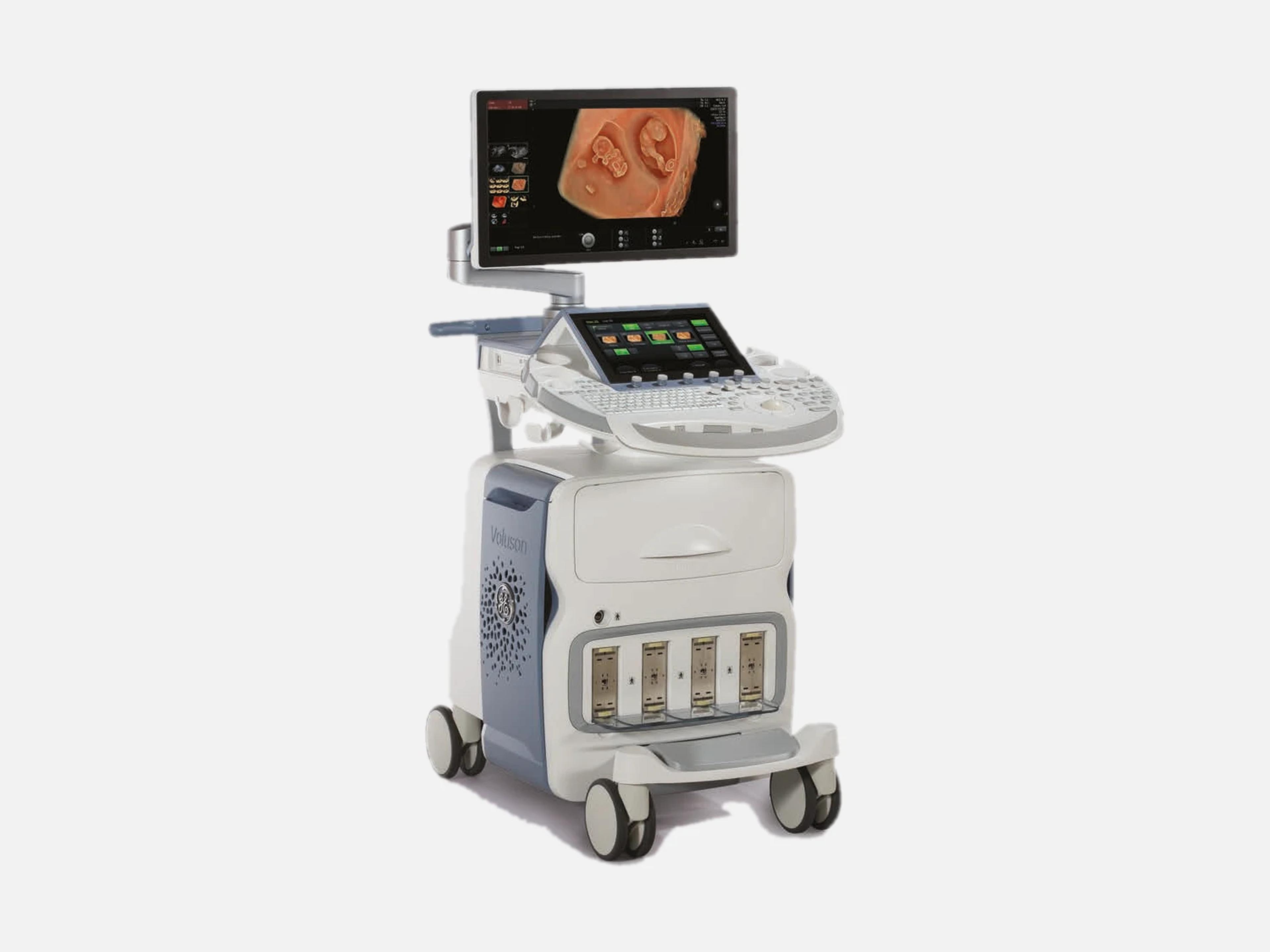
The GE Voluson E8 is a women's health ultrasound system designed for busy practices running routine to complex exams. It is built on the Radiance System Architecture and brings many advanced features from the Voluson E10, which has more scan channels than the E8 and E6 and extra hardware for eM6C electronic 4D probes. On BT13.5 software, the E8 Expert upgrade added Wide Sector and enabled matrix volume probes.
- Released
- 2006first version launched
- Probe ports
- 4BT17/BT18; 3 + CW on BT15/16
- Display
- 23-inchLED monitor, BT15–BT18
Compatible probes
Linear
- 9L-D · 3–8 MHz
- 11L-D · 4–10 MHz
- ML6-15-D · 4–13 MHz Active matrix array
- L8-18I-D · 5–14 MHz From BT21
- RSP6-16-D · 6–18 MHz Real-time 4D volume; not in all countries
Convex & microconvex
- C1-6-D · 2–5 MHz XDclear; introduced with BT19
- C2-9-D · 3–9 MHz XDclear
- RAB6-D · 2–8 MHz Real-time 4D volume
Phased
- M5Sc-D · 1.5–4.5 MHz XDclear
- S4-10-D · 4–9 MHz
Endocavity
- IC 5-9-D · 4–9 MHz Micro-convex, 2D
- RIC5-9-D · 4–9 MHz Real-time 4D volume
Specifications
Display
- Display
23-inch widescreen LED monitor on an adjustable arm; 12.1-inch touch panel (BT15–BT18)23-inch widescreen LED monitor on a fully adjustable monitor arm, plus a 12.1-inch touch panel display (Voluson E-Series, BT15–BT18)Show allShow less
- Display, earlier E8
- 19-inch flat-screen monitor
Physical
- Weight
- 150 kg (330 lb) without peripherals, for the Voluson E6/E8/E10 E-Series
- Dimensions
Height 1533 mm max, 1333 mm min; width 582 mm; depth 1168 mm max, 968 mm minHeight 1533 mm (60.4 in) maximum / 1333 mm (52.5 in) minimum at normal monitor position; width 582 mm (22.9 in); depth 1168 mm (46.0 in) maximum / 968 mm (38.1 in) minimum. Voluson E-Series (E6/E8/E10, BT15–BT18), without monitor and peripherals; height and depth depend on the control console and monitor positions.Show allShow less
- Probe ports
Any 4 probes at BT17/BT18; any 3 plus 1 pencil CW probe at BT15/BT16BT15/BT16 (EC300/EC310): any 3 probes connected at the same time, plus 1 pencil CW probe. BT17/BT18 (EC320/EC330): any 4 probes connected at the same time. A probe storage connector on the left is not active for scanning.Show allShow less
- Controls and user interface
Keyboard, hardkeys, encoders; console rotates ±40°, translates 20 cm, lifts 20 cmControl console with alphanumeric keyboard, hardkeys and encoders/joycoders, plus a 12.1-inch touch panel. The console rotates (±40°), translates (20 cm) and adjusts in height (20 cm) with Lift UP / Lift DOWN buttons in the handlebar opening; the LCD monitor is on a free-adjustable arm. One-button control panel up/down function and swipe menu navigation; xTouch expanded at BT21.Show allShow less
Power & battery
- Power
100–240 VAC ±10%, 50/60 Hz ±2%, 800 VA with all on-board peripherals; dedicated circuit100–240 VAC ±10%, 50/60 Hz ±2%; power consumption 800 VA including all on-board peripherals. Auxiliary outlets for peripherals output 115 V, and equipment connected to them must not exceed 200 VA. Requires a dedicated circuit.Show allShow less
Connectivity & options
- DICOM
Storage, query/retrieve, print, Worklist, MPPS, Storage Commitment, Comprehensive SRVerification, US image and US multi-frame storage, Enhanced US Volume storage, Secondary Capture, Study Root query/retrieve (find, move), basic grayscale and color print, Modality Worklist, Modality Performed Procedure Step, Storage Commitment and Comprehensive SR (E6/E8/E10, software EC360); DICOM export to CD-R or DVD-R.Show allShow less
- Network and export
- WLAN adapter and cellular modem options; email export; encrypted image and volume export
- MMS/SMS image sending
- SIM card to send images and text wirelessly by MMS/SMS
- Security
Voluson SonoDefense, USB defense, whitelisting and HD encryptionVoluson SonoDefense: layered system and patient-data security, including USB defense. User management and security with Windows 10, whitelisting and HD encryption. Within BT15–BT18, whitelisting is available only at EC330 (BT18), and disk encryption and Advanced Security Features are BT17/BT18 software options.Show allShow less
- Remote service (BT21)
InSite, OnWatch proactive diagnostics, RSvP Agent; optional Voluson Remote UpdateInSite connectivity, OnWatch proactive diagnostics and the RSvP Agent for remote service; Voluson Remote Update, an optional purchasable feature that lets administrators download and install software updates and patches on the system.Show allShow less
- Reporting and image sharing
- Works with ViewPoint 6 reporting; Tricefy image sharing and encrypted storage
- 3D printing
- Exports files directly from the system for 3D printing
- Storage and media
Partitioned hard disk (500 GB layout at BT15–BT18); DVD+(R)W; software DVR; USB 3.0Hard disk partitioned into system, user (presets, image archive, patient IDs, reports), rescue and Linux partitions, in the partition layout of a 500 GB HDD at BT15–BT18. DVD+(R)W drive. Integrated software digital video recorder with USB recording; USB 3.0.Show allShow less
Imaging & software
- Imaging modes
B-Mode, M-Mode, Color Flow, Power Doppler, HD-Flow, PW, CW where fitted, 3D, Real-Time 4DB-Mode (2D) with Coded Harmonic Imaging, XTD-View (extended view) and B-Flow; Coded Contrast Imaging (optional); Elastography (optional); M-Mode, Color M-Mode (MCFM) and Anatomical M-Mode for the fetal heart; Color Flow, Power Doppler, HD-Flow (bi-directional angio) and Tissue Doppler; PW Doppler; CW Doppler (where fitted); 3D and Real-Time 4D (Voluson E-Series).Show allShow less
- CW Doppler
- Hardware and software option; a 'Voluson E8 incl. CW' model at BT15
- Revision and software
BT15–BT18 (EC300, EC310, EC320, EC330), BT19, BT20, BT21; earlier E8: BT13.5 (EC250)Radiance-architecture E8: BT15 (EC300, 15.x.x), BT16 (EC310, 16.x.x), BT17 (EC320, 17.x.x), BT18 (EC330, 18.x.x), BT19, BT20 and BT21; E8 software EC350 and EC360 also exist. On BT15–BT18 units the serial number identifies the build release, and earlier units could be upgraded. Earlier E8 releases: BT13.5 (EC250, 14.x.x, shared with the E8 Expert) and software versions 6.0.x, 6.2.x, 7.x.x, 9.x.x, 10.x.x, 12.x.x and EC200.Show allShow less
- Operating system
- Windows 7 at BT15–BT17; Windows 10 at BT18; Windows 10 version 1809, 64-bit, at BT21
- Radiance System Architecture
- Advanced beamformer design, high-performance CPU and parallel processing
- Image optimization
Auto TGC; HDRes for all OB probes and HiPen with BT19; Shadow Reduction with BT21Auto TGC for quick image fine-tuning; HDRes (tissue differentiation and border definition) extended to all OB probes and HiPen (High Penetration) introduced with BT19; Shadow Reduction, improved shadowing behavior with HiPen, with BT21.Show allShow less
- Flow imaging
Radiantflow, SlowflowHD; Slowflow3D optional from BT21Radiantflow: color Doppler visualization of small vessels (a BT19 feature). SlowflowHD: low-velocity vessels in 2D (a BT19 feature). Slowflow3D: low-velocity blood flow in 3D, introduced with the BT21 upgrade and optional on the E8.Show allShow less
- HDlive
HDlive volume rendering; HDlive Silhouette and HDlive Flow options; HDlive StudioHDlive Technologies volume rendering for relational anatomy and developing structures; HDlive Silhouette (variable-transparency rendering of internal structures) and HDlive Flow (vascular structures with depth perception), both optional; HDlive Studio.Show allShow less
- Volume tools
Advanced VCI with OmniView, TUI, xTouch, 4DView offline softwareAdvanced VCI with OmniView: any plane from a 3D or 4D volume by drawing a line, curve, poly-line or trace, with adjustable slice thickness. TUI tomographic display with VCI. xTouch touch navigation of volumes (x/y/z rotation, zoom, MagiCut, HDlive light source, OmniView), expanded at BT21. 4DView offline software to optimize, manipulate and analyze volume data away from the system; not available in all countries.Show allShow less
- Fetal heart
fetalHQ (fetalHQ2 at BT21), SonoVCADheart, STIC; Auto-flip, Quiver, TAPSE/MAPSE at BT21fetalHQ: fetal heart size, shape and contractility from the 4-chamber view using 2D speckle tracking, with z-scores and percentiles; the BT21 upgrade brings fetalHQ2 and the fetalHQ tools Auto-flip (automatic fetal-heart orientation), Quiver and TAPSE/MAPSE measurement. SonoVCADheart standardizes fetal heart orientation to give recommended views from one heart volume or STIC acquisition. STIC fetal heart acquisition, part of the Advanced STIC option at BT13.5.Show allShow less
- Gynecology tools
IOTA Simple Rules, LR2 and ADNEX; Uterine Trace with uterine classification; BetaViewIOTA ovarian-tumor risk tools: IOTA LR2 (added with 510(k) K142472, February 2015), IOTA Simple Rules (at software EC330/BT18 within BT15–BT18) and IOTA ADNEX (added with K181985, November 2018). Uterine Trace: the coronal plane of the uterus from 3D, linked to Uterine Classification pictograms. BetaView imaging of the uterus and endometrium.Show allShow less
- Automation tools
SonoCNS, SonoBiometry, SonoNT, SonoIT, SonoRenderlive, SonoAVC, Scan AssistantSonoCNS: deep-learning application that aligns and displays recommended fetal brain views and measurements (a BT19 feature). SonoBiometry: semi-automated BPD, HC, AC, FL and HL measurements. SonoNT and SonoIT: semi-automatic nuchal and intracranial translucency measurements in the first trimester. SonoRenderlive: automated render-line placement that follows fetal movement in 4D. SonoAVC: automated volume count of hypoechoic structures such as ovarian follicles. Scan Assistant: customizable exam protocols.Show allShow less
- MI/TI Limits
- Customizable TI settings and MI alerts based on ISUOG/AIUM recommendations
Environment
- Operating environment
- Operating 10–30 °C (50–86 °F), 30–80% rH non-condensing; storage humidity below 90% rH
- Heat output
- 2730 BTU/hour without on-board peripherals, plus 300 BTU/hour per person in the room
- Acoustic noise
- Maximum 60 dB(A)
Compliance
- FDA 510(k)
K192159 (2019-08-29), K181985 (2018-11-15), K172342 (2017-09-29) … K061682 (2006-07)K192159 (decided 2019-08-29); K181985 (2018-11-15); K172342 (2017-09-29); K162269 (2016-10-03); K152567 (2015-11-06); K142472 (2015-02-10); K132913 (2013-11-08); K131267, K122327 and K113758 (2011–2013); K112213 (2011-09-01); K101236 (2011-02-08); K061682 (July 2006). Class II, product code IYN (also IYO, ITX).Show allShow less
What to check when buying a used GE Voluson E8
Reject probes with wear or damaged insulation
A probe showing any sign of wear, or with punctured or compromised insulation, must not be used.
How: Inspect each probe offered for wear, and have its insulation verified with IEC 60601-1 electrical safety (leakage) testing.
Inspect endocavity probe housings for separation
A RIC5-9-D transvaginal probe on a Voluson E-Series system came apart during an exam, in a case reported to the FDA.
How: Look for cracks or separating seams along each endocavity probe's housing, and check the probe holders for cracks or damage.
Check a used RIC5-9-D against recall Z-1964-2019
The recall concerned possible transducer misalignment in certain refurbished RIC5-9-D probes, which GE corrected.
How: Confirm whether the probe was in the recall's scope and was corrected, and follow the Basic User Manual's biopsy alignment instructions before any biopsy use.
Check older E8 software against measurement recalls
On earlier-generation E8 units, recalls Z-0113-2008, Z-2404-2008 and Z-0541-2010 concerned software that underestimated PW Doppler velocities, gave inaccurate M-Mode measurements with pan-Zoom, or showed an incorrect velocity scale.
How: Read the installed software version and confirm it is past the versions those recalls name, or that GE's correcting software update was applied.
Common questions about the GE Voluson E8
Is the GE Voluson E8 FDA-cleared?
Yes. The Voluson E8 is FDA-cleared through 510(k) as a Class II device, product code IYN. Its first clearance, K061682, came in July 2006, and K192159, which clears the Voluson E6, E8 and E10 together, was decided on August 29, 2019.
What is the difference between the Voluson E8 and E10?
The E10 has more scan channels than the E8 and extra hardware for the eM6C and eM6C G2 electronic 4D probes. At BT21, the eM6C G2, RM7C and RIC6-12-D are E10-only probes, and Slowflow3D is optional on the E8 but standard on the E10. At BT17 and BT18, an OLED monitor was available only on the E10.
How does the Voluson E8 differ from the Voluson E6?
At BT13.5, the Advanced STIC option was available on the E8 but not on the E6, where STIC was optional, and GE offered an upgrade kit from a Voluson E6 BT13.5 to a Voluson E8 BT13.5. At BT20, every probe available for the E8 is available for the E6 as well. Both are cleared together with the E10 under 510(k)s such as K192159, and the E10 differs from both in scan channels.
Can a used Voluson E8 be upgraded to BT21?
Yes, from BT17, BT18, BT19 or BT20. GE offers Voluson E10, E8 and E6 upgrades to BT21 from each of those releases: from BT20 the upgrade is software only, and from BT17, BT18 or BT19 it includes hardware. BT21 brings Windows 10 version 1809, 64-bit.
Is the Voluson E8 the same as the Voluson S8?
No. The E8 is built on the Radiance System Architecture, while the Voluson S10 Expert and S8 are built on the Voluson Core Architecture. The E8 is cleared together with the E6 and E10 under 510(k)s such as K192159, and the S-series has its own 510(k)s.