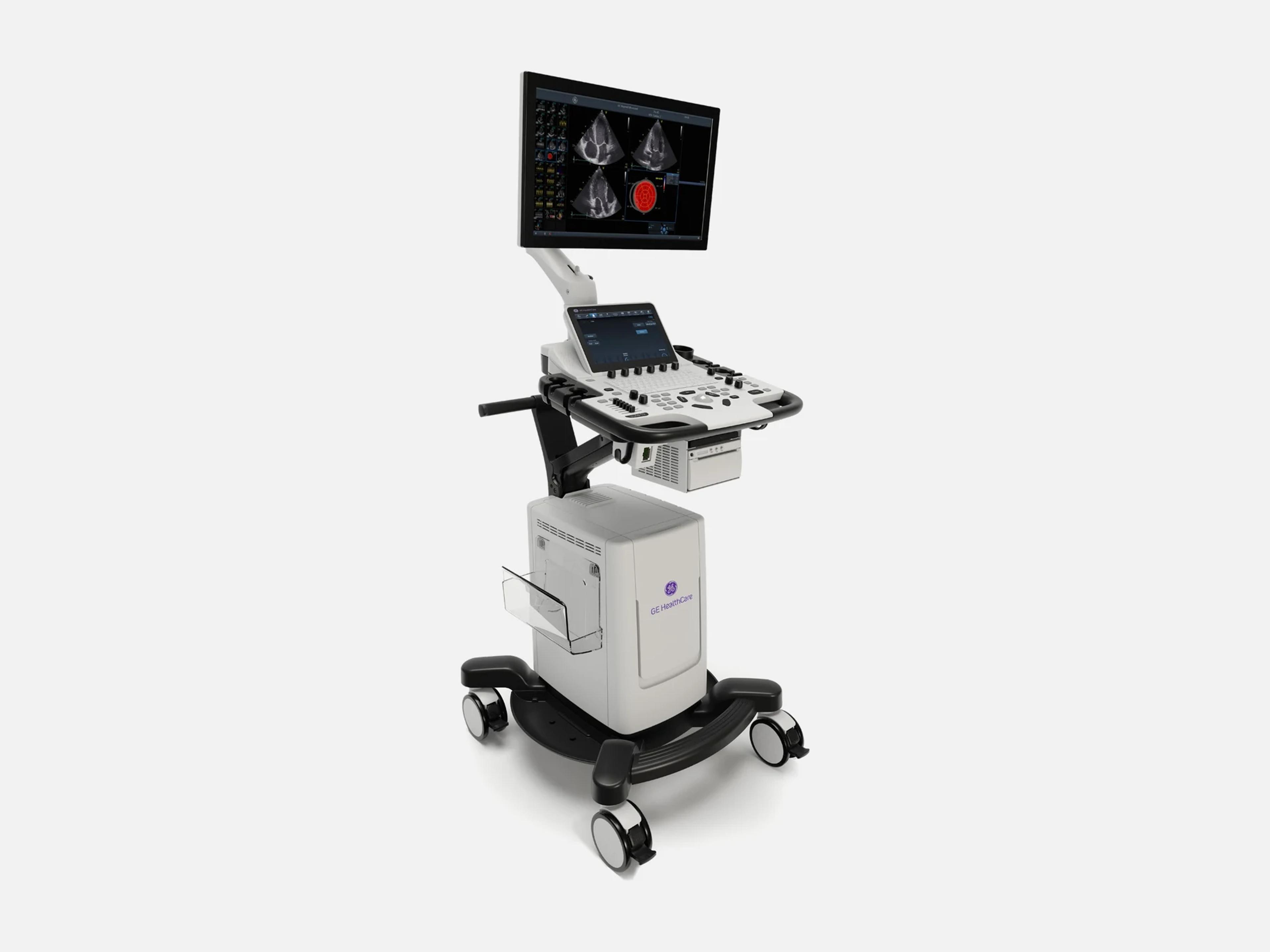
The GE Vivid T9 is a hybrid cardiovascular system for cardiovascular practices and shared services, pairing Vivid cardiac imaging with LOGIQ shared-services functionality. It has a 21.5-inch HD display and four active RS probe ports, and weighs 60 ± 5 kg. It shares its software platform with the Vivid T8 but adds a height-adjustable control panel, a flexible monitor arm and full transducer support.
- Released
- 2018first FDA clearance
- Probe ports
- 4active RS transducer ports
- Display
- 21.5-inch1920 x 1080 HD LCD
- Weight
- 60 ± 5 kg132 ± 11 lb
Compatible probes
Linear
- 9L-RS · 2–10 MHz
- 12L-RS · 4–13 MHz
- L6-12-RS · 4–13 MHz
- ML6-15-RS · 5–15 MHz Active Matrix
- L4-20t-RS · 4–20 MHz XDclear single crystal
- L8-18i-RS · 4–18 MHz Intraoperative
Convex & microconvex
- C1-5-RS · 1–5 MHz
- 4C-RS · 1–5 MHz
- 8C-RS · 3–10 MHz
Phased
- M5Sc-RS · 1–5 MHz XDclear single crystal
- 3Sc-RS · 1–5 MHz
- 6S-RS · 2–7 MHz
- 12S-RS · 4–12 MHz
Endocavity
- E8C-RS · 3–10 MHz Endo micro-convex
- E8Cs-RS · 3–10 MHz Endo micro-convex
Specialty
- 6Tc-RS · 3–8 MHz Transesophageal
- 9T-RS · 3–10 MHz Transesophageal
- P2D · 1–3 MHz Pencil, CW Doppler
Specifications
Display
- Display
21.5-inch widescreen HD flicker-free LCD, 1920 x 1080 pixels, on an articulating arm21.5-inch widescreen high-definition flicker-free LCD, 1920 x 1080 pixels, 256 shades of gray and 16.7 million simultaneous colors, horizontal viewing angle over 170°; articulating arm with 325 mm horizontal bidirectional travel, 150 mm vertical adjustment, side swivel, fold-down and rotation lock for transportShow allShow less
- Touch panel
- 10.1-inch widescreen color multi-touch LCD with a user-configurable software menu
Physical
- Weight
- 60 ± 5 kg (132 ± 11 lb)
- Dimensions
Width 502 mm (keyboard), 590 mm (base); max depth 810 mm; height 1,405–1,755 mmWidth 502 ± 20 mm (19.8 in) at the keyboard and 590 ± 20 mm (23.2 in) at the base; maximum depth 810 ± 20 mm (31.9 in); height 1,405 ± 30 to 1,755 ± 30 mm (55.3 to 69.1 in)Show allShow less
- Probe ports
- Four active RS ports; six probe holders (four standard, two optional); separate ECG port
- Controls and user interface
Backlit full-size hard keys, six TGC pods, FlexFit swivel arm, height-adjustable panelFull-size hard-key layout with interactive control-panel backlighting; rotary dials, patient-management and mode buttons grouped near the trackball; six TGC pods; FlexFit left/right swivel and up/down arm for keyboard and monitor, for seated or standing use; height-adjustable control panel; alphanumeric keyboard supporting eight character setsShow allShow less
Power & battery
- Power
- 100–240 VAC (±10%), 50/60 Hz; maximum 300 VA with peripherals
- Battery
Optional Smart Standby battery; imaging is not allowed when the system is unpluggedOptional Smart Standby battery keeps the system powered rather than shut down when it is moved between rooms; imaging is not allowed when the system is not plugged in; operating temperature narrows to 3–30 °C with the battery fittedShow allShow less
- Smart Standby
Saves data and enters Standby on power loss, then resumes its prior stateOn accidental shutdown or power outage the system saves data and enters Standby; when power returns it turns on in the exact state it had before shutdown; Standby is also entered when the system is moved to another roomShow allShow less
- Start-up time
- One and a half minutes or less; up to four minutes after a power loss or lock-up
Connectivity & options
- Network and DICOM
1000BASE-TX Ethernet, optional USB wireless; DICOM 3.0 with Query/Retrieve, SR and TLS1000BASE-TX Ethernet (RJ45); optional USB wireless network interface kit; DICOM 3.0 Verify, Print, Store, Modality Worklist, Storage Commitment, MPPS, Image Spooler, Query/Retrieve and media exchange; DICOM-SR structured reporting for adult cardiac, pediatric, vascular and abdominal; DICOM/TLS encryption; DICOM Encapsulated PDF and DICOM PDF read; DICOM implicit encoding; simultaneous transfer to multiple destinationsShow allShow less
- USB ports
- Six: one USB 3.1 and two USB 2.0 on the rear; three USB 3.1 under the keyboard
- Video outputs
- HDMI; VGA (1080p); composite color video and S-Video via adapters; stereo audio out
- Storage
1 TB HDD or optional 512 GB SSD; USB stick, CD-RW, DVD-R and optional 1 TB USB driveIntegrated 1 TB HDD (standard) or 512 GB SSD (optional); optional 1 TB USB mobile hard drive; optional DVD-RW drive; storage to USB memory stick, CD-RW (700 MB) and DVD-R (4.7 GB)Show allShow less
- Export formats
DICOM with or without raw data; JPEG, MPEG, AVI; reports as PDF, CHM or TXTDICOM compressed or uncompressed, single or multi-frame, with or without raw data; Save As JPEG, MPEG, AVI, DICOM and Raw DICOM; reports exported as PDF, CHM or TXT; alphanumeric data exportable in a spreadsheet-compatible formatShow allShow less
- Peripheral options
- DVD-RW drive, B/W video printer, USB stick, 1 TB USB hard drive, three-pedal footswitch
- Streaming and remote viewing
Optional Ethernet video streaming, raw-data streaming and Remote Viewing in a browserOptional Streaming sends images as a real-time digital video stream over Ethernet; optional Raw Data Streaming sends raw data to third-party devices designed to process it; optional Remote Viewing streams the console screen to a web browser on the same network, not for diagnostic useShow allShow less
- Remote service
InSite ExC, Virtual Console Observation; optional Digital Expert, eDelivery and SSIInSite Express Connection (ExC) for remote service and training: an on-screen Contact GE button sends a service request with a system snapshot, Virtual Console Observation gives customer-authorized remote viewing and control through an encrypted tunnel, and file transfer sends logs without patient data; optional Digital Expert connects to a GE clinical specialist (US only); optional eDelivery downloads software patches; optional Smart Service Interface for licensed qualified users; remote software reload and recovery after corruption; system-utilization data for Imaging InsightsShow allShow less
- Cybersecurity
Whitelisting, optional drive encryption, LDAP login, password policies, OS patchesApplication whitelisting; optional encryption of the drive holding patient-identifiable data; LDAP login with domain credentials; configurable password and login requirements; last-login information and a configurable login banner; operating-system vulnerability patches in software maintenance releasesShow allShow less
- EchoPAC Plug-in
- Raw data reviewed, analyzed and post-processed on EchoPAC Plug-in, including Q-analysis
- App Launchpad
- Archive-screen tab that launches validated apps; availability varies by country
- Self-contained DICOM Viewer
- Optional viewer on exported CD/DVD or USB media opens stills and loops on a standard PC
Imaging & software
- Revision and software
Version 208 (software 208.x.x); earlier T9 levels 203, 204/205 and v206Version 208, system software 208.x.x; earlier Vivid T9 software levels 203, 204/205 and v206, with a v206-to-v208 upgrade; the release designation Vivid T9 R5 also exists and is not tied to a numeric version; the v208 510(k), K243628, added Clarity+, DICOM Encapsulated PDF reports, Remote Viewing and one-click QuickAppsShow allShow less
- Model number
- H48082BZ, Vivid T9 v208 with Smart Standby
- Operating system
- Windows 10 IoT Enterprise LTSC
- Clinical applications
Cardiac, vascular, abdominal, OB, pediatric, small organ, MSK, urology, intraoperative…Fetal/Obstetrics; Abdominal (includes GYN); Pediatric; Small Organ (breast, testes, thyroid); Neonatal Cephalic; Adult Cephalic; Cardiac (adult and pediatric); Peripheral Vascular; Musculoskeletal Conventional; Musculoskeletal Superficial; Urology (including prostate); Transcranial; Transesophageal; Transrectal; Transvaginal; Interventional guidance (biopsy, fluid drainage, vascular access); Thoracic/Pleural; Intraoperative (Vascular)Show allShow less
- Imaging modes
2D, M-mode, color flow, PW with HPRF, CW, TVI, tissue tracking, strain elastography2D Tissue; Tissue M-mode; Anatomical M-mode; Curved Anatomical M-mode; optional Extended field-of-view (LOGIQ View); Virtual Convex; Virtual Apex; Coded Phase Inversion; Compound Imaging; 2D Color Flow; 2D Color Angio Flow; Color M-mode; Anatomical Color M-mode; optional B-flow, Blood Flow Imaging and Blood Flow Angio Imaging; Strain Elastography; Pulsed Wave Doppler with High PRF; Continuous Wave Doppler; optional LVO Contrast; Tissue Velocity Imaging; Tissue Tracking; optional Tissue Synchronization Imaging, Strain Imaging and Strain Rate Imaging; Tissue Velocity M-mode; Tissue Velocity DopplerShow allShow less
- Contrast
Optional LVO Contrast; Vascular/Abdominal Contrast and Contrast Low MI not in the USAOptional left-ventricular opacification (LVO) contrast with coded phase inversion on the 3Sc-RS, M5Sc-RS and 6Tc-RS probes, accessed through QuickApps; the optional Vascular/Abdominal Contrast and Contrast Low MI presets are not available in the USAShow allShow less
- Cardiac quantification
Optional AFI 3.0, AFI LA, AFI RV, Easy AFI LV, AutoEF 3.0 and Easy AutoEFOptional AFI 3.0 (global and segmental strain with integrated AutoEF, on GE raw data and DICOM data from other makers' scanners); AFI LA (left-atrial strain, volumes and emptying fraction); AFI RV (right-ventricular strain, with TAPSE); Easy AFI LV (one-click strain with AI-based Auto ROI); AutoEF 3.0 (speckle tracking and Simpson, with or without ECG); Easy AutoEF (one-click EF for adult TTE on GE raw B-mode loops, not for ventricles with septal bulge); AutoEF with Optional ECG as a separate option; View Recognition labels views during TTE acquisitionShow allShow less
- Automated measurement
- Optional AI Auto Measure (2D and Spectrum Recognition); Cardiac Auto Doppler
- Stress echo
Optional Smart Stress for pharmacological, bicycle and treadmill stress echoOptional Smart Stress package: 2D pharmacological, bicycle and continuous-capture (treadmill) stress echo; Q-Stress protocols; wall motion scoring; scanning parameters matched to the same projection on the previous level; protocol editor with over 10 levels and up to 10 projectionsShow allShow less
- Tissue Doppler analysis
TVI, Tissue Tracking and QAnalysis; optional TSI, Strain and Strain Rate ImagingTissue Velocity Imaging (myocardial Doppler with color overlay, acquirable in the background during 2D); Tissue Tracking (color-coded systolic displacement); QAnalysis (time curves of tissue velocity, strain rate, strain, displacement and contrast intensity); optional Tissue Synchronization Imaging; optional Strain and Strain Rate Imaging as a real-time color overlayShow allShow less
- Vascular imaging
- Optional B-flow, Blood Flow Imaging, Blood Flow Angio Imaging; automatic carotid IMT
- Image processing
Coded octave imaging, compound imaging, Clarity+ (Advanced SRI), UD Clarity, TruSpeedCoded octave imaging with coded phase inversion (third-generation harmonic tissue imaging); multiple-angle compound imaging; Clarity+ (Advanced SRI) on the 9L-RS, 12L-RS and C1-5-RS; UD Clarity and UD Speckle Reduction Imaging; TruSpeed color flow; confocal imaging with multiple transmit focal zones; Data Dependent Processing; Cine Compound; HR Zoom; Virtual Apex and Virtual Convex; optional LOGIQ View extended field of viewShow allShow less
- Optimization
Automatic tissue optimization, ASO, QuickApps and Penetration QuickAppAutomatic tissue optimization (single-keystroke grayscale optimization); Automatic Spectrum Optimization (single-push real-time PW or CW scale and baseline), with dynamic baseline, PRF and angle-correction adjustment; automatic B-mode optimization of contrast resolution, gain, TGC and grayscale; QuickApps factory and user-programmable sub-presets; Penetration QuickApp for one-click penetration in technically difficult studiesShow allShow less
- Scanning parameters
Depth 1–33 cm; width 10°–168°; composite dynamic range up to 415 dB; probe dependentField-of-view depth 1 cm minimum to 33 cm maximum; sector width 10°–168°; composite dynamic range up to 415 dB, adjustable; PW/HPRF sample volume 1–16 mm, maximum sample-volume depth 30 cm; all probe dependentShow allShow less
- Frame rate
- 2D above 1,000 fps; color flow above 150 fps; depending on probe and settings
- System processing channels
- Digital beamformer with up to 974,026 effective digital channels
- Cine memory
- 500 MB, over 2,000 frames
- ECG
- Integrated three-lead ECG, lead selection, automatic QRS detection, respiratory trace
- Measurements and reporting
Adult and pediatric cardiac, abdominal, renal and OB/GYN packages; Z-scores; Spline ToolAdult and pediatric cardiac measurements and calculations; abdominal calculations (organ, bladder, renal, aortic, mesenteric); renal calculations; OB/GYN module with more than 100 biometry tables and fetal trending; six selectable pediatric Z-score sets; Spline Tool for area, circumference and volume; optional Pre-Post Compare; personalized measurement protocols; customizable report templates; built-in image archiveShow allShow less
- Workflow
Scan Assist Pro, Scan Coach, True Scan Raw Data, protected user presetsScan Assist Pro customizable protocol automation with factory and user templates; Scan Coach reference modules; True Scan Raw Data lets archived images be reprocessed with many scan controls and quantitative tools; user-programmable presets with administrator protection; body marks and text annotations that can activate on freezeShow allShow less
- Probe Check
- Automated transducer element check, standard in the USA
Environment
- Operating
- 3–40 °C (3–30 °C with battery); 30–80% humidity non-condensing; 700–1060 hPa
- Storage and transport
- −5 to 50 °C; 10–90% humidity non-condensing; 700–1060 hPa
- Acoustic noise
- Average 31 dB (minimum 29 dB, maximum 33 dB), depending on ambient temperature
- Heat output
- Up to 3800 BTU/h for the console with monitor and on-board peripherals
Compliance
- FDA 510(k)
K243628 (2025-02-11), K221147 (2022-07-18), K200851 (2020-09-09), K181934 (2018-11-06)K243628 (decided 2025-02-11); K221147 (2022-07-18); K200851 (2020-09-09); K181934 (2018-11-06, with the Vivid T8). Class II ultrasonic pulsed Doppler imaging system, product code IYN; all substantially equivalent.Show allShow less
- Electrical safety
- Class I; BF-type applied parts (probes), CF-type defibrillation-proof (ECG); IEC 60601-1
- CE marking
- CE marked under European Medical Device Regulation 2017/745
Languages
- User interface languages
English, French, German, Spanish, Italian, Portuguese, Swedish, Danish, Norwegian…English, French, German, Spanish, Italian, Portuguese, Swedish, Danish, Norwegian, Polish, Finnish, Greek, Russian, ChineseShow allShow less
What to check when buying a used GE Vivid T9
Reject a damaged, leaking or deformed battery
A battery that is damaged, leaking, deformed or giving off an odor is unsafe to keep in a console that moves between rooms.
How: On units with the Smart Standby battery, look for damage, leaks, odor, deformation or discoloration, and confirm the battery icon shows on screen and the bracket is secure.
Have a biomed test chassis and probe leakage
Leakage from the chassis or a probe is an electrical-safety fault that no visual inspection will find.
How: Ask for chassis and per-probe leakage test results, run to GE's service procedure on every probe offered.
Inspect the power cable and its connectors
A damaged power cable or a loose line, neutral or ground wire is an electrical-safety fault.
How: Unplug the cable and inspect it and its connectors for damage, loose strands and wires that are not properly attached.
Select each TEE probe and watch for alarms
On a 6Tc-RS, a temperature alarm at probe selection was traced to a short-circuited cable in the probe's temperature sensor.
How: Connect and select each TEE probe offered with the unit and confirm no temperature alarm appears.
Common questions about the GE Vivid T9
Is the GE Vivid T9 FDA-cleared?
Yes. The Vivid T9 is FDA-cleared under 510(k) as a Class II ultrasonic pulsed Doppler imaging system, product code IYN. Its clearances are K181934 (November 6, 2018, shared with the Vivid T8), K200851 (September 9, 2020), K221147 (July 18, 2022) and K243628 (February 11, 2025).
Can the GE Vivid T9 scan on battery power?
No. Imaging is not allowed when the system is unplugged. The optional Smart Standby battery keeps the system powered while it is moved between rooms, and after an accidental shutdown or power outage the system saves its data and returns to the same state when power comes back.
What is the difference between the Vivid T9 and the Vivid T8?
They share a software platform and similar hardware. The T9 has a height-adjustable control panel and a flexible monitor arm, and its height adjusts from 1405 to 1755 mm. The T8's control panel is not adjustable, its height is a fixed 1410 mm, and its monitor arm is fixed, with a flexible arm optional.
The T9 is the configuration with full transducer support: the E8Cs-RS, ML6-15-RS and L4-20t-RS probes are listed for the T9 and not the T8.
Is contrast imaging available on the Vivid T9 in the US?
Left-ventricular opacification (LVO) contrast is an option, on the 3Sc-RS, M5Sc-RS and 6Tc-RS probes. The Vascular/Abdominal Contrast and Contrast Low MI options are not available in the USA.
Is the Vivid T9 Ultra Edition a different model?
No. Ultra Edition is not a product name: it refers to a release of the Vivid portfolio.
Is the Vivid T9 Premium the same machine as the Vivid T9?
No. The Vivid T9 Premium, model H48092BM, is a separate model listed among GE's China models, grouped with the T9 for dimensions and T9-only probes. The Vivid T9 itself is model H48082BZ, the Vivid T9 v208 with Smart Standby.