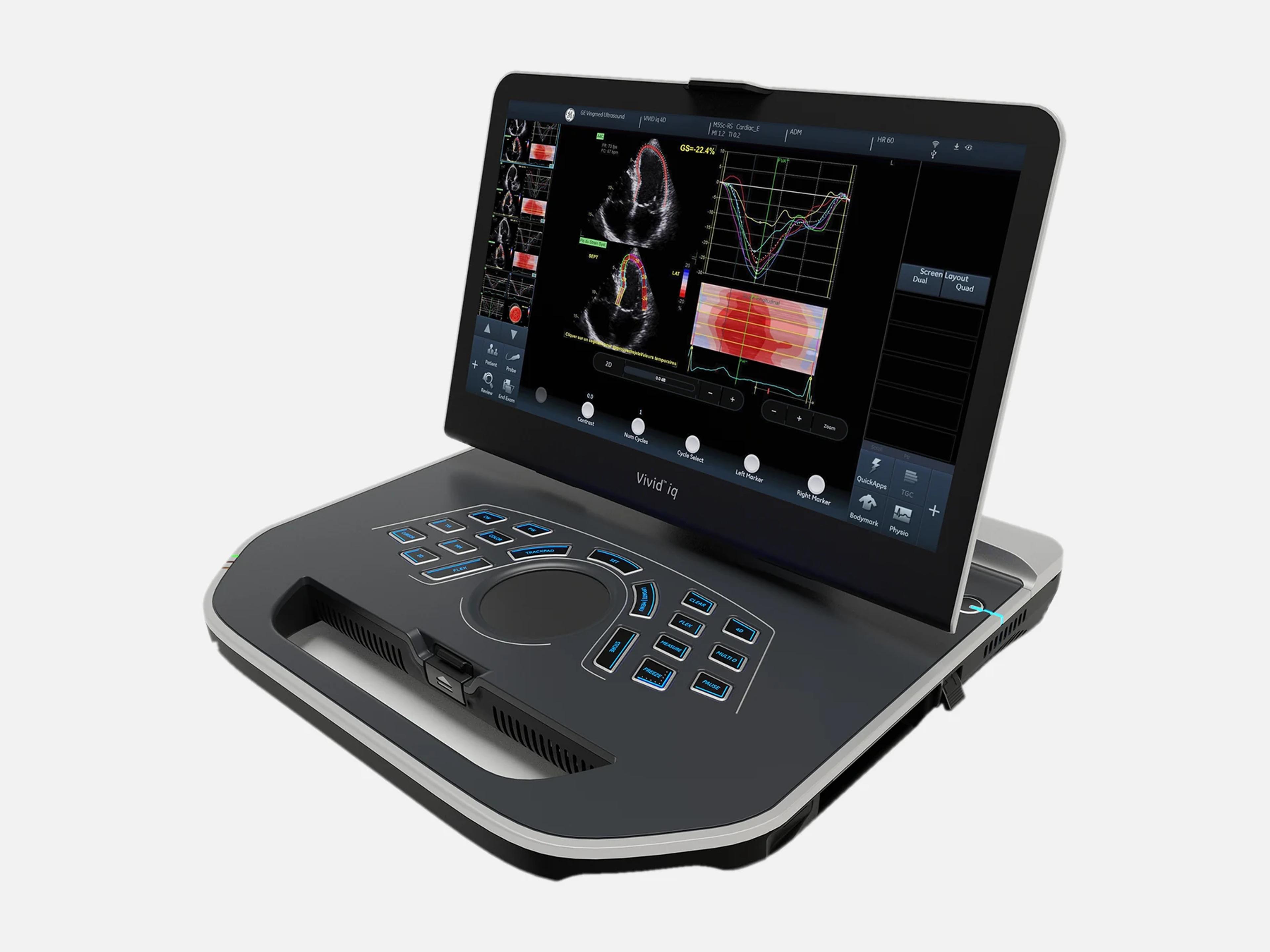
The GE Vivid iq is a laptop-sized portable cardiovascular ultrasound system, designed for cardiac and shared-service imaging. Its 5.2 kg console (with battery) has a 15.6-inch multi-touch screen and one probe port, and the system takes transesophageal probes and intracardiac echo catheters. It sits in the Vivid family alongside Vivid Pioneer, Vivid Explorer, Vivid Advanced and Vivid Focus.
- Released
- 2016launched by GE
- Probe ports
- 13 RS + 1 DLP on cart box
- Display
- 15.6-inchfull HD, multi-touch LCD
- Weight
- 5.2 kg11.5 lb, with battery
Compatible probes
Linear
- 9L-RS Advanced SRI available
- 12L-RS Advanced SRI available
- ML6-15-RS Active matrix wide band
- L8-18i-RS Intraoperative
- L4-20t-RS XDclear wide band; added in K221148
Convex & microconvex
- C1-5-RS Advanced SRI available
- 4C-RS
- 8C-RS
Phased
- 3Sc-RS LV harmonic contrast (optional)
- 6S-RS Pediatric
- 12S-RS Pediatric
- M5Sc-RS XDclear Matrix; Premium and 4D versions only
Endocavity
- E8Cs-RS Micro convex
Specialty
- 6Tc-RS Transesophageal; LV harmonic contrast
- 9T-RS Transesophageal
- 6VT-D 4D multiplane TEE; depends on system release
- 10T-D Transesophageal; added in K221148
- P2D Pencil (CW)
- AcuNav8F Intracardiac catheter
- AcuNav10F Intracardiac catheter
- AcuNav CRYSTAL Ultrasound Catheter Intracardiac; added in K243620
- Sound Star 3D 10F Intracardiac catheter
- Sound Star eco 8F Intracardiac catheter
- Sound Star eco 10F Intracardiac catheter
- SOUNDSTAR CRYSTAL Ultrasound Catheter Intracardiac; added in K243620
Specifications
Display
- Display
- 15.6-inch wide-screen full HD flicker-free LCD with full multi-touch
- Resolution
- 1920 x 1080 pixels
- Colors
- 16.7 million simultaneous colors
- Screen layouts
- Single, dual and quad-screen views
- Transport
- Fold-down and lock mechanism
Physical
- Weight
- Console 5.2±0.1 kg (11.5±0.2 lb) with battery
- Console dimensions
Height 64±1 mm (73±1 with feet), width 390±1 mm, depth 362±1 mmHeight 64±1 mm (2.5 in), 73±1 mm (2.9 in) with feet; width 390±1 mm (15.4 in); depth 362±1 mm (14.3 in)Show allShow less
- Probe ports
- One on the console; the optional cart multi-probe box holds 3 RS-type and 1 DLP-type
- Mobile cart dimensions
- Height 830±20 to 1130±20 mm; width and depth 510±10 mm each
- Mobile cart weight
- 31 kg; maximum 55 kg with full configuration
- Cart adjustment
300 mm single-hand height range on both carts; Premium Cart adds ±45° table rotationStandard and Premium carts: single-hand height adjustment with a 300 mm range; the Premium Cart adds ±45° left-right rotation of the cart table, lockable at center, +45° and −45°, and a rear handle with an integrated probe cable management rackShow allShow less
Power & battery
- Battery scan time, console
- Approximately one hour without external power, depending on operating modes
- Cart charge box
Optional; holds up to 4 batteries for up to 180 more minutes of scanning on batteryOptional on the Standard and Premium carts: holds up to 4 batteries, allowing up to 180 minutes of scanning on battery on top of the console-integrated battery, which is standardShow allShow less
- Battery scan time, on the cart
- Up to 4 hours with the charge box, depending on operating modes and battery status
- Console power adapter
- Input 100–240 V AC, 50/60 Hz, 2.0 A maximum, 175 VA
- Mobile cart power
- Input 100–240 V AC, 50/60 Hz, 350 VA; output 22 V DC, 13.63 A
- Sleep Mode
- Lid closed or Sleep Mode selected: ultrasound hardware off, CPU stays on
Connectivity & options
- Interfaces
- 5 USB, HDMI, ECG, LAN 10/100/1000; optional USB wireless network kit
- DICOM 3.0
Verify, Print, Store, Modality Worklist, Storage Commitment, MPPS, Media Exchange…Verify, Print, Store, Modality Worklist, Storage Commitment, MPPS, Media Exchange, Spooler and Query/RetrieveShow allShow less
- Structured reporting
- Adult cardiac, pediatric, vascular and abdominal
- DICOM security and PDF
- DICOM/TLS encryption, DICOM PDF Read, DICOM Encapsulated PDF
- Export formats
- JPEG, MPEG, AVI, DICOM and Raw DICOM
- Patient-data encryption
- Optional encryption of the drive holding patient-identifiable data
- External video output
- 1920 x 1080; 800 x 600 in ICE mode (CartoSound Interface dataflow)
- Video converter (optional)
- Electrically isolated digital full HD 1920 × 1080 and analog VGA 800 × 600
- Remote Viewing (optional)
- Streams the screen to a browser on the same network; not for diagnostic use
- Remote service
- InSite ExC
- ECG
- Integrated three-lead ECG module with external ECG lead input
- CartoSound interface (optional)
- For SOUNDSTAR, AcuNav, SOUNDSTAR CRYSTAL and AcuNav CRYSTAL ultrasound catheters
- ICE connector cables
- ICE Cord-RS and CRYSTAL ICE Cord-RS
Imaging & software
- Clinical applications
Cardiac (adult and pediatric), Transesophageal, Intracardiac, Peripheral Vascular…Probe dependent: Fetal/Obstetrics, Abdominal (includes GYN), Pediatric, Small Organ (breast, testes, thyroid), Neonatal Cephalic, Adult Cephalic, Cardiac (adult and pediatric), Peripheral Vascular, Musculoskeletal Conventional and Superficial, Urology (including prostate), Transcranial, Transrectal, Transvaginal, Transesophageal, Interventional Guidance (including biopsy and vascular access), Thoracic/Pleural, Intraoperative (vascular), Intracardiac and IntraluminalShow allShow less
- Imaging modes
2D, M-mode, color flow, B-flow, PW/CW Doppler, strain elastography, tissue velocity…2D tissue; tissue, anatomical and curved anatomical M-mode; color flow and color angio; B-flow, Blood Flow Imaging and Blood Flow Angio Imaging; strain elastography; PW (with HPRF) and CW Doppler; Tissue Velocity Imaging, Tissue Tracking, Tissue Velocity M-mode and Tissue Velocity Doppler; LVO contrast optionalShow allShow less
- Cleared imaging modes
B, M, PW, CW, Color Doppler, Color M, Power Doppler, Harmonic, RT 3D (4D), Coded PulseB, M, PW Doppler, CW Doppler, Color Doppler, Color M, Power Doppler, Harmonic Imaging, Real-Time (RT) 3D Mode (4D), Coded Pulse and combined modes; 4D is not in every configurationShow allShow less
- Revision and software
v208, covering all 208.x.x builds; earlier versions v201, v203, v204.96.0 and v206v208, covering all 208.x.x builds; earlier versions v201, v203, v204.96.0 and v206, with a v206-to-v208 upgrade instructionShow allShow less
- Available on v208
Clarity+ for vascular imaging, one-click QuickApp shortcuts, power-saving Sleep ModeClarity+ for vascular imaging, one-click QuickApp shortcuts, the new ergonomic cart and power-saving Sleep ModeShow allShow less
- Advanced SRI
- Available on 9L-RS, 12L-RS and C1-5-RS
- Cardiac analysis (optional)
- AFI 3.0, Easy AFI LV, AutoEF 3.0 and Easy AutoEF
- AI measurements (optional)
- AI Auto Measure – 2D and AI Auto Measure – Spectrum Recognition
- Smart Stress Echo (optional)
- 2D pharmacological, bicycle and continuous-capture treadmill stress echo
- LV contrast (optional)
- LV harmonic contrast imaging with the 3Sc-RS and 6Tc-RS
- Probe Check
- Transducer-element test reporting possible image-quality impacts; standard in the USA
- EchoPAC compatibility
- Raw-data format compatible with EchoPAC Plug-in stations of the same or newer vintage
- 2D frame rate
- In excess of 1,000 fps, depending on probe, settings and applications
- Color flow frame rate
- In excess of 700 fps; 400 fps on 12S-RS; dependent on probe and settings
- Beamformer
- Digital, up to 974,026 effective digital channels
- Dynamic range
- Composite, up to 415 dB
- Scanning depth
- 1 cm minimum to 33 cm maximum, probe dependent
- Scanning width
- 10°–168°, probe dependent
- PW/HPRF Doppler sample volume
- Maximum depth 30 cm; adjustable size 1–16 mm, probe dependent
- Cine memory
- 500 MB
- Storage
- Integrated 512 GB solid-state drive
- Processor
- 11th Generation Intel Core, four cores
- Operating system
- Windows 10 IoT Enterprise LTSC
Environment
- Operating
- 3–40 °C (38–104 °F), 30–80% humidity non-condensing, 700–1060 hPa
- Storage and transport
- −5–50 °C (23–122 °F), 10–90% humidity non-condensing; transport under 16 h
Compliance
- FDA 510(k)
K243620 (2025-02-11), K221148 (2022-07-18), K200708 (2020-09-09), K181727, K161706K243620 (decided 2025-02-11); K221148 (2022-07-18); K200708 (2020-09-09); K181727 (2018-12-06); K161706 (2016-08-05). Class II, 21 CFR 892.1550, product codes IYN, IYO and ITX.Show allShow less
- CE marking
- Conforms to European Medical Device Regulation (MDR) 2017/745
- Electrical safety class
Class I; BF (probes), CF (ECG leads), defibrillation-proof (ICE catheters), IEC 60601-1Class I, with BF applied parts (probes), CF applied parts (ECG leads) and defibrillation-proof applied parts (ICE catheters), per IEC 60601-1Show allShow less
What to check when buying a used GE Vivid iq
Have the system and every probe leakage-tested
A probe with excessive leakage or punctured insulation must not be used.
How: Have a biomed run grounding continuity and chassis leakage tests with a calibrated safety analyzer, test each probe and peripheral for leakage, and compare the results with earlier records.
Inspect the power cord, plug and AC adapter
Damaged insulation on the power cord, plug or adapter is an electrical hazard, and a faulty AC/DC adapter or cable is one cause of failed leakage tests.
How: Look for cut or cracked insulation, pulled strain reliefs and damaged connectors on the power cable, the inlet, the AC/DC adapter and its cable.
Inspect every battery and read its health
A permanent battery error means the pack is damaged or at end of life, so the unit needs a new battery.
How: Look for damage, leaks, odor, deformation or discoloration, then open the battery information window and read capacity and health for the console battery and, on a cart unit, each battery in the charge box.
Demonstrate every imaging mode and licensed option
Options such as contrast are licensed to the unit, so what it actually runs has to match what is being bought.
How: Run B-mode, color flow, PW and CW Doppler and M-mode, demonstrate each option offered with the unit, and record every probe, option and the software version from Config > About.
Common questions about the GE Vivid iq
Is the GE Vivid iq FDA-cleared?
Yes. The Vivid iq is FDA-cleared under 510(k) as a Class II device (21 CFR 892.1550, product codes IYN, IYO and ITX). Its first clearance, K161706, was decided on August 5, 2016, and its most recent, K243620, on February 11, 2025, with K181727, K200708 and K221148 between them.
What versions of the GE Vivid iq are there?
The v208 range runs from a routine system to the high-end version for 4D TEE imaging: Vivid iq v208, v208 Premium and v208 4D, each also with a US designation, plus Vivid iq Vet v208 consoles in the same three versions. There is also a Point of Care version.
The M5Sc-RS XDclear Matrix probe is available only on the Premium and 4D versions.
Does the GE Vivid iq do 4D imaging?
Yes, for transesophageal imaging. The Vivid iq images in 2D TTE, 2D and 4D TEE, and 2D ICE; the 4D version is the high-end configuration for 4D TEE, and the 6VT-D is the system's electronic 4D multiplane TEE probe. Real-Time (RT) 3D Mode (4D) is among its cleared modes, though not every configuration includes it.
Does an older GE Vivid iq run Windows 7?
Early units did. At its first clearance in 2016 (K161706) the Vivid iq ran an embedded Windows 7 operating system, while software v208 runs on Windows 10 IoT Enterprise LTSC. Read a unit's software version under Config > About before you buy.
What is the GE Vivid iq Ultra Edition?
It is a Vivid iq from the 2022 release of GE HealthCare's Vivid portfolio. Ultra Edition is a release name, not a separate product name.