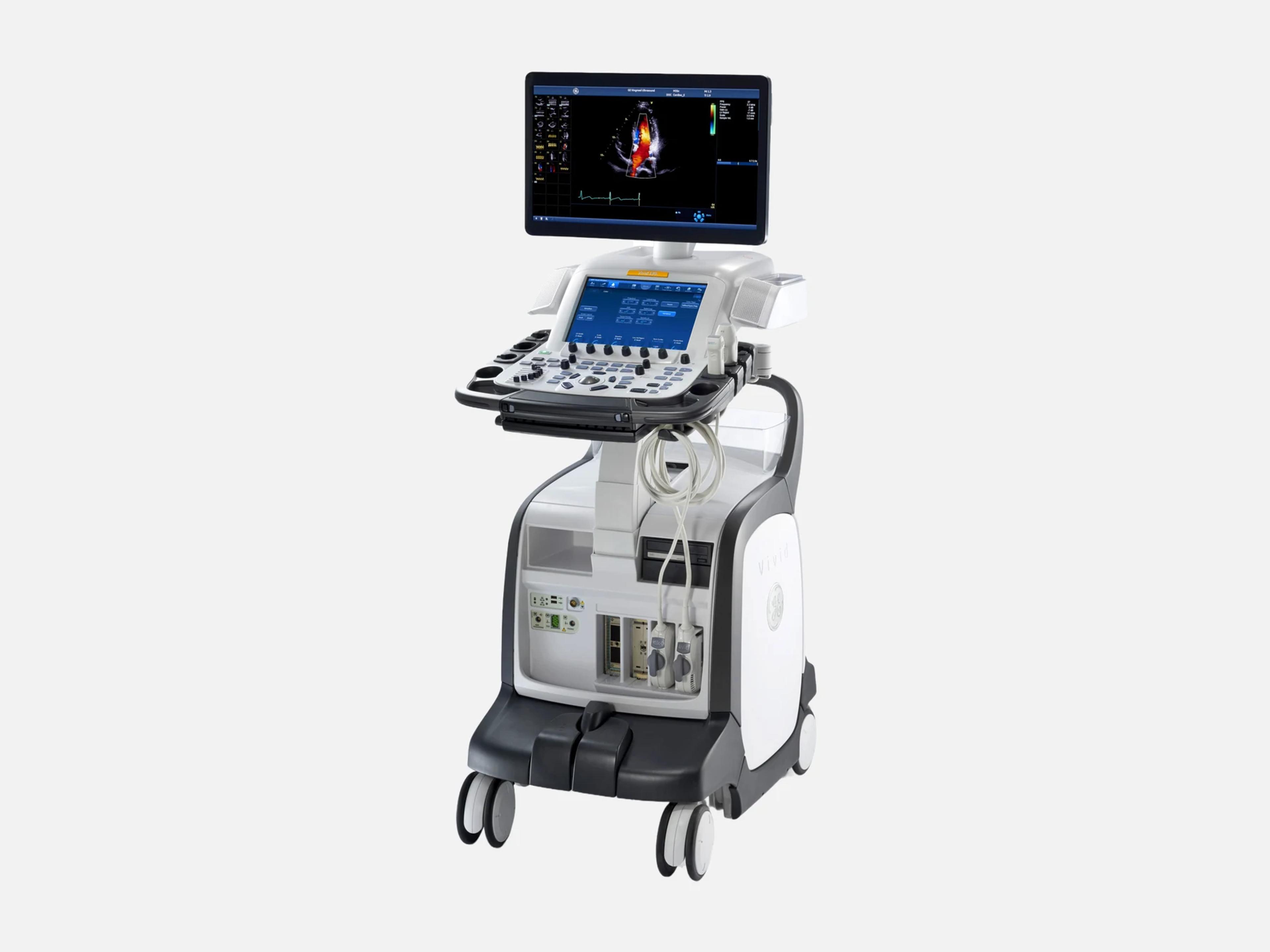
The GE Vivid E90 is a premium 2D cardiovascular ultrasound system for echo labs, pediatric imaging and shared services that also run vascular, abdominal, OB/GYN and small-parts exams. It generates 4D images only with the 4D option; the Vivid E95 is the family's premium 4D system. It shares cSound ADAPT, the 2022 GPU and the 9VT-D probe only with the Vivid E95, and was FDA-cleared with the Vivid E95 and E80.
- Released
- 2015first FDA clearance
- Probe ports
- 53 DLP, 1 DP, 1 CW Doppler
- Display
- 23.8-inchHDU, Ultra Edition (2022)
- Weight
- 120 kg ± 10%no probes or peripherals
Compatible probes
Linear
- 9L-D Vascular
- 11L-D Vascular
- ML6-15-D
- L8-18i-D Intraoperative
Convex & microconvex
- C1-6-D XDclear
- C2-9-D XDclear
- C3-10-D Microconvex, pediatric
- 8C
Phased
- M5Sc-D
- 6S-D Pediatric
- 12S-D Pediatric, neonatal heart
Endocavity
- iC5-9-D
Specialty
- 4Vc-D Matrix array, 2D and 4D (4D option); v202 r.46.0 or higher
- 6Vc-D Pediatric 2D, 3D and 4D (4D option); v204 or higher
- 6Tc Transesophageal; DP port
- 6VT-D Transesophageal
- 9T Transesophageal
- 9VT-D Mini 4D TEE (4D option); introduced with v206
- 10T-D Micro multiplane TEE
- P2D CW Doppler pencil probe
- P6D CW Doppler pencil probe
- 6Tc-RS In the 2015 FDA submission
- 9T-RS In the 2015 FDA submission
Specifications
Display
- Main monitor (Ultra Edition)
- 23.8-inch HDU (High Definition Ultrasound) main monitor
- Main monitor (earlier builds)
22-inch OLED (2018); by 2019, 24-inch LCD or 22-inch OLED; v206 in LCD and OLED versions22-inch high-resolution OLED (2018); by 2019 a choice of 24-inch LCD or 22-inch OLED, the 24-inch LCD added in 510(k) K181685 (2018) and introduced with Com Express hardware at software v203; at v206, LCD and OLED versions, with monitor checks specified for 22-inch OLED and 19-inch LCD monitors.Show allShow less
- Touch screen
- 12.1-inch touch screen (Ultra Edition)
- Monitor arm (articulating)
- 350 mm horizontal and 150 mm vertical travel; swivels to any viewing direction
Physical
- Weight
- 120 kg ± 10% (264 lb ± 10%) with monitor, without probes and peripherals
- Weight, ready for use
- 128 kg (283 lb) or more, depending on installed peripherals
- Weight, earlier builds
- 126 kg, reduced to 120 kg in 2018 by re-arranging internal parts (K181685)
- Dimensions, transport position
- 141.0 × 58.5 × 83.0 cm (55.5 × 23 × 32.7 in), H × W × D, with monitor and peripherals
- Dimensions (Ultra Edition)
W 527 mm (OLED) or 564 mm (HDU); D 844 mm; H 1392–1714 mm; 1180 mm with screen foldedWidth 527 mm (20.7 in) with the OLED monitor or 564 mm (22.2 in) with the HDU monitor; depth 844 mm (33.2 in); height 1392–1714 mm (54.8–67.5 in) across the up/down mechanism and monitor arm; minimum height 1180 mm (46 in) with the screen folded.Show allShow less
- Probe ports
Five: three DLP, one DP (6Tc TEE probe), one Doppler port for CW pencil probesFive probe ports: three DLP ports for Vivid E95/E90/E80 and Vivid E9 probe connectors, one DP port for the 6Tc TEE probe with its Vivid 7 connector, and one Doppler port for non-sector CW pencil (PEDOF) probes; the imaging connectors count as four active ports, and probes can be connected with the system on or off.Show allShow less
- Operating panel
Extendable, height- and side-adjustable; motor-driven up/down; XY brakes and park lockElectronically extendable, height- and side-adjustable control panel: the top console moves up and down (motor-driven, gas-spring assisted, with controls around the handles), sideways and back and forth, with motor-operated X/Y brakes and a park lock for transport; it carries TGC sliders, a trackball and a touch panel with adjustment rotaries, and its keys light up by availability.Show allShow less
- Keyboard and controls
QWERTY keyboard in a drawer below the operating panel; optical trackball; stereo speakersAlphanumeric (QWERTY) keyboard in a drawer below the operating panel, an adjustable floating keyboard; optical trackball; touch screen and monitor arm; stereo speakers in the top console for Doppler audio during scanning and replay.Show allShow less
Power & battery
- Power
100–240 VAC ±10%, 50/60 Hz; 700 W with monitor and on-board peripherals100–240 VAC ±10%, 50/60 Hz; 700 W power consumption including the monitor and on-board peripherals; draws up to 3 A at 230 VAC and up to 7 A at 100 VAC; needs a dedicated single branch circuit (a center-tapped source when using 220 V in North America).Show allShow less
- Power by mode (Ultra Edition)
- Off 18 W; standby or idle 348 W; 2D scanning 367 W; 4D scanning 448 W
- Inrush (50 Hz / 60 Hz)
- 264 VAC: 13 A / 12 A; 220 VAC: 9 A / 11 A; 110 VAC: 5.5 A / 6 A; 90 VAC: 6 A / 5 A
- Voltage drop-out
- Max 10 ms
- Backup battery
- Lithium-ion, fitted on some systems
Connectivity & options
- DICOM
Image and measurement export (DICOM SR); Modality Worklist, Query/Retrieve, StorageDICOM image storage and measurement export, including DICOM SR; Modality Worklist search, Query/Retrieve from a DICOM server and DICOM Storage dataflows; raw-data storage depends on the dataflow configuration; AE title up to 16 characters; pediatric measurements sent by SR populate the receiving pediatric report.Show allShow less
- Network
Ethernet 10/100/1000 Mbit; wireless 802.11a/b/g/n/ac with a GE-approved USB adapterWired Ethernet connector on the rear I/O panel, with an optional 10/100/1000 Mbit Ethernet/DICOM network; wireless LAN (IEEE 802.11a, b, g, n and ac) through a GE-approved USB wireless adapter.Show allShow less
- External monitor
- DVI-D or DisplayPort, duplicating the screen (Com Express hardware, v203 or later)
- Physiological inputs
ECG, PHONO and AUX (pressure/pulse) inputs; ECG for image sync, not monitoringFront patient I/O panel with ECG, PHONO and AUX (pressure/pulse) inputs; ECG is for image synchronization, not patient monitoring, with leads I, II and III selectable in software.Show allShow less
- Printers and storage
Internal B/W printer UP-D898MD; USB: color printer UPD-25MD, flash card, 2 TB RAID1 driveApproved internal printer: UP-D898MD digital black-and-white; approved external USB peripherals include a UPD-25MD color printer, a USB flash card and a 2 TB RAID1 desktop hard drive; DVD multi drive as an option.Show allShow less
- Footswitch
- Optional three-button footswitch for hands-free control
- Review systems
- EchoPAC, Image Vault and other servers via DICOM
- Tricefy
Tricefy Uplink to the Tricefy cloud archive; image sharing with the patientTricefy Uplink dataflow to the Tricefy cloud archive; Tricefy Store keeps images in Tricefy and Tricefy Patient Share shares them with the patient, with measurements sent when DICOM SR is enabled.Show allShow less
- StreamServer
- Option key: live 2D and 4D streaming over LAN or WLAN; sector and TEE probes
- Remote Viewing
- Streams the main monitor over the local network; not for diagnostic use
- View-X
- Option: an external video stream over IP, without audio, in a dedicated window
- Remote service
InSite remote link to GE service; software updates by download in some marketsInSite remote service link to GE online service and applications engineers; software updates by download (eDelivery, InSite) in some markets.Show allShow less
- Security
Disk encryption, LDAP, configurable passwords, application whitelistingDisk encryption of the drive holding the patient archive and images, which the owner decides whether to enable; LDAP user control, including authentication for streaming users; configurable user log-on and internal passwords; application whitelisting enabled at the factory.Show allShow less
- Imaging Insights
- Collects DICOM data for system-utilization and operator-usage dashboards
Imaging & software
- Revision and software
v201, v202, v203, v204 and v206; v206 runs v206.xx system and application softwarePublished software levels: v201 (e.g. v201.102), v202 (e.g. 202 v81.0), v203 (e.g. v203.88.0), v204 and v206 (e.g. v206 Service Pack 94-0); v206 carries v206.xx system software and v206.xx application software.Show allShow less
- Operating system
- Windows 10 Embedded from 2018 (K181685); earlier software on Windows 7 Embedded
- Imaging modes
2D, M, Color, PW/CW Doppler, Angio, Color M, TVI, strain, TSI, contrast; 4D optional2D-Mode, M-Mode, Color Mode, PW and CW Doppler, Power Doppler (Angio), Color M-Mode, Tissue Velocity Imaging (TVI), Tissue Tracking, Strain rate, Strain, Tissue Synchronization Imaging (TSI), contrast applications, and 4D and Multi-plane modes; 4D image generation on the Vivid E90 requires the 4D option.Show allShow less
- Cleared imaging modes
3D, 4D, B, M, PW, CW, Color, Color M, Power Doppler, Harmonic, Coded Pulse and combinedCleared modes (K220882): 3D, real-time 3D (4D), B, M, PW Doppler, CW Doppler, Color Doppler, Color M Doppler, Power Doppler, Harmonic Imaging, Coded Pulse, and the combined modes B/M, B/Color M, B/PWD or CWD, B/Color/PWD or CWD and B/Power/PWD.Show allShow less
- 4D option
- An option on the standard 2D Vivid E90, available as an upgrade; 4D tools require it
- Beamforming
cSound 3.0 software beamformer, XDclear probe technology, cSound ADAPT (E95 and E90 only)cSound software beamformer platform (cSound 3.0), using AI based on GE HealthCare's Edison platform, with XDclear probe technology; cSound ADAPT corrects beamforming for speed-of-sound aberrations, launched with the Vivid Ultra Edition for the 4Vc-D probe, exclusive to the Vivid E95 and Vivid E90 and added in 510(k) K220882.Show allShow less
- Processing hardware
Software beamforming on GPUs; 192 channels processed concurrently; Com Express from v203Software beamforming on GPU: one GPU board does the signal processing, the other drives the monitor and touch screen; 192 channels are transmitted, received and processed concurrently. On systems produced with software v203 and later the back-end processor sits in the card rack with the front-end cards (Com Express hardware); v206 systems use a Com Express back-end processor (ACBEP) with A4000 and T600 GPUs, and the 2022 (Ultra Edition) GPU is exclusive to the Vivid E95 and E90. An earlier Vmax option (K173341, 2017) offered a higher-performance GPU for higher 4D volume rates.Show allShow less
- System drive
- 1 TB 2.5-inch SATA SSD (v206)
- Image processing
TCI, ACE, HD Imaging, UD Clarity, Hybrid Filter, Texture, Virtual ConvexTrue Confocal Imaging (TCI), uniform focusing through the field of view with no dedicated focus control; Adaptive Contrast Enhancement (ACE); HD Imaging (resolution, penetration and image uniformity); second-generation Ultra Definition (UD) Clarity filtering; Hybrid Filter, a B-mode post-processing filter (Off, Mild, Strong); Texture, a B-mode enhancement that attenuates reverberations; Virtual Convex, a wider far-field view with the linear probes; Blood Flow Imaging, color Doppler combined with grayscale speckle imaging; Dynamic Auto Optimization, fewer system adjustments for pediatric and neonatal imaging.Show allShow less
- Strain and EF tools
AFI 2.0, AFI 3.0, Easy AFI LV, AFI LA, AFI RV, Auto EF 2.0, Auto EF 3.0, Easy AutoEFAFI 2.0 (automated LV segmental and global longitudinal strain) and Auto EF 2.0 (speckle-tracking and Simpson's-rule ejection fraction), optional from 2019 with Automatic View Recognition, a deep-neural-network view recognition (K181685); AFI 3.0 and Auto EF 3.0, which also analyze third-party DICOM images (K200743); Easy AFI LV and Easy AutoEF, based on AFI 3.0 and Auto EF 3.0 with an AI-based automatic region of interest (K220882), Easy AutoEF limited to adult TTE on GE raw B-mode LV loops and not supporting LVs with septal bulge; AFI LA and AFI RV, speckle-tracking strain of the left atrium and right ventricle.Show allShow less
- Automated measurement
AI Auto Measure 2D, AI Auto Measure Spectrum Recognition, Cardiac Auto DopplerAI Auto Measure 2D, semi-automatic LV diameter measurement from the parasternal long axis (PLAX); AI Auto Measure Spectrum Recognition, which recognizes common Doppler spectra and starts the Auto Doppler measurement (K200743); Cardiac Auto Doppler, Doppler measurements over all heart cycles for the most common parameters with minimal user interaction.Show allShow less
- Myocardial Work
- Optional: global longitudinal strain (AFI) with arterial blood pressure
- Blood Speckle Imaging
- Optional; for pediatrics, and for TEE with the 6VT-D only
- 4D quantification (4D option)
4D Auto LVQ, AVQ, MVQ, RVQ, TVQ and LAQ; Advanced 4D User Quantification Package4D Auto LVQ, 4D Auto AVQ, 4D Auto MVQ (semi-automatic mitral-valve quantification from TTE or TEE images), 4D Auto RVQ (right-ventricular volumes), 4D Auto TVQ (tricuspid annulus and valve, K200743), 4D Auto LAQ (left-atrial volumes, emptying fraction and strain) and the Advanced 4D User Quantification Package; on the Vivid E90, 4D requires the 4D option.Show allShow less
- 4D views and rendering (4D option)
FlexiViews, FlexiSlice, 4D Markers, Single Beat 4D, HDlive, FlexiLight, HD Color4D Views, FlexiViews, FlexiSlice (in the Advanced 4D User Toolbox), 4D Markers (annotations in 3D/4D datasets, K181685), Single Beat 4D, HDlive 4D tissue visualization, FlexiLight photorealistic 3D/4D rendering with adjustable virtual light, and HD Color 4D color rendering with shadowing, reflections and transparency (K200743); on the Vivid E90, 4D requires the 4D option.Show allShow less
- Workflow tools
QuickApps, Scan Assist Pro, Smart Stress, Dual Crop, Pre-Post Compare, Image ViewQuickApps (stored sub-presets that switch color flow or contrast parameters while keeping the live-image geometry); Scan Assist Pro (protocol-based, stepwise examinations); Smart Stress (stress-echo option); Dual Crop and Pre-Post Compare (K220882); Image View (the main-monitor image duplicated on the touch screen); Spline Tool area measurement; Auto freeze after a user-set period of inactivity, and Auto Freeze by tissue detection on the 4Vc probe; Launchpad, which displays and starts installed third-party apps qualified by GE; enhanced DICOM review with contrast, brightness and zoom/pan controls.Show allShow less
- Other imaging options
Advanced Contrast Low MI, LOGIQView, Strain Elastography, CT Fusion LiveAdvanced Contrast Low MI (optional low-mechanical-index contrast imaging); LOGIQView panoramic scanning; Strain Elastography (K220882); CT Fusion Live, offered only on the Vivid E95, E90 and E80 (K220882); dedicated FAST and lung presets for bedside lung assessment.Show allShow less
- Probe Check
- Element-integrity test run in air, manually or automatically on probe selection (K220882)
Environment
- Operating environment
- 10–35 °C (50–95 °F), 30–85% relative humidity non-condensing, 700–1060 hPa
- Storage and transport
- -20 to +60 °C (-4 to +140 °F), 10–95% non-condensing, 700–1060 hPa
- Heat dissipation
- Up to 2390 BTU/h with monitor and on-board peripherals
- Acoustic noise (Ultra Edition)
- 65 dB maximum, 29 dB minimum
Compliance
- FDA 510(k)
K220882 (2022-07-22), K202658 (2021-03-05), K200743, K181685, K173341, K170823, K150087K220882 (decided 2022-07-22); K202658 (2021-03-05); K200743 (2020-07-23); K181685 (2018-10-25); K173341 (2017-11-02); K170823 (2017-06-12); K150087 (2015-03-04). Cleared as Vivid E80 / Vivid E90 / Vivid E95; Class II, product code IYN, 21 CFR 892.1550.Show allShow less
- Environmental design
- Conforms with IEC 60601-1-9 (environmentally conscious design)
What to check when buying a used GE Vivid E90
Inspect the system end of the power cord
Recall Z-2987-2018 covered Vivid E90 systems because the system end of the power cord could break and expose the conductors.
How: With the system off and unplugged, look for breaks, damage or exposed conductors at the system end of the cord and its connectors, confirm the inlet retainer holds and the line, neutral and ground terminations are correct, and keep a unit with a damaged cord out of use until it has a new one.
Reject a damaged or leaking backup battery
Some systems carry lithium-ion backup batteries, and a damaged lithium-ion pack is a safety risk.
How: Ask whether the unit has backup batteries and, if it does, inspect each one for damage, leakage, odor, deformation or discoloration.
Inspect every probe and have it leakage-tested
A probe that shows any evidence of wear must not be used.
How: Check each housing, lens, seal, cable, strain and bend relief, connector pins and locking mechanism for damage, then have a leakage test run on each probe, following the separate manuals for TEE probes.
Check the DICOM Worklist recalls against the unit
Recalls Z-1779-2017 and Z-2316-2024 concerned the worklist selecting or displaying the wrong patient, and the second is open.
How: Ask whether the unit's serial number falls under either recall and whether the correction was applied, then select a worklist patient and confirm the demographics shown are that patient's.
Common questions about the GE Vivid E90
Is the GE Vivid E90 FDA-cleared?
Yes. The Vivid E90 is FDA-cleared through 510(k) premarket notification together with the Vivid E80 and Vivid E95, as a Class II device (product code IYN, 21 CFR 892.1550). Its first clearance, K150087, was decided on March 4, 2015, and later clearances run through K220882, decided on July 22, 2022.
What is the difference between the Vivid E90 and the Vivid E95?
The Vivid E90 is GE's premium 2D cardiovascular system and the Vivid E95 its premium 4D one. On the Vivid E90, 4D image generation needs the 4D option.
At software v206 the 4V-D probe is for the Vivid E95 only; it is not the 4Vc-D, which the Vivid E90 does take. Both systems share the 2022 GPU, cSound ADAPT and the 9VT-D probe, which are exclusive to the two of them.
How does the Vivid E90 differ from the Vivid E80?
Both generate 4D images only with the 4D option. The 2022 GPU, cSound ADAPT and the 9VT-D mini 4D TEE probe are exclusive to the Vivid E95 and Vivid E90, so the Vivid E80 does not offer them.
What is the Vivid E90 Ultra Edition?
Ultra Edition is not a separate model: it is the 2022 release of the Vivid portfolio, released as of 25 August 2022. Ultra Edition units have the 23.8-inch HDU main monitor, and cSound ADAPT launched with that release for the 4Vc-D probe.
The name is older than the release: a 2020 Ultra Edition package, which brought FlexiLight and HD Color, was FDA-cleared on Vivid systems that include the Vivid E90.
What is the Vivid E90's model number?
The Vivid E90's model number is H45581LB. At software v206 it comes in two versions: GD000110 with an LCD monitor and GD000110-1 with an OLED monitor.