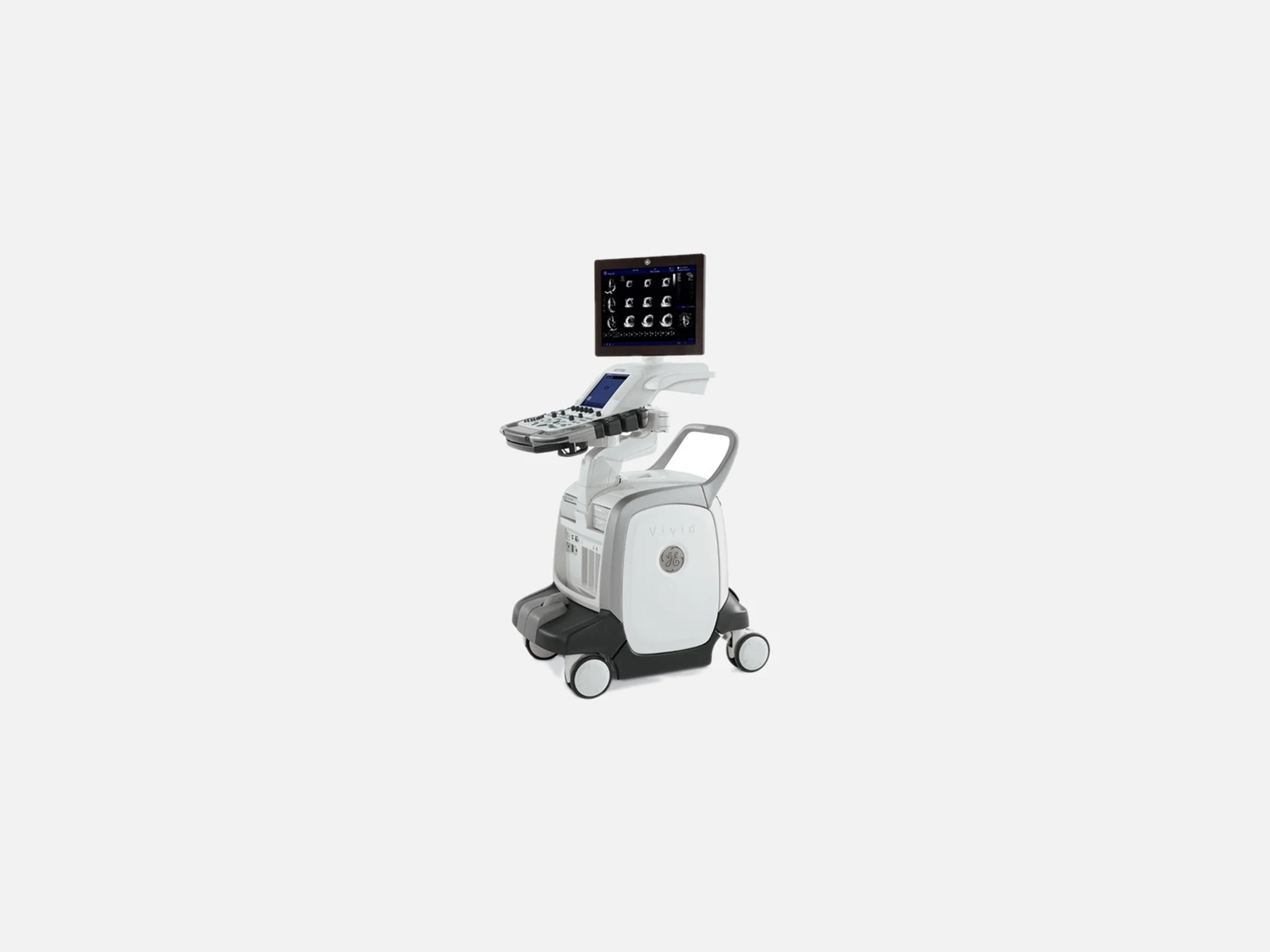
The GE Vivid E9 is a cardiovascular ultrasound system built for 4D imaging, intended mainly for cardiac imaging and analysis, with vascular and general radiology applications. Cleared in 2008 as substantially equivalent to the Vivid 7 in a smaller package, it gained XDclear and new probes such as the M5Sc-D in its 2013 version. That version topped the Vivid series until the Vivid E95 and Vivid E90.
- Released
- 2008first FDA clearance
- Probe ports
- 54 imaging + 1 CW Doppler
- Display
- 17 or 19 inLCD, by configuration
- Weight
- 128 kg or more283 lb, by installed options
Compatible probes
Linear
- 9L-D
- 11L-D
- ML6-15-D Added 2010 (K101149)
- i13L Intraoperative; added 2010
Convex & microconvex
- 4C-D
- C1-5-D Added 2013 (K131514)
- C2-9-D Added 2013 (K131514)
- 8C Added 2013 (K131514)
- iC5-9-D Added 2013 (K131514)
Phased
- M5S-D
- M5Sc-D Added 2013 (K131514)
- 6S-D
- 12S-D Added 2010 (K101149)
- 4V-D 4D volume; added 2010
Specialty
- 6VT-D 4D transesophageal; added 2012
- 6Tc Transesophageal
- 6Tc-RS Transesophageal, via RS adapter
- 6T Transesophageal
- 6T-RS Transesophageal, via RS adapter
- 9T Transesophageal
- 9T-RS Transesophageal, via RS adapter
- P2D CW Doppler pencil
- P6D CW Doppler pencil
Specifications
Display
- Display
- 17-inch or 19-inch LCD, by configuration, on an arm that moves in all directions
- Touch panel
Color LCD touch panel; 10.4-inch on the April 2013 XDclear 4D ExpertColor LCD/TFT touch panel in the upper operator panel, beside a switch board of controls, with stereo loudspeakers; 10.4-inch on the April 2013 XDclear 4D Expert configurationShow allShow less
Physical
- Weight
128 kg (283 lb) or more, depending on installed options, with monitor and peripherals128 kg (283 lb) or more, depending on installed options, with monitor and peripherals; given for BT'13 unitsShow allShow less
- Dimensions
Height 137.5/157.5 cm (54.1/62.0 in), width 54.0 cm (21.2 in), depth 80.0 cm (31.4 in)Height 137.5/157.5 cm (54.1/62.0 in), width 54.0 cm (21.2 in), depth 80.0 cm (31.4 in); given for BT'13 unitsShow allShow less
- Mobility
- Four swivel casters, front and rear; pedal-operated brake and front swivel lock
- Controls and user interface
Top console movable in all directions, with motor-driven height and a keyboard drawerTop console movable in all directions with motor-driven height (Up/Down button at the handles); operator panel with touch screen and switch board; alphanumeric QWERTY keyboard on a drawer below the switch board; optical trackball on the OP-5 lower operator panel; optional tri-pedal USB footswitchShow allShow less
Power & battery
- Power
100–230 VAC ±10%, 50/60 Hz; 1100 W with monitor and on-board peripherals100–230 VAC ±10%, 50/60 Hz; 1100 W power consumption including monitor and on-board peripherals; also stated as 100–240 V, 50 or 60 HzShow allShow less
- Circuit and draw
- Dedicated single branch circuit; up to 5 A at 230 VAC, up to 12 A at 100 VAC
Connectivity & options
- Probe ports
Five: one PD (Vivid 7-compatible), three PDT, one Doppler port for CW (PEDOF) probesFive probe connectors of three types: one PD port (Vivid 7-compatible probe connectors), three PDT ports (Vivid E9 / Vivid E7-specific connectors) and one Doppler port for CW (PEDOF, non-sector) probes; on the relay board, one connector supports 128-XD-channel probes, two support 192-XD-channel probes and one supports both 192- and 256-XD-channel probesShow allShow less
- Connectivity / DICOM
10/100/1000 Mbit Ethernet/DICOM (option); Worklist and Storage dataflows; two USB portsEthernet connector on the rear I/O panel; 10/100/1000 Mbit Ethernet/DICOM network (option); DICOM Connectivity Package option; DICOM dataflows with Worklist and DICOM Storage; two USB ports on the operator panel; InSite remote service (ARFS)Show allShow less
- Physio inputs
- Front patient I/O panel: Phono, ECG, AUX (pressure/pulse)
- On-board peripherals
DVD player/recorder and B/W video printer; DVR optionDVD player/recorder and B/W video printer among the major components; DVR option; the 2009 launch configuration had multiple USB ports, a DVR recorder and a DVD driveShow allShow less
- Software options (v113)
LVO Contrast Imaging, Stress, Auto 2D EF, 4D Strain and LV Mass, IMT, among othersLVO Contrast Imaging; Vascular Contrast; Advanced Contrast Imaging; AFI Productivity Package; IMT; LV Mass Only; 4D Strain and LV Mass; Stress; Auto 2D EF; Rodent; 4V Enable; Advanced Qscan Imaging; MV Assessment; 4D Polarized Stereo Vision Interface; Vivid E9 Advanced Bundle; TEE Interface Module; Quantitative Analysis Package; Tissue Tracking; MPEGVue and eVue; Scan Assist Pro; DICOM Connectivity PackageShow allShow less
Imaging & software
- Imaging modes
2D, M, Color M, Color and Power Doppler, PW, CW, tissue velocity, strain, contrast2D (B) Mode, M-Mode, Color M-Mode, Color Doppler, Power Doppler (Angio), PW and CW Doppler, Tissue Velocity Imaging, Advanced Strain and Contrast applicationsShow allShow less
- 4D imaging
Real-time 3D/4D acquisition with 4D probes (an option on some models)Real-time 3D/4D volume tissue acquisition, with or without color flow, using special 4D probes; 4D on the Vivid E9 Expert and an option on some Vivid E9 modelsShow allShow less
- Harmonic imaging
Octave Imaging (tissue harmonic); harmonic and coded-pulse modes, by transducerOctave Imaging (tissue harmonic imaging); harmonic imaging and coded-pulse modes, with the available combinations depending on the transducerShow allShow less
- Transmit channels
- 192 individually controlled transmit channels (GTX-TLP192 board)
- Configurations
BT'13: XDclear 4D Expert Option, XDclear 2D, XDclear Pro; 17- or 19-inch LCDBT'13 configurations: Vivid E9 with XDclear 4D Expert Option, Vivid E9 with XDclear 2D and Vivid E9 with XDclear Pro, each with a 17-inch or 19-inch LCDShow allShow less
- Revision and software
BT10, BT11 (Breakthrough 2011), BT12 (v112.0), BT'13 with XDclear (v113.x)Release names on record: BT10 (the trade name in the 2010 clearance); Breakthrough 2011 (BT11); Breakthrough 2012 (BT12; software v112.0 is labeled BT'12); BT'13, the XDclear release (application software v113.x). DICOM conformance statements exist for versions 8, 10, 12 and 113Show allShow less
- XDclear
In the 2013 version; M5Sc-D with Single Crystal, Cool Stack and Acoustic AmplifierXDclear technology in the 2013 version of the Vivid E9 (CE mark September 2013, FDA clearance announced October 2013); the M5Sc-D is built with Single Crystal, Cool Stack and Acoustic Amplifier technologiesShow allShow less
- Features at launch (2009)
Accelerated Volume Architecture, Flexi-Volume, 4D Auto LVQ, AFI, 4D Stress echoAccelerated Volume Architecture (AVA); Flexi-Volume acquisition; RV Volumes; 4D color flow; 4D Auto LVQ; Tissue Velocity imaging; AFI; 4D Stress echo; tri-plane TSI; 2D strain; Easy 4D feature package; One-Touch 4D; 4D Virtual StoreShow allShow less
- Features with XDclear (2013)
- Depth Illumination; Polar Vision; automated region-of-interest placement in AFI
Environment
- Heat output
- Up to 3800 BTU/h with monitor and on-board peripherals
- Acoustic noise
- Less than 55 dB(A) at 20 °C, at the operator's head position
Compliance
- FDA 510(k)
K081921 (2008-08-06), K101149 (2010-10-13), K120201 (2012-04-19), K131514 (2013-07-12)K081921 (GE Vivid E9 Ultrasound, 2008-08-06); K101149 (GE Vivid E9BT10, 2010-10-13); K120201 (2012-04-19); K131514 (2013-07-12); Class II deviceShow allShow less
What to check when buying a used GE Vivid E9
Test electrical safety on the console and probes
The console and probes touch patients and staff, and in one reported case an apparent fault in a Vivid E9's power circuit tripped the facility fuse and shocked the engineer restarting it.
How: Ask for an up-to-date safety test record covering grounding continuity, chassis leakage and the leakage of every surface, endocavity, transesophageal and surgical probe that comes with the system.
Inspect the system end of the power cord
On units installed, or given a new power cord, since April 2015, the cord can break at the system end and expose its conductors, a shock risk and the subject of an FDA recall.
How: Look for cracks or exposed wire where the cord enters the system, confirm the inlet connector retainer holds, and ask whether the recall correction was done.
Confirm the software lock-up correction is installed
On Vivid E9 4D units running software 112.1.0, 112.1.1 or 112.1.3, the system can gradually stop responding and lock up during a critical procedure until GE's correction is installed.
How: Read the software version on the system and, if it is one of those, ask for the service record showing GE's correction installed.
Confirm the probe overheating correction was applied
Incorrect probe power surveillance settings for the C1-5-D, C2-9-D, iC5-9-D and M5Sc-D could let those probes overheat, the subject of an FDA recall.
How: If the system comes with any of those probes, ask for the service record showing the correction applied.
Common questions about the GE Vivid E9
Is the GE Vivid E9 FDA-cleared?
Yes. The Vivid E9 is a Class II device, FDA-cleared under four 510(k)s: K081921 (August 6, 2008), K101149 (October 13, 2010, under the trade name GE Vivid E9BT10), K120201 (April 19, 2012) and K131514 (July 12, 2013).
Does every GE Vivid E9 have 4D imaging?
No. 4D is part of the Vivid E9 Expert and an option on some Vivid E9 models, and it needs a 4D probe: the 4V-D volume phased array or the 6VT-D 4D transesophageal probe. On the 2013 XDclear 4D Expert configuration, the 4V-D also needs the 4V Enable software option.
What is the GE Vivid E9 cleared for?
It is cleared as a general-purpose ultrasound system specialized for cardiac imaging, with indications including adult and pediatric cardiac, peripheral vascular, transesophageal, fetal, abdominal (including renal and GYN), pediatric, small organ (breast, testes and thyroid), neonatal and adult cephalic, urology (including prostate), transrectal, transvaginal and intraoperative (abdominal, thoracic and vascular) use.
How does the GE Vivid E9 compare with the Vivid 7?
The Vivid E9 was cleared in 2008 as substantially equivalent to the Vivid 7, in a smaller package, and at launch it was described as 40 percent smaller and 30 percent lighter than the Vivid 7.
Its PD probe port takes Vivid 7-compatible probe connectors, its three PDT ports are specific to the Vivid E9 and Vivid E7, and a fifth port serves CW Doppler probes.
How is the GE Vivid E9 different from the Vivid E95 and Vivid E90?
The Vivid E95 and Vivid E90, on sale in Japan from July 2015, are designed around GE's cSound platform: they perform all image processing in software and carry GE's first OLED display. The Vivid S70 of the same launch moved the high-function transmit and receive hardware of the Vivid E9 with XDclear into software.