GE Versana Premier
GE HealthCare · Versana series
Cart-basedPrimary CareObstetrics & GynecologyMusculoskeletal
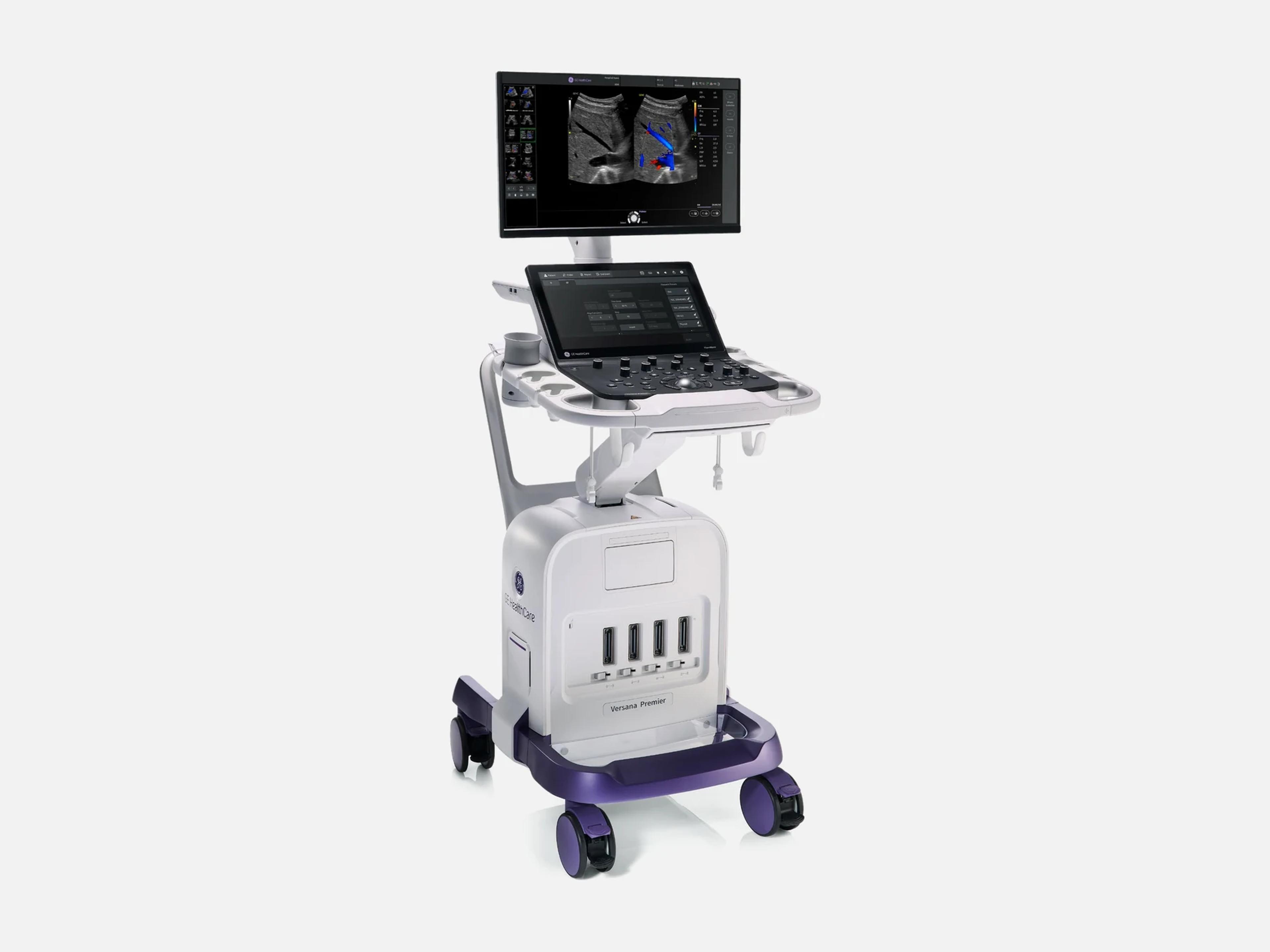
The GE Versana Premier is the highest-tier system in GE HealthCare's Versana ultrasound family, designed for multi-purpose use across general practice, OB/GYN, MSK and cardiology. It suits general practice clinics, check-up, community healthcare and scanning centers; the VS has a 21.5-inch monitor and the VA a 23.8-inch one. Its siblings are the Versana Balance, Essential and portable Active.
- Released
- 2018first FDA clearance
- Probe ports
- 3 or 4active, by configuration
- Display
- 21.5/23.8-inchVS / VA, 1920 x 1080 LED
- Weight
- Under 73 kgno probes or peripherals
Compatible probes
Linear
- 9L-RS
- 12L-RS
- L3-12-RS
- L4-20t-RS Single crystal; listed for R3
- L6-12-RS
- L8-18i-RS
- LK760-RS MSK conventional
Convex & microconvex
- C1-5-RS
- 4C-RS
- 8C-RS Micro convex
- RAB2-6-RS 4D volume probe; 3D/4D needs its option
Phased
- 3Sc-RS
- 6S-RS
- 12S-RS
Endocavity
- E8C-RS Endo micro convex
- E8Cs-RS Endo micro convex
- IC9-RS Endo micro convex; listed for R3
- RIC5-9A-RS Convex volume probe
- BE9CS-RS Simultaneous bi-plane, transrectal
- E7C8L-RS Bi-plane transrectal, micro curve and linear
Specialty
- 6Tc-RS Transesophageal; listed for R3
Specifications
Display
- Monitor
- 21.5-inch 1920 x 1080 LED-backlit (VS); 23.8-inch 1920 x 1080 LED-backlit (VA)
- Touch panel
- 13.3-inch (VS) or 15.6-inch (VA); multi-gesture, user-configurable layout
- Monitor arm
Tilt +45°/-90°, rotate -90°/+90°, fold-down lock; fixed (VS) or flexible (VA) armTilt +45°/-90°, rotate -90°/+90°; fold-down and lock mechanism for transportation; brightness and contrast adjustment. Fixed arm by default on the Versana Premier VS (flexible arm optional); flexible arm by default on the Versana Premier VA.Show allShow less
Physical
- Hardware variants
- Versana Premier VS and Versana Premier VA
- Weight
- Under 73 kg without probes or peripherals; R2: approx. 70 kg (154.3 lbs)
- Dimensions
- H < 1840, W < 600, D < 970 mm; R2: H < 1780, W < 620, D < 810 mm
- Probe ports
- 3 or 4 active, front-facing; a fourth port needs the 4PP front cover assembly
- Controls
Height-adjustable console, trackball, digital keyboard (Push-Push alphanumeric optional)Height-adjustable operator console; touch panel with multiple-gesture recognition and user-configurable layout; digital keyboard standard, Push-Push alphanumeric keyboard optional; function keys and trackball. R2 control panel: Whizz, Scan Coach, CW, PDI and CHI keys, trackball, alphanumeric keyboard, user-configurable keys; loudspeakers for stereo Doppler sound.Show allShow less
- Console
Removable probe/gel holders, gel warmer, front and rear handles, locking wheelsProbe holders and gel holder removable for cleaning; gel warmer switchable left/right; front and rear handles; probe cable management slots and hooks; easily removable air filters; locking wheels. Optional: paper tray, accessory box, flexible cable hook, drawer, endo probe holder, foot rest accessory tray.Show allShow less
- Acoustic noise
- 21.96 to 39.51 dB on the Versana Premier V2
Power & battery
- Electrical power
100–240 VAC, 50/60 Hz, max 500 VA with peripherals; R2: 100–240 V ±10%, max 450 VA100–240 VAC, 50/60 Hz, power consumption maximum of 500 VA with peripherals. R2: 100–240 V ±10%, 50/60 Hz, max. 450 VA including monitor and on-board peripherals (Versana Premier VA and VS).Show allShow less
- Battery
- Optional lithium-ion; minimum 20 minutes on a full charge when AC power is unavailable
- Boot-up
- Under 25 s; R2: 1.5 min or less normally, up to 4 min after power loss or lock-up
- Standby mode
- Standard; freezes imaging, turns off the LCD backlight, locks inputs except On/Off
Connectivity & options
- Inputs and outputs
HDMI 1920 x 1080, Ethernet (RJ45), USB (3 rear, 2 by touch panel), S-Video optionHDMI output (1920 x 1080), S-Video output (option), Ethernet (RJ45), USB (3 in the rear, 2 beside the touch panel). R2 rear panel: dual USB, USB 3.0, Ethernet, HDMI (1920 x 1080), VGA, audio line out, S-Video and composite video out.Show allShow less
- DICOM
DICOM 3.0 option: print, store, worklist, MPPS, query/retrieve, structured reportsDICOM 3.0 (option): Verify, Print, Store, Modality worklist, Storage commitment, Modality Performed Procedure Step (MPPS), Query/retrieve, Structured reporting template. Network storage for import, export, DICOM Read, SaveAs and MPEGVue. R2: network storage configuration, structured reports sent without images, Worklist Auto Query.Show allShow less
- Remote service
- InSite ExC; CSD remote capability; eDelivery software updates; Insite Auto Connect
- Wireless
USB wireless adaptor, Bluetooth adapter; on R2 the A8000 needs R2.1.10 or laterUSB wireless adaptor (peripheral option; sales availability varies by country) and Bluetooth adapter; data can be imported or exported over WiFi with the USB wireless adapter connected. R2: Wireless USB Adapter A8000 only for software R2.1.10 and above.Show allShow less
- Storage
512 GB SSD (356 GB image partition), optional 1 TB second SSD; JPEG, WMV, AVI exportIntegrated 512 GB SSD with a 356 GB partition for image storage; DICOM still image about 2.1 MB; export as JPEG, WMV (MPEG 4) and AVI. Options: 1 TB second SSD, 1 TB external USB HDD, 32 GB USB stick, DVD RW kit.Show allShow less
- Peripheral options
Thermal printers, footswitches, USB ECG kits, DVD RW kit, external HDD, second SSDB/W thermal printers UP-D898MD, UP-898DC, UP-D899MD and UP-D899DC (the last two not for China); UP-D25MD color thermal printer; office printer; 1-pedal and 3-pedal footswitches; 32 GB USB stick; 1 TB external USB HDD; 1 TB second SSD; DVD RW kit; USB ECG kits (AHA/IEC); USB wireless adaptor; Bluetooth adapter; video output adapter.Show allShow less
- Data security
- Patient data disk encryption (AES 256-bit); the owner holds the keys
Imaging & software
- Revision and software
- R1, R1.5, R2.x.x (R2.0.4 to R2.1.11), R3 and V2 (V2 not shown to be R2)
- Architecture
- VisionBoost; 128 physical channels, 8,899,048 system processing channels
- Maximum frame rate
- 1789 fps, depending on probe and mode
- Cine memory
- 384 MB
- Imaging modes
B, CPI harmonic, M, Color M, CFM, PDI, directional PDI, PW with high PRFB-Mode; Coded Phase Inversion Harmonic Imaging; M-Mode; Color M-Mode; Color Flow Mode (CFM); Power Doppler Imaging (PDI); Directional PDI; PW Doppler with high PRF. Cleared modes of operation: B, M, PW, CW, Color, Color M and Power Doppler, Harmonic Imaging, Coded Pulse, 3D/4D and combined B/M, B/Color, B/PWD, B/Color/PWD, B/Power/PWD. R2: 2D gray scale, 2D color flow, M-mode gray scale, color M-mode, Doppler and combinations.Show allShow less
- Optional modes
AMM, Curve AMM, B-Flow, B-Flow Color, CW, TVI, 3D/4D, contrast, elastography strainAnatomical M-Mode, Curve AMM, B-Flow and B-Flow Color, CW Doppler, TVI with Q-Analysis, TVM (on the sector probes), Static 3D/Real-time 4D with TUI and VOCAL (needs the 4D Box Assy on R2), contrast imaging (4C-RS, C1-5-RS, L3-12-RS, IC9-RS), Elastography Strain.Show allShow less
- Standard software
Whizz B-Mode, Whizz CF Mode, SRI-HD, CrossXBeam, Virtual Convex, B-Steer, Scan Coach…Whizz B-Mode, Whizz CF Mode, SRI-HD, CrossXBeam (linear probes), Virtual Convex, B-Steer, Digital TGC, Digital LGC, V-Zoom, Scan Assistant, Scan Coach with Whizz Label function, My Trainer, Whizz Note, Whizz Report, Auto Bladder, SonoBiometry, hip dysplasia calculations, raw data analysis, voice comments, installation wizard.Show allShow less
- Software options
Auto-IMT, LOGIQ View, Needle Recognition, Stress echo, Whizz Follicle, Whizz RenderLive…Auto-IMT, Advanced 3D (Easy 3D), barcode reader, breast productivity with BI-RADS and auto contour, thyroid productivity with TI-RADS and auto contour, LI-RADS, Intensity Ratio, LOGIQ View, Needle Recognition, Probe Check, Follow-up tool, Stress echo, V-Live 2.0, Whizz Easy Style, Whizz Follicle, Whizz RenderLive, Tricefy, Digital Expert Connect (United States only); Breast and Thyroid Productivity-AI (China only).Show allShow less
- Further named features
Auto Ejection Fraction, Whizz Color Flow, Whizz Label, Breast Care, Verisound Collab…Auto Ejection Fraction, Whizz Color Flow, Whizz Label, breast productivity, Breast Care, Biopsy Guideline (interactive needle line), Imaging Insights, Scan Coach Voice Comments, Scan Coach/Assistant Creator, Verisound Collab, Touch LGC, Fetal Growth Curves, Myocardial Doppler, QTVI, Tissue Doppler, TruScan, Whizz Capture Area. Standard or optional status is not stated for these.Show allShow less
- Clinical applications
OB, abdominal, gynecology, urology, pediatric, small parts, cardiac, vascular, MSK…Fetal/Obstetrics, Abdominal, Gynecology, Urology, Pediatric, Small Parts (breast, testes, thyroid), Cardiac Adult, Cardiac Pediatric, Vascular/Peripheral Vascular, Musculoskeletal Conventional and Superficial, Thoracic/Pleural, Transcranial, Transrectal, Transvaginal, Transesophageal, Interventional guidance.Show allShow less
Environment
- Operating environment
- 3–40 °C without battery, 10–30 °C with battery; 30–80% humidity, non-condensing (R2)
- Heat output
- Up to 3800 BTU/h, console with monitor and on-board peripherals (R2)
Compliance
- FDA 510(k)
K242005 (2024-10-02), K210438 (2021-09-10), K200138 (2020-07-01), K182277 (2018-11-21)K242005 (decided 2024-10-02; also covers the Versana Premier Lotus and LOGIQ F; Class II, product codes IYN, IYO, ITX); K210438 (2021-09-10); K200138 (2020-07-01); K182277 (2018-11-21). All Substantially Equivalent.Show allShow less
- Safety conformance
- CE marked (EU MDR 2017/745); IEC 60601-1, 60601-1-2, 60601-2-37; ISO 10993-1; EN 62366
- Place of manufacture
- Wuxi, Jiangsu, China
What to check when buying a used GE Versana Premier
Have a biomed test electrical leakage
The console, each peripheral and each probe must pass an electrical leakage safety test.
How: Have a biomedical technician measure leakage on the system, every peripheral and every probe offered with it.
Inspect each probe's lens, housing and strain relief
Any sign of wear on a probe's lens or housing means it cannot be used, and the strain relief is not sealed against fluid.
How: Look for cracks or damage on the lens face, housing, cable and bend reliefs, and for any sign that fluid has reached the connector.
Check recall Z-2030-2025 on R3 units
On Versana Premier R3 units, this FDA recall concerns the Whizz report showing a previous obstetric patient's Estimated Fetal Weight data.
How: Ask for the unit's correction status and its documentation, and until it is corrected, reboot after each obstetric exam that uses Whizz report or print OB results from the worksheet.
Ask whether any probe was ever dropped
A probe that has fallen to the floor must not be used, even when it looks undamaged.
How: Ask the seller about every probe offered with the unit.
Common questions about the GE Versana Premier
How does the Versana Premier compare with the Versana Balance, Essential and Active?
The Versana Premier is the highest-tier system in the Versana family. Set against the Balance V2, Essential R2 and Active V1.5, the Premier R3 takes up to 4 probe ports, against 4 on the Balance, 3 on the Essential and 1 on the Active (expandable to 3). Its battery has a 20-minute capacity, against 15 minutes on the Balance and Essential and 45 minutes on the portable Active, and it ships with a 512 G SSD plus an optional 1 TB.
Is the GE Versana Premier FDA-cleared?
Yes. The Versana Premier is FDA-cleared through four 510(k) premarket notifications, each found substantially equivalent: K182277 (decided November 21, 2018), K200138 (July 1, 2020), K210438 (September 10, 2021) and K242005 (October 2, 2024). K242005, the clearance for the R3 release, is Class II under product codes IYN, IYO and ITX.
What are the Versana Premier Lotus and LOGIQ F?
They are cleared with the Versana Premier under one 510(k), K242005, and the three share a common software and hardware platform, with different configurations possible.
Is there a veterinary Versana Premier?
Yes. The Versana Premier R3 VA Vet and R3 VS Vet are veterinary configurations, the R2 release has a veterinary option kit with vet labels, and a veterinary probe list is published for the Premier.