GE Versana Balance
GE HealthCare · Versana series
Cart-basedPrimary CareObstetrics & GynecologyMusculoskeletal
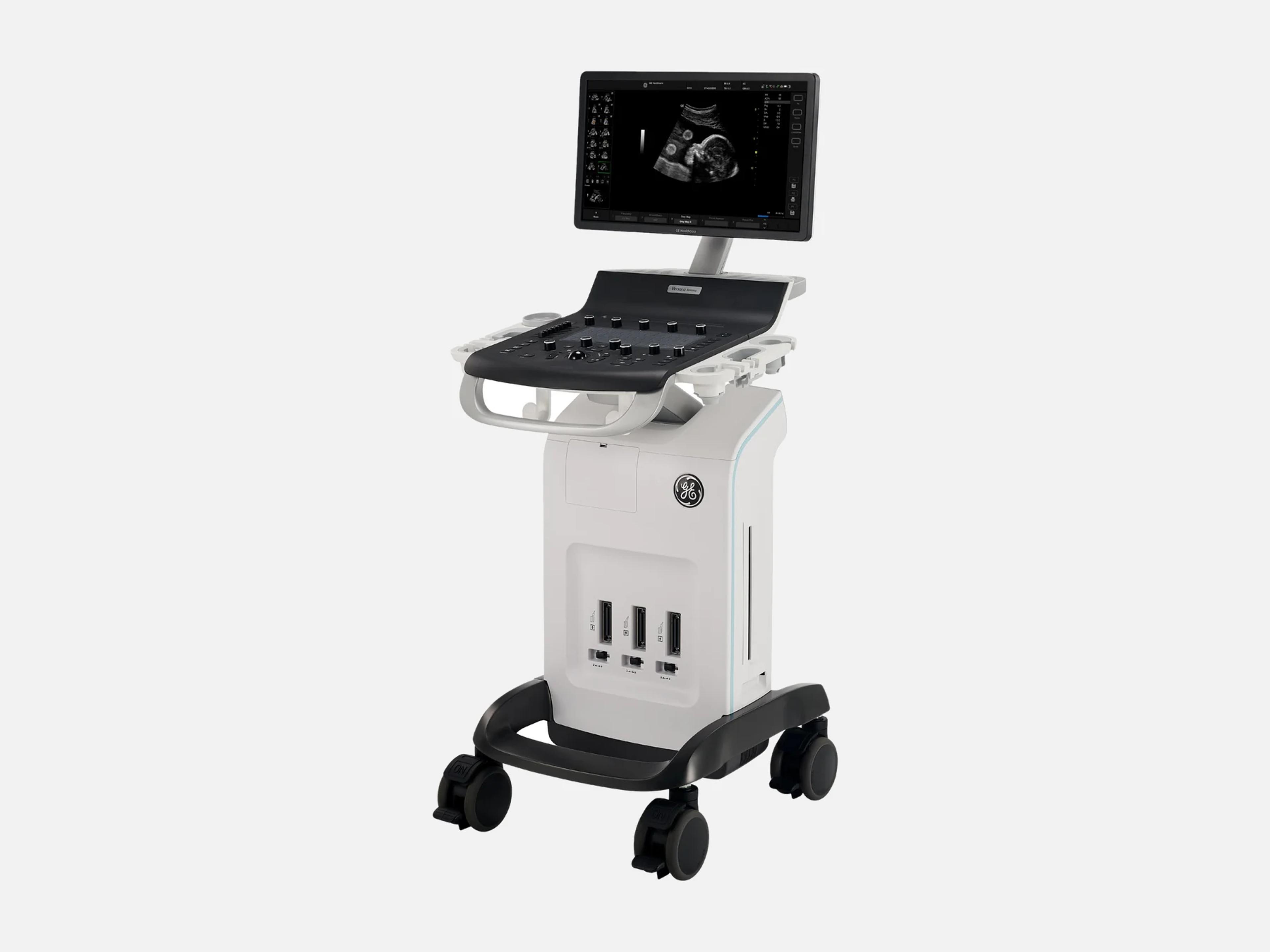
The GE Versana Balance is a cart-based ultrasound system for private clinics, GP offices and other primary care settings, designed for clinicians who have used ultrasound and want to upgrade their capability. It is cleared by the FDA for obstetrics, gynecology, small parts, cardiac, vascular and musculoskeletal imaging. Its Versana siblings for primary care are the Versana Premier, Essential and Active.
- Released
- 2019first FDA clearance
- Probe ports
- Up to 4active; 3-port or 4-port
- Display
- 21.5-inchLED-backlit, 1920 x 1080
- Weight
- Under 60 kgwithout peripherals
Compatible probes
Linear
- L6-12-RS
- 12L-RS
- L8-18i-RS Available on V2; added in 2022 510(k)
Convex & microconvex
- 4C-RS
- 8C-RS Micro convex
- RAB2-6-RS 3D/4D volume probe
Phased
- 3Sc-RS
- 6S-RS
- 12S-RS Available on V2; added in 2022 510(k)
Endocavity
- E8C-RS
- E8Cs-RS Wide field of view
Specifications
Display
- Monitor
- 21.5-inch LED-backlit, 1920 x 1080 (476.1 x 267.8 mm)
- Monitor arm
Fixed arm; rotates -90° to +90°, tilts +25°/-90°; folds down for transportFixed monitor arm with tilt, rotate and pan; rotate angle -90° to +90°; tilt angle +25°/-90°; adjusts left and right; folds down for transportation; brightness, contrast and color-temperature adjustmentShow allShow less
- Touch panel
Optional multi-gesture touch panel, 13.3-inch (Versana Balance V2)Optional multi-gesture touch panel, 13.3-inch on Versana Balance V2; systems are built with or without a touch panel, and on a touch-panel system the primary menu shows on the touch panel; multi-touch controlShow allShow less
Physical
- Weight
- Under 60 kg without peripherals
- Weight, ready for use
About 70 kg or more, depending on peripherals; console under 70 kg (R2)On R2 systems: approximately 70 kg or more when ready for use, depending on installed peripherals; console weight under 70 kgShow allShow less
- Probe ports
Up to 4 active, front-facing; 3-port (3PP) and 4-port (4PP) configurationsUp to 4 active probe ports, front-facing; 3-probe-port (3PP) and 4-probe-port (4PP) configurations, and the 4PP software option needs the 4PP front cover assembly fittedShow allShow less
- Wheels and handles
Four wheels with swivel and brake (rolling lock, swivel lock); front and rear handlesFour wheels, front and rear with swivel and brake functions (rolling lock and caster swivel lock); front and rear handles; probe cable management slotsShow allShow less
- Cart features
Integrated speakers, gel warmer, removable probe and gel holders, removable air filtersIntegrated speakers; gel warmer; probe holders and gel holder removable for cleaning and washing; easily removable air filtersShow allShow less
- Height adjustment
Console lift range 140 mm; offering may vary by country or regionConsole lift up-down range 140 mm; the height-adjustable console offering may vary by country or regionShow allShow less
- Controls
Washable alphanumeric keypad, 8 TGC pods, trackball, user-configurable keysFull alphanumeric keypad under washable protection film; 8 TGC pods; trackball; user-configurable keys; a rotary and Page Up/Down primary-menu keys; dedicated keys including Whizz, B Mode, CF Mode, PW Mode, PDI, CW, M Mode, Freeze, Body Pattern, Set, Scan Coach, Comment, CHI and Utility; operator keyboard height adjustable (configuration dependent)Show allShow less
Power & battery
- Power input
- 100–240 VAC ±10%, 50/60 Hz
- Power consumption
Max. 350 VA with peripherals; 130 VA working, 110 VA standby, 170 VA chargingMax. 350 VA including monitor and on-board peripherals; reference values 130 VA in normal working, 110 VA in standby, 170 VA in normal working with the battery charging; the power box ACDC module supplies DC 19V to the systemShow allShow less
- Energy use
Off 1.9 W; standby 5 W; ready to scan 119.7 W (4D), 97.7 W (freeze), 89.9 W (data)Off 1.9 W; standby 5 W; ready to scan 119.7 W (4D), 97.7 W (freeze), 89.9 W (data); 24-hour energy: off 0.6175 kWh, standby 0.71 kWh, ready to scan 2.87 kWh; freeze engages automatically after 2 minutes of scanning airShow allShow less
- Battery
Optional lithium-ion battery; about 15 minutes of operation on a full chargeOptional lithium-ion battery; about 15 minutes of operation on a full charge; operating temperature with the battery 10–30 °C (50–86 °F); the battery pack has a fuel-gauge test functionShow allShow less
Connectivity & options
- Ethernet
- RJ45; 10BASE-T, 100BASE-TX and 1000BASE-T
- DICOM
DICOM 3.0 with worklist, storage commitment, MPPS, query/retrieve and structured reportsDICOM 3.0: Verify, Print, Store, Modality worklist, Storage commitment, Modality Performed Procedure Step (MPPS), Query/retrieve, Structured reporting template; a structured report can be sent without an image; 100/1000 Mbit Ethernet/DICOM network optionShow allShow less
- Network storage and cloud
- EMR or PACS network storage; Tricefy Cloud upload (internet and subscription required)
- Remote service
- RSVP remote capability
- Wireless
USB wireless and Bluetooth adapters as peripheral options; wireless varies by countryUSB wireless adapter (availability varies by country) and Bluetooth adapter as peripheral optionsShow allShow less
- Video outputs
- HDMI 1.4 and VGA (1920 x 1080), S-Video, composite (CVBS, RCA)
- USB
3 rear (USB 2.0 and USB 3.0) and 1 beside the keyboard3 in the rear and 1 beside the keyboard; the rear panel has USB 2.0 (up to 480 Mbps) and USB 3.0 (up to 5.0 Gbps) portsShow allShow less
- Other outputs
- Audio line-out (RCA); DC 12V 1.5A power-out port
- Storage
Integrated 512 GB SSD, 299 GB for images; extended SSD option (1 TB on V2)Integrated 512 GB SSD with a 299 GB internal partition for image storage; an extended SSD (disk Y) can be installed, an optional 1 TB addition on Versana Balance V2; external USB HDD and USB memory stick (import, export, DICOM read, save as); CD-RW 700 MB; DVD-R 4.4 GBShow allShow less
- Peripheral options
Thermal printers, office printer, footswitches, ECG module, DVD RW kit, barcode scannerB/W and color thermal printers; an office printer; 1-pedal and 3-pedal footswitch; ECG module; DVD RW kit; USB stick; external USB HDD; USB wireless adapter; Bluetooth adapter; barcode scannerShow allShow less
Imaging & software
- Revision and software
Software R2.x.x (R2.0.2, R2.0.3, R2.0.8); generation name: Versana Balance V2Software R2.x.x, with named releases R2.0.2, R2.0.3 and R2.0.8; GE's newer generation of the system is Versana Balance V2. V2 names the system generation and R2.x.x the software, and the two are separate labels.Show allShow less
- Operating system
- Windows 10
- Boot time
- Under 25 s fast boot; under 120 s cold boot
- Applications
Abdominal, obstetrical, gynecological, small parts, musculoskeletal, vascular, cardiacAbdominal, obstetrical, gynecological, small parts, musculoskeletal, vascular/peripheral vascular, urological, pediatric, cardiac, thoracic, transcranial, transvaginal, transrectal, interventional guidanceShow allShow less
- Imaging modes
B, M, color M, CFM, PDI and directional PDI, PW with high PRF, CW, coded harmonics, AMMB-Mode, Coded Harmonic Imaging, M-Mode, Color M-Mode, Color Flow Mode (CFM), Power Doppler Imaging (PDI), Directional PDI, PW Doppler with high PRF, CW Doppler, Anatomical and Curved M-Mode (AMM and Curved AMM, optional); alternating modes B/M/PW/CW/CF/PDI/TVI/TVD; the FDA-cleared modes also include 3D/4D and elastography, availability depending on configurationShow allShow less
- Imaging performance
Max. 1790 fps (probe and mode dependent); depth 1–33 cm; 384 MB cine memory7,411,810 system processing channels; max. frame rate 1790 fps (probes and modes dependent); displayed imaging depth 1–33 cm; 256 shades of gray; 269 dB systematic dynamic range; 384 MB cine memoryShow allShow less
- Image optimization
- Whizz, Whizz Dynamic Image Tuning, CrossXBeam, SRI-HD, LOGIQ View, B-Flow, B-Flow Color
- Standard features
- B-Steer, Virtual Convex, QAnalysis
- Cardiac tools
TVI, QTVI, Tissue Doppler, Myocardial Doppler, TVM (option)Tissue Velocity Imaging (TVI), QTVI, Tissue Doppler and Myocardial Doppler; TVM as a system optionShow allShow less
- Measurement tools
- Auto IMT, Auto Bladder, SonoBiometry, TI-RADS ACR, LI-RADS ACR (option)
- Available on Versana Balance V2
Whizz Label, Whizz Color Flow, V-Live, elastography, Probe Check, Auto EF, Stress EchoWhizz Label, Whizz Color Flow, V-Live, strain elastography, E-IFU electronic user manuals, Probe Check (tests each probe element's response while scanning in air), Auto Ejection Fraction, Stress Echo, Liver Productivity with LI-RADS, Thyroid and Breast Productivity tools, the multi-gesture touch panel and Verisound CollabShow allShow less
- Options
Easy and Advanced 3D, Static 3D/4D, TUI, Vocal, elastography, contrast, BreastCareEasy 3D; Advanced 3D; Static 3D/Real-time 4D with the RAB2-6-RS; TUI; Vocal; strain elastography; contrast; BreastCare; Scan Coach; Follow-Up Tool; needle recognition with the L6-12-RS, 12L-RS and 4C-RS; LI-RADS ACR; battery. Software options also need their hardware: four probe ports the 4PP front cover, DVD writing the DVD writer kit, 3D/4D the 4D boxShow allShow less
- Training and workflow
My Trainer, Scan Assistant, EZ Setting Restore, Voice CommentsMy Trainer on-system training; Scan Assistant (configured image-storage order); EZ Setting Restore; Voice CommentsShow allShow less
- Other named features
Raw Data Analysis, LGC, real-time automatic Doppler calculations, installation wizardInstallation wizard, Raw Data Analysis, Lateral Gain Compensation (LGC), real-time automatic Doppler calculations, patient information database, image archive on the integrated SSD, StandbyShow allShow less
- Software updates
- Electronic software delivery (eDelivery); remote update in some markets
Environment
- Operating temperature
- 3–40 °C (37.4–104 °F) without battery; 10–30 °C (50–86 °F) with battery
- Humidity
- 30–85% non-condensing in operation; 10–90% in storage and transport
- Pressure
- 700–1060 hPa
- Storage and transport temperature
- -5 to 50 °C
- Heat output
- Up to 3800 BTU/h for the console with monitor and on-board peripherals
- Acoustic noise
- 22.91 dB at medium fan speed
Compliance
- FDA 510(k)
- K191792 (August 9, 2019); K220446 (May 11, 2022)
- Safety standards
IEC 60601-1, IEC 60601-1-2, IEC 60601-2-37, ISO 10993-1, EN 62366-1Conforms to IEC 60601-1, IEC 60601-1-2 (EMC emissions Group 1 Class A per CISPR 11), IEC 60601-2-37, ISO 10993-1 and EN 62366-1Show allShow less
What to check when buying a used GE Versana Balance
Run chassis and probe leakage tests
Chassis and probe leakage are the electrical safety tests for this system, and a unit or probe that fails them is not safe to use on patients.
How: Have a biomed run both tests, and on a failure check the power cord and plug ground for continuity and retest the probe on another port to see whether the fault follows the probe or the slot.
Inspect the power cord, plug and inlet
Loose wire strands at the plug can short, and a damaged cord or inlet undermines the system's ground.
How: Look over the cord and its connectors for damage, confirm the line, neutral and ground wires are firmly attached with no stray strands, and check that the inlet retainer holds the plug.
Reject a damaged, leaking or deformed battery
A damaged lithium-ion pack is a safety risk inside the console, and a low battery can cause a failed boot.
How: Where a battery is fitted, charge it and look for damage, leaks, odor, deformation or discoloration.
Look for gel leaked from the gel warmer
A gel warmer left to fill leaks gel inside the system, and leaked gel left uncleaned can short the internal board.
How: Check the reservoir and the console around it for overflowed or dried gel, and treat gel inside the covers as a reason to have the boards inspected.
Common questions about the GE Versana Balance
Is the GE Versana Balance FDA-cleared?
Yes. It is FDA-cleared under 510(k) K191792, decided August 9, 2019, and K220446, decided May 11, 2022. The 2022 clearance takes the 2019 system as its predicate and adds the L8-18i-RS and 12S-RS probes.
Under K220446 the cleared applications are fetal/obstetrics, abdominal, gynecology, urology, pediatric, small parts (breast, testes, thyroid), adult and pediatric cardiac, vascular and peripheral vascular, conventional and superficial musculoskeletal, thoracic/pleural, transcranial, transrectal and transvaginal imaging, plus interventional guidance, for use in a hospital or medical clinic.
How is the GE Versana Balance different from the Versana Premier and Essential?
The Versana Balance V2 has a 21.5-inch main display and a 13.3-inch touch panel, while the Versana Premier R3 offers a 21.5-inch or 23.8-inch main display and a 13.3-inch or 15.6-inch touch panel.
Whizz Label and multi-touch are Versana Balance features that the Versana Essential configuration in 510(k) submission K223407 does not have.
Is there a veterinary version of the GE Versana Balance?
Yes. The Versana Balance Vet is GE's veterinary variant, and it shares its service manual with the Versana Balance.
The LK760-RS linear probe is for veterinary use, so it belongs with a Versana Balance Vet and not with a system used on people.