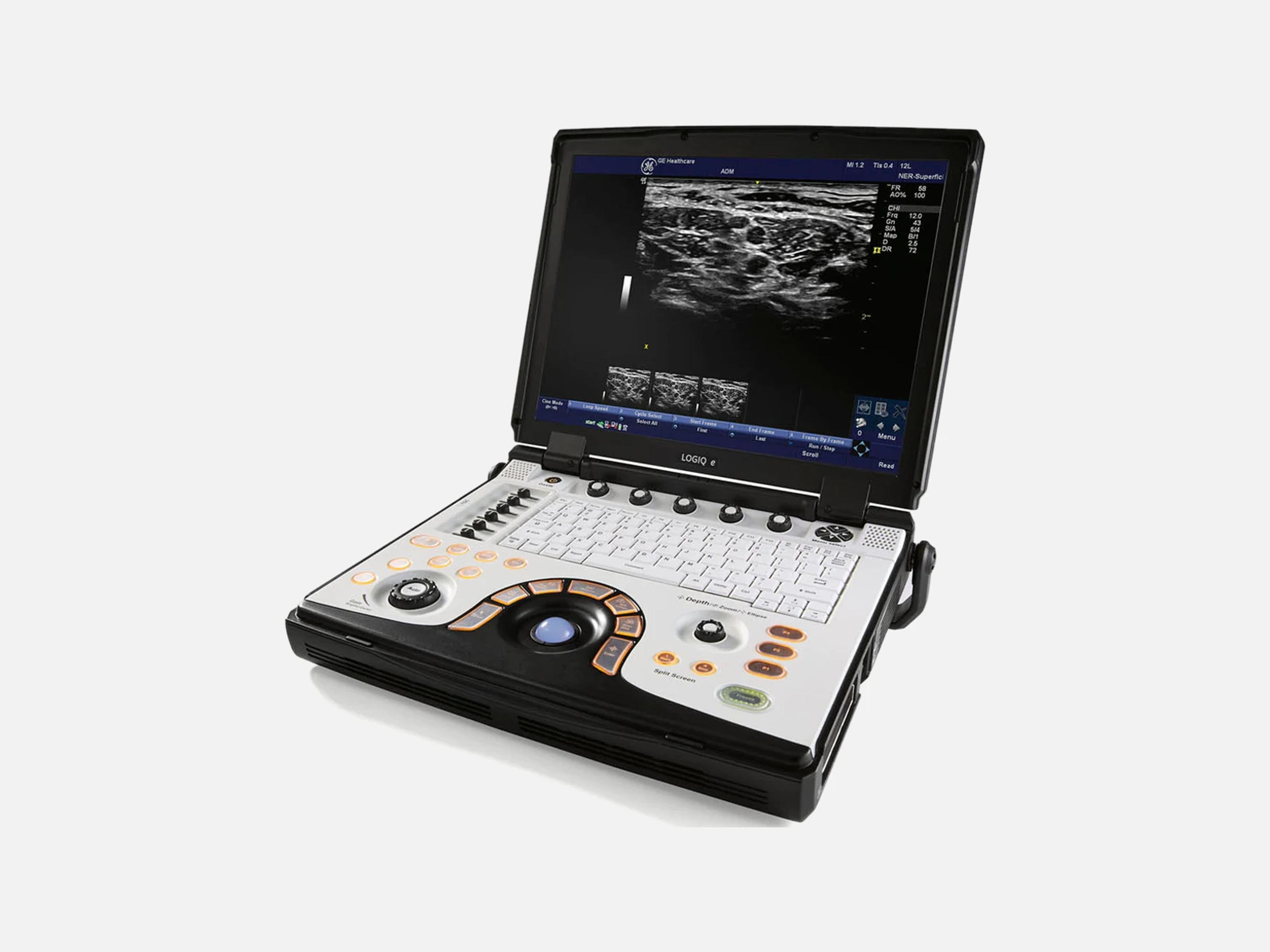
The GE NextGen LOGIQ e is a portable configuration of the LOGIQ e for point-of-care use, with an imaging engine from GE's flagship cart-based systems. Its console weighs about 5.2 kg with battery and has a 15-inch color LCD and one active probe port, or three with the docking cart. Its R7 revision runs software 9.1.x or 9.2.x, and its R8 revision runs R10.1.x.
Compatible probes
Linear
- L4-12t-RS Four configurable buttons
- LK760-RS
Specialty
- 6Tc-RS Transesophageal
Specifications
Display
- Display
- 15-inch high-resolution color LCD, 1024 x 768, ±80° viewing angle, brightness adjustment
Physical
- Weight
- Approx. 5.2 kg (11.5 lb) with battery
- Dimensions
Console 70 x 295 x 346 mm (H x W x L); 100 x 343 x 375 mm with handleConsole only: 70 mm (2.75 in) high, 295 mm (11.61 in) wide, 346 mm (13.62 in) long. With handle: 100 mm (3.94 in) high, 343 mm (13.50 in) wide, 375 mm (14.76 in) long.Show allShow less
- Probe ports
R7 and R8: one active port on the console, three with the docking cartR7 and R8: one active probe port in portable use, three active with the docking cart. The docking cart and the isolation cart each list a 3-probe port as an option, and the console has a docking cart connector.Show allShow less
- Controls
Alphanumeric keyboard, backlit hard keys, trackball; console control from the transducerOperator keyboard with an alphanumeric keyboard, ergonomic hard keys and backlit keys; trackball for scroll, M&A, position, size, scan area width and tilt; a programmable probe with buttons, and console control from the transducer; an adhesive keyboard cover against spills, sprays and drops.Show allShow less
- Carts (options)
Docking cart 53 kg, isolation cart 30.5 kg, each without accessoriesDocking cart: height 810–950 mm (26.6–31.2 in), width 470 mm (15.4 in), depth 617 mm (20.2 in), 53 kg (116.8 lb) without accessories. Isolation cart: height 830–1130 mm (32.7–44.5 in), width 540 mm (21.3 in), depth 510 mm (20.1 in), 30.5 kg (67.1 lb) without accessories.Show allShow less
Power & battery
- Power
- 100–240 V AC, 50/60 Hz, max. 130 VA; DC input on the console, AC on the docking cart
- Battery
Integrated lithium-ion battery; Extended Life Battery among the cart optionsIntegrated lithium-ion battery in the console, or a separate power supply and charger; the system is battery-operated, and an Extended Life Battery is listed among the cart options.Show allShow less
- Battery runtime
- R7 and R8: about 30 minutes portable; 3+ hours on the docking cart's UPS
- Boot time
- R7 and R8: about 25 seconds
Connectivity & options
- Connectivity
Console: 3 x USB 2.0, 10/100/1000 LAN, HDMI. Docking cart: DVI, 4 x USB 2.0Console: USB 2.0 (3), LAN 10/100/1000 BaseT, HDMI. Docking cart: DVI, USB 2.0 (4). InSite ExC capability; single-button send of an image or exam to a memory stick or the network; USB and SD archiving on the R7.Show allShow less
- DICOM
DICOM 3.0, encrypted DICOM; worklist and SR measurements on software 8.x.x and 9.x.xDICOM 3.0 connectivity and encrypted DICOM. On LOGIQ e software 8.x.x and 9.x.x: Modality Worklist query and retrieve, and measurements sent as DICOM structured report (SR) objects to a remote storage SCP.Show allShow less
- Options
Needle Recognition, LOGIQ View panoramic imaging, 3D, Quantitative Flow AnalysisNeedle Recognition Mode, on all linear probes, shows the needle even in Color and Power Doppler; LOGIQ View, a panoramic image up to 60 cm in long axis; 3D; Quantitative Flow Analysis. High-Res PDI, Continuous Wave Doppler, Anatomical M-Mode/Color M-Mode and TVI/TVD are optional modes.Show allShow less
Imaging & software
- Imaging modes
B, M, CFM, PDI, PW Doppler; optional AMM/Color M, High-Res PDI, CW Doppler, TVI/TVDB-Mode, M-Mode, Color Flow Mode (CFM), Power Doppler Imaging (PDI), Pulse Wave Doppler (PWD); optional Anatomical M-Mode/Color M-Mode (AMM), High-Res PDI, Continuous Wave Doppler (CWD) and Tissue Velocity Imaging/Doppler (TVI/TVD).Show allShow less
- Standard features and options
CrossXBeam, SRI-HD, Coded Harmonic Imaging, ATO, Virtual Convex, HD Zoom, easy3D…CrossXBeam (3, 5, 7 or 9 angles of spatial compounding), Speckle Reduction Imaging (SRI-HD), Virtual Convex/Virtual Apex, Fine Angle Steer, HD Zoom (Write Zoom), Coded Harmonic Imaging (CHI), Automatic Optimization (ATO), easy3D, LOGIQ View, Needle Recognition, Stress Echo, eSmart Trainer, Auto IMT, Flow Quantitative Analysis, Patient Follow-up Tool with fusion, InSite ExC capability.Show allShow less
- Software upgrades
B-Steer+ Needle Recognition, Auto-IMT, Follow-Up ToolB-Steer+ Needle Recognition; Auto-IMT, automated intima-media thickness measurement; Follow-Up Tool, which restores imaging parameters from the last examination.Show allShow less
- Revision and software
R7: software 9.1.x and 9.2.x; R8: software R10.1.xLOGIQ e R7: software 9.1.x and 9.2.x (fixed builds R9.1.5 and above, R9.2.6 and above). LOGIQ e R8: software R10.1.x (fixed build R10.1.4 and above).Show allShow less
- Operating system
- Windows 10
- Beamformer
- R7 and R8: 128-channel beamformer
- Processor and storage
- Duo Core CPU, integrated solid-state drive
Compliance
- FDA 510(k)
K151028, LOGIQ e (2015-06-18); NextGen LOGIQ e and LOGIQ e NextGen listed under itK151028, LOGIQ e, decided 2015-06-18; the FDA's device listing carries NextGen LOGIQ e and LOGIQ e NextGen among the proprietary names under it. Its predicate is K133533, LOGIQ e (2014-02-12).Show allShow less
- Safety conformance
AAMI/ANSI ES60601-1; IEC 60601-1, -1-2, -1-6, -2-37; ISO 10993; NEMA UD3Certified to AAMI/ANSI ES60601-1:2005/(R)2012; conforms to IEC 60601-1, IEC 60601-1-2, IEC 60601-1-6, IEC 60601-2-37, ISO 10993 and NEMA UD3.Show allShow less
What to check when buying a used GE NextGen LOGIQ e
Reject a damaged, leaking or deformed battery
A LOGIQ e battery has smoked and sparked, with cell aging and missed maintenance the likely cause, and a BT12 unit burned from its battery side while operating.
How: Look for damage, leaks, odor, deformation or discoloration, then run the system on battery alone, since a unit that will not run on battery points to the battery, its connection or the charge board.
Inspect the power cord, plug and AC/DC adapter
On LOGIQ e systems the joint between the power cord and the AC/DC adapter has arced and overheated, once with a shock and burn to a nurse's hand.
How: Check the cord, plug, inlet and adapter for damaged insulation, strain relief or heat marks, clear any debris from the adapter's cord socket, and never hang the adapter from the cart's probe cable holder.
Inspect docking connectors for burns and liquid residue
On an R7, liquid in the docking connector shorted its power and ground pins and caused flames where power enters the system.
How: Look for burn marks, liquid residue and dust on the cart connector and the console receptacle, and treat any spill marks on the console, probe connector or cart as a fault, since none of them is waterproof.
Have a biomed run electrical safety tests
High leakage from the system, a peripheral or a probe can mean its insulation has degraded.
How: Test the system, its peripherals and every probe for leakage, then check ground continuity at the power cord if the chassis fails, or at the probe port if a probe fails on one port only.
Common questions about the GE NextGen LOGIQ e
Is the GE NextGen LOGIQ e FDA-cleared?
Yes. The FDA lists it, as both NextGen LOGIQ e and LOGIQ e NextGen, under 510(k) K151028, cleared for the LOGIQ e on June 18, 2015. That clearance added the transesophageal application and the 6Tc-RS, 4C-RS and LK760-RS transducers to the LOGIQ e, with K133533 as its predicate.
How is the NextGen LOGIQ e related to the LOGIQ e?
It is a configuration of the LOGIQ e, and NextGen LOGIQ e is GE's US name for it. GE listed it in its US Point of Care Ultrasound range.
What changed between the LOGIQ e R6, R7 and R8?
For the R6, the FDA's device identifier records list an R6-to-R7 upgrade under K151028, in a record published in 2016.
The R7 marks the LOGIQ e's shift from TruScan to a 128-channel beamformer. The R7 runs software 9.1.x or 9.2.x.
The R8 runs software R10.1.x with a Windows 10 security platform, on the same 128-channel platform and 5.2 kg chassis as the R7. The FDA lists the R8 under K151028, in a record published in 2019.
Do LOGIQ e presets survive a software upgrade from R9.1.x to R10.0.x?
No. That upgrade supports only complete disk loading, and customer presets (the system and user configurations) backed up on R9.1.x cannot be restored after it.