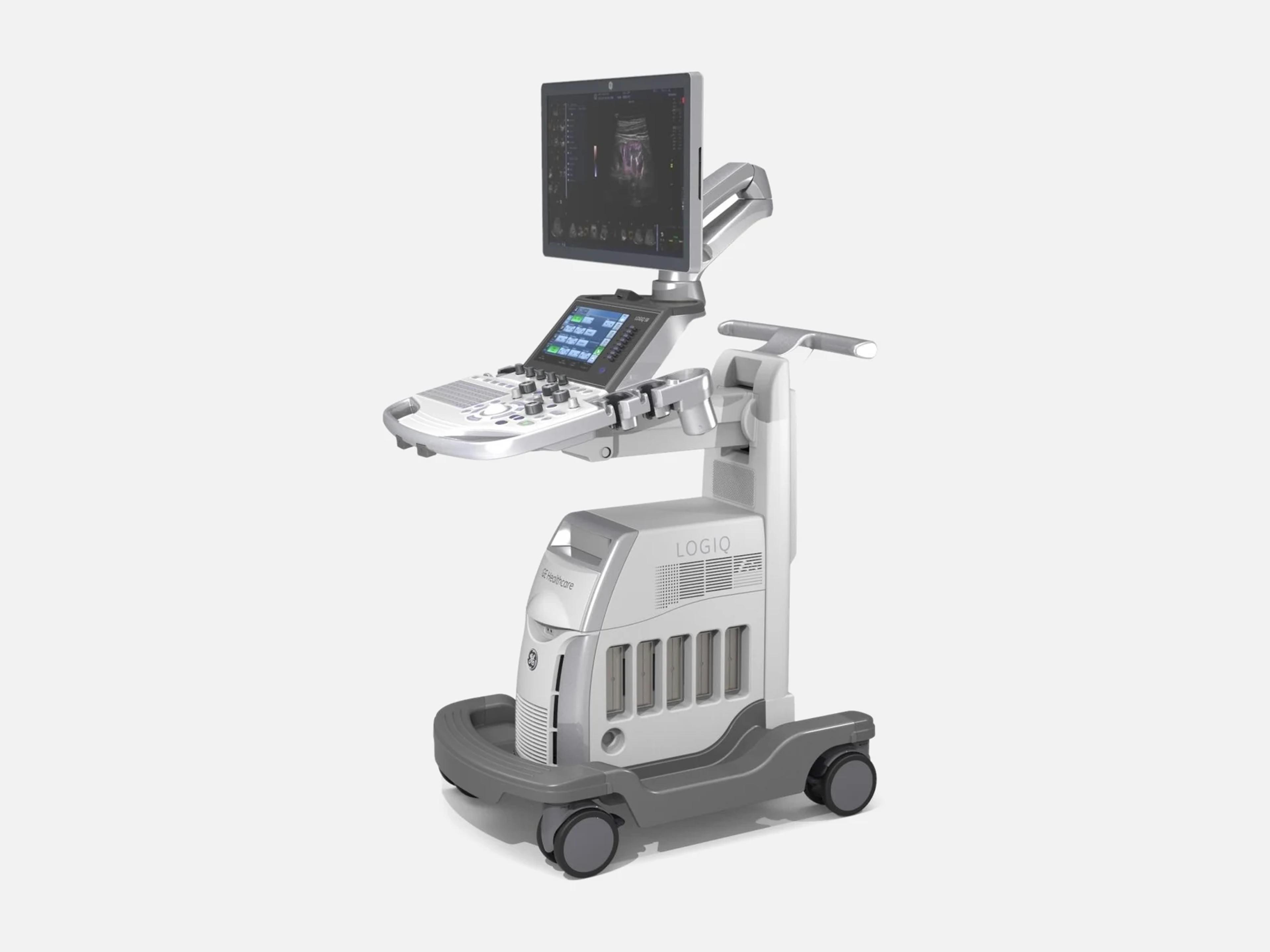
The GE LOGIQ S8 is a cart-based multipurpose ultrasound system for abdominal, vascular, breast, small parts, OB/GYN, cardiac, pediatric, musculoskeletal and urologic imaging. GE placed it above the LOGIQ S7 Expert and below the LOGIQ E9, and it took 4D and the transesophageal application from the E9. GE launched it in 2011 and also sold it as the LOGIQ S8 with XDclear, a variant released in 2015.
- Released
- 2011launched by GE
- Probe ports
- 4 activeplus a CW pencil probe port
- Display
- 22-inch OLEDR4 and later consoles
- Weight
- about 85 kg187.4 lb, no peripherals
Compatible probes
Linear
- 9L-D
- 11L-D
- L3-12-D
- ML6-15-D Matrix array
- L8-18i-D
- L3-9i-D Intraoperative
- RSP6-16-D Volume
Convex & microconvex
- C1-5-D
- C1-6-D XDclear
- C1-6VN-D XDclear
- C2-9-D XDclear
- C2-9VN-D XDclear
- C2-7-D Biopsy
- C2-7VN-D Biopsy
- C2-6b-D Biopsy
- 3CRF-D Biopsy
- C3-10-D XDclear
- 10C-D
- BE9CS-D Bi-plane
- RAB6-D Volume (4D)
- RIC5-9-D Volume (4D)
Phased
- S1-5-D
- M5Sc-D XDclear
- M5S-D
- 3Sp-D
- 6S-D
- S4-10-D
Endocavity
- IC5-9-D Intracavitary
Specialty
- 6Tc-RS Transesophageal; needs the TEE RS-DLP adapter
- P2D CW pencil
- P6D CW pencil
- P8D CW pencil
- FibroScan M+ With the FibroScan option
- FibroScan XL+ With the FibroScan option
Specifications
Display
- Monitor (R4 and later)
22-inch wide OLED, or 23-inch LED-backlit LCD option; 1920 x 1080; viewing angle +/-8922-inch wide-screen high-resolution OLED monitor; 23-inch wide-screen high-resolution LED-backlit LCD monitor as an option. Resolution 1920 x 1080; horizontal/vertical viewing angle +/-89; brightness and contrast adjustment. R4 consoles carry the OLED monitor; R4.2.5x consoles the OLED or the LCD monitor.Show allShow less
- Monitor (R1 to R3)
19-inch color LCD at first clearance (2011); 22-inch OLED from the 2015 XDclear launchA color 19-inch LCD image display at first clearance (510(k) K111582, 2011); some R3 consoles have an OLED monitor; the LOGIQ S8 with XDclear, launched in Japan in October 2015, introduced a 22-inch OLED wide monitor.Show allShow less
- Touch screen
10.1-inch wide color LCD (K170445, 2017); 9-inch LCD in the 2011 and 2015 510(k)sWide 10.1-inch high-resolution color LCD touch screen (510(k) K170445, 2017); a 9-inch LCD touch screen in 510(k)s K111582 (2011) and K152195 (2015).Show allShow less
Physical
- Weight
- About 85 kg (187.4 lb) without peripherals
- Dimensions (R1 to R3)
Height 1720 mm max, 1150 mm min with low cabinet; width 620 mm caster; depth 865 mm maxWithout peripherals: height 1720 mm (67.7 in) max, 1150 mm (45.3 in) min with the low cabinet option; width 500 mm (19.7 in) at the keyboard, 620 mm (24.4 in) at the casters; depth 865 mm (34.1 in) max, 795 mm (31.3 in) at the casters.Show allShow less
- Dimensions (R4 and later)
Height 1760 mm max, 1100 mm min with OLED; width 530 mm caster; depth 865 mm maxWithout peripherals: height 1760 mm (69.3 in) max; min 1100 mm (43.3 in) with the 22-inch OLED, 1150 mm (45.3 in) with the 23-inch LCD. Width 520 mm (20.5 in) at the keyboard, 530 mm (20.9 in) at the casters, 527 mm (20.7 in) with the 22-inch OLED monitor, 561 mm (22.1 in) with the 23-inch LCD monitor. Depth 865 mm (34.1 in) max, 795 mm (31.3 in) at the casters.Show allShow less
- Probe ports
4 active universal pinless ports, 1 parking port, plus a CW pencil probe port4 active universal pinless probe ports and 1 parking port, plus a CW pencil probe port on both the R1 to R3 and the R4-and-later consoles; an LS8 PENCIL CW hardware kit is among the hardware options.Show allShow less
- Console
Integrated SSD, DVD drive, speakers and cable management; front and rear handlesIntegrated SSD, integrated DVD multi drive, on-board thermal printer storage, integrated speakers, integrated cable management, front and rear handles, easily removable air filters.Show allShow less
- Controls
Keyboard adjustable in height and rotation, backlit; integrated gel warmerOperating keyboard adjustable in height and rotation (control panel swivel lever and up/down lever); backlit alphanumeric keyboard; ergonomic hard key layout; interactive back-lighting; integrated recording keys for remote control of up to 6 peripheral or DICOM devices; integrated gel warmer; 10.1-inch touch screen.Show allShow less
- Acoustic noise
- Max. 50 dB(A)
Power & battery
- Power
100-120 VAC or 220-240 VAC (±10%), 50/60 Hz (±2%); 900 VA with on-board peripherals100-120 VAC or 220-240 VAC (±10%), 50/60 Hz (±2%); input 9.0-7.0 A at 100-120 VAC, 4.0-3.7 A at 220-240 VAC; power consumption 900 VA with on-board peripherals. Requires a dedicated single branch circuit.Show allShow less
- Battery
Optional lithium-ion; extended battery on R4 and later, up to one hour of scanningOptional lithium-ion battery in the power supply module. On R4 or later systems an extended or small battery option charges automatically from AC power, and the extended battery allows live scanning on battery power: up to one hour of scanning on battery alone with the extended battery option (LOGIQ S8 XDclear 2.0+).Show allShow less
- Power Assistant
Option (R2 or later): avoids data loss on power failure; move it without a full shutdownOption, R2 or later: avoids loss of data and images on power failure, lets the system be moved without a full shutdown and boot cycle, and manages auto stand-by on power failure.Show allShow less
Connectivity & options
- Network and DICOM
Ethernet; wireless LAN option (R2.x.x or later); DICOM 3.0 option; Tricefy optionEthernet network connection; Wireless LAN (option; R2.x.x or later); DICOM 3.0 (option): Verify, Print, Store, Modality Worklist, Storage Commitment, Modality Performed Procedure Step (MPPS), Media Exchange, off-network/mobile storage queue, Query/Retrieve, Public SR Template, Structured Reporting (vascular and OB); InSite ExC capability; Tricefy (option).Show allShow less
- DICOM conformance (R4.0)
Storage, print, worklist, MPPS, storage commitment, Query/Retrieve (SCU), SR (SCU); IPv4SCU and SCP: Ultrasound Image Storage, Ultrasound Multi-frame Image Storage, Enhanced US Volume Storage and Secondary Capture Image Storage. SCU only: Basic Grayscale and Basic Color Print Management Meta SOP classes; Storage Commitment Push Model, Modality Performed Procedure Step and Modality Worklist FIND; Study Root Query/Retrieve FIND and MOVE; Comprehensive SR and Key Object Selection Document. Networking: DHCP supported, IPv4 only.Show allShow less
- Inputs and outputs
DVI-D signal on an HDMI connector; Ethernet; USB 2.0 and USB 3.0 portsDVI-D signal with HDMI connector; Ethernet; multiple USB 2.0 and USB 3.0 ports (not counting on-board peripherals).Show allShow less
- Image storage
Solid-state drive > 500 GB; export to USB, CD-R, DVD-R; DICOM, JPEG, JPEG2000, WMV, AVISolid-state drive image storage > 500 GB; export to USB memory stick (64 MB to 64 GB), CD-R (700 MB), DVD-R (4.7 GB); DICOM storage formats; export as JPEG, JPEG2000, WMV (MPEG 4) and AVI.Show allShow less
- Peripherals
Thermal printers (B/W, color, A5 color), DVD recorder, foot switch, external printerIntegrated options: digital B/W thermal printer, DVD video recorder, digital color thermal printer, digital A5 color thermal printer; external USB printer via USB isolator, or network printer; foot switch with programmable functionality; video converter; DVI-D output.Show allShow less
- Physiological input
- Physiological Input Panel option: ECG, 2 lead, dual R-trigger
- Options
Volume Navigation, Shear Wave Elastography, FibroScan, Real Time 4D, Stress Echo, Auto EFVolume Navigation, Needle Tracking, Scan Assistant, Compare Assistant, Cardiac Strain (Cardiac AFI), Power Assistant, Breast Productivity Package, Thyroid Productivity Package, FibroScan with VCTE and CAP (not available in Canada), Shear Wave Elastography, Strain Elastography, Quantitative Flow Analysis, TVI, Stress Echo, Auto EF, Coded Contrast Imaging with Parametric Imaging, LOGIQ View, B Steer+, Report Writer, Real Time 4D with Volume Contrast Imaging-Static, Tomographic Ultrasound Imaging, VOCAL II, STIC, HD Live and OmniView.Show allShow less
- Software options (R1 to R4.2.5x)
Includes B-Flow, Auto IMT, AFI, STIC, HDLive; Elastography Quantification not in the USAdvanced 3D, Auto IMT, B-Flow, Coded Contrast, CW Doppler, DICOM, Elastography, Elasto Quantification, Flow Quantification, LOGIQView, Report Writer, Scan Assistant, Stress Echo, TVI (Tissue Velocity Imaging), LS8 HRes Contrast Upgrade, TUI (Tomographic Ultrasound Imaging), VOCAL II, VCI Static, Auto EF, Needle Tracking, Measure Assist Breast, Measure Assist OB, Breast Productivity, Thyroid Productivity, Compare Assistant, Advanced Probes, B Steer+, Software DVR, Shear Wave Elastography, AFI, STIC, OmniView, FibroScan CAP, Advanced Security, HDLive, Tricefy. Elastography Quantification is not available in the United States.Show allShow less
Imaging & software
- Revision and software
Software releases R1, R2, R3, R4 and R4.2.5x; an R4.5.x label is also publishedSoftware releases R1, R2, R3, R4 and R4.2.5x. DICOM conformance statements exist for R2, R3, R4 and R4.2.5x; an IHE listing adds R1 and the label R4.5.x, with no stated relationship to R4.2.5x.Show allShow less
- Options by software release
Shear Wave Elastography from R3; FibroScan CAP from R4; HDLive and Tricefy on R4.2.5xAdvanced 3D standard from R2 onward; Shear Wave Elastography available from R3; FibroScan CAP from R4; Advanced Security on R4 only; HDLive and Tricefy on R4.2.5x only.Show allShow less
- Operating system
Windows 10 Embedded on R4.2.5x and later; Windows XP and 7 Embedded on earlier releasesR4.2.5x and later: Windows 10 Embedded. Windows XP Embedded and Windows 7 Embedded on the earlier release groups (R1.x; R2 to R4).Show allShow less
- Imaging modes
B, M, CFM, PDI, PW Doppler, Static 3D; options include CW Doppler, B-Flow, Real Time 4DB-Mode, M-Mode, Color Flow Mode (CFM), Power Doppler Imaging (PDI), PW Doppler, Static 3D, Anatomical M-Mode, Curved Anatomical M-Mode; options: CW Doppler, TVI, B-Flow/B-Flow Color, Extended Field of View (LOGIQ View), Real Time 4D, B Steer+, Coded Contrast Imaging, Strain Elastography, Shear wave elastography.Show allShow less
- Scanning methods
- Electronic sector, electronic convex, electronic linear, mechanical volume sweep
- Applications
Abdominal, OB, GYN, breast, small parts, vascular, MSK, urology, cardiac, pediatricAbdominal, obstetrical, gynecological, breast, small parts, vascular/peripheral, transcranial, pediatrics and neonatal, musculoskeletal, urological, cardiac.Show allShow less
- Standard features
Automatic Optimization, CrossXBeam, SRI-HD, Coded Harmonic Imaging, Virtual ConvexAutomatic Optimization, CrossXBeam, Speckle Reduction Imaging (SRI-HD), Fine Angle Steer, Coded Harmonic Imaging, Virtual Convex, patient information database, image archive on integrated CD/DVD and hard drive, Advanced 3D, Raw Data Analysis, real-time automatic Doppler calcs, InSite capability, on-board electronic documentation, MyTrainer+, Email to MMS.Show allShow less
- LOGIQ S8 XDclear 2.0+ features
S-Agile Acoustic Architecture, E-Series and XDclear probes, Scan Assistant, CEUSS-Agile Acoustic Architecture, High-performance Probes (E-Series and XDclear probes), B-Flow, Automated Measurements, Power Assistant, Scan Assistant, Volume Navigation, CEUS, 2D Shear Wave Elastography.Show allShow less
- Volume Navigation
Option: fusion of real-time ultrasound with CT, PET, MR and other 3D datasetsOption: fusion of real-time ultrasound with 3D datasets (CT, PET, MR, X-ray angiographic, Tru3D; CBCT and 3D CEUS on the LOGIQ S8 XDclear 2.0+), sensor-based acquisition, position markers, needle tip tracking, virtual tracking, auto image registration.Show allShow less
- 3D/4D imaging
- Real-time 3D and 4D acquisition requires compatible 4D probes
- Controlled Attenuation Parameter
- CAP added alongside FibroScan elastography (K170445, 2017)
- Displayed imaging depth
- 0-33 cm (probe dependent maximum)
- Cine memory
Typical 4000 frames, 3 min (depending on transducer and application)Typical 4000 frames, 3 min (depending on transducer and application); prospective and retrospective capture.Show allShow less
- Privacy and security
Passwords, screen lock, patient-data disk encryption, whitelisting malware protectionPassword policies, session management (lock screen after configurable minutes), disk encryption of the patient data archive partition, whitelisting-type malware protection.Show allShow less
Environment
- Operating
- 10-35 °C (50-95 °F), 30-80% humidity non-condensing, 700-1060 hPa
- Storage and transport
- -10-50 °C (14-122 °F), 10-90% humidity non-condensing, 700-1060 hPa
Compliance
- FDA 510(k)
K111582 (07/26/2011), K131527 (08/26/2013), K152195 (09/29/2015), K170445 (04/11/2017)K111582 (decision July 26, 2011, substantially equivalent), K131527 (August 26, 2013), K152195 (September 29, 2015) and K170445 (April 11, 2017); device name LOGIQ S8, Class II, regulation 21 CFR 892.1550, product code IYN.Show allShow less
- Safety and EMC
ANSI/AAMI ES60601-1 (NRTL); CE marked to 93/42/EEC; EMC Group 1 Class A (CISPR 11)Classified to ANSI/AAMI ES60601-1 by a Nationally Recognized Test Lab; CE marked to Council Directive 93/42/EEC; EMC emissions Group 1 Class A (CISPR 11).Show allShow less
What to check when buying a used GE LOGIQ S8
Have electrical safety and leakage tests run
Grounding continuity, chassis leakage and probe leakage tests find an electrical fault in the console or a probe before the system is used on a patient.
How: Have a trained person run them with every probe connected in turn, and if one probe fails, test another to tell a probe fault from a scanner fault; leakage that follows one port points to bent pins, a poor connection or lost ground continuity in that connector.
Inspect the power cord and plug
A LOGIQ S8 power plug has been reported melted around one prong at the wall outlet, so the cord and plug are a safety item on this console.
How: Look along the cord for cuts, tire marks, exposed insulation and loose hardware, look at the plug for melting around the prongs, and have continuity checked and the cord clamps tightened.
Confirm the S4-10-D recall fix on early software
On R1.1.1 and R1.5.1 software, using the flow model in the cardiac application with the S4-10-D probe could raise acoustic output above its design specification and heat the probe surface, with a risk of skin burn.
How: Read the release under Utility > System > About, and on either release with an S4-10-D probe, get the record that the correction for recall Z-1096-2013 was completed before the probe is used.
Confirm the wrong-patient image recall was corrected
On units built between August and October 2011, an image from a different patient, or the patient's image under another patient's title information, could appear when PRINT was set to save in DICOM format and pressed during LOGIQView pre-mode.
How: Read the build date on the rating plate, and for a unit in that range, get the record of the software update for recall Z-1093-2012 and confirm saved and printed images carry the right patient.
Common questions about the GE LOGIQ S8
Is the GE LOGIQ S8 FDA-cleared?
Yes. The LOGIQ S8 is a Class II ultrasonic pulsed Doppler imaging system, FDA-cleared under 510(k) K111582 on July 26, 2011, with later clearances under K131527 (August 26, 2013), K152195 (September 29, 2015) and K170445 (April 11, 2017).
Under K170445 it is cleared for use by a qualified physician in fetal and obstetric, abdominal, pediatric, small organ (breast, testes, thyroid), neonatal and adult cephalic, adult and pediatric cardiac, peripheral vascular, conventional and superficial musculoskeletal, urology (including prostate), transrectal, transvaginal, transesophageal and intraoperative (abdominal, thoracic, vascular) exams.
What is the difference between the LOGIQ S8 and the LOGIQ E9?
GE placed the LOGIQ E9 at the top of the LOGIQ line and the LOGIQ S8 just below it, as an upper-mid system with the applications and measurement functions of the top-tier E series.
The LOGIQ E9 was a predicate for the S8's first clearance, and later clearances brought E9 features across: 4D, the transesophageal application, Measure Assistant and the C2-9-D, RAB6-D and RIC5-9-D probes in 2013, then the C1-6-D and RSP6-16-D probes in 2015. Shear wave elastography reached the S8 in 2015, cleared with the LOGIQ E9 as the predicate for that mode.
How does the LOGIQ S8 compare with the LOGIQ S7?
GE placed the LOGIQ S7 Expert as the mid model of the LOGIQ line, built on the basic performance of the higher-tier LOGIQ S8.
Some S7 features moved up to the S8 through its clearances: B Steer+ in 2013, the BE9CS and L3-12-D probes in 2015, and Email to MMS and strain elastography on the BE9CS-D in 2017. The S7 Expert/Pro was cleared with a 7-inch touch screen, where the R3 S8 has a 9-inch one.
How does the LOGIQ S8 differ from the LOGIQ E10?
The two are built on different imaging architectures: the LOGIQ S8 XDclear 2.0+ on S-Agile Acoustic Architecture, and the LOGIQ E10 series on cSound Architecture.