GE LOGIQ P10 XDclear
GE HealthCare · LOGIQ series
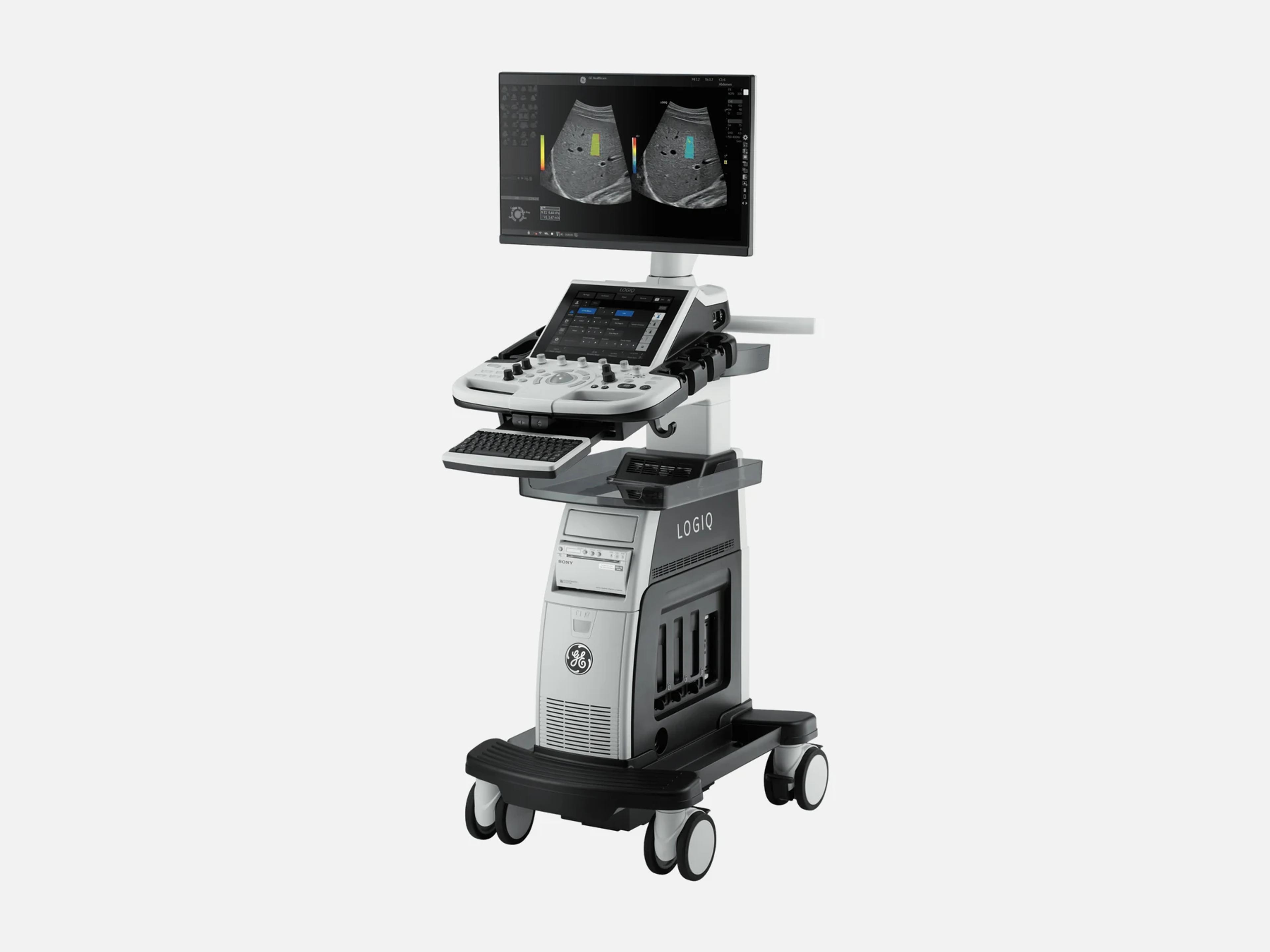
The GE LOGIQ P10 XDclear is a multipurpose cart ultrasound system, the highest configuration of the P Series: the P8 and P9 offer a subset of its features and probes. It is designed for abdominal, obstetrical, gynecological, breast, small parts, musculoskeletal, vascular, urological, pediatric and cardiac exams in hospitals and clinics. Its options include UGAP, Shear Wave Elastography, B-Flow and real-time 4D.
- Released
- 2021first FDA clearance
- Probe ports
- 4 active3 RS and 1 DLP
- Display
- 23.8-inchbezel-less LCD or HDU
- Weight
- 67 kgno peripherals; HD 69 kg
Compatible probes
Linear
- 9L-RS
- 12L-RS
- L3-12-RS
- L4-12t-RS
- L6-12-RS
- ML6-15-RS Matrix array
- L3-9i-RS
- L8-18i-RS
- L10-22-RS
Convex & microconvex
- C1-5-RS
- C1-6-D DLP connector
- C2-7-D
- C3-10-D
- 10C-D
- 8C-RS Microconvex
- RAB2-6-RS 4D volume
Phased
- 3Sc-RS
- M5Sc-RS
- 6S-RS
- 12S-RS
Endocavity
- E8C-RS Transvaginal and transrectal
- E8CS-RS Transvaginal and transrectal
- IC9-RS Transvaginal and transrectal
- RIC5-9A-RS 4D volume
- BE9CS-RS Biplane, transrectal
- E7C8L-RS Biplane transrectal; added with R4.5
Specialty
- 6Tc-RS Transesophageal
- P2D CW pencil
- P6D CW pencil
- P8D CW pencil
Specifications
Display
- Display
23.8-inch HDU (1920 x 1080, contrast >200,000:1) or 23.8-inch bezel-less LCDTwo 23.8-inch monitor configurations: a bezel-less LCD, or an HDU display, for the LOGIQ P10 only, with 1920 x 1080 resolution and a contrast ratio above 200,000:1.Show allShow less
- Touch screen
- 10.4-inch wide color LCD touch screen; dynamic software menu, user-configurable layout
- Monitor arm
Articulating: tilt +15°/-90°, rotate ±90°, travel 660 mm horizontal, 150 mm verticalArticulating monitor arm: tilt +15°/-90°, rotate ±90°, translate 660 mm horizontally and 150 mm vertically; folds down and locks for transport.Show allShow less
Physical
- Weight
67 kg without peripherals (P10 HD 69 kg); 69 kg (152 lb) to 83 kg (183 lb) by loadWithout peripherals: 67 kg for the LOGIQ P10 R4 and R4.5, 69 kg for the P10 HD. LOGIQ P10 R4.5: 69 kg (152 lb) at minimum load and 83 kg (183 lb) at maximum load.Show allShow less
- Dimensions
Height 1345–1595 mm (P10 HD 1390–1640 mm); depth 740 mm; width 430 mm at the panelHeight 1345–1595 mm for the P10 R4 and R4.5, 1390–1640 mm for the P10 HD and the R4.5 with the HDU display, varying with control-panel and monitor position; depth 740 mm (685 mm at the foot cover); width 430 mm at the operator panel and 495 mm at the foot cover.Show allShow less
- Probe ports
4 active (3 RS, 1 DLP) and a CW pencil probe port; probe light4 active probe ports (3 RS and 1 DLP), a CW pencil probe port and a probe light; the CW pencil probe port also appears as a hardware option for R4 and R4.5 consoles.Show allShow less
- Controls
Operator keyboard 810–910 mm high, rotates ±30°; 8 digital TGC controls; joystickOperator keyboard adjustable in height (810–910 mm) and rotation (±30°); 8 independent digital TGC controls; digital alphanumeric keyboard, with a backlit physical keyboard as an option, and a virtual keyboard that can appear on the patient screen; ergonomic hard-key layout with interactive backlighting; customizable and assignable user keys; joystick; Multigestational Touch control; keyless console design; adjustable trackball speed and acceleration.Show allShow less
Power & battery
- Power
100–120 or 220–240 VAC ±10%, 50/60 Hz; 500 VA with peripherals; dedicated circuitRated 100–240 VAC, 50/60 Hz; 100–120 VAC or 220–240 VAC ±10%, 50/60 Hz ±2%; power consumption 500 VA including all on-board peripherals; requires a dedicated single branch circuit.Show allShow less
- Battery
Optional lithium-ion Power Assistant; up to one hour offline with the Extended BatteryOptional Power Assistant for offline scanning, as a battery option (H42832LG) or an extended battery option (H42902LM), with a lithium-ion battery in the power supply module; up to one hour of offline scanning with the Extended Battery; on-screen battery capacity and low-battery indications; the system cannot be powered on from the battery.Show allShow less
- Heat output
Maximum thermal output 700 BTU/hr; cooling requirement 680 BTU/hrMaximum thermal output 700 BTU/hr on the LOGIQ P10 R4.5; cooling requirement 680 BTU/hr, excluding lights, people and other equipment.Show allShow less
Connectivity & options
- Inputs and outputs
HDMI, Ethernet, audio out; USB 2 x 3.0 (panel), 2 x 2.0 (monitor), 3 x 2.0 (rear)HDMI output (with sound on R4.5, not R4, where the external monitor supports HDMI audio), S-Video and Composite outputs; Ethernet (RJ45); external audio out; USB: 2 x USB 3.0 on the operator panel, 2 x USB 2.0 on the monitor and 3 x USB 2.0 at the rear.Show allShow less
- Network
Ethernet 10/100/1000 Mbps with DHCP and IPv6; optional wireless LAN up to 900 MbpsLAN 1000Base-T/100Base-T/10Base-T with DHCP and IPv6 settings; optional wireless LAN up to 900 Mbps; wireless authentication by PEAP where the hospital network supports it.Show allShow less
- DICOM
DICOM 3.0 (option): Store, Print, Worklist, MPPS, Query/Retrieve, Structured ReportingDICOM 3.0 (option): Verify, Print, Store, Modality Worklist, Storage Commitment, Modality Performed Procedure Step (MPPS), Media Exchange, off-network/mobile storage queue, Query/Retrieve and Structured Reporting, with OB-GYN, vascular and echocardiography report templates (not every measurement result is supported); DICOM Viewer (option); EZ DICOM Viewer for export to external media with standalone viewing software, added with R4.5.Show allShow less
- Storage
500 GB M.2 SSD (345 GB for images); 776 MB cine; optional DVD±R/W driveIntegrated 500 GB M.2 solid-state drive with a 345 GB partition for image storage; CINE memory 776 MB; optional integrated DVD±R/W multi drive; export to JPEG, WMV (MPEG 4) and AVI; DICOM storage compressed or uncompressed, single or multi-frame, with or without raw data.Show allShow less
- Data sharing
- Tricefy; DICOM data migration; cloud image collection with anonymization
- Tablet Tools
- Android apps over Bluetooth: Remote Control App, Photo Assistant App, barcode reader
- Remote service
- InSite ExC and iLinq capability (standard)
- Security
SonoDefense; password policies, screen lock, disk encryption, whitelisting, TPMSonoDefense multi-layer cybersecurity and data-privacy protection; password policies; session management with a configurable screen lock; hard-disk encryption of the patient data archive partition; whitelisting-type malware protection; TPM support.Show allShow less
- Physiological input
- 2-lead ECG with dual R trigger; AHA or IEC cable options
- Peripheral options
Thermal printers, needle barcode reader, 3-pedal foot switch, isolation transformer, UPSMounting kits and remote control for a B/W digital thermal printer and digital color A6 and A5 thermal printers; barcode reader for needle information (H43132LZ); wireless LAN card; LOGIQ P Apps (Bluetooth); HDMI output; 3-pedal programmable foot switch (H46732LF); universal video converter; isolation transformer (H48671WN); Ethernet protection cable; EMI and power-supply noise filter; UPS, with UPS support added with R4.5.Show allShow less
- Hardware options
Cabinets, drawer, side tray, probe holders, cable hanger, gel warmer, A/N keyboardHigh cabinet, low cabinet, drawer, side tray, small probe adaptor, vertical endocavitary probe holder, probe cable hanger, rear cable hook, card reader mounting kit, paper tray, OPIO tray, gel warmer, multipurpose holder and physical alphanumeric keyboard.Show allShow less
Imaging & software
- Imaging modes
B, Coded Harmonic, M, B/M, CFM, PDI, PW with high PRF, M-Color Flow, Anatomical M-ModeStandard: B-Mode, Coded Harmonic Imaging (all imaging probes), M-Mode, B/M-Mode, Color Flow Mode (CFM), Power Doppler Imaging (PDI) with directional map, PW Doppler with high PRF, M-Color Flow Mode, Anatomical M-Mode (also from saved B-mode cine) and Curved Anatomical M-Mode. Options: CW Doppler, B-Flow and B-Flow Color, LOGIQView, B Steer+, Coded Contrast Imaging, Tissue Velocity Imaging, Strain and Shear Wave Elastography, UGAP, HDlive, SW DVR, static 3D and real-time 4D.Show allShow less
- Applications
Abdominal, obstetrical, gynecological, breast, small parts, musculoskeletal, vascular…Abdominal, obstetrical, gynecological, breast, small parts, musculoskeletal and superficial, vascular, urological, endocavitary (transvaginal, transrectal), pediatric and neonatal, transcranial, transesophageal, cardiac and intraoperative.Show allShow less
- Scanning parameters
- Up to 3229 frames/s; depth 0–48 cm; frequency 2–22 MHz; system bandwidth 1–25 MHz
- System processing channels
- 1,068,646; Digital P-Agile beamformer
- Image processing
CrossXBeam, SRI-HD, Virtual Convex, Auto tissue and spectral optimization, Auto TGC, CTOStandard: CrossXBeam spatial compounding at 3, 5, 7 or 9 angles; SRI-HD speckle reduction in real time and post-processing, 6 levels; Virtual Convex on all linear and sector transducers; Auto tissue optimization, Auto spectral optimization and Auto TGC; Continuous Tissue Optimization (CTO). ATO/ASO, by probe and configuration.Show allShow less
- Flow imaging
B-Flow, B-Flow Color, B-Flow HD Color, Hybrid B-Flow, HDC, CF/PDI QuantificationB-Flow and B-Flow Color (option), a nonquantitative view of hemodynamics in vascular structures; B-Flow High Definition Color (HD Color); Hybrid B-Flow; HDC (High Definition Color); each on listed probes. CF/PDI Quantification and Flow QA (options).Show allShow less
- Elastography
Strain Elastography, 2D Shear Wave Elastography (kPa, m/s), Elastography QuantificationOptions: Strain Elastography, with Elastography Quantification (Elasto QA) as a separate option; 2D Shear Wave Elastography with color-coded elastograms, Quality Indicator and Anatomical Site Reporting, measured in kPa and m/s, on the C1-5-RS, L3-12-RS, IC9-RS, ML6-15-RS, C1-6-D and 12L-RS.Show allShow less
- Liver assessment
UGAP attenuation for liver steatosis, shown with SWE; Hepatic Assistant (R4.5)UGAP (Ultrasound-Guided Attenuation Parameter), option, R4 or later: calculates an attenuation coefficient to quantify liver steatosis, and can be displayed together with SWE. Hepatic Assistant (option), added with R4.5.Show allShow less
- Contrast
Coded Contrast Imaging (CEUS), AM and HRes modes; TIC analysis with motion trackingCoded Contrast Imaging (CEUS), option: AM mode on C1-6-D, C2-7-D, M5Sc-RS, C1-5-RS, 9L-RS, 3Sc-RS, BE9CS-RS, IC9-RS and E7C8L-RS; HRes mode (HRES CEUS option) on C1-6-D, C2-7-D, M5Sc-RS, C1-5-RS, 9L-RS and 3Sc-RS; time intensity curve (TIC) analysis, with TIC motion tracking standard. Contrast features are enabled only on systems delivered to a country or region where they are allowed.Show allShow less
- 3D/4D
Real-time 4D, Static 3D, 4D TUI, VOCAL II, VCI static, STIC, OmniView, HDlive, SonoAVCOptions: Real-time 4D, 4D TUI, Static 3D, VOCAL II, VCI static, STIC (fetal heart), OmniView, HDlive (virtual light source and skin rendering), SonoAVC and SonoAVC Renal (R4 or later), and Advanced 3D with 3D landscape; the 4D function requires both the 4D hardware and software options. Standard: Easy 3D on all imaging probes and SonoRenderLive.Show allShow less
- Cardiac
CW Doppler, TVI with Q-Analysis, AFI, AutoEF, Cardiac Strain, Stress Echo (options)Options: CW Doppler on the 3Sc-RS, 6S-RS, 12S-RS, P2D, P8D and P6D; Tissue Velocity Imaging (TVI) with Q-Analysis on all sector probes, and TVD by probe and configuration; AFI, semi-automatic regional left-ventricular function from 2D speckle tracking; AutoEF, semi-automatic global ejection fraction, user editable; Cardiac Strain; Stress Echo with exercise and pharmacological protocol templates, a template editor and wall-motion scoring.Show allShow less
- Vascular and needle tools
Auto IMT, B Steer+ needle visualization, LOGIQView extended field of view up to 60 cmOptions: Auto IMT, automatic intima-media thickness on near and far vessel walls; B Steer+ needle visualization, which improves biopsy-needle detectability without slanting the whole B-mode image, on listed probes; LOGIQView extended field of view in B-Mode on all imaging probes, scan length up to 60 cm.Show allShow less
- AI-based tools
Auto Doppler Assistant, Auto Lesion Segmentation, OB Measurement AssistantAuto Doppler Assistant, Auto Lesion Segmentation and OB Measurement Assistant; Doppler Assistant is a standard feature.Show allShow less
- Measurement options
Measure Assistant OB/Breast; Breast/Thyroid productivity; Breast/Thyroid AssistantOptions: Measure Assistant OB (automatic BPD, HC, FL and AC, user editable); Measure Assistant Breast (automatic lesion contour and measurement in a selected region, with BI-RADS assessment, user editable); Breast and Thyroid productivity packages; Breast Assistant and Thyroid Assistant, Powered by Koios DS (R4 or later), configured like a DICOM service; SonoNT/SonoIT (R4 or later); Stepper Volume Measurement (STVOL, added with R4.5) for prostate volume with the E7C8L-RS and a stepper; IOTA LR2 worksheet, not available in the USA.Show allShow less
- Prior-exam comparison
Compare Assistant (option), Volume Navigation Import, Vnav ImportCompare Assistant (option): side-by-side comparison with previous ultrasound or other-modality exams during live scanning. Volume Navigation Import: a prior ultrasound, mammography, CT or MR image beside live images in split screen. Vnav Import (standard).Show allShow less
- Workflow
Scan Assistant, Start Assistant, My Preset, My Page, My Trainer+, Report Writer, MPEGVueStandard: Start Assistant, My Preset (user presets for each probe), My Page (favorite measurements, comments and body patterns on programmable buttons), My Trainer+ (on-board electronic manual), MPEGVue, TruAccess raw data processing and Probe Check, with automatic Probe Health Test diagnostics from R4.5. Options: Scan Assistant (automated exam protocols), Report Writer, SW DVR and SW DVR Basic (to CD/DVD or USB), Digital Expert (added with R4.5) and Q-Path. Quick Patient Change added with R4.5.Show allShow less
- Revision and software
R4 and R4.5, each with an HD model; releases include R4.0.3–R4.0.7, R4.5.1–R4.5.2, R4.5.7GE model designations: LOGIQ P10 R4 (5842860), LOGIQ P10 R4 HD (5858143), LOGIQ P10 R4.5 (5877534) and LOGIQ P10 R4.5 HD (5877535). Published releases for the family include R4.0.3–R4.0.7 under R4 and R4.5.1–R4.5.2 under R4.5, and software R4.5.7 is recorded on P10 units.Show allShow less
- Operating system
- Windows 10 Enterprise (R4, R4.5); P Series SonoDefense is built on Windows 10 IoT
Environment
- Operating temperature
- 10–35 °C (50–95 °F) with a 2D probe; 18–30 °C (64.4–86 °F) with a 4D probe
- Acoustic noise
- 50 dB(A) maximum
Compliance
- FDA 510(k)
K214039 (2022-03-22, R4.5), K203114 (2021-01-08, R4)K214039, decided 2022-03-22, for software R4.5, and K203114, decided 2021-01-08, for software R4; each also includes the LOGIQ P9 and P8. Class II, product codes IYN, IYO and ITX, 21 CFR 892.1550.Show allShow less
What to check when buying a used GE LOGIQ P10 XDclear
Have the system and probes leakage-tested
High leakage can indicate degraded insulation in the console, a peripheral or a probe.
How: Have trained staff test the system, its peripherals and every probe, and if a reading depends on the probe port, test that probe in another connector and inspect the port for bent pins, poor connections and ground continuity.
Confirm the UGAP correction on R4.5.7 units
On software R4.5.7, UGAP can display inaccurate liver-steatosis values, and users were told to stop using it until GE's correction is in place.
How: Check the model, serial number and software version against FDA recalls Z-0155-2026 and Z-0156-2026, and confirm GE's correction has been implemented.
Test the Power Assistant battery, if fitted
A battery that gives off odor or heat, or looks deformed or discolored, must not be used.
How: Confirm the battery icon shows in the status bar, unplug AC power and check that the system stays on, then reconnect AC and confirm the display recovers.
Inspect the power cord and cable reliefs
Cuts, tire marks, exposed insulation or loose hardware on the cord are faults to find before the system is plugged in at your site.
How: Look over the cord, the cable harnesses, the footswitch assembly and each probe's strain and bend reliefs, and have the cord's continuity verified.
Common questions about the GE LOGIQ P10 XDclear
Is the GE LOGIQ P10 XDclear FDA-cleared?
Yes. It is FDA-cleared as a class II device (product codes IYN, IYO and ITX, 21 CFR 892.1550) under two 510(k)s it shares with the LOGIQ P9 and P8: K203114, decided January 8, 2021, for software R4, and K214039, decided March 22, 2022, for software R4.5.
How does the LOGIQ P10 differ from the LOGIQ P9 and P8?
The P10 is the highest configuration of the LOGIQ P Series: it offers every feature and probe available in the series, while the P9 and P8 offer a subset. All three share the same FDA clearances, R4 and R4.5 software levels and indications.
The P10 comes with a 23.8-inch bezel-less LCD or a 23.8-inch HDU monitor; the HDU monitor and the HD models (R4 HD and R4.5 HD) are the P10's alone. Earlier LOGIQ P9 and P7 consoles, at software R1 to R3, have a 21.5-inch monitor and weigh 60 kg; R4 and R4.5 consoles have a 23.8-inch monitor and weigh 67 kg (69 kg for the P10 HD).
What exams is the GE LOGIQ P10 XDclear cleared for?
Its FDA indications are fetal and obstetric, abdominal, pediatric, small organ (breast, testes, thyroid), neonatal and adult cephalic, adult and pediatric cardiac, peripheral vascular, conventional and superficial musculoskeletal, urology including prostate, transrectal, transvaginal, transesophageal and intraoperative abdominal and vascular exams, for use in a hospital or medical clinic.
Are the LOGIQ P10 and the LOGIQ P10 XDclear the same system?
Yes. LOGIQ P10 and LOGIQ P10 XDclear are two names for one system, and XDclear is the name of its probes.