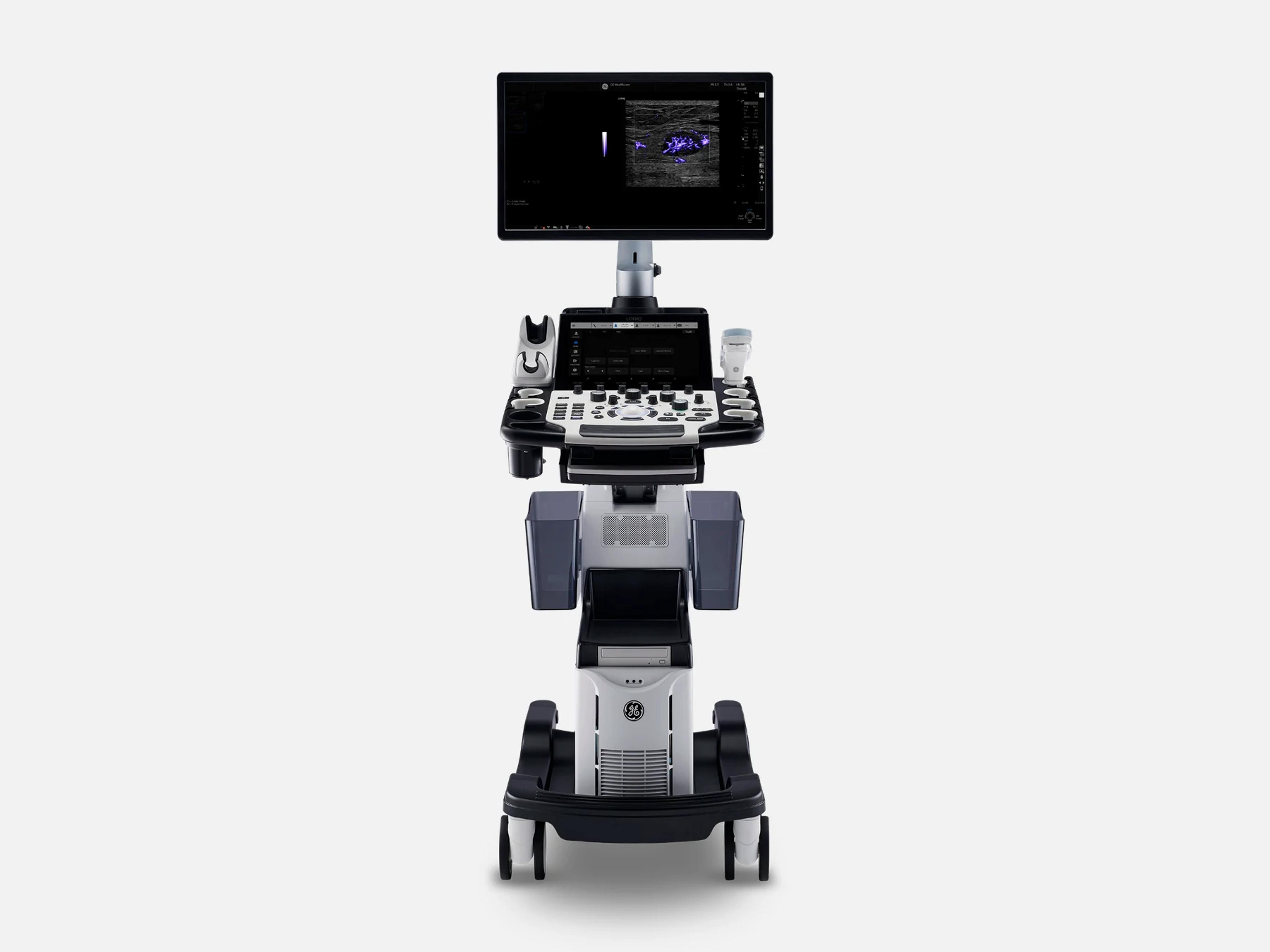
The GE LOGIQ Fortis is an all-in-one ultrasound system designed for whole-body imaging by radiology departments and multi-purpose users. Its applications run from abdominal and obstetrical to peripheral vascular, musculoskeletal and cardiac imaging. It shares two FDA 510(k) clearances with the LOGIQ E10s, and Auto Abdominal Suite 2.0 with the LOGIQ E10 Series; the LOGIQ Totus has the Suite 1.0 feature set.
- Released
- 2021first FDA clearance
- Probe ports
- 4active DLP probe ports
- Display
- 23.8-inchLCD or HDU monitor
- Weight
- 85 kg187.4 lb
Compatible probes
Linear
- 9L-D Added with the K253366 clearance
- L2-9-D XDclear; needs the Advanced Probe option
- L2-9VN-D XDclear, VNav sensor; needs the Advanced Probe option
- L3-12-D
- L3-9i-D Intraoperative
- L4-20t-D XDclear button probe
- L6-24-D R4 shear wave on units with the name underlined on the label
- L8-18i-D
- ML4-20-D Matrix linear, XDclear
- ML6-15-D Matrix linear
Convex & microconvex
- C1-6-D XDclear; needs the Advanced Probe option
- C1-6VN-D XDclear, VNav sensor; needs the Advanced Probe option
- C2-7-D Microconvex, biopsy
- C2-7VN-D Microconvex, biopsy, VNav sensor
- C2-9-D XDclear; needs the Advanced Probe option
- C2-9VN-D XDclear, VNav sensor; needs the Advanced Probe option
- C3-10-D XDclear microconvex; needs the Advanced Probe option
- BE9CS-D Biplane microconvex
- RAB6-D Real-time 4D volume
Phased
- 6S-D Sector; supports the CW and TVI options
- 12S-D Wide-band sector; added with the K253366 clearance
- M5Sc-D XDclear matrix sector; needs the Advanced Probe option
Endocavity
- IC5-9-D Microconvex intercavity
- RIC5-9-D Real-time 4D microconvex intercavity
Specialty
- 6Tc-RS Transesophageal; with RS-DLP adapter
- P2D CW pencil probe, 2 MHz
- P6D CW pencil probe, 6 MHz
- P8D CW pencil probe, 8 MHz
- Vscan Air CL Wireless dual probe, convex and linear
Specifications
Display
- Display
23.8-inch, LCD monitor or HDU display; HDU at 1920 x 108023.8-inch main monitor; consoles come with an LCD monitor or an HDU display. The R4.x HDU display is a 23.8-inch widescreen high-resolution panel at 1920 x 1080. Under K211524: a 23.8-inch High Contrast LED LCD monitor, with a 23.8-inch High Resolution LED LCD monitor option.Show allShow less
- Touch screen
- 12.1-inch high-resolution color touch screen (R4.x HDU console)
- Monitor arm
About 150 mm (5.91 in) vertical and 350 mm (13.78 in) horizontal travel from centerThe main monitor moves about 150 mm (5.91 in) vertically and 350 mm (13.78 in) horizontally from center. On the R4.x HDU: 90° swivel in both directions, fold-down and lock for transport, and display translation independent of the console.Show allShow less
Physical
- Weight
- 85 kg (187.4 lb)
- Height
1250–1800 mm (49–71 in) with HDU display; 1210–1760 mm (48–69 in) with LCD monitor1250–1800 mm (49–71 in) with the HDU display, or 1210–1760 mm (48–69 in) with the LCD monitor; measured with the floating keyboard stowed and the display tilted for transport.Show allShow less
- Width
530 mm (20.9 in) at casters; 545 mm (21.5 in) with LCD; 565 mm (22.2 in) with HDU530 mm (20.9 in) at the casters, 545 mm (21.5 in) at the LCD monitor, or 565 mm (22.2 in) at the HDU display.Show allShow less
- Depth
885 mm (34.8 in)885 mm (34.8 in), measured with the floating keyboard stowed and the display tilted for transport.Show allShow less
- Probe ports
- 4 active DLP ports; 1 inactive storage port and Vscan Air wireless connection (R4.x)
- Controls
Touch panel, trackball, joystick, on-screen keyboard, user-defined and P1/P2 keysTouch panel, joystick controls, on-screen keyboard, user-defined keys, Mode/Gain/XYZ (3D) controls, trackball with trackball keys and programmable P1/P2 keys; a physical alphanumeric keyboard is an external peripheral, and the operator panel has no motors. On R4.x: operating keyboard adjustable in height and rotation, ergonomic hard-key layout, interactive backlighting, integrated recording keys for remote control of up to 4 peripheral or DICOM devices, and an integrated gel warmer.Show allShow less
- Console adjustment
- Top console swivels left and right and raises or lowers
- Wheel brakes
- Independent brake pedal on each wheel; swivel lock on the left rear wheel
Power & battery
- Power
100–240 VAC (±10%), 50/60 Hz, 0.9 kVA with monitor and on-board peripherals100–240 VAC (±10%), 50/60 Hz; power consumption 0.9 kVA including the monitor and on-board peripherals (0.9 kVA maximum with peripherals on R4.x). Needs a dedicated power line and ground; circuit breaker at the rear bottom; power cord fixed by a bracket.Show allShow less
- Battery
Optional Power Assistant (2 packs) or Scan on Battery (4 packs); Li-ion 14.4 V, 5900 mAhOptional, in two forms: Power Assistant, with two packs, and Scan on Battery, with four. The packs are rechargeable lithium-ion 4S2P, 14.4 V, 5900 mAh. On loss of AC power the system switches to Power Assistant, which avoids a reboot; Scan on Battery keeps it scanning off AC power.Show allShow less
- Cold-boot time
- Total start-up time normally under 170 seconds
Connectivity & options
- Connectivity
USB 3.0, RJ-45 Ethernet (10/100/1000), HDMI (1920x1080 only), optional S-VideoRear I/O: USB 3.0, RJ-45 Ethernet (10/100/1000 Mbps Ethernet/DICOM network connection), optional S-Video and HDMI (1920x1080 only). The LAN is IPv6-ready and runs IPv4 or IPv6, not both. LOGIQ Apps connect to Android devices over Bluetooth.Show allShow less
- DICOM
DICOM 3.0 incl. worklist, MPPS, storage commitment, query/retrieve; Structured ReportingDICOM 3.0 on R4.x: Verify, Print, Store, Modality worklist, Storage commitment, MPPS, Media exchange, Off network/mobile storage queue and Query/retrieve; Structured Reporting; InSite capability.Show allShow less
- Wireless
- Optional wireless LAN, 802.11ac/a/b/g/n; second wireless LAN option for Vscan Air
- Storage
1 TB M.2 SSD, about 730 GB for images; DVD-R drive; exports BMP, JPEG, PNG, AVI, MP4…One 1 TB M.2 SSD on the BEPS holds the base software, application software and patient archive, with about 730 GB of image storage; integrated DVD-R multi drive; DICOM storage format; export to BMP, JPEG, JPEG 2000, PNG, AVI, MP4 and WMV.Show allShow less
- Security
SonoDefense; system and user partitions encryptable; RFID badge login on R5 and laterSonoDefense multi-layer cybersecurity; full disk encryption of the system partition and user partitions; an RFID reader for badge login on LOGIQ Fortis R5 and later.Show allShow less
- Hardware options
Real-time 4D, CW and Pencil CW, ECG, S-Video, V Nav, wireless, gel warmer, DVD, printerInternal hardware options: Realtime 4D (DC4D), CW Doppler (GCW), Pencil CW, S-Video (VCS), Patient I/O (ECG), Power Assistant, Scan on Battery, Volume Navigation (V Nav), Wireless, Gel Warmer, DVD Drive and Printer (Digital Graphic). External peripherals include a Vscan Air dedicated USB wireless option and a Vscan Air and Charger option.Show allShow less
- Advanced Probe option
- H46612LS; activates C1-6-D, C1-6VN-D, C2-9-D, C2-9VN-D, C3-10-D, L2-9-D, L2-9VN-D, M5Sc-D
- LOGIQ Apps
LOGIQ Remote (depth, gains, freeze, store) and LOGIQ Photo, Android apps over BluetoothAndroid apps that connect over Bluetooth: LOGIQ Remote adjusts system controls such as depth, PW, CF and B-Mode gain, freeze and store; LOGIQ Photo captures photos that go into the patient's exam.Show allShow less
- LOGIQ AppAPI
Open platform for third-party apps and custom research development; App Launchpad tabAn open platform that gives access to third-party apps and allows custom development for research, with installed apps launched from the App Launchpad tab. PIUR tUS inside, a third-party app that turns 2D ultrasound into AI-powered 3D imaging with automated segmentation, was among the first AppAPI integrations, for thyroid examination.Show allShow less
- Verisound Collab
- Tele-ultrasound with secure, real-time remote access to exams; not for diagnostic use
Imaging & software
- Revision and software
R3.x.x, R4.x.x and R5.x.x consoles, LCD or HDU; releases R3.1.3 to R5.0.4Global (except China) console models by software generation: R3.x.x (6601000 LCD, 6602000 HDU), R4.x.x (6601000-10, 6602000-10) and R5.x.x (6601000-5, 6602000-5); R2 software and R2/R3-born systems are also referenced. Point releases listed as parts: R3.1.3, R3.1.5, R3.1.6, R3.2.1, R3.2.2, R3.2.3, R4.1.1, R4.6.0, R4.6.1 and R5.0.4.Show allShow less
- Operating system
- Windows 10 Embedded base image; Windows 10 Enterprise LTSC 2019 (64-bit) on R4.x
- Clinical applications
Abdominal, Obstetrical, Gynecological, Breast, Small Parts, Peripheral Vascular…Abdominal, Obstetrical, Gynecological, Breast, Small Parts, Peripheral Vascular, Transcranial (adult and neonatal), Pediatric and Neonatal, Musculoskeletal (general and superficial), Urological, Cardiac (adult and pediatric), Interventional, Pleural (R4.x).Show allShow less
- Imaging modes
B, M, CFM, PDI, MVI, PW, LOGIQView, Anatomical M-Mode; options incl. B-Flow, CW, 3D/4DOperating modes on R4.x: B-Mode, M-Mode, Color Flow Mode (CFM), Microvascular Imaging (MVI), Power Doppler Imaging (PDI), Extended Field of View (LOGIQView), PW Doppler and Anatomical M-Mode; optional B-Flow, CW Doppler, Volume Modes (3D/4D), Contrast Imaging, Strain elastography, Shear wave elastography and UGAP. Harmonic Imaging is among the system's modes. K231989 adds Coded Pulse, Attenuation Imaging and combined B/M, B/Color, B/PWD, B/Color/PWD and B/Power/PWD modes. Availability depends on installed options.Show allShow less
- Imaging performance
Up to 9,675 Hz frame rate; 0–100 cm depth; 0.7–24 MHz; 1 GB CINE memoryFrame rate up to 9,675 Hz (fps); displayed imaging depth 0–100 cm; system frequency range 0.7–24 MHz; 1 GB of CINE memory (R4.x).Show allShow less
- Processing channels
- Up to 192 channels processed at once, DA192 front end
- Imaging architecture
cSound Architecture: XDclear transducers and cSound Imageformer with advanced SRIcSound Architecture combines XDclear transducers and the cSound Imageformer with advanced Speckle Reduction Imaging (SRI) to raise processing power and data throughput, with all pixels in focus from near field to far field.Show allShow less
- Processor and memory
- i5 Coffee Lake module with 16 GB memory
- B-Mode processing
CrossXBeam, SRI-HD, Advanced SRI Type 1 standard; Advanced SRI Type 2 optional; ACECrossXBeam variable-angle spatial compounding and Speckle Reduction Imaging (SRI-HD, Advanced SRI Type 1) are standard on R4.x, with Advanced SRI Type 2 as a system option. Adaptive Contrast Enhancement (ACE) is part of Digital B-Mode, and on R5 it extends beyond liver imaging to other applications.Show allShow less
- Automatic optimization
One-button Automatic Optimization (low, medium, high); CTO and CATO keep adjusting gainAutomatic Optimization, standard on R4.x, optimizes the B-Mode image for contrast resolution with one button at a low, medium or high setting. CTO (Continuous Tissue Optimization) and CATO keep adjusting B-Mode gain uniformity and overall gain, and CATO keeps adjusting overall B-Mode contrast while the probe moves.Show allShow less
- Flow imaging
MVI; Radiantflow in Color Doppler, Power Doppler and MVI; optional B-FlowMicrovascular Imaging (MVI), a flow mode for blood flow in joints, lymph nodes and other small structures; Radiantflow, which shows tiny vessels with a 3D effect in Color Doppler, Power Doppler and MVI; and optional B-Flow, which images blood-flow echoes and tissue together in real time without vessel-wall overlap.Show allShow less
- CW Doppler
Optional CW Doppler with steerable CW, on M5Sc-D, 6S-D, 6Tc-RS, P2D, P6D and P8DCW Doppler is optional, with steerable CW mode included, on the M5Sc-D, 6S-D, 6Tc-RS, P2D, P6D and P8D probes; the CW Doppler option (GCW) and a separate Pencil CW option are both listed.Show allShow less
- Elastography
Optional 2D shear wave with quality map (kPa and m/s); optional strain elastography2D shear wave elastography with a quality map gives quantitative tissue elasticity in kPa and m/s; optional on R4.x with the C1-6-D, C1-6VN-D, L2-9-D, L2-9VN-D, IC5-9-D, L8-18i-D, ML6-15-D, L3-12-D and L6-24-D. Strain elastography is optional, with a relative analysis tool, for qualitative and semi-quantitative tissue assessment.Show allShow less
- Liver tools
Optional UGAP (dB/cm/MHz); UGFF steatosis grading; Hepatic AssistantUGAP (Ultrasound Guided Attenuation Parameter) measures liver attenuation in dB/cm/MHz with an auto-measure algorithm, optional on R4.x with the C1-6-D, C1-6VN-D, C2-9-D and C2-9VN-D. UGFF, new in the R5 era, reports liver fat infiltration as a percentage to grade steatosis. Hepatic Assistant is a system option on R4.x; in its R5-era form it combines 2D shear wave elastography and UGFF in one workflow, and in 2022 it paired UGAP with shear wave elastography.Show allShow less
- Contrast (CEUS)
Optional coded contrast with TIC analysis and parametric imaging; availability by countryContrast-enhanced ultrasound images tissue structure and lesion vascularity. Coded contrast imaging is optional on R4.x, with time intensity curve (TIC) analysis and parametric imaging; contrast features are enabled only on systems delivered to countries or regions where they are permitted.Show allShow less
- Real-time 4D
Optional Real-time 4D: STIC, Omniview, HDlive, volume contrast and tomographic imagingReal-time 4D is optional, with Spatio-Temporal Image Correlation (STIC), Omniview, Volume contrast imaging, Tomographic ultrasound imaging and HDlive; the Realtime 4D (DC4D) hardware option uses the RAB6-D or RIC5-9-D for its functional check.Show allShow less
- Volume Navigation
Optional V Nav: Fusion Imaging with a volume DICOM dataset; Needle Tip TrackingVolume Navigation (V Nav) supports image-guided procedures: Fusion Imaging merges live ultrasound with a volume DICOM dataset (CT, MR, PET/CT, CBCT, SPECT, 3D CEUS), and Needle Tip Tracking follows the needle in plane or out of plane.Show allShow less
- Cardiac options
Optional TVI, Stress echo, Auto EF and Cardiac AFIOptional on R4.x: TVI (on the M5Sc-D, 6Tc-RS and 6S-D), Stress echo, Auto EF (semi-automatic global ejection fraction) and Cardiac AFI (a bull's-eye view of the left ventricle built from three longitudinal views).Show allShow less
- LOGIQView
- Extended field of view, scan lengths up to 160 cm (63 in); standard
- Raw data
Raw data analysis standard; optional Raw Data Streaming to third-party devicesRaw data analysis is standard on R4.x and lets image processing and quantification be applied after the exam; optional Raw Data Streaming sends raw data to third-party devices built to process it.Show allShow less
- Workflow tools
EZ Imaging; Start Assistant; Scan Assistant, Compare Assistant, Report Writer (optional)EZ Imaging: customizable probe presets and a touch panel showing the most-used modes for the connected probes. Start Assistant picks the category, probe, preset or Scan Assistant program from the worklist exam description. Optional: Scan Assistant (customizable step-by-step exam automation), Compare Assistant (a prior ultrasound, mammography, CT or MR study beside live images) and Report Writer (on-board reporting).Show allShow less
- AI options (R4.x)
Auto Preset Assistant, Auto Renal Measure Assistant, OB Measure Assistant…System options on R4.x: Auto Preset Assistant (detects the anatomy and switches to the matching preset), Auto Renal Measure Assistant (kidney length, height and width), OB Measure Assistant (BPD, HC, FL, AC and HL), Auto Abdominal Color Assistant, and Breast Assistant and Thyroid Assistant, Powered by Koios DS (lesion risk aligned to a BI-RADS or TI-RADS category). Auto Doppler Assist is listed as standard, and Auto Abdominal Suite 1.0 was named as new in R4.Show allShow less
- Auto Abdominal Suite 2.0
Auto Aorta Measure Assistant, Auto CBD Measure Assistant, SmartEdit…Auto Abdominal Suite 2.0 with SmartEdit: Auto Aorta Measure Assistant (abdominal aorta, AP and transverse), Auto CBD Measure Assistant (common bile duct AP dimension), Auto Abdominal Color Assistant 2.0 (detects the anatomy and sets color parameters, ROI size and position), Auto Renal Measure Assistant and Auto Preset Assistant. SmartEdit adds shortcut keys for segmentation-based editing of the auto-measurements. R5-era tools.Show allShow less
- Doppler and lesion tools
Auto Doppler Assistant; Auto Lesion SegmentationAuto Doppler Assistant detects the direction of blood flow, steers the color box, and places and angles the pulsed Doppler sample volume; Auto Lesion Segmentation traces lesion boundaries and generates two-dimensional measurements.Show allShow less
- ViewPoint Ultra
- On-scanner reporting; version 1.0 runs only on LOGIQ R5 systems; sold in the U.S. only
- Probe Check
Optional, licensed probe diagnostics from the lens echo; labeled Probe Test on R3Optional, enabled with an OAC license. It first appeared in R2 software as Automatic Probe Diagnostics (VITA) and checks probe health from automated lens-echo acquisition; the touch-panel button reads Probe Test in R3 and Probe Check in R4 and later.Show allShow less
Environment
- Operating environment
10–35 °C (50–96 °F), 30–80% humidity non-condensing, 70–106 kPaOperating temperature 10–35 °C (50–96 °F), humidity 30–80% non-condensing, atmospheric pressure 70–106 kPa; probe environmental limits can differ.Show allShow less
- Heat output
- Up to 3070 Btu/hr with the monitor and on-board peripherals
- Acoustic noise
- Under 48 dB(A) at 20 °C, measured 1 m from all four sides and 1 m above the floor
Compliance
- FDA 510(k)
K253366 (2026-01-07), K231989 (2023-11-07), K211524 (2021-08-27); product code IYNK253366 (decided 2026-01-07), device name LOGIQ Fortis; K231989 (2023-11-07) and K211524 (2021-08-27), device name LOGIQ E10s, LOGIQ Fortis. All Substantially Equivalent; product code IYN.Show allShow less
- Safety conformance
ANSI/AAMI ES60601-1, CAN/CSA-C22.2 No. 60601-1; CE marked to EU MDR 2017/745Classified to ANSI/AAMI ES60601-1 by a Nationally Recognized Test Lab, certified to CSA CAN/CSA-C22.2 No. 60601-1, and CE marked to EU MDR 2017/745 (R4.x).Show allShow less
What to check when buying a used GE LOGIQ Fortis
Reject damaged, leaking or deformed battery packs
Scan on Battery packs are swapped as a full set, so one bad pack means a whole new set.
How: On units with Power Assistant or Scan on Battery, look at every pack for damage, leaks, odor, deformation or discoloration.
Inspect the power cable and its plug pins
A power cable with any damage has to be swapped for a new one.
How: Look for bent plug pins, worn or missing coating on the pins, and a bend in the cable just past the plug's strain relief.
Test the operator panel's movement and gas spring
If the gas spring is not working correctly, the panel can drop suddenly when the manual release handle is used.
How: Move the operator panel in every direction it should travel, and confirm it moves easily and latches where it should.
Confirm every cover, shield and screw is present
Missing covers can cause EMI/RFI problems while scanning, and the system is meant to run only with all covers in place.
How: Check the EMI shielding, internal covers, air-flow panels and screws, and look at the filter grid on the front where air enters.
Common questions about the GE LOGIQ Fortis
Is the GE LOGIQ Fortis FDA-cleared?
Yes. The LOGIQ Fortis is FDA-cleared under 510(k) with product code IYN, and it is CE marked under EU MDR 2017/745.
K253366, decided on January 7, 2026, names the LOGIQ Fortis alone. Two earlier clearances, K211524 (decided August 27, 2021) and K231989 (decided November 7, 2023), name the LOGIQ E10s and the LOGIQ Fortis together.
Is the GE LOGIQ Fortis the same as the LOGIQ E10s?
They share regulatory paperwork, which does not make them one system. Two FDA clearances, K211524 and K231989, cover the LOGIQ E10s and LOGIQ Fortis together, and in Japan the LOGIQ Fortis went on sale on February 25, 2022 as a variant under the LOGIQ E10s regulatory product name.
The January 2026 clearance, K253366, names the LOGIQ Fortis alone.
How does the LOGIQ Fortis compare with the LOGIQ Totus?
On the abdominal tools, Auto Abdominal Suite 2.0 is available on the LOGIQ Fortis and the LOGIQ E10 Series. The LOGIQ Totus has Auto Abdominal Color Assistant 1.0, Auto Preset Assistant and the Auto Renal Measure Assistant, which together match the Auto Abdominal Suite 1.0 feature set.
Suite 2.0, with SmartEdit, also includes the Auto Aorta Measure Assistant and the Auto CBD Measure Assistant, and its color tool is Auto Abdominal Color Assistant 2.0.
Does the LOGIQ Fortis have Micro B-Flow?
No. Micro B-Flow Imaging is limited to the LOGIQ E10. The LOGIQ Fortis offers optional B-Flow, which shows blood-flow echoes in real time without vessel-wall overlap, and the two are not interchangeable.
Is there a veterinary version of the LOGIQ Fortis?
Yes. GE makes veterinary consoles: the LOGIQ Fortis R3 HDU VET, the LOGIQ Fortis-V R4 HDU and the LOGIQ Fortis-V R5 HDU. The R3 veterinary console comes with a paper user manual only.