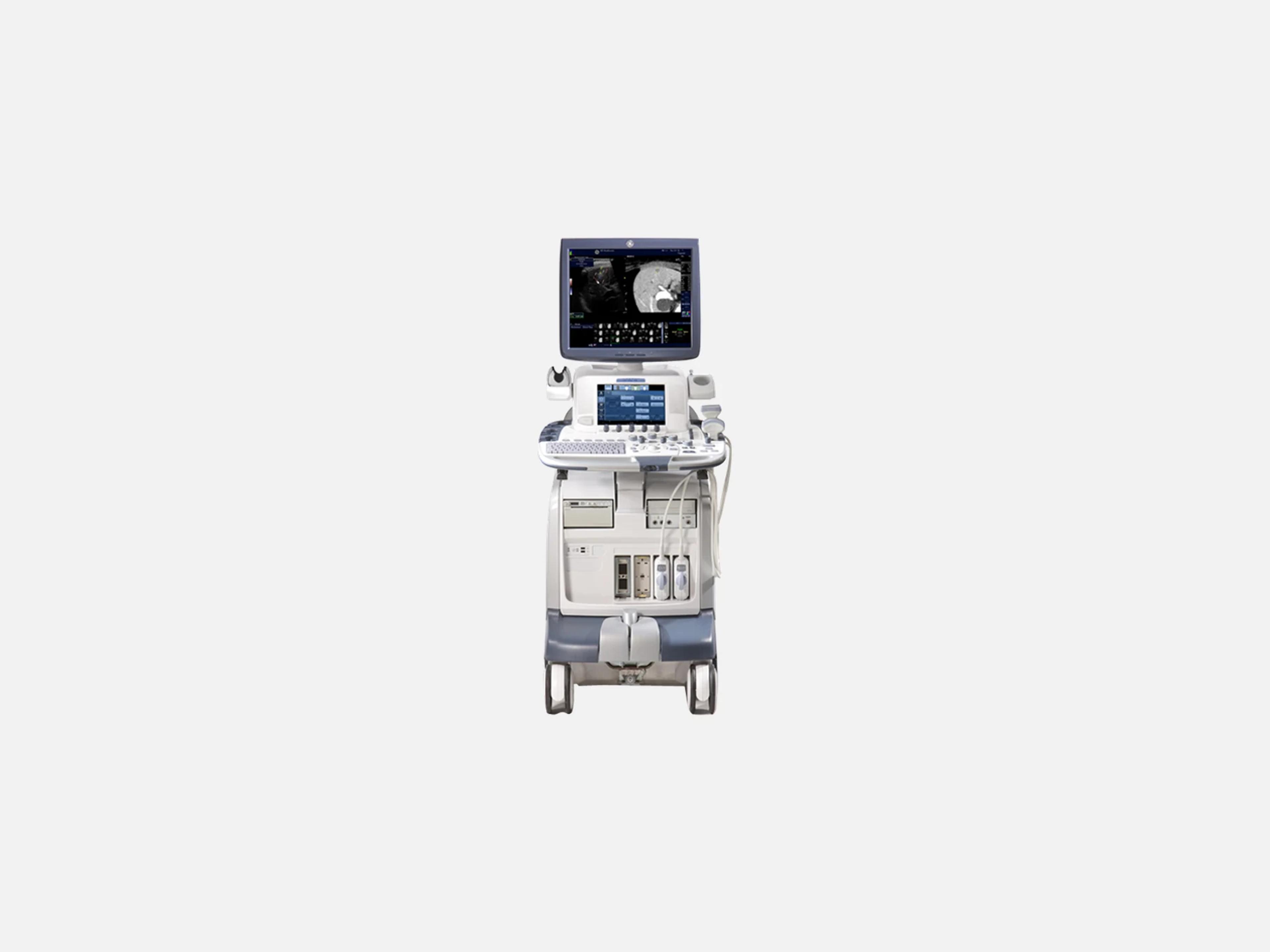
The GE LOGIQ E9 is a cart-based premium general imaging system for high-volume ultrasound departments, used for vascular, liver, pediatric and OB/GYN work. GE launched it in 2008 as the flagship of the LOGIQ line, and built the LOGIQ E9 with XDclear on the same platform in 2012. The LOGIQ E9 is built on Agile Acoustic Architecture, while the LOGIQ E10 uses cSound, and its R6 software is also called XDclear 2.0.
- Released
- 2008launched by GE
- Probe ports
- 4all DLP on R4.x and later
- Display
- 23-in LCDR6.x and later
- Weight
- 140 kg309 lb, R4.x and later
Compatible probes
Linear
- 9L-D
- 11L-D
- ML6-15-D Matrix array
- L8-18i-D
- L3-9i-D Intraoperative, T-shaped; software level R6.x.x
- RSP6-16-D Real-time 4D
Convex & microconvex
- C1-5-D
- C1-6-D XDclear
- C2-9-D XDclear; software level R4
- M6C-D Matrix array
- 3CRF-D Micro-convex, biopsy
- 3CRF Micro-convex, biopsy; non-DLP connector
- RAB 4-8 4D curved array; software level R2.x.x
- RNA5-9-D Real-time 4D micro-convex
- RIC5-9-D Real-time 4D micro-convex
Phased
- S1-5-D R4.x and later
- S4-10-D R4.x and later
- S4-10 Non-DLP connector; software level R2.x.x
- 6S-D Adult and pediatric cardiac
- 6S-DLP Pediatric
- M5S-D Matrix array; software level R2.x.x
Endocavity
- IC5-9-D Micro-convex intracavitary
Specialty
- 6Tc Multiplane TEE; software level R2.x.x
- P2D CW pencil, 2 MHz; software level R2.x.x
- P6D CW pencil; software level R2.x.x
- RAB2-5-D Real-time 4D
- RAB4-8-D Real-time 4D
- RAB6-D Real-time 4D; R4.x and later
Specifications
Display
- Main monitor
19-in LCD on R4.x and R5.x; 23-in LCD or 22-in OLED on R6.x and laterR4.x and R5.x: 19-inch high-resolution LCD monitor (Monitor V2), non-interlaced. R6.x and later: 23-inch widescreen high-definition LCD or 22-inch widescreen high-definition OLED, non-interlaced.Show allShow less
- Monitor arm
Articulating; about 100 mm (3.94 in) vertical and 250 mm (9.84 in) horizontal travelArticulating arm: moves about 100 mm (3.94 in) vertically and 250 mm (9.84 in) horizontally when unlocked, and tilts down for transport. The 19-inch LCD platform tilts forward and back and moves left and right.Show allShow less
- Touch panel
- 10.4-in LCD touch panel on the operator panel
Physical
- Weight
135 kg (298 lb) on R3.x and earlier; 140 kg (309 lb) on R4.x and laterReady for use: 135 kg (298 lb) on R3.x and earlier; 140 kg (309 lb) on R4.x and later, or more depending on installed peripherals.Show allShow less
- Dimensions (H × W × D)
1130 × 585 × 830 mm (5205000 to -6); 1300 × 585 × 830 mm (-7 to -9)With the floating keyboard stowed and the LCD monitor down: 1130 × 585 × 830 mm (H × W × D) for consoles 5205000 and 5205000-2 to -6; 1300 × 585 × 830 mm for consoles 5205000-7, -8 and -9.Show allShow less
- Base and wheels
- Four casters, pedals between the front wheels; front and rear handles
- Top console
Motor-driven height; moves freely in all directions when unlockedHeight is motor-driven from Up/Down buttons around the handles; the console moves freely in all directions when unlocked, with a Lock button for unparking and sideways movement.Show allShow less
- Controls
TGC controls, trackball, alphanumeric keyboard and full-sized floating keyboardOperator panel with TGC controls, image-quality controls, Measure & Analyze controls, frogleg controls and an alphanumeric keyboard; trackball and trackball keys with Measure, Comment, Body Pattern, Clear, Zoom and 3D/4D controls; full-sized floating keyboard.Show allShow less
- Probe ports
Four; one non-DLP and three DLP on R3.x and earlier, four DLP on R4.x and laterFour probe ports. R3.x and earlier: one non-DLP port, which takes the S1-5, S4-10, 6Tc and 3CRF connectors, plus three DLP ports. R4.x and later: four DLP ports. CW pencil probes connect through the CW connector when the CW option (CW Board, R2.x.x) is installed; consoles 5205000-5 and -6 are MRX, non-CW configurations at R3.1.0.Show allShow less
- Console models
- 5205000 and 5205000-2 to 5205000-9
Power & battery
- Power input
100–240 VAC, 50/60 Hz; dedicated power and ground; center-tapped source at 220 V100–240 VAC, 50/60 Hz (console variants 5205000-2, -4 and -6 are 220–240 VAC); dedicated power and ground required; 220 V operation needs a center-tapped source.Show allShow less
- Power consumption
18 W standby, 490 W idle, 600–700 W scanning, with LCD and on-board peripheralsIncluding the LCD and on-board peripherals: 18 W standby, 490 W idle without scanning, 600–700 W scanning depending on scan mode.Show allShow less
- Amperage
- Up to 8 A at 230 VAC; up to 10 A at 100 VAC
- Battery
24 V Extended Power Shutdown battery in the Back End Processor24 V Extended Power Shutdown (EPS) battery in the Back End Processor, with a battery load-capacity diagnostic.Show allShow less
- Sleep mode
- R2.x.x and R3.x.x software only
Connectivity & options
- Network
10/100/1000 Mbps Ethernet; optional WLAN up to 300 Mbps10/100/1000 Mbps Ethernet; optional WLAN up to 300 Mbps (a WLAN dongle on R2.x.x to R3.x.x, WLAN V3 on R6.x.x and later).Show allShow less
- DICOM (R6.X)
Option: storage, verification, worklist, print, query/retrieve, storage commitment, SRDICOM option, set up from a site network worksheet (AE Title, IP, port). At R6.X: image and exam storage, verification, worklist query, image printing, query/retrieve, Modality Performed Procedure Step, Storage Commitment and Comprehensive SR.Show allShow less
- USB
2 ports on the operator panel; internal USB 3.0 hub on R6.x and laterTwo USB connectors on the operator panel; internal USB 3.0 hub on R6.x and later. BEP6.2 supports USB 2.0 speeds, so USB 3.0 devices connected to it run at USB 2.0 speed.Show allShow less
- Video outputs
Rear DVI-I (analog RGB and digital DVI), 1280 × 1024 at 60 Hz, 24-bitRear DVI-I port (analog RGB and digital DVI), fixed 1280 × 1024 at 60 Hz, 24-bit, cloning the main display; DVI-D output at a minimum of 1280 × 1024 at 60 Hz, 24-bit; S-Video through the optional BEP6.x scan converter board.Show allShow less
- Remote service
- InSite ExC remote service, which needs internet access
- Storage
500 GB hard drive (BEP6.X; 250 GB earlier); DVD R/W driveHard drive in the Back End Processor for system configuration and software: a 500 GB assembly on BEP6.X, 250 GB earlier; DVD R/W drive (DVD-R supported).Show allShow less
- Printers and peripherals
UP-D898MD black-and-white and UP-DR80MD A4 printers; DVD recorder; USB footswitchUP-D898MD black-and-white printer and UP-DR80MD medical-grade A4 printer on board; DVD recorder option; USB footswitch; external LCD display (R4 and later).Show allShow less
- Hardware options
V Nav Drive Bay tracking, eTRAX and VirtuTRAX sensors, CW board, ECG module, WLANV Nav Drive Bay 3D tracking system (DriveBay2+ for R4.x and later); eTRAX needle sensor (Needle Tracking Option, R2.0.5 or later); VirtuTRAX sensor (Virtual Tracking Option, R2.0.5 or later); CW Board (R2.x.x); Patient I/O ECG module (R2.x.x); USB footswitch (R2.x.x and later); WLAN (dongle on R2.x.x to R3.x.x, WLAN V3 on R6.x.x and later); external LCD display (R4 and later); DVD recorder (DVR) card; S-Video scan converter board (BEP6.x); USB microphone dongle for R6 wide-screen monitors.Show allShow less
- DVR
- Software DVR on R6 and later; hardware DVR option not supported
- Option activation
- Software options enabled by a Software Option String specific to each system
Imaging & software
- Imaging modes
B, M, Color and Power Doppler, Color M, PW, CW, harmonics, 3D/4D, TVI, B-FlowB-Mode, M-Mode, Color Doppler (Color Flow), Power Doppler, Color M-Mode, PW Doppler, CW Doppler, Harmonic Imaging, Coded Pulse; combined modes B/M, B/Color M, B/PWD or CWD, B/Color/PWD or CWD and B/Power/PWD; real-time 3D/4D with 4D probes; Tissue Velocity Imaging; Volume Navigation; Contrast; Elastography; Shear Wave elastography; needle guidance imaging; B-Flow.Show allShow less
- Image-quality technologies
Agile Acoustic Architecture, Automatic Optimization, Coded Harmonics, CrossXBeam, SRIAgile Acoustic Architecture; Automatic Optimization (AO); Coded Harmonic Imaging (Coded Harmonics); CrossXBeam; Speckle Reduction Imaging (SRI); E-Series transducer technology (Acoustic Amplifier Technology); XDclear transducer technology on the C1-6 and C2-9 transducers.Show allShow less
- Advanced tools
V Nav, volume imaging, Elastography, Shear Wave, TVI, Q-Analysis, Auto-IMT, AutoEF, AFIVolume Navigation (V Nav) with Fusion, GPS and Needle Tracking; OmniTRAX active tracker (XDclear upgrade only); Volume Ultrasound with multiplanar imaging, C-plane, Tomographic Ultrasound Imaging (TUI) and Volume Calculation (VOCAL); Elastography; Shear Wave elastography (kPa or m/s); Tissue Velocity Imaging (TVI), Tissue Velocity Doppler (TVD) and Q-Analysis; Auto-IMT; AutoEF; AFI; Parametric Imaging; Contrast Imaging; LOGIQView.Show allShow less
- Workflow
Scan Assistant, Compare Assistant, Modality Worklist, Query Retrieve, raw dataScan Assistant; Compare Assistant; Modality Worklist; Query Retrieve; Raw Data (GE raw data format); Breast and Thyroid Productivity Packages with DICOM SR-compatible summaries.Show allShow less
- Contrast imaging
- Enabled only on systems delivered to an authorized country or region
- Revision and software
R1.0.x (Phase I), R2.0.x (BT2010), R3.x.x (BT2011), R4, R5, R6 (XDclear 2.0)R1.0.x (Phase I; R1.0.3 to R1.0.6); R2.0.x (BT2010; R2.0.3 to R2.0.5); R3.x.x (BT2011, also labeled BT11; R3.1.0 to R3.1.3); R4 (revisions 1.0 to 3.1); R5 (revisions 1.0 to 1.3); R6, also called XDclear 2.0 (revisions 1.1 to 2.1). Each console model is marked original, upgrade available or not supported for each level, and MRX2 boards 5393908-7 and -8 need R6.1.11 or later.Show allShow less
Environment
- Operating temperature
- 10–35 °C
- Storage and transport temperature
- −10 to 50 °C, for periods under 16 hours
- Humidity
- 30–80%, non-condensing (operating, storage and transport)
- Pressure
- 70–106 kPa (operating, storage and transport)
- Heat output
- Up to 4712 Btu/hr with the LCD and on-board peripherals
- Acoustic noise
- Less than 48 dB(A) at 20 °C, at the operator's head position
Compliance
- FDA 510(k)
K082185, K092271, K110943, K123564, K142160, K152309, K163077; Class IIK082185 (models 5205000 and 5205000-2), August 15, 2008; K092271 (LOGIQ E9 BT2010, models 5205000-3 and 5205000-4), November 17, 2009; K110943, July 22, 2011; K123564, December 18, 2012; K142160, October 10, 2014; K152309 (LOGIQ E9 and LOGIQ E9 XDclear 2.0), September 14, 2015; K163077 (LOGIQ E9 and LOGIQ E9 XDclear 2.0), November 17, 2016. Regulatory class II.Show allShow less
What to check when buying a used GE LOGIQ E9
Inspect the power cord's system end and inlet
The cord's system end can break and expose its conductors, the shock risk behind FDA recalls Z-2983-2018 and Z-2984-2018, while a fire and heat damage at the inlet have been traced to a failing plug and to a cord not specified for the system.
How: Look for cracks, separation or scorching at the cord's system end, the C20 inlet and the breaker, confirm the cord is one GE specifies, seats firmly with its retainer working and has its line, neutral and ground wires secure, and ask for the recall correction records.
Have electrical safety and probe leakage tested
Grounding continuity and chassis, patient-lead and probe leakage show whether the system is electrically safe to use on a patient, and probe leakage that changes from port to port points to the system's connector rather than the probe.
How: Ask for a visual inspection and then grounding, chassis leakage, isolated patient lead and probe leakage tests to NFPA 99 or IEC 62353, with each probe partly immersed in saline while connected and active, and have any port that reads high checked for bent pins and poor ground.
Check R3.1.0 and R3.1.1 units for recall correction
On LOGIQ E9 units with R3.1.0 or R3.1.1 software, images could be attached to the wrong patient and measurements and calculations could come out wrong, the problem behind FDA recall Z-0705-2012 and a field safety notice.
How: Confirm the installed software level, and on a unit that ran either version ask for the recall correction record and check that stored images match their patient and offline measurements are intact.
Verify measurements and calculations on a known target
A resistive index calculated lower than the true value, and OB values displayed wrongly after some measurements were deleted, have both been reported on the LOGIQ E9, the second traced to software.
How: Check distance and tissue depth measurements against a target of known size, then run an RI and an OB calculation and delete one measurement to confirm the rest still display correctly.
Common questions about the GE LOGIQ E9
Is the GE LOGIQ E9 FDA-cleared?
Yes. It was first cleared through 510(k) K082185 on August 15, 2008, for console models 5205000 and 5205000-2, and K092271 followed on November 17, 2009, for the BT2010 release on consoles 5205000-3 and 5205000-4.
Later clearances are K110943 (July 22, 2011), K123564 (December 18, 2012), K142160 (October 10, 2014), K152309 (September 14, 2015) and K163077 (November 17, 2016), the last two for the LOGIQ E9 and the LOGIQ E9 XDclear 2.0. It is a Class II device.
What is the GE LOGIQ E9 cleared to scan?
Its cleared indications (K123564) are fetal, abdominal, pediatric, small organ (breast, testes, thyroid), neonatal and adult cephalic, adult and pediatric cardiac, peripheral vascular, conventional and superficial musculoskeletal, urology including prostate, transrectal, transvaginal, transesophageal and intraoperative (abdominal, thoracic, vascular and neurosurgical) imaging, by a qualified physician.
It is not intended for ophthalmic use or for any use that passes the acoustic beam through the eye.
Can the GE LOGIQ E9 fuse CT or MR images with live ultrasound?
Yes, with Volume Navigation (V Nav): a position sensor on the probe registers a previously acquired ultrasound, CT or MR DICOM volume with the live image. It works in B-Mode, Color Flow, PDI and Contrast modes, and not during 3D/4D or active timeline modes.
The V Nav Drive Bay 3D tracking system is a hardware option (DriveBay2+ for R4.x and later), and the eTRAX Needle Tracking Option and VirtuTRAX Virtual Tracking Option each need R2.0.5 or later.
Does the GE LOGIQ E9 have shear wave elastography?
Yes, as an option. Shear Wave generates shear waves in tissue with the diagnostic transducer and gives results in kPa or m/s, and Elastography shows the spatial distribution of tissue elasticity by estimating strain before and after the tissue is distorted.
The C1-6-D and C1-6VN-D are the probes optimized for liver Shear Wave elastography on the LOGIQ E9. On systems with older MRX boards, the option needs a new MRX board before it can be installed.