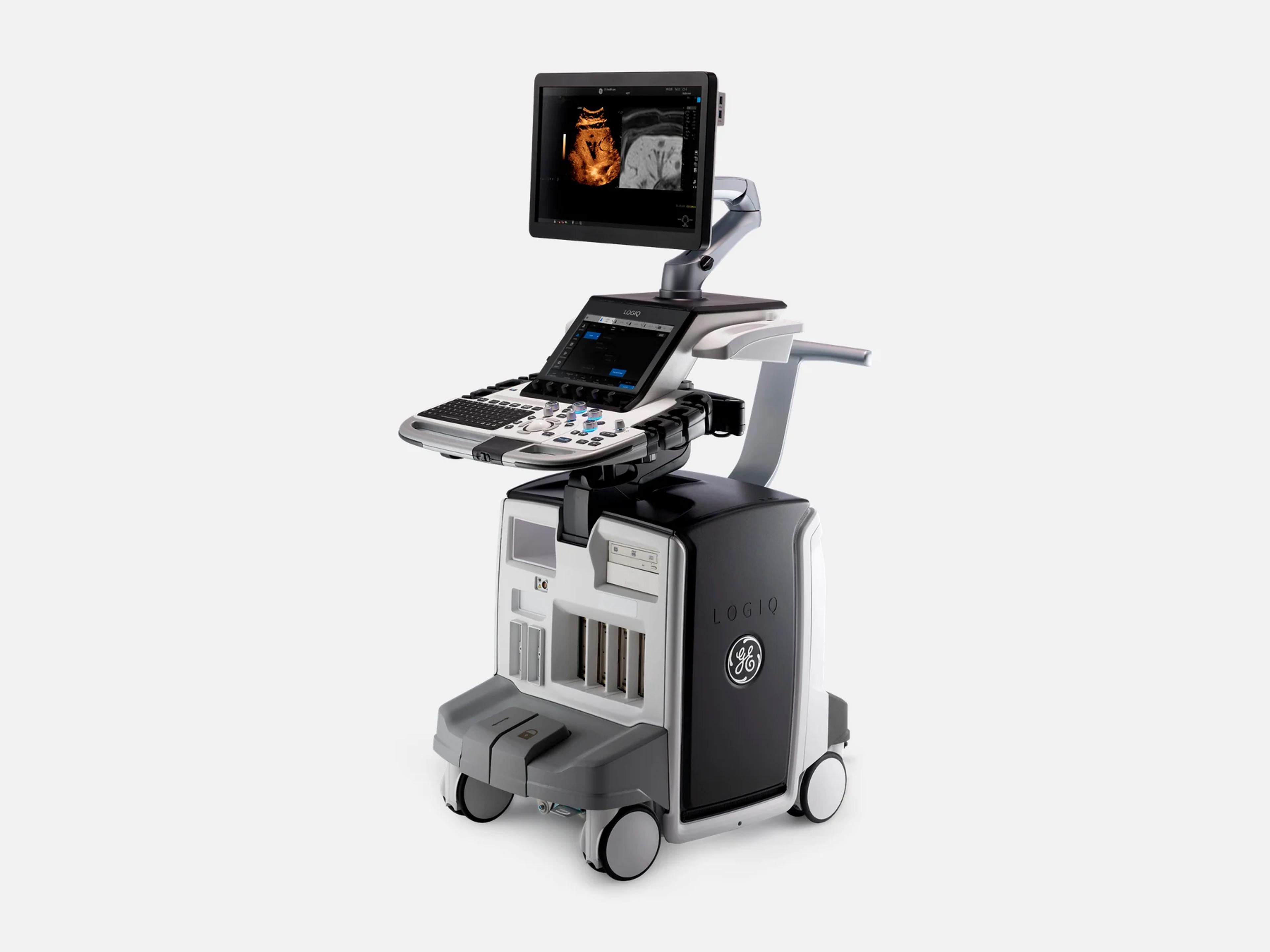
The GE LOGIQ E10 is a cart-based ultrasound system, announced in 2018 as the top model of the LOGIQ general-purpose series. Its liver tools pair 2D shear wave elastography with Ultrasound-Guided Fat Fraction (UGFF), and Koios DS powers its breast and thyroid assistants. Its series sibling is the LOGIQ E10s, and on R5 it shares transmit, receive and back-end processing hardware with the LOGIQ Fortis.
- Released
- 2018launched by GE
- Probe ports
- 4DLP ports
- Display
- 23.8-inchLED LCD, or 22-inch OLED
- Weight
- 129 kgwith HDU; 126 kg with OLED
Compatible probes
Linear
- L2-9-D
- L2-9VN-D
- L3-12-D
- L3-9i-D Intraoperative
- L4-20t-D
- L6-24-D
- L8-18i-D
- ML4-20-D Linear matrix
- ML4-20VN-D Linear matrix
- ML6-15-D Linear matrix
Convex & microconvex
- C1-6-D
- C1-6VN-D
- C2-6b-D Not supported on R4
- C2-7-D
- C2-7-D-LC
- C2-7VN-D
- C2-9-D
- C2-9VN-D
- C3-10-D
- IC5-9-D
- BE9CS-D Urology
Phased
- M5Sc-D
- 6S-D
- 12S-D Not supported on R4
Endocavity
- RIC5-9-D Mechanical 4D
- RIC5-9-D with ferrite R5 only; for the prostate option
Specialty
- 6Tc-RS Transesophageal
- RAB6-D Mechanical 4D
- P2D CW pencil, 2 MHz
- P6D CW pencil, 6 MHz
- P8D CW pencil, 8 MHz
- Vscan Air CL Wireless, curved and linear; from R4
Specifications
Display
- Main monitor
23.8-inch High Contrast LED LCD (HDU) or 22-inch widescreen OLED23.8-inch High Contrast LED LCD (HDU) on R4 and R5 systems, which are also documented with a 22-inch widescreen OLED; R3-era systems came in OLED and HDU versions, and the 2018 launch model had an OLED display.Show allShow less
- Monitor arm
About 150 mm vertical and 350 mm horizontal travel from center; 90° rotation each wayArticulating monitor arm: about 150 mm (5.91 in) vertical and 350 mm (13.78 in) horizontal travel from center, with 90° rotation at the mount each way.Show allShow less
- Touch panel
- 12.1-inch color touch screen
Physical
- Dimensions
1300 mm H × 585 mm W × 990 mm D (51 × 23 × 39 in), keyboard stowed, monitor down1300 mm high × 585 mm wide × 990 mm deep (51 × 23 × 39 in), with the floating keyboard stowed for transport and the main monitor down; the original 2017 submission gave a depth of 900 mm.Show allShow less
- Weight
- 129 kg with HDU monitor, 126 kg with OLED monitor; includes monitor and peripherals
- Probe ports
- Four DLP probe ports, the only probe-port type on the console
- Controls
- Alphanumeric keyboard, operator-panel knobs and buttons, touch panel, trackball
- Console adjustment
XY sliding top console with park lock; motorized Z (height) adjustmentThe top console moves freely left and right on an XY mechanism with a park lock, and its height (Z) adjustment is motor driven, with the control buttons between the handles; floating keyboard and articulating monitor.Show allShow less
Power & battery
- Power
100–240 VAC ±10%, 50/60 Hz, 0.9 kVA with monitor and on-board peripherals100–240 VAC ±10%, 50/60 Hz, 0.9 kVA including monitor and on-board peripherals; a dedicated power line and ground are required, and a center-tapped source is required on 220 V power.Show allShow less
- Battery
Lithium-ion; Power Assistant or Scan on Battery internal battery optionsLithium-ion batteries in two internal options: Power Assistant, which switches the system to battery when AC power is lost, and Scan on Battery, which keeps scanning while the system is unplugged.Show allShow less
Connectivity & options
- Rear I/O
USB 3.0, Ethernet RJ-45 (10/100/1000 Mbps), HDMI 1920 × 1080; optional S-VideoUSB 3.0 port; Ethernet (RJ-45, 10/100/1000 Mbps), set up for IPv4 or IPv6 but not both; HDMI at 1920 × 1080 only; optional S-Video (NTSC 720 × 480i at 60 Hz, PAL 720 × 576i at 50 Hz).Show allShow less
- Wireless
Wireless LAN option; Bluetooth for LOGIQ Apps; separate Vscan Air wireless optionInternal wireless LAN option, plus a second wireless LAN option for Vscan Air; LOGIQ Apps connect to Android devices over Bluetooth, and the Vscan Air CL uses a dedicated USB wireless option.Show allShow less
- DICOM (R5.x)
Worklist, Query/Retrieve, Storage, SR Storage, Print, MPPS, Export/Import, STOW-RSDICOM Worklist Download, Query/Retrieve, Storage, SR Storage, Print, Modality Performed Procedure Step, Export/Import and STOW-RS User Agent, plus Storage Commitment.Show allShow less
- Security
SonoDefense; RFID badge login (R5); full SSD encryption; Advanced Security optionSonoDefense multi-layer cybersecurity; an integrated RFID reader for badge login on R5; full disk encryption of the SSD; Advanced Security option.Show allShow less
- Hardware options
Gel warmer, DVD drive, printer, ECG, CW Doppler, Pencil CW, Real Time 4D, V Nav…Internal options: Gel Warmer, DVD Drive, Printer (Digital Graphic), Patient I/O (ECG), CW Doppler (GCW), Pencil CW, Realtime 4D (DC4D), Volume Navigation (V Nav) with an optional roll stand, Tablet, DVR, LAN Protection Cable and a Vscan Air charger; respirometer support. External peripherals include a color inkjet printer, a color printer, a 3-button USB footswitch, a probe holder and storage bins.Show allShow less
- Remote service and lifecycle
Verisound Fleet, MyGEHealthCare, eDelivery, InSite, Digital Expert Connect and moreVerisound Fleet, MyGEHealthCare, eDelivery (software delivered direct to the device), InSite connection (R4 and later, when enabled), Digital Expert Connect, Device Management 2.0, Remote Expert Training, clinical applications training and advanced system diagnostics.Show allShow less
- Apps and collaboration
LOGIQ Remote and LOGIQ Photo apps over Bluetooth; Verisound Collab tele-ultrasoundLOGIQ Remote (adjusts system controls) and LOGIQ Photo (captures photos into the exam) for Android devices over Bluetooth; Remote Control and Photo Assistant apps; Verisound Collab tele-ultrasound for remote real-time access to exams, not for diagnostic use; Send Images via Email (R5).Show allShow less
- Open platform and data
LOGIQ AppAPI, AppAPI Extend, AppAPI RoundTrip, APP Launchpad, raw data streamingLOGIQ AppAPI, an open platform for third-party applications on or beside the system with real-time data streaming; AppAPI Extend; AppAPI RoundTrip (R5); APP Launchpad (R4); Raw Data Streaming/Network Streaming (R4), with color flow support added in R5; RF Data Capture; PIUR tUS inside, a third-party 3D application offered in CE-marked European markets.Show allShow less
Imaging & software
- Imaging modes
B, M, PW/CW Doppler, Color, Color M, Power Doppler, Harmonic, 3D/4D, elastography…B, M, PW Doppler, CW Doppler, Color Doppler, Color M Doppler, Power Doppler, Harmonic Imaging, Coded Pulse, 3D/4D, Elastography, Shear Wave Elastography, Attenuation Imaging and contrast imaging; combined B/M, B/Color, B/PWD, B/Color/PWD and B/Power/PWD; Anatomical and curved anatomical M-Mode.Show allShow less
- Flow imaging
Color Flow, Power Doppler, MVI with Radiantflow, B-Flow, Micro B-FlowColor Flow, Power Doppler Imaging, Microvascular Imaging (MVI) with Radiantflow, B-Flow (with hybrid B-Flow added in 2020), Micro B-Flow, color quantification and Semi-Quantitative Flow Analysis.Show allShow less
- Elastography and liver tools
2D Shear Wave Elastography with quality map, strain elastography, UGAP, UGFF2D Shear Wave Elastography with quality map; strain elastography; Ultrasound-Guided Attenuation Parameter (UGAP), extended to the C2-9(VN)-D probes in 2021; Ultrasound-Guided Fat Fraction (UGFF) for adult imaging (R5); Hepatic Assistant, which combines 2D shear wave elastography and UGFF in one workflow; Elastography Analysis.Show allShow less
- Contrast
- Contrast Enhanced Ultrasound (CEUS) option, with CEUS LI-RADS check-sheet (R4)
- 3D/4D
Real Time 4D option; Advanced 3D, Static 3D, VOCAL II, Omniview with VCI and moreReal Time 4D option with Static 3D, VOCAL II, tomographic ultrasound imaging, volume contrast imaging-static and Scalpel; Advanced 3D; Tru3D; Omniview with VCI; STIC; SonoRenderLive; SonoNT and SonoIT; SonoAVC for renal cyst.Show allShow less
- Image processing
cSound Architecture; Advanced SRI, SRI HD Type 2, ACE, CTO/CATO, EZ Imaging, raw datacSound Architecture; Advanced Speckle Reduction Imaging (SRI); SRI HD Type 2; Adaptive Contrast Enhancement (ACE), extended in R5 from liver to more applications including thyroid; CTO/CATO automatic optimization; auto-spectral optimize; EZ Imaging presets and simplified touch panel; raw data processing; LOGIQView; Q-Analysis; Clean Pixel Tag; XDclear and E-Series transducers.Show allShow less
- Automated assistants
Auto Abdominal Suite 2.0, Auto Doppler Assistant, Auto Lesion Segmentation and moreAuto Abdominal Suite 2.0 with SmartEdit (R5): Auto Aorta Measure Assistant, Auto CBD Measure Assistant, Auto Abdominal Color Assistant 2.0, Auto Renal Measure Assistant and Auto Preset Assistant; Auto Abdominal Imaging Suite 1.0 and Auto Abdominal Color Assistant; Auto Color Assistant (R4); Auto Doppler Assistant; Auto Lesion Segmentation; OB Measure Assistant; Compare Assistant; Scan Assistant with Scan Assistant Creator; Smart Assistant.Show allShow less
- Breast and thyroid AI
- Breast Assistant and Thyroid Assistant, powered by Koios DS; KOIOS Lite (R5)
- Cardiac tools
- Stress Echo, Smart stress, Cardiac AFI, AFI 2.0, Auto EF2.0, Auto EF without ECG
- Navigation and interventional
Volume Navigation, Fusion Imaging, Needle Tip Tracking, B-Steer+ and moreVolume Navigation (V Nav) with improved image-based registration (2020); Fusion Imaging with auto-registration; Active Tracker; Needle Tip Tracking; Virtual Tracking; 3D GPS Markers; B-Steer+; Verza Needle Guidance; Multi-Modality Query Retrieve; a CT or MRI Active Tracker starter kit and a needle tracking kit for 16g or smaller needles.Show allShow less
- Reporting and workflow
Ez Touchpanel 2.0, ViewPoint on-scanner reporting, Verisound Reporting, Report WriterEz Touchpanel 2.0 (R5); Viewpoint on LOGIQ on-scanner reporting, with ViewPoint Ultra 1.0 exclusive to LOGIQ R5 systems and commercially available only in the United States; Verisound Reporting; Report Writer; Advanced Abdominal Tools Package.Show allShow less
- Probe and image checks
Probe Check (Automatic Probe Diagnostics) licensed option; Image Quality CheckProbe Check (Automatic Probe Diagnostics, VITA or VITAOnDemand by release), an optional licensed feature introduced in R2 software that uses automated lens echo acquisition to report probe health; Image Quality Check (IQC) for quality-assurance evaluations; Advanced Probe Option (H46612LS).Show allShow less
- Probe-dependent options
Multi-Parametric Prostate option (R5, RIC5-9-D with ferrite); Vscan Air CL from R4Multi-Parametric Prostate Option (H46102BE) on LOGIQ E10 R5, which needs the RIC5-9-D with external ferrite; Vscan Air CL wireless dual probe support from R4 with a Wi-Fi USB and wireless charger, with PW mode added in R5.Show allShow less
- Architecture
Digital beamforming on cSound; DA192 board, up to 192 channels at onceDigital beamforming system built on the cSound Architecture; the card rack carries one DA192 (Data Acquisition 192 ch) board and one DPI (DLP Probe Interface) board, processing up to 192 ultrasound channels at once.Show allShow less
- Processor
i5 Coffee Lake COM Express, 16 GB; second GPU for color flow, standard from R4COM Express module with an i5 Coffee Lake processor, 16 GB memory and 512 MB pre-graphics memory; R4/R5-born systems have two GPU slots, and the second GPU for color flow processing is standard on the LOGIQ E10 from R4.Show allShow less
- Storage (R4/R5)
- Single 1 TB M.2 SSD for OS, software and patient archive; full disk encryption
- Operating system
- Windows 10 Embedded base image (Windows 10 IoT Enterprise 2019 LTSC Value)
- Revision and software
Software levels R1.x through R5.x; LOGIQ E10 Series R4 and R5 consolesSoftware levels R1.x through R5.x; R1.x was LOGIQ E10 only, and from R2.x the LOGIQ E10 is documented with the LOGIQ E10s. LOGIQ E10 Series R4 is model 5935000E10-4 and R5 is 5935000E10-5 (100–240 VAC). Documented releases include R1.5, R2.5.5, R4.6.0, R4.6.1, R4.6.2, R5.0.3 and R5.0.4; the R4 update dates from August 2023 and R5 from September 2025.Show allShow less
- Veterinary versions
- LOGIQ E10 Vet R4 and LOGIQ E10 Vet R5, each with its own user manual
Environment
- Heat output
- Up to 3070 Btu/hr with monitor and on-board peripherals
- Acoustic noise
- Less than 48 dB(A) at 20 °C, measured 1 m from each side and 1 m above the floor
Compliance
- FDA 510(k)
K251985 (2025-10-29), K231966 (2023-11-07), K211488 (2021-09-10), K200158, K173555K251985 (decided 2025-10-29); K231966 (2023-11-07); K211488 (2021-09-10); K200158 (2020-04-17); K173555 (2017-12-20). Class II, product code IYN.Show allShow less
What to check when buying a used GE LOGIQ E10
Reject a damaged, leaking or deformed battery
A weak battery can crash the system during a battery test, and in each battery option the batteries are changed only as a full set.
How: Inspect every fitted battery for damage, leaks, odor, deformation or discoloration, and save and back up data before any battery test.
Have a biomed run electrical safety tests
They check ground continuity, leakage and every probe's leakage against the IEC 60601-1 and IEC 62353 procedures.
How: Ask for the recorded results for the console and for each probe offered with it.
Inspect the power cable, plug and inlet
A damaged power cable has to be swapped out before use, and grounding or shielding faults show up as interference on the image.
How: Look for a bend just past the plug's strain relief, bent or worn pins, burnt areas, exposed strands or a damaged inlet, and confirm the inlet connector retainer holds.
Confirm the TEE recall correction on early units
On early-serial LOGIQ E10 units, recall Z-0588-2019 covered a TEE probe over-temperature condition that could go undetected.
How: Check the console's serial number against the recall and get evidence the correction was made before relying on TEE operation with a 6Tc-RS.
Common questions about the GE LOGIQ E10
Is the GE LOGIQ E10 FDA-cleared?
Yes. The LOGIQ E10 is FDA-cleared under 510(k) as a Class II device, product code IYN. Its first clearance, K173555, was decided on December 20, 2017; the later ones are K200158 (April 17, 2020), K211488 (September 10, 2021), K231966 (November 7, 2023) and K251985 (October 29, 2025).
What is the difference between the LOGIQ E10 and the LOGIQ E10s?
Both are models of the LOGIQ E10 Series and share one service manual, but each has its own 510(k): the LOGIQ E10s was first cleared in 2020 under K200119. The LOGIQ E10 dates from software R1, while the LOGIQ E10s first appears at R2.
On R4 and later systems, the second GPU used for color flow processing is standard on the LOGIQ E10 and an option on the LOGIQ E10s. R4 and R5 LOGIQ E10 consoles also have a clear front-cover insert with a U-light, where the LOGIQ E10s has an opaque one.
How is the LOGIQ E10 related to the LOGIQ Fortis?
They are separate LOGIQ products on shared hardware: the LOGIQ E10 has the same transmit, receive and back-end processing hardware and the same acquisition software architecture as the LOGIQ Fortis, and Auto Abdominal Suite 2.0 is available on both. The E10 Series is the leadership platform of the LOGIQ line, while the LOGIQ Fortis is cleared together with the LOGIQ E10s rather than the LOGIQ E10.
How is the LOGIQ E10 different from the LOGIQ E9?
The LOGIQ E10 is a new platform, cleared with the LOGIQ E9 as its predicate device and with the same imaging modes. Its L2-9-D and ML4-16-D probe families were introduced as improvements on the E9's 9L-D and ML6-15-D, and the L3-9i-D, 6S-D, C2-6b-D and P6D were later carried over from the LOGIQ E9.
Is there a veterinary version of the LOGIQ E10?
Yes. GE builds veterinary versions, the LOGIQ E10 Vet R4 and the LOGIQ E10 Vet R5, each with its own user manual.
Are the LOGIQ E11 and LOGIQ E20 the same as the LOGIQ E10?
They are additional marketing names listed in the original LOGIQ E10 clearance, together with the LOGIQ E10 Pro. The LOGIQ E11 and LOGIQ E20 are exclusive to the Chinese market.